Epic study • Story, dialogue and instruction
Mahābhārata
Explore the Mahābhārata’s eighteen books, characters and story arc, with on-page English readings on Draupadī, Karṇa, the Gītā, dharma, grief and the final journey.
Begin with a path that suits you
The Mahābhārata brings a family struggle for kingship into conversation with duty, devotion, loss, political judgment and liberation. The war is central, but the epic continues through mourning, instruction, retirement and the final journey.
Learning goal: locate an episode within the whole epic, identify its speaker and circumstances, and support your explanation with an available passage.
- New to the story? Read the story arc and character guide, then choose a close reading.
- Want to study a passage? Begin with Draupadī’s question, the Yakṣa dialogue or Arjuna’s request for instruction.
- Reading the full epic? Use the eighteen-book map and keep one named edition beside your notes.
The story overview and book map include major outcomes. English passages remain visible; answer feedback opens only when you choose it.
The story from the family’s origins to its final journey
The story at a glance
Story order, not a dated historical chronology. This pathway groups the eighteen books; it does not measure equal periods of time. It includes major outcomes.
- 01 · Ādi
BeginningsFamily origins, education, escape and marriages.
- 02 · Sabha
The dice hallRoyal ambition, gambling and Draupadī’s challenge.
- 03 · Vana
Forest exileJourneys, stories and the Yakṣa dialogue.
- 04 · Virāṭa
The hidden yearLife in disguise and emergence from concealment.
- 05 · Udyoga
Before the warCounsel, peace efforts and competing allegiances.
- 06 · Bhīṣma → Droṇa → Karṇa → Śalya
The principal warThe Gītā, successive commanders and battlefield losses.
- 07 · Sauptika
The night attackViolence against the sleeping camp.
- 08 · Strī
MourningBereavement and funeral observances.
- 09 · Śānti + Anuśāsana
Instruction after victoryBhīṣma’s teaching to the surviving king.
- 10 · Aśvamedhika
The horse sacrificeRoyal renewal and the next generation.
- 11 · Āśramavāsika
The elders withdrawForest retirement and the elders’ final years.
- 12 · Mausala
The Vṛṣṇis’ endDestruction of Kṛṣṇa’s people and his departure.
- 13 · Mahāprasthānika + Svargārohaṇika
Final departure and testingThe journey, the dog and the concluding tests.
Source: the on-page English outline of Ādi Parva, Section II, Kisari Mohan Ganguli. Use the eighteen-book map to open each full book.
A source-linked overview of the whole epic
Sauti addresses the sages. This reading paraphrases his outline, which provides the foundation for the story and book map below.
Reference: Ādi Parva, Section II — Parva-saṅgraha, outline of the eighteen books. Kisari Mohan Ganguli, English translation (1883–1896).
English reading — attributed handbook paraphrase
In Ādi Parva, Section II, Sauti outlines the epic’s eighteen major books. The account moves from the Kuru family’s origins and the Pāṇḍavas’ marriage to Draupadī through royal assemblies, defeat at dice, forest exile, life in disguise and failed negotiations. Four books recount the principal battle under successive commanders. The night attack and the women’s mourning follow. Bhīṣma’s instruction occupies the books of peace and instruction. The later books describe the horse sacrifice, elders’ retirement, destruction of the Vṛṣṇis, the Pāṇḍavas’ final journey and Yudhiṣṭhira’s entry into heaven. The outline also names embedded narratives and teaching dialogues within these books.
Read the complete cited section →
Handbook paraphrase of the identified public-domain translation; not an exact quotation.
1. A dynasty and competing heirs
The opening book establishes the Kuru line, Bhīṣma’s renunciation of kingship and his binding vow, the births of Dhṛtarāṣṭra and Pāṇḍu, and the arrival of the next generation. The Pāṇḍavas survive the plot involving the house of lac, encounter allies while living away from court, and marry Draupadī. Arjuna’s marriage to Subhadrā and the burning of Khāṇḍava belong to this opening movement too. The epic’s beginnings are already wider than the conflict between two sets of cousins.
2. Royal ambition and the dice hall
The Sabha Parva places the new assembly and Yudhiṣṭhira’s Rājasūya sacrifice beside Duryodhana’s envy and Śakuni’s gambling. Yudhiṣṭhira loses at dice, and Draupadī challenges the claim that she has been won. Dhṛtarāṣṭra’s intervention does not settle the conflict: another game leads to exile. Read her actual question below before reducing this turning point to a lesson about gambling.
3. Exile, instruction and a hidden year
The forest book includes journeys, weapons, conversations and stories such as Nala and Damayantī and Sāvitrī and Satyavān. These narratives are part of what the exiles hear while living through distress. In the Virāṭa Parva the Pāṇḍavas live in disguise at another king’s court, and Arjuna’s defence of the cattle helps bring that period to its close. In the Udyoga reading below, Yudhiṣṭhira recalls twelve years in the woods and one additional year in concealment.
4. Negotiation gives way to war
Envoys, counsel and Kṛṣṇa’s peace mission precede the battle. Arjuna chooses Kṛṣṇa as an adviser who will not fight, while Duryodhana chooses the troops offered to him. The disagreement over the kingdom remains unresolved. Kuntī’s appeal to Karṇa makes the approaching battle a conflict of birth, remembered injury and allegiance as well as territory.
5. Battle and the cost of victory
The main war proceeds through the Bhīṣma, Droṇa, Karṇa and Śalya books. Bhīṣma falls but remains alive on his bed of arrows. Abhimanyu, Jayadratha, Ghaṭotkaca, Droṇa and Karṇa are among those who die in the subsequent fighting. Bhīma’s mace encounter with Duryodhana brings the principal battle to its close. Aśvatthāman’s attack on sleeping opponents then kills Draupadī’s sons and other survivors of the fighting.
6. Mourning, government and departure
The women’s lamentations and Kuntī’s acknowledgment of Karṇa follow the battle. Yudhiṣṭhira’s distress leads into extended instruction by Bhīṣma. The horse sacrifice, elders’ withdrawal into the forest and destruction of the Vṛṣṇis come later. The Pāṇḍavas eventually give up kingship and depart with Draupadī. Yudhiṣṭhira’s last tests belong to the story’s conclusion, not to an unrelated appendix.
Source for this overview: the on-page Parva-saṅgraha paraphrase above and Ganguli’s complete Ādi Parva, Section II. The close readings below supply the voices and arguments that an overview cannot retain.
Characters, relationships and names
A selected Kuru family tree
Follow the labeled relationships. A “+” joins the two named parents or spouses; the note says which. Indented branches show children or household relationships as labeled. This is a selected reading aid, not a complete genealogy.
Earlier generation: Śantanu, Satyavatī and Vyāsa
- Śantanu + Gaṅgā
Parents of- Bhīṣma / Devavrata
- Śantanu + Satyavatī
Parents of- Citrāṅgada
- Vicitravīrya
Husband of Ambikā and Ambālikā; dies childless
- Satyavatī + Parāśara
Parents of- Vyāsa / Dvaipāyana
Birth father of the three brothers shown below
Three brothers and the two royal households
- Vyāsa + Ambikā
Birth parents of- Dhṛtarāṣṭra
Married to Gāndhārī- Duryodhana, Duḥśāsana and their brothers
The hundred sons of Dhṛtarāṣṭra and Gāndhārī
- Vyāsa + Ambālikā
Birth parents of- Pāṇḍu
Married to Kuntī and Mādrī; dynastic father of the five Pāṇḍavas- Kuntī’s sons in Pāṇḍu’s household
Yudhiṣṭhira — Dharma; Bhīma — Vāyu; Arjuna — Indra - Mādrī’s sons in Pāṇḍu’s household
Nakula and Sahadeva — the Aśvins
- Vyāsa + Ambikā’s attendant
Birth parents of- Vidura
Half-brother of Dhṛtarāṣṭra and Pāṇḍu
Birth and dynasty are distinct. The succession account describes births through Vyāsa after Vicitravīrya dies. The Pāṇḍavas belong to Pāṇḍu’s household, while the birth narrative identifies divine fathers. Read the two English selections below before treating every connector as biological descent.
Karṇa, Draupadī and the next generation
- Karṇa: Kuntī’s son through Sūrya before her marriage; raised by Rādhā and Adhiratha. He is the maternal half-brother of Kuntī’s three Pāṇḍava sons. Read Kuntī’s revelation and his reply.
- Draupadī: wife of all five Pāṇḍavas, not their sister. Read the assembly passage.
- Arjuna + Subhadrā: parents of Abhimanyu. Abhimanyu + Uttarā: parents of Parīkṣit. This is one descendant line; the Pāṇḍavas have other children.
Ādi Parva, Section XCV — selected Kuru genealogy
Vaiśampāyana recounts the lineage to Janamejaya. This selection supplies the relationships in the family tree.
English reading — attributed handbook paraphrase. Kisari Mohan Ganguli, English translation (1883–1896).
Śantanu and Gaṅgā have Devavrata, later called Bhīṣma. Śantanu and Satyavatī have Citrāṅgada and Vicitravīrya. Satyavatī previously had Dvaipāyana, Vyāsa, with Parāśara. After Vicitravīrya dies childless, Vyāsa fathers Dhṛtarāṣṭra, Pāṇḍu and Vidura to continue the family. Dhṛtarāṣṭra and Gāndhārī have a hundred sons. Pāṇḍu’s wives are Kuntī and Mādrī; the five Pāṇḍavas are born through divine fathers. Arjuna and Subhadrā have Abhimanyu, whose son with Uttarā is Parīkṣit.
Read the complete cited section →
Handbook paraphrase of the identified public-domain translation; not an exact quotation.
Ādi Parva, Section CVI — the mothers of the three brothers
This passage distinguishes the mothers and the account of succession after Vicitravīrya’s death.
English reading — attributed handbook paraphrase. Kisari Mohan Ganguli, English translation (1883–1896).
In Ganguli’s account, Vyāsa fathers Dhṛtarāṣṭra with Ambikā and Pāṇḍu with Ambālikā. When Ambikā is asked to approach him again, she sends her attendant instead. Their son is Vidura, brother of Dhṛtarāṣṭra and Pāṇḍu. The narration identifies these births with the continuation of Vicitravīrya’s line. This distinguishes the birth father, mothers and dynastic succession; it does not make Vicitravīrya their birth father.
Read the complete cited section →
Handbook paraphrase of the identified public-domain translation; not an exact quotation.
Start with relationships rather than a list of heroes and villains. Both sides belong to the Kuru family: “Kaurava” can refer broadly to that line, although it is often used for Dhṛtarāṣṭra’s sons in accounts of the conflict. A name can also identify different people: Kṛṣṇā in the dice-hall passage is Draupadī; Kṛṣṇa as Govinda in the Gītā is Arjuna’s charioteer.
Handbook orientation: the map below draws on the opening exchange, Parva-saṅgraha and the named dialogues reproduced in this guide.
The five Pāṇḍavas
Yudhiṣṭhira, Bhīma, Arjuna, Nakula and Sahadeva. The sons of Pāṇḍu whose claim, exile and return shape the central narrative. Yudhiṣṭhira’s judgments, Bhīma’s strength and Arjuna’s martial role recur; the twins remain participants in the family’s fate.
Draupadī
Also called Kṛṣṇā, Yājñasenī and the princess of Pañcāla. Wife of the five Pāṇḍavas. Her question in the assembly, her speech during exile and her bereavement after the night attack deserve attention in their own right.
Dhṛtarāṣṭra and Gāndhārī
The parents of Duryodhana and his brothers. Dhṛtarāṣṭra is the king addressed by advisers and by Sañjaya. Gāndhārī’s loss and response are prominent after the battle.
Duryodhana, Duḥśāsana and Śakuni
The opposing royal household and its gambling ally. Duryodhana seeks power over the kingdom; Duḥśāsana acts against Draupadī in the hall; Śakuni plays the decisive dice games.
Kuntī and Mādrī
Pāṇḍu’s two wives. Yudhiṣṭhira explicitly names both mothers when explaining why he chooses Nakula in the Yakṣa dialogue. Kuntī later reveals Karṇa’s birth to him.
Karṇa
Son of Kuntī; raised by Rādhā and Adhiratha. He begins his encounter with Kuntī by identifying himself through the parents who raised him. His answer places her late appeal beside his allegiance to Dhṛtarāṣṭra’s sons.
Kṛṣṇa
Also called Vāsudeva, Keśava, Govinda and Janārdana. Adviser, peace envoy and Arjuna’s charioteer. His instruction to Arjuna forms the Bhagavad Gītā within the epic. His words and actions need their particular narrative settings.
Bhīṣma
Also called Devavrata and the son of Gaṅgā. An elder bound by his earlier vow, commander on the opposing side and later Yudhiṣṭhira’s instructor. His role changes across the books.
Droṇa, Kṛpa and Aśvatthāman
Teachers and warriors; Aśvatthāman is Droṇa’s son. Droṇa trains the princes and later commands the army. His son’s response to the war leads into the night attack.
Abhimanyu, Subhadrā and Parīkṣit
Arjuna’s family and the next generation. Subhadrā and Arjuna are Abhimanyu’s parents. Abhimanyu’s death appears in the Droṇa book; Parīkṣit’s birth and revival appear in the horse-sacrifice book.
Vidura and Sañjaya
Counsellor and reporting voice. Vidura advises Dhṛtarāṣṭra. Sañjaya acts as envoy and narrates the battlefield dialogue in the Gītā selection.
Vyāsa, Vaiśampāyana and Sauti
Composer and successive telling voices. The opening frame identifies their distinct roles. Janamejaya and the sages at Naimiṣa belong to different listening assemblies.
Ganguli’s online text often uses spellings such as Yudhishthira, Bhimasena, Duryodhana and Vaisampayana. Match the person and scene when moving between those spellings and the forms used in our headings.
A map of all eighteen books
A parva is a division of the epic. This map follows the eighteen major books in Ganguli’s translation. The English labels are orientation aids, rather than a second translation of the titles. Each book link opens its section index.
| Book | Reading focus |
|---|---|
| 1. Ādi Parva Beginnings | The narrative frame, family origins, education, house of lac, Draupadī’s marriage, Arjuna’s journeys and Khāṇḍava. |
| 2. Sabha Parva The assembly | Royal assemblies, the Rājasūya, dice games, Draupadī’s challenge and the decision that leads to exile. |
| 3. Vana / Āraṇyaka Parva The forest | The exiles’ conversations, sacred journeys, Arjuna’s quest for weapons and stories told to the Pāṇḍavas. |
| 4. Virāṭa Parva Life in disguise | The hidden year in Virāṭa’s kingdom, Kīcaka’s death, cattle raids and the family’s emergence from disguise. |
| 5. Udyoga Parva The effort before war | Embassies, Vidura’s counsel, peace negotiations, Karṇa’s conversations and preparations for battle. |
| 6. Bhīṣma Parva The first commander | The Bhagavad Gītā, the first ten days of fighting and Bhīṣma’s fall onto his bed of arrows. |
| 7. Droṇa Parva The teacher as commander | Abhimanyu’s death, Arjuna’s response, Jayadratha and Ghaṭotkaca, and the fall of Droṇa. |
| 8. Karṇa Parva Karṇa’s command | The fighting under Karṇa and his final encounter with Arjuna. |
| 9. Śalya Parva The last principal battles | Śalya’s command and death, Śakuni’s death and Bhīma’s mace encounter with Duryodhana. |
| 10. Sauptika Parva The sleeping warriors | Aśvatthāman’s night attack and its consequences for the surviving families. |
| 11. Strī Parva The women | Mourning on the battlefield, funeral observances, Gāndhārī’s response and Kuntī’s revelation about Karṇa. |
| 12. Śānti Parva Peace and instruction | Yudhiṣṭhira’s distress; Bhīṣma on kingship, duties in emergencies and liberation. |
| 13. Anuśāsana Parva Further instruction | Extended instruction on conduct, gifts and duties, concluding with Bhīṣma’s departure. |
| 14. Aśvamedhika Parva The horse sacrifice | The royal horse sacrifice, Arjuna’s journeys, Parīkṣit’s revival and further teaching including the Anugītā. |
| 15. Āśramavāsika Parva The elders’ forest life | Dhṛtarāṣṭra, Gāndhārī and Kuntī leave court; encounters with the departed and the elders’ final years. |
| 16. Mausala Parva The destruction with clubs | The Vṛṣṇis’ destruction, Kṛṣṇa and Balarāma’s departures and Arjuna’s later distress. |
| 17. Mahāprasthānika Parva The great departure | The Pāṇḍavas relinquish the kingdom, travel with Draupadī and fall in turn; Yudhiṣṭhira faces the test involving the dog. |
| 18. Svargārohaṇika Parva The ascent to heaven | Yudhiṣṭhira’s encounters and final testing, followed by the concluding account of the heroes. |
Source: read the on-page outline and Ādi Parva, Section II. The outline reports an eighteen-day war; eighteen books and eighteen days are different kinds of division.
Do not stop a full reading at the end of Śalya Parva. The night attack, grief, instruction and final tests are substantial parts of what follows the principal battle.
The opening source passage
The complete selected opening exchange is preserved below. This is a place to practise following the epic’s layers of narration before approaching its other scenes.
Mahābhārata, Ādi Parva, Section I — opening conversation
Sauti tells the sages where he heard an earlier recitation. Keep storyteller, earlier reciter, and composer distinct.
Reference: Kisari Mohan Ganguli; English translation (1883–1896). Check the cited passage or chapter →
English translation
Ugrasrava, the son of Lomaharshana, surnamed Sauti, well-versed in the Puranas, bending with humility, one day approached the great sages of rigid vows, sitting at their ease, who had attended the twelve years' sacrifice of Saunaka, surnamed Kulapati, in the forest of Naimisha. Those ascetics, wishing to hear his wonderful narrations, presently began to address him who had thus arrived at that recluse abode of the inhabitants of the forest of Naimisha.
Having been entertained with due respect by those holy men, he saluted those Munis (sages) with joined palms, even all of them, and inquired about the progress of their asceticism. Then all the ascetics being again seated, the son of Lomaharshana humbly occupied the seat that was assigned to him.
Seeing that he was comfortably seated, and recovered from fatigue, one of the Rishis beginning the conversation, asked him,
'Whence comest you, O lotus-eyed Sauti, and where hast you spent the time? Tell me, who ask you, in detail.'
Accomplished in speech, Sauti, thus questioned, gave in the midst of that big assemblage of contemplative Munis a full and proper answer in words consonant with their mode of life.
Sauti said, "Having heard the diverse sacred and wonderful stories which were composed in his Mahabharata by Krishna-Dvaipayana, and which were recited in full by Vaisampayana at the Snake-sacrifice of the high-souled royal sage Janamejaya and in the presence also of that chief of Princes, the son of Parikshit, and having wandered about, visiting many sacred waters and holy shrines, I journeyed to the country venerated by the Dwijas (twice-born) and called Samantapancaka where formerly was fought the battle between the children of Kuru and Pandu, and all the chiefs of the land ranged on either side.
Thence, anxious to see you, I am come into your presence. You reverend sages, all of whom are to me as Brahma; you greatly blessed who shine in this place of sacrifice with the splendour of the solar fire: you who have concluded the silent meditations and have fed the holy fire; and yet who are sitting—without care, what, O you Dwijas (twice-born), shall I repeat, shall I recount the sacred stories collected in the Puranas containing precepts of religious duty and of worldly profit, or the acts of illustrious saints and sovereigns of mankind?"
The Rishi replied, "The Purana, first promulgated by the great Rishi Dvaipayana, and which after having been heard both by the gods and the Brahmarshis was highly esteemed, being the most eminent narrative that exists, diversified both in diction and division, possessing subtile meanings logically combined, and gleaned from the Vedas, is a sacred work. Composed in elegant language, it includes the subjects of other books.
It is elucidated by other Shastras, and comprehends the sense of the four Vedas. We are desirous of hearing that history also called Bharata, the holy composition of the wonderful Vyasa, which dispells the fear of evil, just as it was cheerfully recited by the Rishi Vaisampayana, under the direction of Dvaipayana himself, at the snake-sacrifice of Raja Janamejaya?"
Public-domain translation. This is the complete selected opening exchange, not the entire section.
Who is speaking, and who is listening?
Ugraśravas, called Sauti, approaches the sages gathered at Śaunaka’s sacrifice in Naimiṣa. He says he heard Vaiśampāyana recite the Mahābhārata at Janamejaya’s snake sacrifice and attributes its composition to Kṛṣṇa-Dvaipāyana, Vyāsa. The sages request that account.
- Composition: the frame names Vyāsa.
- Earlier recitation: Vaiśampāyana speaks at Janamejaya’s sacrifice.
- Present telling: Sauti addresses the sages at Naimiṣa.
- Voices inside the account: characters speak, question, advise and disagree.
In the Gītā reading, Sañjaya reports a dialogue between Arjuna and Kṛṣṇa. In the Sāvitrī reading, Mārkaṇḍeya tells the embedded story. In each case, distinguish the framing voice from the speaker of the selected words.
Did Sauti compose the work according to this opening?
Answer: He attributes its composition to Vyāsa and recalls Vaiśampāyana’s recitation. His own role in this frame is the telling to the sages.
How to read its questions about dharma
Handbook study guidance: keep the conflict in view before extracting a maxim. The speakers in these readings face different pressures. Draupadī questions a claim made against her; Karṇa responds to a late demand from his birth mother; Arjuna asks for instruction; Yudhiṣṭhira chooses between possible brothers to revive.
- Authority and responsibility: compare Draupadī’s unanswered question with Bhīṣma’s account of protection. Who has power to act in each setting?
- Kinship and allegiance: read Karṇa’s reply beside Yudhiṣṭhira’s choice. Which relationship does each speaker invoke?
- Action and its cost: hold Arjuna’s request beside the postwar account. Do not erase either setting.
- Learning and power: examine Ekalavya’s exclusion and loss together with the narrator’s description, rather than supplying a simple slogan.
- Mortality and care: compare the Yakṣa exchange, Sāvitrī’s dialogue and the final journey.
Record the exact wording, then label your own question or inference. “This speaker argues…” is often a more accurate beginning than “Hinduism says…”. The following selections preserve disagreements; the guide does not claim to resolve every religious interpretation.
Gaṅgā, Devavrata and the two parts of Bhīṣma’s vow
Learning goal: identify the marriage condition, the appointment of an heir and the two commitments made during a later succession negotiation.
Reading path: selected portions of Ādi Parva XCVIII and C in Ganguli’s edition. Section XCIX contains intervening explanation not reproduced here. Read this alongside the earlier family outline; these selections do not reproduce every birth narrative.
Gaṅgā’s condition and the eighth child
Selected marriage condition, the children and the disclosure; earlier arrangements and the later account of the Vasus are not reproduced in full.
Reference: Ādi Parva, Section XCVIII — selected narrative and dialogue. The Mahabharata of Krishna-Dwaipayana Vyasa, translated by Kisari Mohan Ganguli, 1883–1896; Internet Sacred Text Archive witness.
English reading — attributed handbook paraphrase
Gaṅgā agrees to marry Śāntanu on condition that he not interfere with her actions or speak unkindly to her. Seven children are cast into the river. When she approaches the eighth, Śāntanu intervenes to save him. She preserves the child, identifies herself and explains the births through the Vasus’ curse and her agreement to release them. Their marriage ends under its stated condition.
Handbook paraphrase of Ganguli’s public-domain translation, not an exact quotation. Section numbering follows this edition; specialist review pending.
Does Śāntanu remain silent when the eighth child is threatened?
Answer: No. He intervenes, and Gaṅgā says that the child will live.
Devavrata is returned and made heir
Selected reunion and appointment before the later marriage negotiation.
Reference: Ādi Parva, Section C — selected narrative and dialogue. The Mahabharata of Krishna-Dwaipayana Vyasa, translated by Kisari Mohan Ganguli, 1883–1896; Internet Sacred Text Archive witness.
English reading — attributed handbook paraphrase
Śāntanu sees a youth checking the river’s flow. Gaṅgā identifies him as their son and describes his education and skill. Śāntanu takes Devavrata home and installs him as heir-apparent. The later promise therefore concerns a succession position he already holds.
Handbook paraphrase of Ganguli’s public-domain translation, not an exact quotation. Section numbering follows this edition; specialist review pending.
Does Devavrata already have a succession position before the later vow?
Answer: Yes. He has been installed as heir-apparent.
The marriage negotiation concerns succession
Selected proposed marriage and first promise; the fuller account of Śāntanu’s grief is omitted.
Reference: Ādi Parva, Section C — selected narrative and dialogue. The Mahabharata of Krishna-Dwaipayana Vyasa, translated by Kisari Mohan Ganguli, 1883–1896; Internet Sacred Text Archive witness.
English reading — attributed handbook paraphrase
Śāntanu seeks to marry Satyavatī. Her father requires that her future son succeed him. Devavrata learns the cause of his father’s grief and promises that son the throne. Satyavatī’s father accepts Devavrata’s sincerity but worries that Devavrata’s own children might later claim it.
Handbook paraphrase of Ganguli’s public-domain translation, not an exact quotation. Section numbering follows this edition; specialist review pending.
Does the father’s further concern accuse Devavrata of lying?
Answer: No. It concerns children Devavrata might have.
A second commitment addresses future descendants
Selected additional vow, its recognition and Śāntanu’s boon.
Reference: Ādi Parva, Section C — selected narrative and dialogue. The Mahabharata of Krishna-Dwaipayana Vyasa, translated by Kisari Mohan Ganguli, 1883–1896; Internet Sacred Text Archive witness.
English reading — attributed handbook paraphrase
Devavrata adds a commitment to brahmacarya and remaining without children. The marriage is agreed, and the gathered beings acclaim him as Bhīṣma. He brings Satyavatī to Śāntanu, who grants him control over when death will approach. Renunciation of the throne and renunciation of descendants are distinct commitments.
Handbook paraphrase of Ganguli’s public-domain translation, not an exact quotation. Section numbering follows this edition; specialist review pending.
Are the throne and descendants addressed by only one promise?
Answer: No. The narrative describes an initial promise and an additional commitment.
A condition, a position and a commitment
| Reading | What changes |
|---|---|
| Gaṅgā and Śāntanu | Intervention ends the marriage under its stated condition; the eighth child survives |
| Devavrata’s return | The child is identified and later installed as heir |
| The first promise | A future son of Satyavatī is promised succession |
| The additional vow | The concern about Devavrata’s descendants is answered |
Handbook reading guidance: keep the narrative’s supernatural birth-and-curse explanation distinct from the terms spoken in the marriage and succession scenes. The account of Gaṅgā is a particular epic episode; it does not supply instructions for family conduct.
Should a section number be treated as universal across editions?
No. The Roman numerals here follow Ganguli’s translation. Use the named book, episode and source link as well as the number when consulting another edition.
Continue: the subsequent reigns, marriages and succession crisis.
Optional review: distinguish the existing succession position, the promise concerning a future king and the added commitment concerning descendants.
The next generation: Ambā’s choice and a succession crisis
Learning goal: distinguish the installation of a king, a marriage arranged through force, a woman’s stated prior choice, and a later appeal to preserve the line.
Reading path: selected portions of Ādi Parva CI–CIII, after Bhīṣma’s vow. These readings precede the existing selection concerning the mothers of the three brothers.
Two sons of Satyavatī succeed in turn
Selected reigns after Śāntanu’s death, before the marriage episode.
Reference: Ādi Parva, Section CI — selected narrative and dialogue. The Mahabharata of Krishna-Dwaipayana Vyasa, translated by Kisari Mohan Ganguli, 1883–1896; Internet Sacred Text Archive witness.
English reading — attributed handbook paraphrase
Śāntanu and Satyavatī have Citrāṅgada and Vicitravīrya. After Śāntanu dies, Bhīṣma, acting under Satyavatī’s direction, installs Citrāṅgada. He is later killed in combat with a gandharva of the same name. Bhīṣma performs the funeral rites and installs the younger Vicitravīrya, who is still a minor. The young king rules under Bhīṣma’s guidance.
Handbook paraphrase of Ganguli’s public-domain translation, not an exact quotation. Section numbering follows this edition; specialist review pending.
Does Bhīṣma take the throne after Citrāṅgada’s death?
Answer: No. He installs Vicitravīrya and guides him.
The Kāśī princesses and Ambā’s stated choice
Selected removal from the self-choice assembly, Ambā’s speech and the later household events; most combat detail is omitted.
Reference: Ādi Parva, Section CII — selected narrative and dialogue. The Mahabharata of Krishna-Dwaipayana Vyasa, translated by Kisari Mohan Ganguli, 1883–1896; Internet Sacred Text Archive witness.
English reading — attributed handbook paraphrase
Bhīṣma takes the three Kāśī princesses from their self-choice assembly by force for Vicitravīrya, challenging the assembled kings. Later, Ambā says that she had already chosen the king of Saubha, that he had accepted her, and that her father approved. Bhīṣma consults learned Brahmins and permits her to do as she wishes. Ambikā and Ambālikā marry Vicitravīrya. The section ends with his illness, death and funeral arrangements.
Handbook paraphrase of Ganguli’s public-domain translation, not an exact quotation. Section numbering follows this edition; specialist review pending.
Are all three princesses married to Vicitravīrya in this account?
Answer: No. Ambā states her earlier choice and is released; Ambikā and Ambālikā marry him.
Satyavatī’s request meets Bhīṣma’s earlier vow
Selected succession discussion after Vicitravīrya’s death; the proposals that follow in later sections are not reproduced here.
Reference: Ādi Parva, Section CIII — selected narrative and dialogue. The Mahabharata of Krishna-Dwaipayana Vyasa, translated by Kisari Mohan Ganguli, 1883–1896; Internet Sacred Text Archive witness.
English reading — attributed handbook paraphrase
After the funeral, Satyavatī appeals to Bhīṣma to preserve Śāntanu’s line. She asks him to raise children through his brother’s widows, take the throne and marry. Bhīṣma acknowledges her appeal’s claim to duty but refuses to abandon his earlier commitments, treating fidelity to truth as decisive. She invokes the emergency. He proposes examining another established course with learned advisers, while distinguishing emergency practices from ordinary conduct.
Handbook paraphrase of Ganguli’s public-domain translation, not an exact quotation. Section numbering follows this edition; specialist review pending.
Does Bhīṣma accept the request to abandon his commitments?
Answer: No. He refuses and proposes consultation about another course.
Listen for whose decision is being described
Handbook reading guidance: Ambā’s speech states a prior choice; retain it beside the account of the princesses’ removal. Bhīṣma’s justification of force in the full section is his speech within the narrative, not a handbook recommendation. The later succession discussion also presents more than one position: identify the request, the refusal and the proposal for consultation.
Does the selected Ambā passage complete her later story?
No. It supplies her statement and the response at this stage. Her later experiences and their relation to the war require further readings; do not infer a complete resolution from this section alone.
Can the succession discussion be used as a present-day marriage or reproductive instruction?
This reader studies an epic family crisis. Its historical categories and speakers’ arguments do not constitute a contemporary procedure. Read the named episode and its later narrative developments in context.
Continue: the later births and family relationships, then the princes’ education and Ekalavya.
Optional review: locate the eldest princess’s stated choice, the two marriages that proceed, and the earlier vow invoked during the later crisis.
Kuntī’s earlier history and Pāṇḍu’s forest crisis
Learning goal: keep the earlier birth account, the hunting dispute and the later household decision distinct. Identify both women’s reply to Pāṇḍu’s proposed withdrawal.
Reading path: selections from Ādi Parva CXI, CXVIII and CXIX. The intervening sections contain marriages, royal events and other birth accounts. This is a selected path, not an uninterrupted narration.
Pṛthā, the invocation and Karṇa’s earlier birth
Selected earlier history and upbringing; the section also anticipates the later gift of Karṇa’s armor, which is not reproduced here.
Reference: Ādi Parva, Section CXI — selected narrative and dialogue. The Mahabharata of Krishna-Dwaipayana Vyasa, translated by Kisari Mohan Ganguli, 1883–1896; Internet Sacred Text Archive witness.
English reading — attributed handbook paraphrase
Śūra’s daughter Pṛthā is raised in Kuntibhoja’s household, where her service to Durvāsas earns an invocation for summoning a deity to grant a child. She tests it by calling Sūrya. She expresses fear and does not consent to his request; he insists the summons must bear fruit and fulfills his desire. Karṇa is born with armor and earrings. Fearing her relatives, she places him in the water. Rādhā and her husband find and raise him as Vasusena.
Handbook paraphrase of Ganguli’s public-domain translation, not an exact quotation. Section numbering follows this edition; specialist review pending.
Does this episode occur after Pāṇḍu’s curse?
Answer: No. It belongs to Kuntī’s earlier life; the account later returns to the invocation in Pāṇḍu’s household.
The forest encounter and Kindama’s curse
Selected hunting encounter, dispute and curse; this is a particular narrative, not a comprehensive statement of hunting ethics.
Reference: Ādi Parva, Section CXVIII — selected narrative and dialogue. The Mahabharata of Krishna-Dwaipayana Vyasa, translated by Kisari Mohan Ganguli, 1883–1896; Internet Sacred Text Archive witness.
English reading — attributed handbook paraphrase
Pāṇḍu shoots a mating pair of deer. The wounded male identifies himself as the ascetic Kindama in deer form. Pāṇḍu appeals to royal hunting practice; Kindama says his objection concerns being struck during mating. He curses Pāṇḍu to die when he unites sexually with his wife, with that wife following him in death. Kindama dies, and Pāṇḍu is overcome by grief.
Handbook paraphrase of Ganguli’s public-domain translation, not an exact quotation. Section numbering follows this edition; specialist review pending.
Does Kindama’s stated objection simply reject every instance of hunting?
Answer: No. In this exchange, he specifically reproaches the timing and cruelty of the act. The full section retains both speakers’ arguments.
Kuntī and Mādrī answer Pāṇḍu’s resolve
Selected decision and the wives’ reply; the lengthy descriptions of ascetic austerities are not reproduced.
Reference: Ādi Parva, Section CXIX — selected narrative and dialogue. The Mahabharata of Krishna-Dwaipayana Vyasa, translated by Kisari Mohan Ganguli, 1883–1896; Internet Sacred Text Archive witness.
English reading — attributed handbook paraphrase
After the curse, Pāṇḍu proposes renouncing worldly attachments and wandering alone in restraint. Kuntī and Mādrī ask to accompany him, saying they too will give up comforts and undertake austerities. He accepts forest life with them. He gives away ornaments and sends attendants to tell Hastināpura that he and his wives have withdrawn. Dhṛtarāṣṭra grieves on hearing the news.
Handbook paraphrase of Ganguli’s public-domain translation, not an exact quotation. Section numbering follows this edition; specialist review pending.
Does Pāṇḍu carry out the initial proposal to leave both wives behind?
Answer: No. Their reply is followed by his decision to undertake forest life with them.
Earlier history and a later decision
Handbook reading guidance: Pṛthā and Kuntī name the same woman in these readings. Keep her early fear and refusal visible in the Sūrya episode, rather than retelling it as uncomplicated agreement. The forest withdrawal is a separate event with a proposal, a reply and a changed decision.
Follow Karṇa forward: the later encounter between Kuntī and Karṇa returns to questions of birth, upbringing and allegiance. His earlier upbringing should remain visible alongside that later disclosure.
Does this selection finish Karṇa’s life story?
No. Section CXI itself anticipates a later event involving his armor, while this selection concentrates on the early birth and upbringing. Later choices need their own source readings.
Continue: the invocation in Pāṇḍu’s household and the brothers’ births.
Optional review: name the earlier gift, the person who identifies himself in the hunting encounter, and the two people who ask to remain with Pāṇḍu.
The Pāṇḍava births: requests, mothers and divine parentage
Learning goal: distinguish the mothers, the deities invoked and the brothers’ place in Pāṇḍu’s family. Retain Kuntī’s replies to requests for further children.
Reading path: selected portions of Ādi Parva CXXII–CXXIV. Sections CXX–CXXI contain preceding discussions not reproduced here; the linked chapters supply the fuller sequence.
Kuntī discloses the invocation to Pāṇḍu
Selected latter exchange after Pāṇḍu’s wider arguments about offspring and earlier customs; those arguments are not reproduced in full.
Reference: Ādi Parva, Section CXXII — selected narrative and dialogue. The Mahabharata of Krishna-Dwaipayana Vyasa, translated by Kisari Mohan Ganguli, 1883–1896; Internet Sacred Text Archive witness.
English reading — attributed handbook paraphrase
In the discussion about obtaining children, Kuntī tells Pāṇḍu of the invocation Durvāsas gave her in her youth. She says a deity called through it can grant a child, and asks whom she should summon. Pāṇḍu chooses the deity of justice and virtue, explaining that he hopes for a son foremost in righteousness. She agrees to act.
Handbook paraphrase of Ganguli’s public-domain translation, not an exact quotation. Section numbering follows this edition; specialist review pending.
Who identifies the first deity to be summoned in this exchange?
Answer: Pāṇḍu names the deity of justice and virtue after Kuntī explains the invocation.
The births of Yudhiṣṭhira and Bhīma
Selected first two births; detailed calendrical descriptions and Bhīma’s infant feat are omitted.
Reference: Ādi Parva, Section CXXIII — selected narrative and dialogue. The Mahabharata of Krishna-Dwaipayana Vyasa, translated by Kisari Mohan Ganguli, 1883–1896; Internet Sacred Text Archive witness.
English reading — attributed handbook paraphrase
Kuntī summons the deity of justice and receives the son named Yudhiṣṭhira. Pāṇḍu then asks for a child of exceptional strength, and she invokes Vāyu. Bhīma is born. The narrative associates the brothers with different divine fathers and announces different qualities at their births.
Handbook paraphrase of Ganguli’s public-domain translation, not an exact quotation. Section numbering follows this edition; specialist review pending.
Are Yudhiṣṭhira and Bhīma associated with the same deity here?
Answer: No. The first is associated with justice or Dharma, the second with Vāyu.
Arjuna’s birth and Kuntī’s reply to a further request
Selected preparation, birth and closing reply; the long celestial celebration and predictions are not reproduced.
Reference: Ādi Parva, Section CXXIII — selected narrative and dialogue. The Mahabharata of Krishna-Dwaipayana Vyasa, translated by Kisari Mohan Ganguli, 1883–1896; Internet Sacred Text Archive witness.
English reading — attributed handbook paraphrase
Pāṇḍu undertakes austerities to please Indra and asks Kuntī to observe a vow. After Indra promises a son, she invokes him and Arjuna is born. Later Pāṇḍu wishes for further children through her. Kuntī objects, appealing to the limits she states for such unions even in distress. Her response remains part of the chapter after the birth celebrations.
Handbook paraphrase of Ganguli’s public-domain translation, not an exact quotation. Section numbering follows this edition; specialist review pending.
Does the chapter end with Kuntī simply agreeing to every further request?
Answer: No. It includes her objection to another request.
Mādrī’s request and the twins
Selected request, assistance, birth and later boundary; the speakers’ comparisons of status and generalizations about women are not adopted as handbook teaching.
Reference: Ādi Parva, Section CXXIV — selected narrative and dialogue. The Mahabharata of Krishna-Dwaipayana Vyasa, translated by Kisari Mohan Ganguli, 1883–1896; Internet Sacred Text Archive witness.
English reading — attributed handbook paraphrase
Mādrī tells Pāṇḍu of her wish for children and asks him to approach Kuntī for help. He does so, and Kuntī tells Mādrī to think of a deity. Mādrī invokes the twin Aśvins and bears Nakula and Sahadeva. When Pāṇḍu later asks Kuntī to help again, she complains that one invocation brought Mādrī two sons and asks him not to command her further. The five brothers grow among the forest ascetics.
Handbook paraphrase of Ganguli’s public-domain translation, not an exact quotation. Section numbering follows this edition; specialist review pending.
Which two brothers are Mādrī’s sons in this account?
Answer: Nakula and Sahadeva. Kuntī is the mother of Yudhiṣṭhira, Bhīma and Arjuna.
A family map grounded in these readings
| Son | Mother in the account | Divine parentage named |
|---|---|---|
| Yudhiṣṭhira | Kuntī | Deity of justice, Dharma |
| Bhīma | Kuntī | Vāyu |
| Arjuna | Kuntī | Indra |
| Nakula and Sahadeva | Mādrī | The twin Aśvins |
Handbook reading guidance: the narrative calls them Pāṇḍu’s sons while identifying divine parentage. Keep those descriptions and their mothers’ identities distinct; do not silently replace the epic account with modern biological terminology. The invocations here are narrated gifts and events, not a reproductive procedure supplied to the reader.
Are all five brothers born to Kuntī?
No. The selected account assigns the first three to Kuntī and the twins to Mādrī. The earlier Karṇa account also involves Kuntī, but is separate from these five births.
Do Pāṇḍu’s arguments about marriage and offspring establish one rule for Hindu families?
They are speeches within the linked epic discussion. These selections identify the proposals and responses without turning their historical categories or gendered assertions into universal contemporary instructions.
Connect generations: the births of Dhṛtarāṣṭra, Pāṇḍu and Vidura distinguish their mothers and succession context. Then continue to the princes’ education.
Optional review: reconstruct the table from memory, then check the source panels. Identify where Kuntī responds to a further request and where Mādrī first asks for help.
After the forest births: loss, care and the return to Hastināpura
Learning goal: trace the children’s change of circumstances through bereavement, entrusted care, a public report and shared mourning.
Reading path: selected portions of Ādi Parva CXXV–CXXVII, following the five brothers’ births. Read these beside the earlier curse; the selections retain the stated resistance and subsequent care arrangements.
Pāṇḍu’s death and Mādrī’s resistance
Selected death and immediate exchange; the seasonal description is omitted.
Reference: Ādi Parva, Section CXXV — selected narrative and dialogue. The Mahabharata of Krishna-Dwaipayana Vyasa, translated by Kisari Mohan Ganguli, 1883–1896; Internet Sacred Text Archive witness.
English reading — attributed handbook paraphrase
In the spring forest, Pāṇḍu is overcome by desire and seizes Mādrī against her will. She resists, but he disregards the curse and dies during their union. Kuntī arrives after hearing Mādrī’s cries. When Kuntī questions her conduct, Mādrī says she tried to stop him. The narration itself has already described her resistance.
Handbook paraphrase of Ganguli’s public-domain translation, not an exact quotation. Section numbering follows this edition; specialist review pending.
Is Mādrī’s resistance only a later claim in her speech?
Answer: No. The narrator describes it before her reply to Kuntī.
The bereaved wives discuss the children’s care
Selected later exchange and the chapter’s ending; the speakers’ reasons are not adopted as handbook instructions.
Reference: Ādi Parva, Section CXXV — selected narrative and dialogue. The Mahabharata of Krishna-Dwaipayana Vyasa, translated by Kisari Mohan Ganguli, 1883–1896; Internet Sacred Text Archive witness.
English reading — attributed handbook paraphrase
Kuntī first says she will follow Pāṇḍu in death and asks Mādrī to raise the children. Mādrī asks instead to follow him, expressing confidence that Kuntī can raise her sons alongside Kuntī’s own. She entrusts the children to Kuntī. The chapter then narrates Mādrī’s death on Pāṇḍu’s funeral pyre.
Handbook paraphrase of Ganguli’s public-domain translation, not an exact quotation. Section numbering follows this edition; specialist review pending.
Who remains to care for all five children in the subsequent account?
Answer: Kuntī. The next section describes her return with the children.
The ascetics bring the family to Hastināpura
Selected consultation, return and report; ceremonial details and the full public speech are not reproduced.
Reference: Ādi Parva, Section CXXVI — selected narrative and dialogue. The Mahabharata of Krishna-Dwaipayana Vyasa, translated by Kisari Mohan Ganguli, 1883–1896; Internet Sacred Text Archive witness.
English reading — attributed handbook paraphrase
The forest ascetics regard Pāṇḍu’s surviving family as entrusted to their care. They decide to take Kuntī and the children to Bhīṣma and Dhṛtarāṣṭra at Hastināpura, bringing the parents’ remains. The household and citizens receive them. An elder identifies the five sons and their parentage, reports the deaths, and asks that the children be honored and the funeral obligations fulfilled.
Handbook paraphrase of Ganguli’s public-domain translation, not an exact quotation. Section numbering follows this edition; specialist review pending.
Do the ascetics leave the children to make the journey alone?
Answer: No. They take responsibility for bringing the family and making a public report.
The city mourns with the children
Selected arrangements, lament and consolation; this is a royal narrative, not a complete funeral procedure.
Reference: Ādi Parva, Section CXXVII — selected narrative and dialogue. The Mahabharata of Krishna-Dwaipayana Vyasa, translated by Kisari Mohan Ganguli, 1883–1896; Internet Sacred Text Archive witness.
English reading — attributed handbook paraphrase
Dhṛtarāṣṭra asks Vidura to arrange royal funeral rites for Pāṇḍu and Mādrī. Vidura consults Bhīṣma; relatives, priests and citizens take part. Grief is shared by the household and the wider community. After the rites, the people console the sons. When the Pāṇḍavas sleep on the ground, citizens also set aside their beds and mourn with them.
Handbook paraphrase of Ganguli’s public-domain translation, not an exact quotation. Section numbering follows this edition; specialist review pending.
Does the scene portray grief only within the immediate family?
Answer: No. Citizens and others participate in mourning and in consoling the bereaved children.
More than a change of setting
Handbook reading guidance: the journey carries a surviving mother, children and news of death into the royal household. Identify who undertakes their care, who gives the report and who arranges the rites. Preserve the narrator’s account of Mādrī’s resistance beside the accusations made during grief.
Does Mādrī’s death establish an obligation for a grieving spouse?
No. This reader presents a particular episode and its speakers’ arguments, not a requirement that bereaved spouses die. The handbook does not present dying with a spouse as a religious obligation.
Is the royal funeral account a complete contemporary ceremony guide?
No. It is a selected narrative of arrangements and mourning. For practical orientation, use the funeral guide and guidance appropriate to the family’s tradition.
Continue: the princes’ early rivalry and the response to Bhīma’s disappearance.
Optional review: recall who stays with the children, who escorts them, who reports to the assembly and who is asked to organize the rites.
Early rivalry: Bhīma’s disappearance, warnings and mutual protection
Learning goal: distinguish rough childhood conduct, a planned attack, uncertainty about a missing brother, his returning report and a warning from within the other household.
Reading path: selected portions of Ādi Parva CXXVIII–CXXIX. The earlier part of CXXVIII includes further rites and the older generation’s withdrawal; that material is outside this selected path.
Bhīma’s strength in childhood play
Selected childhood conduct after the chapter’s earlier rites and elders’ withdrawal.
Reference: Ādi Parva, Section CXXVIII — selected narrative and dialogue. The Mahabharata of Krishna-Dwaipayana Vyasa, translated by Kisari Mohan Ganguli, 1883–1896; Internet Sacred Text Archive witness.
English reading — attributed handbook paraphrase
The princes grow up together. Bhīma repeatedly overpowers Dhṛtarāṣṭra’s sons in games and physical contests, with conduct that causes injuries and distress. The narrator describes this as childishness rather than malice. Duryodhana, seeing Bhīma’s strength, develops hostility and thinks about removing him to secure the throne.
Handbook paraphrase of Ganguli’s public-domain translation, not an exact quotation. Section numbering follows this edition; specialist review pending.
Does the narrator describe Bhīma’s conduct and Duryodhana’s intention in the same way?
Answer: No. The account distinguishes childish displays of strength from a deliberate hostile plan.
The riverside outing becomes a deliberate attack
Selected plot and aftermath; the extensive setting and full Nāga episode are omitted.
Reference: Ādi Parva, Section CXXVIII — selected narrative and dialogue. The Mahabharata of Krishna-Dwaipayana Vyasa, translated by Kisari Mohan Ganguli, 1883–1896; Internet Sacred Text Archive witness.
English reading — attributed handbook paraphrase
Duryodhana arranges a riverside outing and secretly poisons food given to Bhīma. After Bhīma loses consciousness, he binds him and throws him into the water. Bhīma reaches the Nāga realm. The narrative describes a supernatural recovery and recognition by a relative among the Nāgas. This selected account concerns an intended killing, not a continuation of ordinary play.
Handbook paraphrase of Ganguli’s public-domain translation, not an exact quotation. Section numbering follows this edition; specialist review pending.
Is the attack presented as an accidental result of the games?
Answer: No. The narrator identifies planning and intent.
The missing brother returns and tells his story
Selected anxiety, return and the brothers’ response.
Reference: Ādi Parva, Section CXXIX — selected narrative and dialogue. The Mahabharata of Krishna-Dwaipayana Vyasa, translated by Kisari Mohan Ganguli, 1883–1896; Internet Sacred Text Archive witness.
English reading — attributed handbook paraphrase
Yudhiṣṭhira asks Kuntī whether Bhīma has returned. She sends the brothers to search and tells Vidura of her fear. Vidura urges care for the other sons and reassures her. After his stay with the Nāgas, Bhīma returns and reports the attack. Yudhiṣṭhira urges silence about it and mutual protection; the brothers become vigilant, with continuing counsel from Vidura.
Handbook paraphrase of Ganguli’s public-domain translation, not an exact quotation. Section numbering follows this edition; specialist review pending.
Who supplies the brothers with an account of what happened?
Answer: Bhīma reports it after returning. Earlier uncertainty and his later report are different stages.
A warning from Yuyutsu and the start of instruction
Selected later warning and the section’s final transition.
Reference: Ādi Parva, Section CXXIX — selected narrative and dialogue. The Mahabharata of Krishna-Dwaipayana Vyasa, translated by Kisari Mohan Ganguli, 1883–1896; Internet Sacred Text Archive witness.
English reading — attributed handbook paraphrase
During another attempt to poison Bhīma, Yuyutsu, a son of Dhṛtarāṣṭra, warns the Pāṇḍavas out of friendship. The account says the poison has no effect on Bhīma. Hostile schemes continue. Dhṛtarāṣṭra then sends the princes for instruction in arms under Gautama, also called Kṛpa. The section thus moves from danger within the household toward formal education.
Handbook paraphrase of Ganguli’s public-domain translation, not an exact quotation. Section numbering follows this edition; specialist review pending.
Does every son of Dhṛtarāṣṭra act against the Pāṇḍavas in this selection?
Answer: No. Yuyutsu gives them a warning.
Follow how knowledge changes
| Stage | What the account makes known |
|---|---|
| The plot | The narrator discloses Duryodhana’s planning and intent |
| The absence | The family searches and fears what may have happened |
| The return | Bhīma gives the brothers his account |
| A later warning | Yuyutsu informs them of another threat |
Handbook reading guidance: retain the distinction between the narrator’s disclosure and what family members know at a given moment. Yuyutsu’s warning also prevents a blanket description of all Dhṛtarāṣṭra’s sons as acting alike.
Should the Nāga episode be read as advice for treating poisoning?
No. It is supernatural epic narration. The strength-giving substances and recovery described here are not medical instructions.
Is Yudhiṣṭhira’s instruction to remain silent a universal rule for responding to harm?
It is his response in this dangerous family situation, alongside mutual protection and Vidura’s counsel. This narrative selection does not turn it into general advice to conceal wrongdoing.
Continue: the education section and Ekalavya. Kṛpa’s appointment is an earlier transition toward that larger account; the intervening teaching episodes are not all reproduced here.
Optional review: name the returning witness, the adviser who counsels the family and the son of Dhṛtarāṣṭra who warns the brothers.
Droṇa’s arrival: recognition, a promise and Arjuna’s practice
Learning goal: follow how a demonstrated skill leads to recognition and instruction, then distinguish a pupil’s promise from the teacher’s later assurance.
Reading path: selected portions of Ādi Parva CXXXIII–CXXXIV, after Kṛpa’s earlier appointment. The preceding sections supply teachers’ histories; those are not reproduced in this path.
The well demonstration leads to recognition
Selected feat and report to Bhīṣma; Droṇa’s longer account of his earlier life is omitted.
Reference: Ādi Parva, Section CXXXIII — selected narrative and dialogue. The Mahabharata of Krishna-Dwaipayana Vyasa, translated by Kisari Mohan Ganguli, 1883–1896; Internet Sacred Text Archive witness.
English reading — attributed handbook paraphrase
Droṇa is living privately with Kṛpa when the princes lose their ball in a well. He recovers it using a chain of grass blades invested with the qualities of weapons, and retrieves a ring with an arrow. He sends the astonished princes to describe him and his skill to Bhīṣma. Bhīṣma recognizes Droṇa and welcomes him as a teacher.
Handbook paraphrase of Ganguli’s public-domain translation, not an exact quotation. Section numbering follows this edition; specialist review pending.
Who recognizes the teacher after hearing the princes’ report?
Answer: Bhīṣma. The princes first witness the feat and then describe it to him.
Arjuna promises to fulfill an undisclosed purpose
Selected acceptance of pupils and initial request; the teacher’s eventual fee belongs to a later episode.
Reference: Ādi Parva, Section CXXXIV — selected narrative and dialogue. The Mahabharata of Krishna-Dwaipayana Vyasa, translated by Kisari Mohan Ganguli, 1883–1896; Internet Sacred Text Archive witness.
English reading — attributed handbook paraphrase
Bhīṣma places the princes under Droṇa’s instruction. Droṇa asks them to promise that, after mastering arms, they will accomplish a purpose he holds in his heart. The others remain silent; Arjuna agrees whatever that purpose may be. Droṇa embraces him. This promise precedes the later episodes of training and the teacher’s demand for a fee.
Handbook paraphrase of Ganguli’s public-domain translation, not an exact quotation. Section numbering follows this edition; specialist review pending.
Has Droṇa already specified the purpose when Arjuna agrees?
Answer: Not in this selected opening exchange.
Arjuna notices habit and practices at night
Selected extinguished lamp, practice and the teacher’s assurance; other instruction scenes are not reproduced.
Reference: Ādi Parva, Section CXXXIV — selected narrative and dialogue. The Mahabharata of Krishna-Dwaipayana Vyasa, translated by Kisari Mohan Ganguli, 1883–1896; Internet Sacred Text Archive witness.
English reading — attributed handbook paraphrase
While Arjuna is eating, the lamp goes out, yet his practiced hand continues to reach his mouth. Reflecting on habit, he begins practicing with his bow at night. Droṇa hears him and promises to make him an archer without an equal. The assurance later matters in Arjuna’s complaint concerning Ekalavya.
Handbook paraphrase of Ganguli’s public-domain translation, not an exact quotation. Section numbering follows this edition; specialist review pending.
What prompts Arjuna’s thought about practice here?
Answer: His ability to continue eating after the light goes out.
Two promises with different speakers
| Speaker | Commitment in the reading |
|---|---|
| Arjuna | To accomplish Droṇa’s purpose after learning, before it is specified |
| Droṇa | To make Arjuna an archer without an equal |
Handbook reading guidance: keep those commitments separate when reading Ekalavya’s practice and the later demand. The teacher’s assurance matters to Arjuna’s complaint there. A single story about perseverance does not encompass all the questions about access, obligation and favoritism raised by the wider account.
Continue: the existing Ekalavya reading, then the target test and public demonstration.
Optional review: identify who reports the well demonstration, who recognizes Droṇa, and who makes each of the two commitments.
Education, Ekalavya and the cost of a promise
Ekalavya: skill, exclusion and the teacher’s demand
Vaiśampāyana narrates the princes’ education. These selected paragraphs move from Ekalavya’s rejection and independent practice to Arjuna’s complaint, Droṇa’s demand and its result. Intervening narrative is omitted.
Reference: Ādi Parva, Section CXXXIV — Ekalavya episode. Kisari Mohan Ganguli, English translation (1883–1896).
English translation — selected passage
Amongst those that came there, O monarch, was a prince named Ekalavya, who was the son of Hiranyadhanus, king of the Nishadas (the lowest of the mixed orders). Drona, however, cognisant of all rules of morality, accepted not the prince as his pupil in archery, seeing that he was a Nishada who might (in time) excel all his high-born pupils.
But, O oppressor of all enemies, the Nishada prince, touching Drona’s feet with bent head, wended his way into the forest, and there he made a clay-image of Drona, and began to worship it respectfully, as if it was his real preceptor, and practised weapons before it with the most rigid regularity. In consequence of his exceptional reverence for his preceptor and his devotion to his purpose, all the three processes of fixing arrows on the bowstring, aiming, and letting off became very easy for him.
'You had lovingly told me, clasping me, to your bosom, that no pupil of thine should be equal to me. Why then is there a pupil of thine, the mighty son of the Nishada king, superior to me?"
'O Ekalavya, if you are really intent on making me a gift, I should like then to have the thumb of your right hand.'
"Vaisampayana continued, 'Hearing these cruel words of Drona, who had asked of him his thumb as tuition-fee, Ekalavya, ever devoted to truth and desirous also of keeping his promise, with a cheerful face and an unafflicted heart cut off without ado his thumb, and gave it unto Drona. After this, when the Nishada prince began once more to shoot with the help of his remaining fingers, he found, O king, that he had lost his former lightness of hand.
And at this Arjuna became happy, the fever (of jealousy) having left him.
Read the complete cited section →
Public-domain translation; selected passage, not the complete section. Wording follows the linked online witness.
Handbook reading guidance: retain both the account of Ekalavya’s devotion and the description of Droṇa’s words as cruel. The selection also names Arjuna’s jealousy. A retelling that keeps only the gift loses parts of the scene’s stated context.
What changes after Ekalavya gives the requested fee?
Answer: The narrator says that he continues shooting with his remaining fingers but loses his former lightness of hand. Arjuna becomes happy. Those consequences are part of the account.
The social classification in this historical translation belongs to its account of exclusion. It is not a present-day judgment of a reader’s worth or eligibility to learn.
From the target test to the arena: skill, limits and Karṇa’s standing
Learning goal: distinguish focused performance, the conditions attached to a weapon, public recognition and an argument about eligibility and birth.
Reading path: selected portions of Ādi Parva CXXXV–CXXXIX, with the target’s setup linked from CXXXIV. Read the two test scenes first, then the arrangements, Arjuna’s display and the two Karṇa scenes.
The artificial bird: question, focus and release
Selected conclusion of the test begun at the end of CXXXIV; that preceding section describes the artificial bird and the other pupils’ replies.
Reference: Ādi Parva, Section CXXXV — selected narrative and dialogue. The Mahabharata of Krishna-Dwaipayana Vyasa, translated by Kisari Mohan Ganguli, 1883–1896; Internet Sacred Text Archive witness.
English reading — attributed handbook paraphrase
After the others have been dismissed from the test, Droṇa calls Arjuna to aim. Asked what he sees, Arjuna first identifies only the bird, then only its head rather than its body. Droṇa orders him to shoot. Arjuna cuts off the target’s head. The preceding section identifies the bird as an artificial target placed in a tree.
Read the setup at the end of Section CXXXIV →
Handbook paraphrase of Ganguli’s public-domain translation, not an exact quotation. Section numbering follows this edition; specialist review pending.
Does this selected wording say that Arjuna sees only the bird’s eye?
Answer: No. Ganguli’s passage here names the bird’s head.
A rescue is followed by a restriction on a weapon
Selected river encounter, gift and conditions; retain the restriction beside the grant.
Reference: Ādi Parva, Section CXXXV — selected narrative and dialogue. The Mahabharata of Krishna-Dwaipayana Vyasa, translated by Kisari Mohan Ganguli, 1883–1896; Internet Sacred Text Archive witness.
English reading — attributed handbook paraphrase
When a water creature seizes Droṇa during a bath, he calls on his pupils for help. Arjuna responds immediately and frees him. Droṇa gives Arjuna the Brahmaśiras weapon with instructions for deploying and recalling it. He prohibits its use against a human opponent, warning of its destructive consequences, and limits when it may be used. Arjuna agrees to the conditions.
Handbook paraphrase of Ganguli’s public-domain translation, not an exact quotation. Section numbering follows this edition; specialist review pending.
Does the grant describe possession alone, without limits?
Answer: No. Instructions and restrictions accompany it.
The household prepares a public demonstration
Selected proposal, permission and arrangements; the full ceremonial and architectural description is omitted.
Reference: Ādi Parva, Section CXXXVI — selected narrative and dialogue. The Mahabharata of Krishna-Dwaipayana Vyasa, translated by Kisari Mohan Ganguli, 1883–1896; Internet Sacred Text Archive witness.
English reading — attributed handbook paraphrase
Droṇa tells Dhṛtarāṣṭra that the princes have completed their education and asks permission for a public display. The king agrees and tells Vidura to carry out Droṇa’s directions. A site and spectator spaces are prepared, and the household and citizens assemble. The princes demonstrate their acquired skills before the audience.
Handbook paraphrase of Ganguli’s public-domain translation, not an exact quotation. Section numbering follows this edition; specialist review pending.
Is the public display arranged by the pupils alone?
Answer: No. The teacher proposes it, the king authorizes it and Vidura coordinates the arrangements.
A divided audience watches Arjuna’s skill
Selected restraint of the mace combat and Arjuna’s display; the long catalogue of feats is summarized.
Reference: Ādi Parva, Section CXXXVII — selected narrative and dialogue. The Mahabharata of Krishna-Dwaipayana Vyasa, translated by Kisari Mohan Ganguli, 1883–1896; Internet Sacred Text Archive witness.
English reading — attributed handbook paraphrase
The spectators divide in support of Bhīma and Duryodhana during their mace combat. Droṇa asks Aśvatthāman to restrain them, then presents Arjuna. Arjuna displays skill with multiple weapons and targets, including supernatural weapon effects. The household and crowd respond with excitement. As the display ends, a forceful sound from the gate turns attention toward a new arrival.
Handbook paraphrase of Ganguli’s public-domain translation, not an exact quotation. Section numbering follows this edition; specialist review pending.
Does the display begin without any need to restrain rivalry?
Answer: No. Droṇa intervenes in the mace combat before presenting Arjuna.
Karṇa’s challenge and the installation at Aṅga
Selected challenge, lineage question, installation and friendship; the full exchange and celestial imagery are omitted.
Reference: Ādi Parva, Section CXXXVIII — selected narrative and dialogue. The Mahabharata of Krishna-Dwaipayana Vyasa, translated by Kisari Mohan Ganguli, 1883–1896; Internet Sacred Text Archive witness.
English reading — attributed handbook paraphrase
Karṇa enters and repeats Arjuna’s feats with Droṇa’s permission, then seeks a duel. Kṛpa asks him to state his parents and royal lineage before Arjuna decides whether to fight. Duryodhana offers to install him as king of Aṅga, and the installation takes place. Karṇa asks what can repay such a gift; Duryodhana asks for friendship, which Karṇa grants.
Handbook paraphrase of Ganguli’s public-domain translation, not an exact quotation. Section numbering follows this edition; specialist review pending.
What does Duryodhana ask for after the installation?
Answer: Karṇa’s friendship.
Adhiratha’s arrival exposes another basis of judgment
Selected filial greeting, insult, response and close of the assembly.
Reference: Ādi Parva, Section CXXXIX — selected narrative and dialogue. The Mahabharata of Krishna-Dwaipayana Vyasa, translated by Kisari Mohan Ganguli, 1883–1896; Internet Sacred Text Archive witness.
English reading — attributed handbook paraphrase
Adhiratha enters, and Karṇa bows to him with filial affection. Adhiratha embraces him as his son. Bhīma ridicules Karṇa’s standing as a charioteer’s son; Duryodhana rebukes him and argues for prowess rather than dismissing a warrior by birth. Sunset ends the gathering. Duryodhana leaves with Karṇa, and the spectators depart with differing views of the day’s victor.
Handbook paraphrase of Ganguli’s public-domain translation, not an exact quotation. Section numbering follows this edition; specialist review pending.
Does Karṇa conceal his filial regard when Adhiratha appears?
Answer: No. He sets aside his bow and bows to him.
A demonstration changes more than reputation
Handbook reading guidance: the arena scenes move from exhibited ability to questions of status and allegiance. Retain Kṛpa’s question, Duryodhana’s intervention, Karṇa’s request and Adhiratha’s greeting. Bhīma’s insult is his speech in the scene, not a judgment this handbook adopts about ancestry or eligibility.
Is the arena Karṇa’s first mention in this account?
No. His earlier birth and upbringing are supplied here, and the opening of the linked Section CXXXIV also lists him among Droṇa’s pupils. The arena changes his public standing and relationship with Duryodhana.
Is “the bird’s eye” the wording supplied by this translation?
The selected passage says “head.” Keep that wording when citing Ganguli. A familiar retelling may frame the detail differently and should be named separately.
Does the weapon gift erase its stated conditions?
No. The restrictions form part of the same account. A summary of Arjuna’s skill should not omit the limits given with the weapon.
Compare later allegiance: Karṇa’s later reply to Kuntī belongs to another stage of the story. Keep the earlier upbringing and the arena friendship available beside that later discussion.
Optional review: name the target detail, the person who organizes the demonstration, the person who questions Karṇa’s lineage, and the relationship affirmed when Adhiratha arrives.
After instruction: Drupada’s capture and Yudhiṣṭhira’s appointment
Learning goal: distinguish the teacher’s requested fee, a limit placed on the ensuing violence, a negotiated settlement and the later appointment of an heir.
Reading path: selected portions of Ādi Parva CXL–CXLI after the arena. Read beside Arjuna’s earlier promise to Droṇa; the teacher’s purpose now has a concrete demand.
The requested fee: capture Drupada
Selected demand, capture and restraint; most combat detail is omitted.
Reference: Ādi Parva, Section CXL — selected narrative and dialogue. The Mahabharata of Krishna-Dwaipayana Vyasa, translated by Kisari Mohan Ganguli, 1883–1896; Internet Sacred Text Archive witness.
English reading — attributed handbook paraphrase
Droṇa asks his trained pupils to capture Drupada and bring him as the teacher’s fee. The first attacking force is defeated. Arjuna then advances with his brothers and takes Drupada captive. When the princes begin devastating the capital, Arjuna asks Bhīma to stop killing the soldiers and concentrate on delivering the requested fee. Bhīma stops, and Drupada is brought to Droṇa.
Handbook paraphrase of Ganguli’s public-domain translation, not an exact quotation. Section numbering follows this edition; specialist review pending.
Does Arjuna ask the victors to continue the destruction without limit?
Answer: No. After the capture, he calls for restraint and completion of the stated task.
A divided kingdom and an unsettled friendship
Selected exchange after capture and the narrator’s account of its aftermath.
Reference: Ādi Parva, Section CXL — selected narrative and dialogue. The Mahabharata of Krishna-Dwaipayana Vyasa, translated by Kisari Mohan Ganguli, 1883–1896; Internet Sacred Text Archive witness.
English reading — attributed handbook paraphrase
Droṇa recalls their childhood friendship and Drupada’s claim that a king cannot befriend someone who is not a king. He keeps half the conquered kingdom, restores half to Drupada and proposes friendship on those terms. Drupada agrees in speech and is released. The narrator then describes his sorrow and search for a means of obtaining a son who could overcome Droṇa. The spoken settlement does not end the conflict.
Handbook paraphrase of Ganguli’s public-domain translation, not an exact quotation. Section numbering follows this edition; specialist review pending.
Does the narrator present the settlement as the end of all resentment?
Answer: No. Drupada’s later intention is retained after his spoken agreement.
Yudhiṣṭhira becomes heir-apparent
Selected appointment and later anxiety; the chapter’s further training and campaigns are not reproduced.
Reference: Ādi Parva, Section CXLI — selected narrative and dialogue. The Mahabharata of Krishna-Dwaipayana Vyasa, translated by Kisari Mohan Ganguli, 1883–1896; Internet Sacred Text Archive witness.
English reading — attributed handbook paraphrase
Dhṛtarāṣṭra installs Yudhiṣṭhira as heir-apparent, naming qualities including firmness, patience, benevolence and honesty. Yudhiṣṭhira’s conduct and attention to affairs enhance his standing. As the brothers’ strength and achievements grow, the narrative describes Dhṛtarāṣṭra becoming anxious and unable to sleep. The appointment and the later unease are separate stages.
Handbook paraphrase of Ganguli’s public-domain translation, not an exact quotation. Section numbering follows this edition; specialist review pending.
Is Yudhiṣṭhira only an informal favorite in this passage?
Answer: No. The account describes a formal appointment as heir-apparent.
A completed task does not settle every relationship
Handbook reading guidance: retain both the capture and Arjuna’s call to stop further killing. Likewise, distinguish Drupada’s spoken agreement from the later intention the narrator supplies. The episode does not end with only a gift or a declaration of friendship.
Does the return of half the kingdom remove the narrative’s account of resentment?
No. The selected aftermath remains part of the reading. Keep the settlement and its consequences together.
Continue: counsel, the invitation to Vāraṇāvata and Vidura’s warning.
Optional review: identify the fee, the act of restraint, what is restored and the appointment that follows.
Toward Vāraṇāvata: counsel, invitation, concealed danger and warning
Learning goal: distinguish private proposals, public invitations, the narrator’s disclosure of a plot, an indirect warning and the brothers’ responses.
Reading path: selected portions of Ādi Parva CXLII and CXLIV–CXLVIII. Section CXLIII begins with a compressed account of the escape; Janamejaya then asks for the fuller history. The following sections return to the detailed sequence. Do not count that opening summary as a second escape.
Dhṛtarāṣṭra asks Kaṇika for political advice
Selected opening consultation and orientation to the counsel; the extended advice and embedded animal story are not reproduced.
Reference: Ādi Parva, Section CXLII — selected narrative and dialogue. The Mahabharata of Krishna-Dwaipayana Vyasa, translated by Kisari Mohan Ganguli, 1883–1896; Internet Sacred Text Archive witness.
English reading — attributed handbook paraphrase
Dhṛtarāṣṭra tells Kaṇika that he is jealous of the Pāṇḍavas’ increasing power and asks whether he should pursue peace or war. Kaṇika responds with counsel emphasizing vigilance, concealment, exploitation of opponents’ weaknesses and ruthless destruction of enemies. These positions are the adviser’s speech in the episode, not a statement that every speaker in the epic endorses them.
Handbook paraphrase of Ganguli’s public-domain translation, not an exact quotation. Section numbering follows this edition; specialist review pending.
Who asks the question about peace or war?
Answer: Dhṛtarāṣṭra asks it; Kaṇika supplies the counsel.
Does Duryodhana’s prediction establish that all the elders approve?
Answer: No. His prediction must be distinguished from their actual conduct.
Does the account say that Yudhiṣṭhira is wholly unaware of the king’s motives?
Answer: No. It explicitly describes his understanding alongside his response.
Purocana receives the concealed plan
Selected purpose of the instructions; construction and ignition details are omitted.
Reference: Ādi Parva, Section CXLVI — selected narrative and dialogue. The Mahabharata of Krishna-Dwaipayana Vyasa, translated by Kisari Mohan Ganguli, 1883–1896; Internet Sacred Text Archive witness.
English reading — attributed handbook paraphrase
Duryodhana privately orders Purocana to prepare a residence intended to burn with Kuntī and the brothers inside, while appearing comfortable and welcoming. He demands secrecy and expects the deaths to be mistaken for an accident. Purocana accepts and travels to Vāraṇāvata to carry out the plan. The narrator has disclosed this intent before the family enters the residence.
Handbook paraphrase of Ganguli’s public-domain translation, not an exact quotation. Section numbering follows this edition; specialist review pending.
Is the danger presented as an unforeseen accident?
Answer: No. The account identifies a concealed plan.
Vidura’s warning is understood and explained
Selected farewell, private meaning and Kuntī’s question.
Reference: Ādi Parva, Section CXLVII — selected narrative and dialogue. The Mahabharata of Krishna-Dwaipayana Vyasa, translated by Kisari Mohan Ganguli, 1883–1896; Internet Sacred Text Archive witness.
English reading — attributed handbook paraphrase
The family leaves with the citizens’ sorrow and blessings. Vidura speaks to Yudhiṣṭhira in language the others cannot understand, using indirect images to warn him about danger and escape. Yudhiṣṭhira says he understands. Later Kuntī asks what passed between them. He explains that Vidura warned of a combustible residence and a way out. The exchange distinguishes hearing words from understanding their meaning.
Handbook paraphrase of Ganguli’s public-domain translation, not an exact quotation. Section numbering follows this edition; specialist review pending.
Does Kuntī initially understand the warning in the same way as Yudhiṣṭhira?
Answer: No. She asks him to explain it afterward.
The house is inspected and the danger recognized
Selected reception, inspection and the brothers’ discussion; building-material details are omitted.
Reference: Ādi Parva, Section CXLVIII — selected narrative and dialogue. The Mahabharata of Krishna-Dwaipayana Vyasa, translated by Kisari Mohan Ganguli, 1883–1896; Internet Sacred Text Archive witness.
English reading — attributed handbook paraphrase
The citizens welcome the Pāṇḍavas, and Purocana provides hospitality. After they enter the specially prepared residence, Yudhiṣṭhira recognizes its combustible character and relates it to Vidura’s warning. Bhīma suggests returning to their earlier lodging. Yudhiṣṭhira argues for concealing their awareness while arranging a secure escape and learning the surrounding routes. Their caution responds to a danger already identified in the narrative.
Handbook paraphrase of Ganguli’s public-domain translation, not an exact quotation. Section numbering follows this edition; specialist review pending.
Do the brothers give the same first response to the discovery?
Answer: No. Bhīma proposes a move; Yudhiṣṭhira explains another course.
Track who knows what
| Layer | Reading to locate |
|---|---|
| Advice to the ruler | Kaṇika’s counsel after the question about peace or war |
| Private proposal | Duryodhana’s request to send the brothers away |
| Public invitation | The festival visit framed as a pleasant journey |
| Disclosed plot | Purocana’s assigned purpose |
| Warning and recognition | Vidura’s message and the later inspection of the house |
Handbook reading guidance: a speech in the epic is not automatically the epic’s single moral conclusion. Keep Kaṇika’s counsel, Duryodhana’s predictions and Yudhiṣṭhira’s reasoning attached to their speakers. The narrator gives the reader information that not every character has at the same moment.
Does the festival invitation describe the entire reason for the journey?
No. The surrounding readings expose another purpose. Read the invitation beside the private exchanges and the warning.
Do these selections complete the house-of-lac episode?
No. They reach recognition and preparation. Continue with the escape and aftermath readings below for the later events. The opening summary in CXLIII already states that an innocent Niṣāda woman and her children die; a fuller treatment must retain them rather than report only the family’s escape.
Later in this reader: Draupadī’s question in the dice hall belongs to a subsequent phase. These new readings fill part of the earlier sequence, while further events still intervene.
Optional review: identify the publicly stated reason for travel, who receives the concealed instructions, who understands the warning first and who asks for its explanation.
Vāraṇāvata: preparation, escape, river crossing and aftermath
Learning goal: follow the stages of escape, recognize the help supplied by others, and distinguish survival from an uncomplicated moral outcome.
Reading path: read the miner’s help, the fire and escape, the crossing, then the report and aftermath. If you read only one passage today, start with the fire account and retain the people who die alongside the people who survive.
A trusted miner turns warning into preparation
Selected credentials, excavation and concealed precautions.
Reference: Ādi Parva, Section CXLIX — selected narrative. The Mahabharata of Krishna-Dwaipayana Vyasa, translated by Kisari Mohan Ganguli, 1883–1896; Internet Sacred Text Archive witness.
English reading — attributed handbook paraphrase
Vidura’s friend approaches the Pāṇḍavas privately and identifies himself as a skilled miner sent to help them. He repeats details of Vidura’s earlier exchange with Yudhiṣṭhira as evidence of his connection. Yudhiṣṭhira accepts him and asks for help without Purocana discovering it. The miner constructs an underground passage and conceals its entrance beneath the floor. The brothers remain watchful while outwardly appearing content; the townspeople do not know their preparations.
Handbook paraphrase of Ganguli’s public-domain translation, not an exact quotation. Section numbering follows this edition; specialist review pending.
How does the miner establish that he comes from Vidura?
Answer: He recalls particulars of the earlier private exchange. The warning now leads to practical assistance, not merely advice.
The escape scene and its human cost
The escape includes deaths outside the royal family
Selected decision, feast, fire and departure; retain the unnamed victims.
Reference: Ādi Parva, Section CL — selected narrative. The Mahabharata of Krishna-Dwaipayana Vyasa, translated by Kisari Mohan Ganguli, 1883–1896; Internet Sacred Text Archive witness.
English reading — attributed handbook paraphrase
After a year, Yudhiṣṭhira considers Purocana deceived and decides the time for escape has arrived. At a feast arranged by Kuntī, a Niṣāda woman and her five sons eat and drink, then remain asleep in the residence. Bhīma sets the house alight. The brothers and Kuntī enter the underground passage and emerge unnoticed. Purocana, the woman and her children die in the fire. The townspeople believe the Pāṇḍavas have perished. Exhaustion and fear slow the escaping family, and Bhīma carries his mother and brothers through the darkness.
Handbook paraphrase of Ganguli’s public-domain translation, not an exact quotation. Section numbering follows this edition; specialist review pending.
Does the family’s escape mean nobody else is harmed?
Answer: No. Purocana, the Niṣāda woman and her five sons die. The narrative cannot be reduced to the royal family’s survival.
Handbook reading guidance: identify who makes the decision and who starts the fire before evaluating it. Do not remove the unnamed victims or invent a justification that the selected passage does not supply. Description of an act in the epic is not, by itself, instruction to imitate it.
Another trusted agent helps the family cross the river
Selected recognition, boat crossing and message; prediction is the messenger’s reported speech.
Reference: Ādi Parva, Section CLI — selected narrative. The Mahabharata of Krishna-Dwaipayana Vyasa, translated by Kisari Mohan Ganguli, 1883–1896; Internet Sacred Text Archive witness.
English reading — attributed handbook paraphrase
Vidura sends another trusted person to the forest. He finds the family assessing a river’s depth and shows them a boat on the Gaṅgā. To establish that Vidura sent him, he repeats the earlier warning’s images. He also conveys encouragement and a prediction of victory attributed to Vidura; this remains reported speech within the narrative. The agent accompanies the family across, reminds them to remain careful and returns after seeing them safely on the opposite bank. They send a message back to Vidura and continue in secrecy.
Handbook paraphrase of Ganguli’s public-domain translation, not an exact quotation. Section numbering follows this edition; specialist review pending.
Are the tunnel and river crossing the same rescue?
Answer: No. One helper constructs an escape passage; another helps the family across the Gaṅgā. Both establish their connection to Vidura.
Handbook reading guidance: notice the prediction’s speaker and occasion. Reported encouragement belongs to the dialogue; it should not be turned into a present-day promise to the reader.
The public report and the surviving family follow different paths
Selected discovery, mourning and continued flight; accusation is not the same as independently established knowledge.
Reference: Ādi Parva, Section CLII — selected narrative. The Mahabharata of Krishna-Dwaipayana Vyasa, translated by Kisari Mohan Ganguli, 1883–1896; Internet Sacred Text Archive witness.
English reading — attributed handbook paraphrase
After the fire, the townspeople discover Purocana’s remains and those of the Niṣāda woman and her five sons. They condemn the suspected plot and send word that the Pāṇḍavas have died. The miner conceals the tunnel’s opening beneath the ashes. Dhṛtarāṣṭra orders funeral observances, and relatives mourn the presumed dead; Vidura grieves less because he knows the truth. Meanwhile, the brothers and Kuntī cross the Gaṅgā and proceed south into the forest. Thirst, fatigue and uncertainty persist. Yudhiṣṭhira again asks Bhīma to carry the family.
Handbook paraphrase of Ganguli’s public-domain translation, not an exact quotation. Section numbering follows this edition; specialist review pending.
Why does Vidura respond differently to the news?
Answer: He knows the family survived. The others mourn on the basis of the report they received.
Follow the changes in knowledge
| Stage | What the reading lets you distinguish |
|---|---|
| Preparation | A private warning, a helper’s credentials and a concealed plan. |
| Fire | The family’s escape, other people’s deaths and the townspeople’s mistaken conclusion. |
| Crossing | Further assistance and continued caution after leaving the house. |
| Aftermath | A public report, the mourning it prompts and knowledge not shared by everyone. |
Questions to keep open
How should the decision to burn the residence be assessed? What does the narrative’s focus allow us to know about the unnamed woman and her children, and what remains unavailable? These are questions for careful discussion, not a single moral conclusion established by this handbook.
The readings preserve Ganguli’s designation of the family as Niṣāda; this guide does not infer the individuals’ names or equate an epic designation with a present-day community identity. The victims are people in the narrative, not merely evidence used to explain a mistaken report.
Optional review: without looking back, name the two forms of help, identify who starts the fire, and explain why different people reach different conclusions afterward. Then check your answers against the four passages.
Continue: return to the invitation and warning to follow the full sequence. The dice hall belongs to a much later phase; these selections do not fill every intervening episode.
Forest refuge: Hiḍimbā, Bhīma and Ghaṭotkaca
Learning goal: follow an encounter through care, disclosure, threat, intervention and agreement. Distinguish what each character wants before drawing a lesson.
Reading path: begin with the exhausted family, then Hiḍimbā’s decision, the confrontation, the family’s response and the agreement and Ghaṭotkaca’s introduction.
Name note: this guide uses Hiḍimba for the brother and Hiḍimbā for the sister. Ganguli’s displayed spelling “Hidimva” appears for both; follow the relationships and speakers rather than treating them as one character.
Bhīma finds water and watches over the sleeping family
Selected flight, thirst and return to the resting place.
Reference: Ādi Parva, Section CLIII — selected narrative and dialogue. The Mahabharata of Krishna-Dwaipayana Vyasa, translated by Kisari Mohan Ganguli, 1883–1896; Internet Sacred Text Archive witness.
English reading — attributed handbook paraphrase
Bhīma carries his mother and brothers through difficult country as they conceal their identity. Fatigue and thirst eventually stop them. Hearing Kuntī’s repeated complaint of thirst, he sets the family beneath a spreading tree and goes in search of water, guided by the calls of water birds. He finds a lake and brings water back in his soaked garment. Seeing his mother and brothers asleep on the ground, he grieves at the contrast with their former life. His strength does not remove his sorrow or their vulnerability.
Handbook paraphrase of Ganguli’s public-domain translation, not an exact quotation. Section numbering follows this edition; specialist review pending.
What does Bhīma do besides carrying the family?
Answer: He seeks water and returns to their resting place. Care in this reading includes ordinary needs as well as extraordinary strength.
Handbook reading guidance: connect the present discomfort to the preceding flight. The scene remains a story about displaced people in danger; physical escape has not immediately restored their former circumstances.
Hiḍimbā refuses her brother’s command
Selected command, changed intention and disclosure; graphic details are omitted.
Reference: Ādi Parva, Section CLIV — selected narrative and dialogue. The Mahabharata of Krishna-Dwaipayana Vyasa, translated by Kisari Mohan Ganguli, 1883–1896; Internet Sacred Text Archive witness.
English reading — attributed handbook paraphrase
The rākṣasa Hiḍimba notices the sleeping travelers and sends his sister to kill them for food. On reaching them, Hiḍimbā sees Bhīma awake and is attracted to him. She decides not to carry out her brother’s command, assumes a human form, and tells Bhīma both who sent her and what she now wants. She offers escape and a life together. Bhīma refuses to abandon his sleeping mother and brothers. When she offers to rescue them all, he still declines to wake them out of fear of her brother.
Handbook paraphrase of Ganguli’s public-domain translation, not an exact quotation. Section numbering follows this edition; specialist review pending.
Does Hiḍimbā carry out the order that brought her to the family?
Answer: No. She rejects it and discloses it to Bhīma. His first refusal concerns leaving his sleeping family.
Handbook reading guidance: distinguish her disclosure from her proposal, and distinguish his refusal to leave from a later agreement. A proposal in one exchange does not establish the outcome of the whole episode.
Threat to Hiḍimbā becomes a challenge to Bhīma
Selected warning, threat and defense; combat detail is treated separately.
Reference: Ādi Parva, Section CLV — selected narrative and dialogue. The Mahabharata of Krishna-Dwaipayana Vyasa, translated by Kisari Mohan Ganguli, 1883–1896; Internet Sacred Text Archive witness.
English reading — attributed handbook paraphrase
Hiḍimbā warns Bhīma that her brother is approaching in anger and offers to carry the family away. Bhīma insists he can protect them. Hiḍimba sees his sister in human form, condemns her choice and threatens to kill her with the travelers. Bhīma intervenes, challenges him to fight, and argues against punishing her for her desire. The exchange distinguishes the brother’s command, the sister’s decision and Bhīma’s response; they do not share one intention.
Handbook paraphrase of Ganguli’s public-domain translation, not an exact quotation. Section numbering follows this edition; specialist review pending.
Who becomes the target of Hiḍimba’s anger?
Answer: His sister as well as the travelers. Bhīma confronts that threat; the sister’s decision differs from the brother’s command.
Handbook reading guidance: attach accusation, boast and defense to their speakers. These are arguments during a confrontation, not statements that every character or the handbook endorses.
The family wakes and Arjuna offers assistance
Selected explanation, offer of help, combat outcome and urgency to leave.
Reference: Ādi Parva, Section CLVI — selected narrative and dialogue. The Mahabharata of Krishna-Dwaipayana Vyasa, translated by Kisari Mohan Ganguli, 1883–1896; Internet Sacred Text Archive witness.
English reading — attributed handbook paraphrase
Kuntī asks Hiḍimbā who she is and why she has come. Hiḍimbā explains the command, her changed intention, and the fight underway. The brothers see Bhīma wrestling with Hiḍimba. Arjuna offers help and urges an end to the fight because they must leave; his statements about rākṣasa powers belong to this dialogue. Bhīma kills Hiḍimba. The brothers congratulate him, and Arjuna urges them to move on before Duryodhana can trace them. Ending the immediate attack does not end their need for secrecy.
Handbook paraphrase of Ganguli’s public-domain translation, not an exact quotation. Section numbering follows this edition; specialist review pending.
Does Arjuna leave Bhīma to manage everything without offering help?
Answer: No. He offers assistance and stresses that the family must leave. Bhīma completes the fight himself.
Handbook reading guidance: read the outcome beside the instruction to move on. The family still has a larger danger to consider after the immediate confrontation.
An agreement precedes Ghaṭotkaca’s birth and farewell
Selected appeal, conditions, assent, birth and departure; landscape catalogue and final foreshadowing omitted.
Reference: Ādi Parva, Section CLVII — selected narrative and dialogue. The Mahabharata of Krishna-Dwaipayana Vyasa, translated by Kisari Mohan Ganguli, 1883–1896; Internet Sacred Text Archive witness.
English reading — attributed handbook paraphrase
When Bhīma threatens Hiḍimbā, Yudhiṣṭhira restrains him. She appeals to Kuntī and Yudhiṣṭhira, expressing distress at rejection and offering help. Yudhiṣṭhira permits companionship by day with Bhīma’s return at night; Bhīma agrees and limits his stay to the birth of a son. Their son Ghaṭotkaca rapidly grows in the epic’s extraordinary account. His parents name him by comparison with a water-pot-shaped head. He becomes devoted to the Pāṇḍavas. Hiḍimbā departs, and Ghaṭotkaca promises to return when his father needs him.
Handbook paraphrase of Ganguli’s public-domain translation, not an exact quotation. Section numbering follows this edition; specialist review pending.
Who agrees to the arrangement, and what does Ghaṭotkaca promise?
Answer: Bhīma expressly agrees. Ghaṭotkaca later promises to return when needed.
Handbook reading guidance: the emotional appeal and negotiated conditions are narrative speech, not a modern relationship rule. The rapid growth is epic imagery, not a biological claim.
Keep the stages separate
| Reading task | Question to bring to the passage |
|---|---|
| Identify a need | Who needs help, and what form of help is sought? |
| Follow disclosure | What does one character tell another that was not previously known? |
| Distinguish intentions | Which command, proposal or refusal belongs to which speaker? |
| Locate agreement | Where are conditions stated and assent expressed? |
| Recognize an unfinished story | What remains open after the selected ending? |
A manageable reading session
- Read one English selection without trying to remember every name.
- Identify the speaker or actor responsible for its central decision.
- Answer the nearby recall question, then open its feedback.
- Return to the source link if a detail needs checking; the selection and its scope remain visible here.
Scope: these selections introduce the encounter and family connection. They do not supply every intervening episode or Ghaṭotkaca’s later battlefield story. The designation rākṣasa belongs to the epic’s narrative categories; this guide does not equate it with a present-day ethnic community.
Continue: read the preceding escape and aftermath to understand why the family is traveling secretly. The dice hall is a later phase, with further narrative still between them.
Ekacakrā and Baka: hospitality, deliberation and protection
Learning goal: follow a household crisis through investigation, competing proposals, an agreed intervention and a concealed public explanation. Read the reasons for a decision before reducing the episode to its outcome.
Choose a reading path: for the main sequence, read the demand, the offer, the objection and the aftermath. For a closer family reading, add the mother’s speech and the children’s responses.
Name note: this guide uses Ekacakrā and Baka. Ganguli’s displayed spellings are “Ekachakra” and “Vaka.” References below follow his section numbering.
Vyāsa leads the family to a place of refuge
Selected journey, counsel and lodging; the predictions remain Vyāsa’s speech.
Reference: Ādi Parva, Section CLVIII — selected narrative and dialogue. The Mahabharata of Krishna-Dwaipayana Vyasa, translated by Kisari Mohan Ganguli, 1883–1896; Internet Sacred Text Archive witness.
English reading — attributed handbook paraphrase
The Pāṇḍavas and Kuntī travel in disguise through different regions, continuing their studies during the wandering. They meet Vyāsa, who says he has come to help in their misfortune. He leads them to Ekacakrā and introduces them to a brāhmaṇa’s dwelling. He asks them to remain there in disguise until his return. His assurances about their future kingship and prosperity belong to his speech within the story, not a guarantee made by this handbook.
Handbook paraphrase of Ganguli’s public-domain translation, not an exact quotation. Section numbering follows this edition; specialist review pending.
Who arranges their lodging?
Answer: Vyāsa. Refuge here includes an introduction to a household and instructions to remain concealed.
Kuntī hears the household’s distress
Selected daily arrangements and Kuntī’s response; the father’s long lament is not reproduced in full.
Reference: Ādi Parva, Section CLIX — selected narrative and dialogue. The Mahabharata of Krishna-Dwaipayana Vyasa, translated by Kisari Mohan Ganguli, 1883–1896; Internet Sacred Text Archive witness.
English reading — attributed handbook paraphrase
The family lives on alms at Ekacakrā. They bring what they gather to Kuntī, who divides it; Bhīma receives half, while she and the other brothers share the remainder. One day Kuntī and Bhīma hear their hosts weeping. Kuntī recalls the household’s hospitality and wishes to repay it by helping. Bhīma asks her to discover the cause. She enters and sees the father, mother, daughter and young son in grief. The father’s lament voices his distress, rather than a settled conclusion supplied by the narrator.
Handbook paraphrase of Ganguli’s public-domain translation, not an exact quotation. Section numbering follows this edition; specialist review pending.
Does Kuntī know the cause before offering to investigate?
Answer: No. She first hears their sorrow; Bhīma asks her to learn what has caused it.
The mother argues that she should bear the danger
Selected proposal and fears; the speaker’s claims about women’s duty remain her argument.
Reference: Ādi Parva, Section CLX — selected narrative and dialogue. The Mahabharata of Krishna-Dwaipayana Vyasa, translated by Kisari Mohan Ganguli, 1883–1896; Internet Sacred Text Archive witness.
English reading — attributed handbook paraphrase
The host’s wife offers to go in her husband’s place. She argues that he can provide for their children, while she fears insecurity and threats to the family if he dies. She connects her proposal with claims about a wife’s duty and merit. These are the reasons she gives while facing an imposed danger. The selection preserves her voice without making her claims a universal account of women’s obligations.
Handbook paraphrase of Ganguli’s public-domain translation, not an exact quotation. Section numbering follows this edition; specialist review pending.
Whose claims about a wife’s duty are being studied?
Answer: The mother’s speech in this crisis. They are not an instruction issued by the handbook.
The children respond to their parents’ fear
Selected daughter’s appeal and young son’s response.
Reference: Ādi Parva, Section CLXI — selected narrative and dialogue. The Mahabharata of Krishna-Dwaipayana Vyasa, translated by Kisari Mohan Ganguli, 1883–1896; Internet Sacred Text Archive witness.
English reading — attributed handbook paraphrase
The daughter offers herself to protect her parents and younger brother. She argues in terms of family continuity, dependence and duty, including claims that undervalue her own place in the household. Her parents become more sorrowful on hearing her. The young boy then tells them not to weep and says he will defeat the rākṣasa with a blade of grass. His innocent confidence briefly brings joy to the grieving family; it does not itself remove the danger.
Handbook paraphrase of Ganguli’s public-domain translation, not an exact quotation. Section numbering follows this edition; specialist review pending.
Does the boy’s declaration resolve the threat?
Answer: No. It changes the family’s mood briefly; practical help still has to come.
The host explains Baka’s demands
Selected account of tribute and failed protection; retain the speaker’s perspective.
Reference: Ādi Parva, Section CLXII — selected narrative and dialogue. The Mahabharata of Krishna-Dwaipayana Vyasa, translated by Kisari Mohan Ganguli, 1883–1896; Internet Sacred Text Archive witness.
English reading — attributed handbook paraphrase
The host tells Kuntī that Baka rules the area through his strength and protects it against outside enemies. In return he demands a cartload of food, two buffaloes and the person delivering them. Households must provide this tribute in turn; refusing brings danger to the whole family. The host criticizes the territorial king for failing to secure the people’s safety. His household’s turn has arrived. Unable to choose a family member to send, he sees no escape from the threat.
Handbook paraphrase of Ganguli’s public-domain translation, not an exact quotation. Section numbering follows this edition; specialist review pending.
What makes the danger larger than one household’s private problem?
Answer: The tribute falls on households in turn and is enforced by threats. The host also describes failed public protection.
Kuntī offers help and Bhīma agrees
Selected proposal, host’s objection, reassurance and assent.
Reference: Ādi Parva, Section CLXIII — selected narrative and dialogue. The Mahabharata of Krishna-Dwaipayana Vyasa, translated by Kisari Mohan Ganguli, 1883–1896; Internet Sacred Text Archive witness.
English reading — attributed handbook paraphrase
Kuntī proposes that one of her sons take the tribute instead. The host refuses to save himself by exposing a guest to death. Kuntī replies that every son is dear to her and that she expects the chosen son to survive because of his demonstrated strength and abilities. She asks that the matter remain private. The host and his wife accept her reassurance. Kuntī then asks Bhīma to undertake the task, and he agrees.
Handbook paraphrase of Ganguli’s public-domain translation, not an exact quotation. Section numbering follows this edition; specialist review pending.
Does the host immediately accept the replacement?
Answer: No. He objects to risking a guest’s life before Kuntī explains why she expects her son to survive.
Yudhiṣṭhira questions the risk to Bhīma
Selected private objection and Kuntī’s reasons; the full list of merit claims is not reproduced.
Reference: Ādi Parva, Section CLXIV — selected narrative and dialogue. The Mahabharata of Krishna-Dwaipayana Vyasa, translated by Kisari Mohan Ganguli, 1883–1896; Internet Sacred Text Archive witness.
English reading — attributed handbook paraphrase
On returning, Yudhiṣṭhira asks whether Bhīma’s undertaking is his own decision or follows Kuntī’s instruction. He condemns risking the brother on whom the family depends. Kuntī replies that she has considered the matter deliberately. She wishes to repay their host and trusts Bhīma’s strength, recalling the escape from the house and his defeat of Hiḍimba. She also claims religious merit for helping. Her confidence and Yudhiṣṭhira’s concern remain different arguments within the exchange.
Handbook paraphrase of Ganguli’s public-domain translation, not an exact quotation. Section numbering follows this edition; specialist review pending.
Why does Yudhiṣṭhira initially object?
Answer: He fears losing the brother whose strength has protected the family. Kuntī answers with gratitude and confidence based on earlier events.
Bhīma takes the food and confronts Baka
Selected assent, departure and confrontation; graphic combat details omitted.
Reference: Ādi Parva, Section CLXV — selected narrative and dialogue. The Mahabharata of Krishna-Dwaipayana Vyasa, translated by Kisari Mohan Ganguli, 1883–1896; Internet Sacred Text Archive witness.
English reading — attributed handbook paraphrase
After hearing Kuntī, Yudhiṣṭhira approves her compassionate intention but insists on secrecy. The next morning Bhīma takes the tribute to Baka’s forest. Instead of handing it over, he eats the food and calls Baka by name. Baka attacks in anger. Bhīma finishes eating, then fights him, first exchanging uprooted trees and then wrestling. The account depicts Bhīma overcoming the immediate attacker through extraordinary strength; the community’s response follows in the next section.
Handbook paraphrase of Ganguli’s public-domain translation, not an exact quotation. Section numbering follows this edition; specialist review pending.
What condition does Yudhiṣṭhira retain after approving the plan?
Answer: Secrecy. The family’s concealed identity still matters while helping the town.
The town discovers the outcome without learning the whole story
Selected death, promise, return and public explanation.
Reference: Ādi Parva, Section CLXVI — selected narrative and dialogue. The Mahabharata of Krishna-Dwaipayana Vyasa, translated by Kisari Mohan Ganguli, 1883–1896; Internet Sacred Text Archive witness.
English reading — attributed handbook paraphrase
Baka dies in the fight. Bhīma makes his relatives promise not to kill people, leaves the body at the town gate and returns unseen to the host’s dwelling. He tells Yudhiṣṭhira what happened. The townspeople discover the body and trace the previous day’s tribute to their host. To conceal the Pāṇḍavas, the host says an unnamed brāhmaṇa skilled in mantras carried the food and accomplished the rescue. The people rejoice and establish a celebration honoring brāhmaṇas. The public explanation differs from what the reader has witnessed.
Handbook paraphrase of Ganguli’s public-domain translation, not an exact quotation. Section numbering follows this edition; specialist review pending.
Do the townspeople learn that Bhīma performed the deed?
Answer: No. The host’s explanation protects the Pāṇḍavas’ identity. Compare the public account with the narrator’s account.
Read the discussion before naming its lesson
Handbook reading guidance: make a record of the reasons each speaker supplies. Gratitude, fear, confidence, family responsibility and secrecy can appear in the same episode without being interchangeable.
Keep the host’s description of the tribute distinct from the family’s proposals about how to meet it. Keep Kuntī’s confidence distinct from Bhīma’s assent and Yudhiṣṭhira’s initial objection. A later outcome does not erase the earlier deliberation.
The speeches about a wife’s or daughter’s sacrifice are given in a household under coercion. This guide presents them for study, not as instructions for women or children to accept harm. Ask whose assessment of duty is being voiced and how the next speaker responds.
Use a short comparison record
| Record | Question |
|---|---|
| The problem | What has happened, and who supplies that information? |
| The proposal | What does the speaker want someone to do? |
| The reason | What evidence, obligation or fear supports the proposal? |
| The objection | Which concern does another speaker raise? |
| The outcome | What changes, and what information remains private? |
Two questions for a second reading
Must gratitude mean accepting the first proposed action?
The supplied readings let you examine how proposals are questioned and explained. Identify the objection and response before deciding what this episode can support; the handbook establishes no general rule that a guest must take any requested risk.
Is the town’s account identical to the reader’s account?
No. Compare the narrator’s description with the host’s explanation. A report inside a story can be purposeful and incomplete.
Scope: these English selections preserve the speakers and outcomes while omitting some long speeches, graphic battle detail and lists of religious rewards. They are attributed paraphrases, not a complete replacement for the cited sections. An epic celebration does not, by itself, establish a present-day festival date or practice.
Optional review: explain the crisis, identify the host’s first objection, state Yudhiṣṭhira’s concern, and distinguish the outcome from the public explanation. Check each answer against its reading.
Continue: the forest encounter supplies part of the earlier context. The dice hall comes later; further events still intervene.
News of Pāñcāla: a broken friendship, extraordinary births and a new journey
Learning goal: distinguish a new report from an embedded backstory, and follow how listeners turn information into questions and a possible next step.
Reading path: begin with the new guest and questions, read the recalled friendship and the birth account, then return to Kuntī’s proposal. The account moves backward in time before returning to the household.
Name note: Draupadī, Pāñcālī and Kṛṣṇā designate the woman introduced here. Kṛṣṇā in this birth account should not be confused with Kṛṣṇa, who is a different character. Follow the person and setting as well as the spelling.
A visiting narrator brings news of Pāñcāla
Selected arrival, report and the listeners’ questions.
Reference: Ādi Parva, Section CLXVII — selected narrative and dialogue. The Mahabharata of Krishna-Dwaipayana Vyasa, translated by Kisari Mohan Ganguli, 1883–1896; Internet Sacred Text Archive witness.
English reading — attributed handbook paraphrase
The Pāṇḍavas remain in their host’s dwelling at Ekacakrā after Baka’s death. Another brāhmaṇa comes to stay, and the family asks him about his travels. Alongside accounts of places, he reports Draupadī’s forthcoming self-choice and the extraordinary births associated with Drupada’s sacrifice. The brothers ask how Dhṛṣṭadyumna and Draupadī were born, why Droṇa taught Drupada’s son, and how the friendship between Droṇa and Drupada broke down. Their questions prompt an account of earlier events.
Handbook paraphrase of Ganguli’s public-domain translation, not an exact quotation. Section numbering follows this edition; specialist review pending.
Are the brothers witnessing the birth themselves?
Answer: No. They hear an account from another guest while staying at Ekacakrā.
The broken friendship is retold within the new account
Selected friendship, rejection, capture and division; earlier birth and instruction details omitted.
Reference: Ādi Parva, Section CLXVIII — selected narrative and dialogue. The Mahabharata of Krishna-Dwaipayana Vyasa, translated by Kisari Mohan Ganguli, 1883–1896; Internet Sacred Text Archive witness.
English reading — attributed handbook paraphrase
The guest recalls Droṇa and Drupada studying together in Bharadvāja’s hermitage. After becoming king, Drupada rejects Droṇa’s attempt to renew the friendship, arguing that unequal status prevents it. Humiliated, Droṇa becomes the Kuru princes’ teacher and asks his pupils to capture Drupada as his fee. After their victory, he divides Drupada’s kingdom and again offers friendship. Drupada agrees in speech, but the guest’s account says the humiliation continues to trouble him. Spoken agreement and the end of resentment are not the same event.
Handbook paraphrase of Ganguli’s public-domain translation, not an exact quotation. Section numbering follows this edition; specialist review pending.
Does Drupada’s acceptance end his resentment?
Answer: Not in this account. The narration explicitly keeps the humiliation in view.
Drupada’s purpose and the birth account
Selected request, priests, births, naming and instruction; ritual detail and descriptive catalogues omitted.
Reference: Ādi Parva, Section CLXIX — selected narrative and dialogue. The Mahabharata of Krishna-Dwaipayana Vyasa, translated by Kisari Mohan Ganguli, 1883–1896; Internet Sacred Text Archive witness.
English reading — attributed handbook paraphrase
Drupada seeks a son capable of killing Droṇa. Upayāja first refuses his request, then directs him to Yāja, who accepts and obtains his brother’s assistance. During the sacrifice, Dhṛṣṭadyumna arises from the fire armed and armored; an unseen voice announces his future role against Droṇa. A daughter emerges from the sacrificial platform, and another announcement connects her with future upheaval. The queen asks to be recognized as their mother. The boy is named Dhṛṣṭadyumna and the dark-complexioned girl Kṛṣṇā. The account concludes with Droṇa teaching the prince weapons despite the prediction attached to his birth.
Handbook paraphrase of Ganguli’s public-domain translation, not an exact quotation. Section numbering follows this edition; specialist review pending.
Who states the predictions associated with the births?
Answer: An unseen voice in the narrative. Those announcements are not the handbook’s moral verdict.
Kuntī proposes a change of destination
Selected proposal and Yudhiṣṭhira’s response; the departure itself is outside this selection.
Reference: Ādi Parva, Section CLXX — selected narrative and dialogue. The Mahabharata of Krishna-Dwaipayana Vyasa, translated by Kisari Mohan Ganguli, 1883–1896; Internet Sacred Text Archive witness.
English reading — attributed handbook paraphrase
Returning to the listeners’ situation, Kuntī observes that they have spent many nights in the host’s dwelling. Alms are now harder to obtain, and the surrounding places have become familiar. She proposes Pāñcāla, referring to what they have heard about its king and the availability of alms. Yudhiṣṭhira says they should follow her guidance but adds that he does not yet know whether his younger brothers wish to go. This passage reaches a proposal and response, not the completed journey.
Handbook paraphrase of Ganguli’s public-domain translation, not an exact quotation. Section numbering follows this edition; specialist review pending.
Has the whole family’s departure already occurred in this reading?
Answer: No. It ends with Yudhiṣṭhira noting that the younger brothers’ wishes are still unknown to him.
Keep the two timelines visible
| Timeline | How to follow it |
|---|---|
| The listeners’ present | The family receives a visitor, hears a report and asks questions. |
| The recalled past | The visitor supplies the background requested by those questions. |
| Return to the present | A proposal about where to go next belongs to the listeners’ circumstances. |
Handbook reading guidance: when a narrator introduces another speaker, note whose voice you are following. A remembered event can explain a present question without occurring at the same time as it.
Different kinds of statements need different questions
- A question: what information do the listeners still lack?
- An argument: whose position does the speaker want someone else to accept?
- A prediction: who announces it, and what has not happened yet?
- A proposal: what response is still required before action?
Do not turn an announcement about later conflict into a judgment that Draupadī is personally responsible for every event of the war. This selection supplies a birth account and its foreshadowing, not the later events or an assessment of all their causes.
The sacrificial births belong to the epic’s extraordinary narrative. This guide does not present the scene as a medical account, an archaeological reconstruction or instructions for conducting a rite.
Return to the earlier reading without merging accounts
The earlier teacher’s-fee section studies the capture at its place in the narrative. Here the same conflict is recalled by a new speaker for another purpose. Compare their references and selected scope; do not silently combine separate retellings into a quotation that neither source supplies.
What makes a useful comparison?
Identify the episode, the current speaker and the question being answered. Then mark which details each selection includes or omits. A shorter account is not automatically a contradiction.
Optional review: identify who brings the news, which question prompts the backstory, where predictions enter, and what remains undecided at the end. Check the four English selections before consulting their complete sections.
Scope: selected attributed paraphrases, with the full references beside them. The complete birth and friendship accounts contain additional detail. The announcement of a self-choice does not supply the later contest or marriage arrangements; those require their own readings. Specialist review remains pending.
Continue: return to Ekacakrā and the Baka episode for the household setting. The dice hall is later still; these readings do not claim to fill every intervening event.
On the road to Pāñcāla: a river encounter and Tapatī’s story
Learning goal: distinguish a disagreement, a defeated opponent’s release, an exchange of knowledge and a story told to answer a question. Follow who speaks and which timeline each passage occupies.
Reading path: begin with the family’s assent and Vyāsa’s visit and the river encounter. Then follow Arjuna’s question, Tapatī’s reply and the intermediary’s role.
The family agrees to go; Vyāsa’s earlier visit supplies a prediction
Selected assent, departure and recalled visit; note the change in narrative time.
Reference: Ādi Parva, Section CLXXI — selected narrative and dialogue. The Mahabharata of Krishna-Dwaipayana Vyasa, translated by Kisari Mohan Ganguli, 1883–1896; Internet Sacred Text Archive witness.
English reading — attributed handbook paraphrase
Kuntī asks the younger brothers about the journey to Pāñcāla, and they agree. The narrative also recalls a visit by Vyāsa while the family was still in its host’s dwelling. Vyāsa tells of a maiden who repeatedly asked Śiva for an accomplished husband. In his account, she receives a promise of five husbands in a later life, although she says she wants only one. Vyāsa identifies her later birth with Drupada’s daughter and directs the brothers toward Pāñcāla. This is his narrated explanation and prediction; the marriage itself has not yet been recounted here.
Handbook paraphrase of Ganguli’s public-domain translation, not an exact quotation. Section numbering follows this edition; specialist review pending.
Does this account already narrate the marriage?
Answer: No. It supplies Vyāsa’s explanation and direction before the later marriage episode.
A dispute at the river becomes a request for mercy
Selected dispute, combat, appeal, release and opening exchange; further teaching omitted.
Reference: Ādi Parva, Section CLXXII — selected narrative and dialogue. The Mahabharata of Krishna-Dwaipayana Vyasa, translated by Kisari Mohan Ganguli, 1883–1896; Internet Sacred Text Archive witness.
English reading — attributed handbook paraphrase
On the journey, Arjuna carries a torch as the family reaches the Gaṅgā. The gandharva Aṅgāraparṇa objects to their approach at twilight. Arjuna contests his claim to exclude others. The dispute becomes a fight, and Arjuna’s fiery weapon destroys the gandharva’s chariot. His wife Kumbhīnasī asks Yudhiṣṭhira to protect her husband. Yudhiṣṭhira directs Arjuna to spare the defeated opponent, and Arjuna releases him. Aṅgāraparṇa acknowledges his defeat and offers knowledge and horses. The encounter changes from exclusion and violence to release and conversation. The speeches about the river’s freedom from danger remain within the epic dialogue.
Handbook paraphrase of Ganguli’s public-domain translation, not an exact quotation. Section numbering follows this edition; specialist review pending.
Who asks that the defeated gandharva be protected?
Answer: Kumbhīnasī appeals to Yudhiṣṭhira, who directs Arjuna to release him.
An unfamiliar form of address prompts an ancestral story
Selected question, introduction and first encounter; long descriptions omitted.
Reference: Ādi Parva, Section CLXXIII — selected narrative and dialogue. The Mahabharata of Krishna-Dwaipayana Vyasa, translated by Kisari Mohan Ganguli, 1883–1896; Internet Sacred Text Archive witness.
English reading — attributed handbook paraphrase
Arjuna asks why the gandharva calls him Tāpatya when he knows himself as a son of Kuntī. The gandharva begins an account of Tapatī, daughter of the Sun, and King Saṃvaraṇa. The Sun considers the king a suitable husband for her. During a hunt, Saṃvaraṇa loses his exhausted horse and encounters Tapatī on a mountain. Captivated, he asks who she is. She does not answer at this point and disappears. The account begins as an explanation of a name, not an event occurring to the traveling brothers.
Handbook paraphrase of Ganguli’s public-domain translation, not an exact quotation. Section numbering follows this edition; specialist review pending.
What starts the story within the conversation?
Answer: Arjuna asks about the name Tāpatya. The answer moves into an earlier account.
Tapatī expresses affection and states a condition
Selected return, appeal and reply; retain the speakers’ different positions.
Reference: Ādi Parva, Section CLXXIV — selected narrative and dialogue. The Mahabharata of Krishna-Dwaipayana Vyasa, translated by Kisari Mohan Ganguli, 1883–1896; Internet Sacred Text Archive witness.
English reading — attributed handbook paraphrase
After Saṃvaraṇa collapses in distress, Tapatī reappears and urges him to rise. He asks her to accept him, describing overwhelming desire and proposing a gandharva marriage. Tapatī says she is attracted to him too, but that he must ask her father for her hand. She identifies herself and names the Sun as her father. Her statements about paternal control belong to her speech in this account. The king’s urgent appeal and her response are distinct; his desire does not by itself complete an agreement.
Handbook paraphrase of Ganguli’s public-domain translation, not an exact quotation. Section numbering follows this edition; specialist review pending.
Does Tapatī simply accept the king’s immediate proposal?
Answer: No. She expresses affection but directs him to approach her father.
Vasiṣṭha acts as an intermediary
Selected mediation through Tapatī’s return; the broader account is not reproduced.
Reference: Ādi Parva, Section CLXXV — selected narrative and dialogue. The Mahabharata of Krishna-Dwaipayana Vyasa, translated by Kisari Mohan Ganguli, 1883–1896; Internet Sacred Text Archive witness.
English reading — attributed handbook paraphrase
The king’s attendants find him, and his minister tends to him. Saṃvaraṇa remains on the mountain, worships the Sun and thinks of his priest Vasiṣṭha. Vasiṣṭha arrives, recognizes the king’s condition and approaches the Sun on his behalf. He requests Tapatī for Saṃvaraṇa, and the Sun agrees. Vasiṣṭha returns with her to the king. This selection follows the change from a solitary appeal to an intermediary’s request and the father’s response; it does not reproduce the entire surrounding account.
Handbook paraphrase of Ganguli’s public-domain translation, not an exact quotation. Section numbering follows this edition; specialist review pending.
Who approaches the Sun on the king’s behalf?
Answer: Vasiṣṭha. The selected exchange follows the condition stated in Tapatī’s earlier reply.
Recognize a change in the relationship
Handbook reading guidance: do not stop at the fight. Locate the appeal, the instruction to release and the response afterward. Ask which act makes a new kind of conversation possible, without turning one encounter into a guarantee that every conflict will resolve in the same way.
A story can answer a small question
An unfamiliar name may prompt a long answer. Track the question alongside the account it opens. If the answer moves into another time, keep a note of the original speaker and listener so that you can recognize the return to their conversation.
| Reading layer | What to record |
|---|---|
| The travelers | Their current destination, situation and immediate exchanges. |
| A recalled visit | The event the narrator returns to and the explanation supplied there. |
| The river conversation | The disagreement, appeal and changed relationship. |
| The embedded story | The question it answers and the characters who belong to it. |
Read claims in their stated setting
The river speeches are part of an epic disagreement about access. They do not establish current travel permissions, bathing conditions or safety. An assertion of sacred protection is not a practical instruction to enter water.
The marriage-related statements here are narrative explanations, requests and responses. This guide does not turn a repeated request into a rule for obtaining a spouse, or a character’s statement about women into a universal instruction. The later marriage narrative must be studied in its own context.
Likewise, a speaker’s claims about extraordinary knowledge remain part of the story. The handbook does not present supernatural sight or a weapon as a technique a reader can reproduce.
Questions for a second reading
Is every sentence in a source selection the narrator’s own assertion?
No. Separate narration from a character’s speech and from a story recounted by that character. Name the speaker before evaluating the claim.
Does the first proposal settle an encounter?
Look for an answer, a condition, an objection or a later decision. The selected passages let you practice locating responses rather than treating an opening statement as the outcome.
Optional review: identify the intervention after the fight, explain what question starts the embedded story, and distinguish an expression of affection from the response it receives. Check your answers beside the relevant English selections.
Scope: these are selected passages, not the full river discourse or the whole ancestral account. The selections retain the changes of speaker and the requested mediation; further teaching and the wider story remain outside their stated scope. Specialist review remains pending.
Continue: the news of Pāñcāla explains the preceding proposal to travel. The dice hall belongs to a later stage, with further events still intervening.
Vasiṣṭha and Parāśara: loss, retaliation and the arguments for restraint
Learning goal: follow how a speaker uses a remembered event and an embedded example to challenge a destructive intention. Keep loss, an argument about protection and harm to uninvolved beings distinct.
Content note: these readings concern violent bereavement, severe distress and self-destructive intentions. The selections omit graphic and procedural detail.
Choose a reading path: for the teaching exchange, start with Parāśara’s revelation, Aurva’s answer and the further intervention. For the family context, begin with the loss and Adṛśyantī’s news.
Hospitality gives way to an attempt at seizure
Selected Nandinī dispute and outcome; detailed descriptions and army catalogue omitted.
Reference: Ādi Parva, Section CLXXVII — selected narrative and dialogue. The Mahabharata of Krishna-Dwaipayana Vyasa, translated by Kisari Mohan Ganguli, 1883–1896; Internet Sacred Text Archive witness.
English reading — attributed handbook paraphrase
Viśvāmitra receives hospitality at Vasiṣṭha’s hermitage, provided through the extraordinary cow Nandinī. He offers wealth or his kingdom in exchange for her. Vasiṣṭha refuses because she supports guests, sacrifices and other obligations. Viśvāmitra tries to take her by force. Nandinī appeals to Vasiṣṭha and refuses to leave; after he says he has not abandoned her, she produces forces that drive the king’s troops away without killing them. Viśvāmitra then reconsiders physical power and turns toward ascetic effort.
Handbook paraphrase of Ganguli’s public-domain translation, not an exact quotation. Section numbering follows this edition; specialist review pending.
Does the refusal merely concern the size of the offered payment?
Answer: No. Vasiṣṭha explains the obligations Nandinī sustains; a larger offer does not settle that concern.
A quarrel and its escalation lead to bereavement
Selected confrontation, intervention and loss; graphic violence and details of self-destructive acts omitted.
Reference: Ādi Parva, Section CLXXVIII — selected narrative and dialogue. The Mahabharata of Krishna-Dwaipayana Vyasa, translated by Kisari Mohan Ganguli, 1883–1896; Internet Sacred Text Archive witness.
English reading — attributed handbook paraphrase
King Kalmāṣapāda and Śakti, Vasiṣṭha’s son, dispute who should yield a path. The king strikes Śakti, who curses him. Viśvāmitra intervenes to prevent reconciliation and directs a rākṣasa to enter the king. The account later describes the king killing Śakti and the other sons of Vasiṣṭha. Vasiṣṭha does not destroy Viśvāmitra’s family in retaliation, but his grief becomes a desire to die. The narrative describes unsuccessful attempts without allowing them to end his life.
Handbook paraphrase of Ganguli’s public-domain translation, not an exact quotation. Section numbering follows this edition; specialist review pending.
Are non-retaliation and freedom from grief the same here?
Answer: No. The account depicts restraint toward others alongside profound personal distress.
Adṛśyantī brings news of a surviving descendant
Selected news, return and release of the king; self-destructive details and later succession omitted.
Reference: Ādi Parva, Section CLXXIX — selected narrative and dialogue. The Mahabharata of Krishna-Dwaipayana Vyasa, translated by Kisari Mohan Ganguli, 1883–1896; Internet Sacred Text Archive witness.
English reading — attributed handbook paraphrase
During Vasiṣṭha’s distressed wandering, Adṛśyantī, Śakti’s widow, follows him. He hears recitation, and she explains that the voice belongs to the child she carries. Learning that his son has a surviving descendant, Vasiṣṭha abandons his wish for self-destruction and returns with her to the hermitage. Later Kalmāṣapāda threatens them. Vasiṣṭha restrains him and releases him from the curse; the king regains his reason and is directed to return to his realm and cease insulting brāhmaṇas. The extraordinary events belong to the epic account.
Handbook paraphrase of Ganguli’s public-domain translation, not an exact quotation. Section numbering follows this edition; specialist review pending.
Who tells Vasiṣṭha about the child?
Answer: Adṛśyantī. Her explanation changes what he knows about his family.
Parāśara learns whose son he is
Selected revelation and opening of Vasiṣṭha’s example; the longer account continues below.
Reference: Ādi Parva, Section CLXXX — selected narrative and dialogue. The Mahabharata of Krishna-Dwaipayana Vyasa, translated by Kisari Mohan Ganguli, 1883–1896; Internet Sacred Text Archive witness.
English reading — attributed handbook paraphrase
Adṛśyantī gives birth to Parāśara, whom Vasiṣṭha raises. The child calls Vasiṣṭha his father. His mother explains that Vasiṣṭha is his grandfather and that his father Śakti was killed. Parāśara’s grief turns to a resolve to destroy the world. Vasiṣṭha begins an account of the Bhṛgu family’s persecution and a surviving child, introducing an example through which he seeks to change his grandson’s intention. A family revelation becomes the occasion for further teaching.
Handbook paraphrase of Ganguli’s public-domain translation, not an exact quotation. Section numbering follows this edition; specialist review pending.
Is Vasiṣṭha the father Parāśara initially believes him to be?
Answer: No. Adṛśyantī explains the relationship and the loss of Śakti.
Aurva’s ancestors ask him to restrain his purpose
Selected naming, restoration of sight, anger and appeal; the ancestors’ longer explanation omitted.
Reference: Ādi Parva, Section CLXXXI — selected narrative and dialogue. The Mahabharata of Krishna-Dwaipayana Vyasa, translated by Kisari Mohan Ganguli, 1883–1896; Internet Sacred Text Archive witness.
English reading — attributed handbook paraphrase
The surviving Bhṛgu child becomes known as Aurva. The attackers regain their sight after appealing to him, but he resolves to destroy the world in response to his family’s losses. His ancestors appear and ask him to restrain his anger and spare the worlds. The selection follows their appeal; it does not reproduce every explanation they give for the earlier violence. Vasiṣṭha tells this account to Parāśara, so the ancestral appeal is part of a story within his own counsel.
Handbook paraphrase of Ganguli’s public-domain translation, not an exact quotation. Section numbering follows this edition; specialist review pending.
Has the restoration of sight already ended Aurva’s destructive intention?
Answer: No. The account goes on to describe that intention and an appeal to restrain it.
Aurva answers the appeal rather than immediately accepting it
Selected objection and resolution; extraordinary imagery remains narrative.
Reference: Ādi Parva, Section CLXXXII — selected narrative and dialogue. The Mahabharata of Krishna-Dwaipayana Vyasa, translated by Kisari Mohan Ganguli, 1883–1896; Internet Sacred Text Archive witness.
English reading — attributed handbook paraphrase
Aurva argues that his anger responds to real persecution and the failure of anyone to protect his family. He fears that suppressing it will consume him and asks for a course that benefits both himself and the worlds. The ancestors direct him to place the fire of his anger in the ocean instead of destroying the worlds. He follows their direction. Vasiṣṭha returns from this example to Parāśara and urges him not to destroy the world.
Handbook paraphrase of Ganguli’s public-domain translation, not an exact quotation. Section numbering follows this edition; specialist review pending.
Does Aurva’s reply deny that the victims needed protection?
Answer: No. He explicitly argues from their persecution and the absence of a protector.
Further intervention ends Parāśara’s destructive rite
Selected changed intention, rite, intervention and cessation; ritual details and wider causal explanation omitted.
Reference: Ādi Parva, Section CLXXXIII — selected narrative and dialogue. The Mahabharata of Krishna-Dwaipayana Vyasa, translated by Kisari Mohan Ganguli, 1883–1896; Internet Sacred Text Archive witness.
English reading — attributed handbook paraphrase
Parāśara gives up destroying the worlds but begins a rite that consumes rākṣasas in revenge for his father. Several sages come to stop it. Pulastya asks whether he takes pleasure in killing innocent beings who know nothing of Śakti’s death and urges peace. He also offers his own interpretation of the earlier events, which remains a speech in the narrative. Addressed by Pulastya and Vasiṣṭha, Parāśara ends the rite. Abandoning one destructive intention had not immediately ended every act of retaliation.
Handbook paraphrase of Ganguli’s public-domain translation, not an exact quotation. Section numbering follows this edition; specialist review pending.
What distinction does Pulastya ask Parāśara to recognize?
Answer: The beings being killed include innocents unconnected with his father’s death.
Follow the speakers through the nested account
| Layer | Reading question |
|---|---|
| The river conversation | Who is telling Arjuna this account? |
| The remembered family history | Which losses and relationships explain the later discussion? |
| Vasiṣṭha’s counsel | What intention is he trying to change? |
| The example within that counsel | Which objection is answered inside the embedded story? |
| The return to Parāśara | What changes, and what still requires intervention? |
Handbook reading guidance: identify an argument before deciding whether it answers another character’s concern. A speaker can acknowledge a wrong while disputing the proposed response to it. Do not treat the end of one exchange as proof that every related conflict has ended.
Questions that preserve the difficulty
What distinction is made between protecting people and harming uninvolved beings? Does an example answer the listener’s concern, or does it open another question? What evidence in the English selection supports your answer? These are prompts for study, not a single moral conclusion assigned to the entire epic.
The narrative contains different explanations for earlier events. The paraphrases identify where they are offered rather than silently turning every speaker’s explanation into the narrator’s final judgment.
Should a selection replace the whole cited chapter?
No. Its scope note identifies what is included and omitted. Use the adjacent link for the complete witness when comparing wording or studying an omitted argument.
Can these events be treated as instructions for grief or revenge?
No. They are epic accounts presented for reading and discussion. The handbook does not present self-destructive acts, supernatural release or collective retaliation as practices to follow.
Optional review: draw a simple record of the speakers in the teaching exchange. For each change of mind, identify who intervenes and which concern is addressed. Then check the selections before attempting a broader interpretation.
Scope: selected passages from the gandharva’s account, with long speeches, graphic details and some intervening narrative omitted. The ancestry and ritual episodes are not claimed complete. Epic categories and army lists should not be converted into claims about the character or responsibility of present-day communities. Specialist review remains pending.
Continue: the preceding river conversation supplies the speaking frame. The dice hall lies later in the story; further events intervene.
Approaching the svayaṃvara: guidance, arrival and the announced contest
Learning goal: distinguish a question about a past account, a recommendation, an expectation and the conditions announced for an event.
Reading path: follow Arjuna’s question and Dhaumya’s appointment, then move to the fellow travelers, the arrival and rules, and the introductions. For the contest setting alone, begin at the arrival.
Arjuna asks for an explanation of a troubling episode
Selected question and the gandharva’s explanation; graphic violence and the widow’s death omitted.
Reference: Ādi Parva, Section CLXXXIV — selected narrative and dialogue. The Mahabharata of Krishna-Dwaipayana Vyasa, translated by Kisari Mohan Ganguli, 1883–1896; Internet Sacred Text Archive witness.
English reading — attributed handbook paraphrase
Arjuna asks why Kalmāṣapāda asked Vasiṣṭha to father a son with his queen, and whether Vasiṣṭha’s conduct was wrong. The gandharva answers with an earlier episode: while under the curse, the king killed a brāhmaṇa despite his wife’s plea. She cursed the king so that approaching his own wife would bring death and foretold a son through Vasiṣṭha. Later the queen reminds the freed king of this curse. The gandharva presents these events as the explanation of the arrangement. Arjuna’s question and the answer remain visible as a moral inquiry within the narrative.
Handbook paraphrase of Ganguli’s public-domain translation, not an exact quotation. Section numbering follows this edition; specialist review pending.
Does Arjuna accept every narrated action without asking about it?
Answer: No. He explicitly questions this episode and requests an explanation.
The conversation ends with a recommendation and a new guide
Selected recommendation, exchange, appointment and renewed destination.
Reference: Ādi Parva, Section CLXXXV — selected narrative and dialogue. The Mahabharata of Krishna-Dwaipayana Vyasa, translated by Kisari Mohan Ganguli, 1883–1896; Internet Sacred Text Archive witness.
English reading — attributed handbook paraphrase
Arjuna asks the gandharva to recommend a learned priest. The gandharva names Dhaumya, who is practicing at Utkochaka. Arjuna gives the gandharva his fiery weapon and leaves the offered horses with him until needed. The parties exchange respectful farewells. The family visits Dhaumya, who accepts appointment as their priest. Encouraged by his presence and blessings, they resolve to attend Draupadī’s svayaṃvara with him. Their confidence about recovering their position is anticipation, not a report that the kingdom has already been regained.
Handbook paraphrase of Ganguli’s public-domain translation, not an exact quotation. Section numbering follows this edition; specialist review pending.
Does Dhaumya accompany a completed royal restoration?
Answer: No. His appointment precedes the journey and strengthens the family’s hopes.
Other travelers invite the family to join them
Selected encounter and invitation; descriptions and predictions shortened.
Reference: Ādi Parva, Section CLXXXVI — selected narrative and dialogue. The Mahabharata of Krishna-Dwaipayana Vyasa, translated by Kisari Mohan Ganguli, 1883–1896; Internet Sacred Text Archive witness.
English reading — attributed handbook paraphrase
On the way to Pāñcāla, the family meets brāhmaṇas traveling together. Asked where they come from, Yudhiṣṭhira says they are brothers traveling with their mother from Ekacakrā. The travelers describe Drupada’s festival, Draupadī’s self-choice, the arriving rulers, performances and gifts. They invite the family to go with them and speculate about what might happen. Yudhiṣṭhira agrees to attend with them. The invitation reports an anticipated gathering; its guesses about the outcome have not yet been fulfilled.
Handbook paraphrase of Ganguli’s public-domain translation, not an exact quotation. Section numbering follows this edition; specialist review pending.
What information does Yudhiṣṭhira give the travelers?
Answer: Their family relationship, their mother’s presence and their departure from Ekacakrā.
An unrecognized family attends the announced contest
Selected arrival, private intention and public conditions; architectural catalogue omitted.
Reference: Ādi Parva, Section CLXXXVII — selected narrative and dialogue. The Mahabharata of Krishna-Dwaipayana Vyasa, translated by Kisari Mohan Ganguli, 1883–1896; Internet Sacred Text Archive witness.
English reading — attributed handbook paraphrase
The family reaches Pāñcāla, lodges with a potter and remains unrecognized. Drupada privately hopes Arjuna will win his daughter’s hand and has a difficult bow prepared. Publicly, he announces that the successful archer will obtain her. At the gathering the brothers sit with brāhmaṇas. Draupadī enters with offerings and a garland. Dhṛṣṭadyumna announces the bow, mark and five arrows, requiring the mark to be shot through the opening of a machine and also naming qualifications of lineage, appearance and strength. The narrator’s disclosure of Drupada’s wish differs from the terms heard by the assembly.
Handbook paraphrase of Ganguli’s public-domain translation, not an exact quotation. Section numbering follows this edition; specialist review pending.
Is Drupada’s private hope the same as his public announcement?
Answer: No. The narration tells the reader whom he hopes for; the assembly hears the announced conditions.
Dhṛṣṭadyumna introduces the assembled rulers
Selected opening names and concluding direction; the long roster is not reproduced in full.
Reference: Ādi Parva, Section CLXXXVIII — selected narrative and dialogue. The Mahabharata of Krishna-Dwaipayana Vyasa, translated by Kisari Mohan Ganguli, 1883–1896; Internet Sacred Text Archive witness.
English reading — attributed handbook paraphrase
Dhṛṣṭadyumna names the assembled rulers to his sister. The list includes Duryodhana and other sons of Dhṛtarāṣṭra accompanied by Karṇa, followed by Śakuni, Aśvatthāman and many more. He concludes by connecting her choice with success in shooting the mark. The passage introduces the field of participants and their standing. It does not yet tell which attempt succeeds or how the gathering responds afterward.
Handbook paraphrase of Ganguli’s public-domain translation, not an exact quotation. Section numbering follows this edition; specialist review pending.
Does appearing in the roster establish success in the contest?
Answer: No. The names precede the attempts and their outcome.
Keep information attached to its audience
| Kind of information | Question for the reader |
|---|---|
| A private intention | Who knows it, and how does the reader learn it? |
| A public announcement | What action is required, and what qualifications are stated? |
| An expectation | Who hopes or predicts, and what remains unaccomplished? |
| An introduction | Does it name a participant or establish a result? |
Handbook reading guidance: a narrator can disclose information that characters in a scene have not been told. Keep that advantage visible rather than assuming everyone shares the reader’s knowledge.
Read the device description at its stated level
The supplied selection identifies a difficult bow, an elevated mark, five arrows and a machine opening. Study those terms alongside the source link. The text excerpt is the basis for this reading; the handbook supplies no engineering reconstruction of the device.
Questions belong inside the reading
When a listener asks whether an action was wrong, preserve the question as well as the answer. An explanatory story and a modern instruction are different things. The selected exchange about succession is presented as the gandharva’s answer; the handbook does not prescribe that arrangement for present-day families.
Does a rule announced in this episode define every svayaṃvara?
No. This reading studies one narrated event in a named edition. Broader comparisons require other identified passages rather than an assumption that every event uses this format.
Should the participant list be memorized before reading on?
Not for this reading path. Begin by understanding what the list does in the scene. Return to particular names when a later action makes them relevant.
Optional review: explain what the travelers expect, what the narrator reveals privately, and what the assembly is told publicly. Check that each answer points to the correct English selection.
Scope: these readings reach the introduction of the participants. The contest attempts, Draupadī’s responses, the immediate confrontation and the later marriage arrangements remain subsequent episodes. Long descriptions, lists and some graphic material are omitted as marked. Specialist review remains pending.
Continue: news of Pāñcāla provides the earlier motivation to travel, and the river conversation supplies the immediate frame. The dice hall is a later phase, not the next event.
The svayaṃvara outcome: the shot, the protest and the departure
Learning goal: follow the contest’s outcome while distinguishing an action, a character’s claim and the narrator’s account.
Reading path: begin with Karṇa’s attempt, then read Arjuna’s shot, the protest and the end of the confrontation. Read after the announced conditions.
Edition note: the section labels reproduce the linked witness’s printed headings, including CLXL–CLXLII, which follow CLXXXIX in this sequence. These selected readings stop at the return to the potter’s dwelling; the family’s subsequent discussion belongs to the next episode.
Karṇa’s attempt and Draupadī’s refusal
Selected attempts and refusal in this linked edition.
Reference: Ādi Parva, Section CLXXXIX — selected narrative and dialogue
English reading — attributed handbook paraphrase
The assembled rulers compete for Draupadī. Kṛṣṇa recognizes the disguised Pāṇḍavas and points them out to Balarāma. Several kings fail to string the bow. Karṇa takes it up, strings it and fits arrows to it; the Pāṇḍavas expect him to succeed. Draupadī then declares that she will not choose a sūta as her husband. Karṇa puts the bow aside. Further attempts fail, and Arjuna prepares to try. This selection follows the refusal account printed in Ganguli’s linked witness; it does not establish that every version tells the episode identically.
Read the linked section in Kisari Mohan Ganguli’s translation
Handbook paraphrase of Ganguli’s public-domain translation, not an exact quotation. Section labels reproduce the linked witness; specialist review pending.
Does this passage describe Karṇa missing the target?
No. It describes his preparation, Draupadī’s refusal and his withdrawal before a completed shot.
Arjuna shoots the mark amid divided expectations
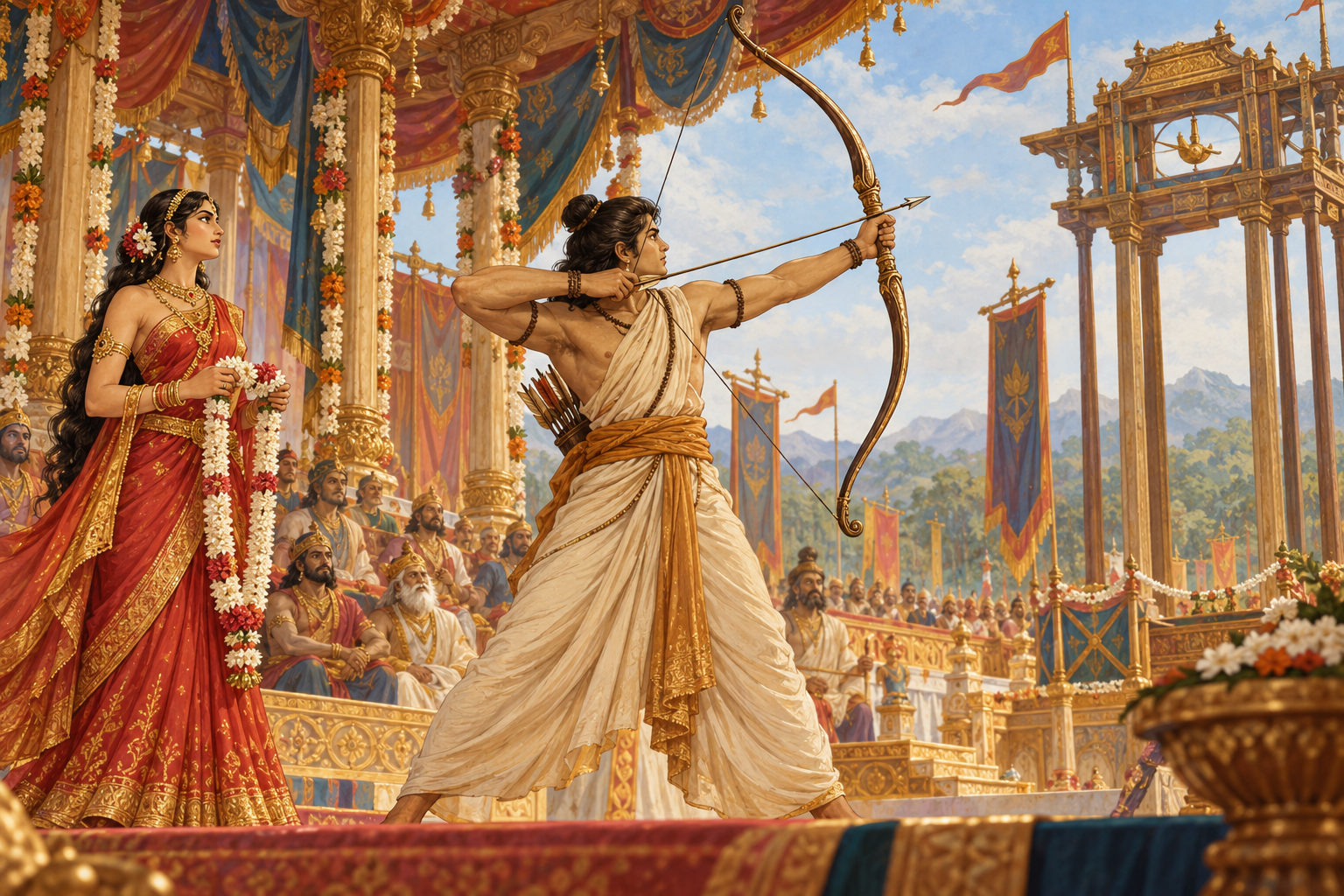
Selected debate, reverence, shot and response.
Reference: Ādi Parva, Section CLXL — selected narrative and dialogue
English reading — attributed handbook paraphrase
As Arjuna rises from the brāhmaṇas, some spectators fear that failure will expose them to ridicule; others urge confidence. He approaches the bow, walks around it, bows to Īśāna and remembers Kṛṣṇa. He strings the bow and uses the five arrows to bring down the mark through the opening in the machine. The assembly responds with celebration and disappointment. Draupadī approaches with a robe and garland and follows him. This section also lists Karṇa among those unable to string the bow, in tension with the preceding section’s description of his preparation.
Read the linked section in Kisari Mohan Ganguli’s translation
Handbook paraphrase of Ganguli’s public-domain translation, not an exact quotation. Section labels reproduce the linked witness; specialist review pending.
Who is the Kṛṣṇā approaching with the garland at the end?
Draupadī, also called Kṛṣṇā. The male Kṛṣṇa recognized the brothers earlier; the garland scene concerns Draupadī.
The disappointed kings challenge the result
Selected protest, threat and protection; hostile speeches condensed.
Reference: Ādi Parva, Section CLXLI — selected narrative and dialogue
English reading — attributed handbook paraphrase
Drupada intends to give his daughter to the successful contestant, whom the assembly sees as a brāhmaṇa. Disappointed kings accuse him of slighting them. They claim that the self-choice belongs to kṣatriyas and threaten Drupada and Draupadī. As they advance, Drupada seeks the brāhmaṇas’ protection. Arjuna and Bhīma stand against the attackers, and Bhīma uproots a tree for use in the confrontation. Kṛṣṇa identifies the brothers to Balarāma and speaks of their escape from the house of lac. Balarāma rejoices that their aunt Kuntī is alive.
Read the linked section in Kisari Mohan Ganguli’s translation
Handbook paraphrase of Ganguli’s public-domain translation, not an exact quotation. Section labels reproduce the linked witness; specialist review pending.
Are the angry kings’ claims the narrator’s settled judgment?
They are the opponents’ speeches. Read them beside their threats, the successful shot and the response of the other characters.
Combat ends and the brothers leave the gathering
Selected encounters, mediation and return; detailed combat omitted.
Reference: Ādi Parva, Section CLXLII — selected narrative and dialogue
English reading — attributed handbook paraphrase
Arjuna asks the brāhmaṇas offering help to watch while he faces the attackers. Karṇa fights him but withdraws after Arjuna presents himself as a brāhmaṇa trained by his teacher. Bhīma throws Śalya down without greatly injuring him. The kings pause to question the fighters’ identities. Kṛṣṇa tells the assembly that the maiden has been fairly won and persuades the kings to stop fighting. The brothers leave with Draupadī. Meanwhile Kuntī worries about their delayed return, and Arjuna finally reaches the potter’s dwelling in the late afternoon.
Read the linked section in Kisari Mohan Ganguli’s translation
Handbook paraphrase of Ganguli’s public-domain translation, not an exact quotation. Section labels reproduce the linked witness; specialist review pending.
What ends the collective confrontation?
The kings’ uncertainty and Kṛṣṇa’s intervention lead them to desist. The account then shifts to Kuntī waiting and Arjuna returning.
Handbook reading guidance
The brothers’ disguise makes this an episode about uneven knowledge as well as archery. Kṛṣṇa recognizes them while many contestants still judge them by their appearance as brāhmaṇas. The reader already knows Arjuna’s identity. Keep those perspectives separate when explaining the crowd’s surprise.
Two details need careful reading. First, Draupadī’s refusal uses a social designation as its stated objection. Preserve her speech as part of this edition’s narrative without presenting exclusion as a handbook instruction. Second, the two adjoining sections describe Karṇa’s handling of the bow differently. The earlier section says he strings it; the next includes him among those unable to string it. Naming this tension is more faithful to the linked witness than silently rewriting either passage.
The name Kṛṣṇā can refer to Draupadī. In the garland scene, the actions and the reference to the daughter of Drupada identify her. Kṛṣṇa’s recognition of the brothers and his later mediation are separate moments. Read pronouns and names with their surrounding scene rather than assuming every similar name identifies the same person.
| Moment | What to distinguish |
|---|---|
| The attempt | Preparing to shoot and completing the shot are separate actions. |
| The garland | Draupadī’s response follows Arjuna’s success. |
| The protest | The disappointed kings make claims and threats; those speeches are not an editorial endorsement. |
| The departure | The immediate fighting ends before the family discusses the marriage arrangement. |
Optional delayed review
Later, recall the order: refusal, successful shot, protest, intervention, return. Then reopen the four readings and check which character speaks or acts at each point. Explain one difference between what the disguised brothers know and what the assembly knows.
Related reading: revisit the announced contest to compare its conditions with the reaction to the winner, or return to the earlier news of Pāñcāla to follow how an expectation becomes an event.
From Kuntī’s reply to the marriage discussion at Pāñcāla
Learning goal: explain how a misunderstanding becomes a debated proposal, while tracking observation, inference and direct identification.
Reading path: follow Kuntī’s reply, the household observation, the report, the reception, the disclosure and objection, and the discussion before Vyāsa. For the central disagreement, read the first and last two selections together.
Edition and scope: section labels CLXLIII–CLXLVIII reproduce the linked Ganguli witness. These selections stop when Vyāsa begins his private explanation; they do not yet recount the marriage rites. English readings are attributed handbook paraphrases, followed by separate reading guidance.
Kuntī answers before seeing Draupadī
Selected misunderstanding, family discussion and visit.
Reference: Ādi Parva, Section CLXLIII — selected narrative and dialogue
English reading — attributed handbook paraphrase
The brothers describe Draupadī to their mother as the alms they have brought. Without seeing her, Kuntī tells them to share what they obtained. Seeing Draupadī, she immediately becomes troubled and asks how her words can remain true without wrong or distress to the princess. Yudhiṣṭhira first proposes that Arjuna marry her. Arjuna objects that his elder brothers should marry first. Yudhiṣṭhira, recalling Vyāsa’s words and fearing division among the brothers, proposes that all five marry her. Kṛṣṇa and Balarāma visit, recognize the family and leave to protect their disguise.
Read the linked section in Kisari Mohan Ganguli’s translation
Handbook paraphrase of Ganguli’s public-domain translation, not an exact quotation. Section labels reproduce the linked witness; specialist review pending.
Does Kuntī knowingly give this instruction after seeing Draupadī?
No. The narrative stresses that she has not seen her, followed by immediate concern when she does.
Dhṛṣṭadyumna watches the household
Selected meal, overnight observation and return to Drupada.
Reference: Ādi Parva, Section CLXLIV — selected narrative and dialogue
English reading — attributed handbook paraphrase
Dhṛṣṭadyumna secretly follows the brothers to the potter’s dwelling. Kuntī directs Draupadī to set aside food for offerings, brāhmaṇas and others needing food, then divide the remainder among the family. Bhīma receives half because of his appetite; the other half is divided into six shares. At night the brothers discuss weapons and warfare, and Dhṛṣṭadyumna listens. In the morning he returns to Drupada, who anxiously asks who has taken his daughter and whether the successful archer might be Arjuna. The king’s questions reveal his continuing uncertainty.
Read the linked section in Kisari Mohan Ganguli’s translation
Handbook paraphrase of Ganguli’s public-domain translation, not an exact quotation. Section labels reproduce the linked witness; specialist review pending.
What does Dhṛṣṭadyumna hear that will matter to his report?
The brothers discuss military subjects. He later uses this observation, alongside their feats, to infer their identity.
A report leads to a formal inquiry
Selected inference, priest’s message and response; recap shortened.
Reference: Ādi Parva, Section CLXLV — selected narrative and dialogue
English reading — attributed handbook paraphrase
Dhṛṣṭadyumna reports the contest, the household and the brothers’ military conversation. From these signs and reports of their escape from the fire, he concludes that they are the disguised Pāṇḍavas. Drupada sends his priest to ask who they are and explain his hope that Arjuna would marry Draupadī. Yudhiṣṭhira has the visitor received respectfully. He answers by emphasizing that the successful contestant fulfilled the announced challenge and reassures the king, without yet giving the explicit identification that follows later. Another messenger announces that the feast is ready.
Read the linked section in Kisari Mohan Ganguli’s translation
Handbook paraphrase of Ganguli’s public-domain translation, not an exact quotation. Section labels reproduce the linked witness; specialist review pending.
Is the report already Yudhiṣṭhira’s direct disclosure?
No. Dhṛṣṭadyumna draws an inference; the priest then seeks confirmation, and Yudhiṣṭhira’s explicit disclosure comes later.
Drupada observes his guests at the palace
Selected invitation, reception and observation; object catalogue shortened.
Reference: Ādi Parva, Section CLXLVI — selected narrative and dialogue
English reading — attributed handbook paraphrase
The family accepts Drupada’s invitation and travels to his palace, with Kuntī and Draupadī riding together. The king has arranged objects associated with different occupations and social orders, including agricultural equipment and weapons, to help identify his guests. The brothers take their seats confidently in age order and enjoy the feast. Afterward they examine the weapons with interest. Drupada, his son and the ministers take this as a sign of royal birth and rejoice. The scene presents their method of inference within the narrative, rather than a reliable way to classify people today.
Read the linked section in Kisari Mohan Ganguli’s translation
Handbook paraphrase of Ganguli’s public-domain translation, not an exact quotation. Section labels reproduce the linked witness; specialist review pending.
What distinguishes this scene from a direct statement of identity?
The hosts interpret conduct and interests. They have not yet heard the brothers name themselves.
Identity is disclosed, but the marriage proposal is disputed
Selected identification, reassurance and objection.
Reference: Ādi Parva, Section CLXLVII — selected narrative and dialogue
English reading — attributed handbook paraphrase
Drupada asks directly who his guests are. Yudhiṣṭhira identifies them as Pāṇḍu’s sons and names himself, Bhīma and Arjuna. He recounts their escape from the house of lac. Drupada welcomes them and promises support for recovering their inheritance. He then proposes Arjuna’s marriage to Draupadī. Yudhiṣṭhira instead says that she should marry all five brothers, citing their mother’s instruction and their rule of sharing what they obtain. Drupada objects that this conflicts with the usage and Vedic norms he recognizes. The disagreement is brought to further discussion rather than disappearing at the disclosure of identity.
Read the linked section in Kisari Mohan Ganguli’s translation
Handbook paraphrase of Ganguli’s public-domain translation, not an exact quotation. Section labels reproduce the linked witness; specialist review pending.
Does Drupada’s joy at recognizing the brothers settle the marriage question?
No. He welcomes them but objects to the proposal that all five should marry Draupadī.
Vyāsa hears the different positions
Selected objections, reasons and transition to a private explanation.
Reference: Ādi Parva, Section CLXLVIII — selected narrative and dialogue
English reading — attributed handbook paraphrase
Vyāsa invites those present to state their views. Drupada objects to the proposed marriage, and Dhṛṣṭadyumna raises the relation between an elder brother and a younger brother’s wife. Yudhiṣṭhira appeals to his conscience, precedents he has heard and obedience to his mother. Kuntī fears that her words will become untrue. Vyāsa supports the proposal and takes Drupada aside to explain its background privately. This section records the competing reasons and announces the explanation; the explanation itself belongs to the following section.
Read the linked section in Kisari Mohan Ganguli’s translation
Handbook paraphrase of Ganguli’s public-domain translation, not an exact quotation. Section labels reproduce the linked witness; specialist review pending.
What remains to be read after this discussion?
Vyāsa’s private explanation to Drupada and the subsequent resolution. This reading stops before those events.
Handbook reading guidance
Kuntī’s reply is often remembered as a single decisive sentence. Here it begins a discussion: she realizes what has happened, voices concern for Draupadī and asks for a way through the difficulty. Yudhiṣṭhira initially proposes Arjuna alone, Arjuna invokes the seniority of his brothers, and a different proposal follows. Reading the sequence prevents the misunderstanding from erasing the deliberation around it.
Keep proposals distinct from completed actions. The contest has produced a successful archer, but the identity inquiry and marriage discussion continue. The objections of Drupada and Dhṛṣṭadyumna remain part of this account, alongside the reasons offered by Yudhiṣṭhira and Kuntī. Vyāsa’s intervention introduces another stage. The proposed arrangement is debated within the story; these passages alone do not supply a general instruction for marriage practice.
Notice whose speech is available. These selections contain extensive discussion by the family and hosts but no direct statement by Draupadī answering the specific proposal of marriage to all five. The narrator describes her conduct elsewhere in the sequence. Those descriptions should not be expanded into an invented speech or an unsupported account of her private reasoning.
| Stage | How knowledge changes |
|---|---|
| At the dwelling | Kuntī answers without seeing the person brought home, then recognizes the difficulty. |
| The secret observation | Dhṛṣṭadyumna gathers signs from conduct and conversation. |
| The report and feast | The hosts form an inference and seek confirmation. |
| The direct answer | Yudhiṣṭhira names the family; uncertainty about identity ends. |
| The marriage discussion | The participants disagree about what should happen next and ask Vyāsa for explanation. |
Optional delayed review
Later, explain the difference between Kuntī’s first reply and Yudhiṣṭhira’s later proposal. Then name one objection and one supporting reason from the final reading, keeping each attached to its speaker. Reopen the passage to check your account.
Related reading: return to the contest and departure for the preceding events, or the escape from Vāraṇāvata for the survival now disclosed to Drupada.
Vyāsa’s explanation, the wedding rites and Kuntī’s blessing
Learning goal: distinguish a divine explanation, a narrated ritual and a blessing for the future.
Reading path: begin with Vyāsa’s explanation, continue to the weddings, and finish with Kuntī’s blessing. Read after the preceding objections and discussion.
Edition and scope: references follow the linked Ganguli witness’s printed labels CLXLIX, CC and CCI. The selections are attributed English paraphrases, not the complete chapters or a ritual manual.
Vyāsa gives a divine background for the marriage
Selected explanation and former-life account; the opening sacrifice and other details condensed.
Reference: Ādi Parva, Section CLXLIX — selected narrative and dialogue
English reading — attributed handbook paraphrase
Vyāsa tells Drupada of Indra encountering Śiva and finding four former Indras in a mountain cave. The five are destined for human birth, and Śrī is appointed their shared wife; Nārāyaṇa approves. Vyāsa identifies the Pāṇḍavas with those Indras and Draupadī with Śrī, then gives Drupada celestial sight to behold their former forms. He also recounts a maiden whose ascetic practice pleased Śiva. She repeatedly asked for a husband; Śiva granted five husbands in a future birth. She protested that she wanted one husband with every virtue, but he explained the repeated request. Vyāsa identifies that maiden with Draupadī. His explanation combines divine identity, a vision and a former-life boon.
Read the linked section in Kisari Mohan Ganguli’s translation
Handbook paraphrase of Ganguli’s public-domain translation, not an exact quotation. Section labels reproduce the linked witness; specialist review pending.
Does the maiden simply ask for five husbands?
No. In the narrated exchange she asks for a husband repeatedly and then explicitly says that she desires one husband with every virtue.
Drupada accepts and Dhaumya conducts the weddings
Selected acceptance, ritual actions and succession; gift catalogue and extraordinary bodily claim omitted.
Reference: Ādi Parva, Section CC — selected narrative and dialogue
English reading — attributed handbook paraphrase
After hearing Vyāsa, Drupada accepts the proposed marriage as divinely ordained. Vyāsa names the day as auspicious and directs Yudhiṣṭhira to marry first. The palace prepares for the wedding, and the brothers arrive with their priest Dhaumya. Dhaumya kindles the sacred fire and offers clarified butter with mantras. He unites Yudhiṣṭhira and Draupadī; they walk around the fire and take each other’s hand. The remaining brothers marry her on successive days with the priest’s assistance. Drupada gives wealth afterward, and the family remains in Pāñcāla.
Read the linked section in Kisari Mohan Ganguli’s translation
Handbook paraphrase of Ganguli’s public-domain translation, not an exact quotation. Section labels reproduce the linked witness; specialist review pending.
Does this reading describe all five weddings taking place at once?
No. Yudhiṣṭhira’s wedding comes first; the other brothers follow on successive days.
Kuntī blesses Draupadī and Kṛṣṇa sends gifts
Selected greeting, blessing and presents; lists shortened.
Reference: Ādi Parva, Section CCI — selected narrative and dialogue
English reading — attributed handbook paraphrase
The women of Drupada’s household greet Kuntī. Draupadī, wearing red silk and the auspicious thread at her wrist, approaches her mother-in-law respectfully. Kuntī blesses her through comparisons with celebrated divine and human couples, including Śacī and Indra, Damayantī and Nala, Arundhatī and Vasiṣṭha, and Lakṣmī and Nārāyaṇa. She wishes her happiness, children, prosperity, care for guests and elders, and a future place as queen. Kṛṣṇa sends valuable wedding gifts, which Yudhiṣṭhira accepts with joy. Kuntī’s words express hopes for the household’s future, rather than announcing that every hoped-for event has already occurred.
Read the linked section in Kisari Mohan Ganguli’s translation
Handbook paraphrase of Ganguli’s public-domain translation, not an exact quotation. Section labels reproduce the linked witness; specialist review pending.
Is Kuntī’s blessing a report of events already completed?
No. It wishes happiness and a future position for Draupadī; the narrative has not yet reached those later events.
Handbook reading guidance
The first reading supplies the explanation announced in the previous discussion. Read it as Vyāsa’s account to Drupada within this edition. Its vision and former-life narrative should remain attributed; they are not a modern historical reconstruction.
The second reading shifts from explanation to preparation and action. Drupada’s acceptance comes before the rites. Dhaumya conducts them, Yudhiṣṭhira marries first, and the other brothers follow on later days. The passage describes this particular marriage; its compressed ritual sequence is not a complete set of instructions for conducting a ceremony.
The last reading changes the register again. Kuntī’s comparisons honor Draupadī and express wishes for her future household. Treat the aspirations as a blessing, keeping them distinct from a record of an achieved kingdom or an outcome guaranteed to every reader.
| Reading | What kind of account is this? |
|---|---|
| Vyāsa’s explanation | A character’s account of divine identity and a former life. |
| The wedding rites | Narrated actions conducted by a named priest in a stated order. |
| Kuntī’s blessing | Affectionate wishes addressed to Draupadī. |
Optional delayed review
Later, name one detail belonging to each kind of account. Then check the readings: who explains, who conducts the rites, and who blesses? Keep those roles separate when retelling the episode.
Related reading: return to the differing positions before Vyāsa to connect the explanation to the question it answers, or revisit Dhaumya’s appointment to trace his role in the family’s journey.
News at Hastināpura: intrigue, force and the case for reconciliation
Learning goal: compare competing responses to the Pāṇḍavas’ survival, identifying what each speaker proposes and whose interests the proposal serves.
Reading path: begin with the news, compare Duryodhana’s proposals with Karṇa’s alternative, then read Bhīṣma, Droṇa and Vidura. For the reconciliation argument alone, read the final three selections.
Edition and scope: these selected English paraphrases follow Kisari Mohan Ganguli’s linked Ādi Parva, Sections CCII–CCVII. The council has not yet sent its mission or implemented the proposed division; those events follow later.
News changes what the Kuru court knows
Selected reports, misunderstanding and private response.
Reference: Ādi Parva, Section CCII — selected narrative and dialogue
English reading — attributed handbook paraphrase
The rulers learn that the disguised contestants were the Pāṇḍavas and that Draupadī has married them. Duryodhana’s party returns to Hastināpura distressed by their survival and new alliance. Vidura tells Dhṛtarāṣṭra that the Kurus are prospering. The king initially assumes that Duryodhana has won Draupadī; Vidura corrects him and describes the Pāṇḍavas’ welcome and allies. Dhṛtarāṣṭra then expresses affection for his nephews. Once Vidura leaves, Duryodhana and Karṇa approach the king privately and urge him to consider weakening the Pāṇḍavas.
Read the linked section in Kisari Mohan Ganguli’s translation
Handbook paraphrase of Ganguli’s public-domain translation, not an exact quotation. Section labels reproduce the linked witness; specialist review pending.
What does Dhṛtarāṣṭra misunderstand at first?
He assumes the good news concerns Duryodhana’s marriage. Vidura explains that it concerns the surviving Pāṇḍavas.
Duryodhana proposes division and covert harm
Selected private counsel; proposed violence condensed.
Reference: Ādi Parva, Section CCIII — selected narrative and dialogue
English reading — attributed handbook paraphrase
Dhṛtarāṣṭra says that his praise in Vidura’s presence concealed his private intentions and invites Duryodhana and Karṇa to speak. Duryodhana proposes sowing division between the brothers, buying away Drupada’s support, keeping the family in Pāñcāla, and disrupting their marriage. He also proposes secretly killing Bhīma or bringing the brothers back in order to harm them. He argues that their alliance must be weakened before confidence in Drupada becomes established. He asks the king to judge the proposals and Karṇa to respond. These are proposed actions, not completed events.
Read the linked section in Kisari Mohan Ganguli’s translation
Handbook paraphrase of Ganguli’s public-domain translation, not an exact quotation. Section labels reproduce the linked witness; specialist review pending.
Does the passage report that Drupada accepts a bribe?
No. Buying away his support is one of Duryodhana’s proposals; no successful bribery is narrated here.
Karṇa rejects intrigue and urges immediate attack
Selected strategic objections and alternative; generalization about women omitted.
Reference: Ādi Parva, Section CCIV — selected narrative and dialogue
English reading — attributed handbook paraphrase
Karṇa argues that earlier schemes failed even when the Pāṇḍavas were young and nearby. They are now stronger and farther away. He considers their unity, Draupadī’s attachment and Drupada’s integrity obstacles to intrigue. He therefore urges an immediate military attack before their allies assemble and before Kṛṣṇa can bring Yādava support. His rejection of covert schemes is a judgment about their effectiveness, not a turn toward peace. Dhṛtarāṣṭra praises his martial counsel but calls for Bhīṣma, Droṇa and Vidura to deliberate with them.
Read the linked section in Kisari Mohan Ganguli’s translation
Handbook paraphrase of Ganguli’s public-domain translation, not an exact quotation. Section labels reproduce the linked witness; specialist review pending.
Why is Karṇa’s rejection of intrigue not a proposal for reconciliation?
He replaces the covert proposals with a call for immediate armed attack.
What claim supports Bhīṣma’s proposed division?
The Pāṇḍavas also have a claim to their paternal kingdom; his advice is not presented merely as a gift to outsiders.
Droṇa proposes a mission; Karṇa challenges the advisers
Selected practical proposal and disagreement; Karṇa’s illustrative king story omitted.
Reference: Ādi Parva, Section CCVI — selected narrative and dialogue
English reading — attributed handbook paraphrase
Droṇa agrees that the Pāṇḍavas should receive a share. He proposes a courteous messenger bearing wedding gifts, an invitation to return with Drupada’s permission, a formal welcome and restoration to their paternal position. Karṇa challenges the loyalty of Bhīṣma and Droṇa despite the king’s favors to them. Appealing to destiny, he questions whether advisers can determine who retains sovereignty. Droṇa rejects this accusation and says that his advice seeks the prosperity of the entire Kuru family. He warns of destruction if reconciliation is refused.
Read the linked section in Kisari Mohan Ganguli’s translation
Handbook paraphrase of Ganguli’s public-domain translation, not an exact quotation. Section labels reproduce the linked witness; specialist review pending.
How does Droṇa turn a general recommendation into a course of action?
He specifies the messenger, gifts, invitation, reception and restoration that would put reconciliation into practice.
Vidura warns against partiality and supports conciliation
Selected counsel on advisers, family, alliances and public welfare.
Reference: Ādi Parva, Section CCVII — selected narrative and dialogue
English reading — attributed handbook paraphrase
Vidura defends Bhīṣma and Droṇa as trustworthy advisers who regard both branches of the family equally. He warns that counsel encouraging the king’s partiality toward his own sons does not serve his true interests. He stresses the Pāṇḍavas’ strength, allies and claim to the kingdom, and urges kindly treatment that could remove the stain of the fire plot and protect Kuru lives. Drupada’s friendship could strengthen them all. Vidura also notes the people’s joy at the brothers’ survival and asks why war should be pursued when conciliation can achieve the end.
Read the linked section in Kisari Mohan Ganguli’s translation
Handbook paraphrase of Ganguli’s public-domain translation, not an exact quotation. Section labels reproduce the linked witness; specialist review pending.
Whose welfare does Vidura ask the king to consider?
Both branches of the family and the people of the realm, rather than only the advantage of the king’s own sons.
Handbook reading guidance
The marriage changes the political setting: the brothers are known to be alive and have gained strong allies. Different speakers interpret the same news through different aims. Read the proposals as a debate, preserving both disagreement and the reasons offered.
Karṇa criticizes Duryodhana’s methods while retaining the aim of defeating the brothers. By contrast, Bhīṣma grounds a settlement in their ancestral claim; Droṇa supplies a diplomatic course of action; Vidura challenges partiality and appeals to wider welfare. Agreement that the brothers are strong does not mean agreement about what should be done.
Distinguish three stages: a proposal, a decision and its execution. These readings contain proposals and arguments. A messenger suggested by Droṇa is not yet a messenger sent; half a kingdom recommended by Bhīṣma is not yet land transferred. Keep the narrative’s timing visible when retelling the sequence.
| Speaker | Proposed response | Reason emphasized |
|---|---|---|
| Duryodhana | Covertly weaken the brothers and their alliance | Act before their position becomes secure |
| Karṇa | Attack immediately | Intrigue will fail; allied forces may soon assemble |
| Bhīṣma | Conclude a treaty and give an ancestral share | Equal regard, rightful claim and family reputation |
| Droṇa | Send gifts and invite an honored return | Make reconciliation concrete |
| Vidura | Accept conciliatory counsel | Restrain partiality and protect the wider family and realm |
Optional delayed review
Later, name two speakers who disagree about methods, then two who agree on reconciliation but emphasize different reasons. Check your answers against the readings. Finally, identify one proposal that has not yet been carried out.
Related reading: revisit the Pāñcāla marriage alliance for the immediate background or the escape from the house of lac for the event behind the court’s damaged reputation.
Vidura’s mission, the return and the settlement at Indraprastha
Learning goal: trace how the council’s advice becomes a mission and settlement, then identify the new concern raised by Nārada.
Reading path: follow the authorized mission, the return and city-building, and Nārada’s warning. Begin with the preceding council debate if you want to compare advice with implementation.
Edition and scope: these attributed English paraphrases follow Ganguli’s Ādi Parva, Sections CCVIII–CCX. The city description is selected, and Nārada’s illustrative story is introduced rather than retold in full here.
Dhṛtarāṣṭra sends Vidura to Pāñcāla
Selected decision, gifts and invitation.
Reference: Ādi Parva, Section CCVIII — selected narrative and dialogue
English reading — attributed handbook paraphrase
Dhṛtarāṣṭra accepts the counsel of Bhīṣma, Droṇa and Vidura. He acknowledges that Pāṇḍu’s sons, like his own, are entitled to the kingdom and asks Vidura to bring them back with Kuntī and Draupadī. Vidura travels to Drupada’s court carrying jewels and wealth. He greets the family, presents the gifts and conveys the Kuru court’s pleasure in the alliance. Before the Pāṇḍavas and Kṛṣṇa, he asks Drupada to permit their return to their ancestral kingdom. He says he will notify Dhṛtarāṣṭra once permission is received.
Read the linked section in Kisari Mohan Ganguli’s translation
Handbook paraphrase of Ganguli’s public-domain translation, not an exact quotation. Section labels reproduce the linked witness; specialist review pending.
What has changed since Droṇa proposed a messenger?
The king has now authorized a mission, and Vidura has actually traveled and delivered the invitation.
Return, division and the building of Indraprastha
Selected agreement, reception and settlement; architectural and botanical catalogues shortened.
Reference: Ādi Parva, Section CCIX — selected narrative and dialogue
English reading — attributed handbook paraphrase
Drupada consults the brothers and Kṛṣṇa, then agrees to their departure. The party returns to Hastināpura, where representatives of the court and joyful citizens receive them. Later Dhṛtarāṣṭra directs the brothers to take half the kingdom and reside at Khāṇḍavaprastha to prevent renewed differences with their cousins. They agree and move to the undeveloped region. With Kṛṣṇa present and Vyāsa assisting in selection of the site, they perform propitiatory rites and lay out a city. The narrator describes its defenses, streets, dwellings and gardens; it becomes known as Indraprastha. Learned residents, merchants and skilled artisans arrive. Kṛṣṇa and Balarāma eventually return to Dvārakā.
Read the linked section in Kisari Mohan Ganguli’s translation
Handbook paraphrase of Ganguli’s public-domain translation, not an exact quotation. Section labels reproduce the linked witness; specialist review pending.
What follows the welcome at Hastināpura?
A later direction to take half the kingdom and settle at Khāṇḍavaprastha, where the brothers build the city called Indraprastha.
Nārada asks the brothers to safeguard their unity
Selected framing question, reception and warning; the illustrative story is only introduced here.
Reference: Ādi Parva, Section CCX — selected narrative and dialogue
English reading — attributed handbook paraphrase
Janamejaya asks how the brothers lived after obtaining Indraprastha and how disagreement over their shared marriage was avoided. Vaiśampāyana describes Yudhiṣṭhira governing with his brothers. Nārada visits and receives an honored welcome. After greeting Draupadī, he speaks privately to the brothers and tells them to establish a rule to prevent disunion. He introduces Sunda and Upasunda, brothers whose former closeness did not prevent their fatal conflict over Tilottamā. Yudhiṣṭhira asks to hear their story in detail. This section introduces the warning; it does not yet state the brothers’ eventual rule.
Read the linked section in Kisari Mohan Ganguli’s translation
Handbook paraphrase of Ganguli’s public-domain translation, not an exact quotation. Section labels reproduce the linked witness; specialist review pending.
Has the brothers’ specific rule already been established in this reading?
No. Nārada urges them to make one and introduces an illustrative story; the detailed arrangement comes afterward.
Handbook reading guidance
Vidura now acts on a royal command. His gifts and formal request make the reconciliation concrete, while Drupada’s consultation precedes departure. Compare the delivered invitation with the earlier proposal rather than treating the council’s recommendation as something already accomplished.
The sequence distinguishes the welcome in the old capital from settlement in a new city. The court receives the family before directing the move. The narrative first names Khāṇḍavaprastha and then calls the developed city Indraprastha. Its splendid description conveys an epic vision of prosperity; this passage alone does not establish modern archaeological identifications.
Political settlement does not end the story’s concern with unity. Nārada shifts attention to the brothers’ relationship. His warning introduces a story within the story, and Yudhiṣṭhira’s question opens the next stage. Avoid importing a later rule into a reading that has only asked for one.
| Stage | What happens |
|---|---|
| Decision | Dhṛtarāṣṭra authorizes Vidura’s mission. |
| Invitation | Vidura delivers gifts and seeks Drupada’s permission. |
| Return | The party receives a welcome at Hastināpura. |
| Settlement | The brothers accept half the kingdom and build their city. |
| New question | Nārada asks them to prevent division among themselves. |
Optional delayed review
Later, reconstruct these five stages without looking. Then check which actions belong to Vidura, Drupada, Dhṛtarāṣṭra and Nārada. Explain why a welcome, a settlement and a warning are separate events.
Related reading: revisit Droṇa’s proposed mission for the earlier plan, or the marriage discussion for the background to Nārada’s concern.
Nārada’s warning: Sunda, Upasunda and the agreement among the brothers
Learning goal: follow the example Nārada tells and explain how it leads to an explicit agreement among his listeners.
Reading path: follow the boon, the conquest, Tilottamā’s task and the conflict and agreement. Start with Nārada’s arrival for the question that frames the story.
Edition and scope: these attributed English paraphrases follow Ganguli’s Ādi Parva, Sections CCXI–CCXIV. Austerities, warfare and descriptive catalogues are selected or condensed; the subsequent test of the agreement belongs to the next episode.
Closely united brothers obtain a limited boon
Selected kinship, ambition and boon; severe austerities and festivities condensed.
Reference: Ādi Parva, Section CCXI — selected narrative and dialogue
English reading — attributed handbook paraphrase
Nārada describes Sunda and Upasunda as sons of Nikumbha, closely united in their habits, aims and actions. Seeking sovereignty over the three worlds, they perform severe austerities. Brahmā offers a boon, but refuses their request for immortality because their practice has been directed toward conquest. The brothers instead ask to be safe from all created beings except one another. Brahmā grants that request along with the other powers they sought. They return home in triumph. Their confidence in their mutual loyalty leaves one another as the exception to their protection.
Read the linked section in Kisari Mohan Ganguli’s translation
Handbook paraphrase of Ganguli’s public-domain translation, not an exact quotation. Section labels reproduce the linked witness; specialist review pending.
Are the brothers granted unrestricted immortality?
No. Brahmā refuses that request; their protection retains the exception that each can kill the other.
Conquest disrupts worship, study and settled life
Selected conquest and consequences; violent descriptions shortened.
Reference: Ādi Parva, Section CCXII — selected narrative and dialogue
English reading — attributed handbook paraphrase
After their celebrations, the brothers muster their forces and set out to conquer. The gods withdraw before them, and the brothers extend their power through the worlds. They then target brāhmaṇas and royal sages because, in their reasoning, sacrificial offerings strengthen the gods. Their soldiers destroy sacred places and extinguish sacrificial fires; sages flee, and the narrative describes sacrifice, study and festivals coming to a halt. The story depicts their shared purpose becoming a source of widespread harm, rather than treating their agreement with one another as proof of good conduct.
Read the linked section in Kisari Mohan Ganguli’s translation
Handbook paraphrase of Ganguli’s public-domain translation, not an exact quotation. Section labels reproduce the linked witness; specialist review pending.
Why do the brothers target the sacrificial communities?
They believe the offerings support the gods whom they oppose. This is the attackers’ rationale within Nārada’s account.
Tilottamā is created for a particular task
Selected appeal, creation and commission; the divine assembly’s detailed reactions omitted.
Reference: Ādi Parva, Section CCXIII — selected narrative and dialogue
English reading — attributed handbook paraphrase
Distressed sages and divine beings bring the brothers’ destructive actions before Brahmā. After hearing their account, he resolves on a response and summons Viśvakarman. The celestial craftsman creates a woman of extraordinary beauty, named Tilottamā because her form draws on minute portions of beautiful things. She asks what task she is to perform. Brahmā directs her to approach Sunda and Upasunda and cause them to quarrel. Nārada’s story therefore gives her a specific commission as part of the response to the brothers’ oppression.
Read the linked section in Kisari Mohan Ganguli’s translation
Handbook paraphrase of Ganguli’s public-domain translation, not an exact quotation. Section labels reproduce the linked witness; specialist review pending.
Is Tilottamā’s role introduced as an unexplained accident?
No. The passage first describes the appeal for help, her creation and the task assigned to her.
The brothers’ conflict leads to the Pāṇḍavas’ agreement
Selected confrontation, consequence and return to the listening brothers; graphic details omitted.
Reference: Ādi Parva, Section CCXIV — selected narrative and dialogue
English reading — attributed handbook paraphrase
Tilottamā approaches Sunda and Upasunda while they are drinking and celebrating. Each tries to claim her for himself. Their rivalry becomes rage, and they kill one another with their maces, fulfilling the exception in their boon. Nārada turns back to the Pāṇḍavas and urges an arrangement to prevent quarrels concerning Draupadī. They consult and agree in his presence: if one sees another sitting with Draupadī, the one who intrudes must live in the forest for twelve years as a brahmacārin. Nārada departs satisfied, and the narrator connects their agreement with the avoidance of dispute.
Read the linked section in Kisari Mohan Ganguli’s translation
Handbook paraphrase of Ganguli’s public-domain translation, not an exact quotation. Section labels reproduce the linked witness; specialist review pending.
What duration does this linked edition give for the consequence?
Twelve years in the forest as a brahmacārin. This selection follows Ganguli’s wording rather than replacing it with a different duration.
Handbook reading guidance
Keep the two sets of brothers distinct. Nārada tells the Pāṇḍavas about Sunda and Upasunda; he does not say their lives and conduct are identical. An illustrative warning draws attention to a risk without erasing those differences.
The boon contains the condition that later matters. The brothers trust their unity so completely that they retain only one another as a possible source of death. Their shared ambition then harms others. Closeness, power and disciplined effort do not by themselves settle the moral character of the purpose they serve.
At the end, notice the return from Nārada’s narrated past to the listening Pāṇḍavas. They discuss and make a stated agreement rather than merely assuming affection will prevent conflict. Its wording is specific to this household and this edition. It is not general marriage guidance or a complete account of how the arrangement will later be interpreted.
| Narrative stage | Detail to track |
|---|---|
| Protection | The boon includes an exception. |
| Power | The brothers use their strength for conquest and oppression. |
| Response | Tilottamā receives a defined task. |
| Conflict | The exception becomes decisive. |
| Application | Nārada’s listeners make an explicit agreement. |
Optional delayed review
Later, explain why the boon’s exception matters to the ending. Then identify the point where Nārada finishes his example and addresses the Pāṇḍavas again. Check the final reading for the agreement’s condition and consequence.
Related reading: return to the settlement and Nārada’s arrival for the frame, or the preceding marriage discussion for the household background.
Arjuna’s undertaking: protection, interpretation and the first journeys
Learning goal: identify a conflict between duties and compare how the scope of an undertaking is argued within successive episodes.
Reading path: begin with the petitioner and the weapons chamber, continue to Ulūpī’s argument, and finish with the condition at Maṇipura. Read after the agreement made before Nārada.
Edition and scope: these attributed English paraphrases follow Ganguli’s Ādi Parva, Sections CCXV–CCXVII. The journey is selected rather than a complete itinerary. Place names follow the narrative and do not by themselves establish modern geographical identifications.
Arjuna protects a petitioner and accepts the consequence
Selected dilemma, recovery of cattle and discussion of the agreement.
Reference: Ādi Parva, Section CCXV — selected narrative and dialogue
English reading — attributed handbook paraphrase
A brāhmaṇa whose cattle have been stolen asks the rulers for protection. Arjuna promises help, but the weapons are in the chamber where Yudhiṣṭhira is sitting with Draupadī. He weighs the duty to protect the petitioner against the agreement among the brothers. Choosing to act, he enters, obtains his weapons and recovers the cattle. On returning, he asks leave to fulfill the agreed forest exile. Yudhiṣṭhira says he is not displeased and argues that a younger brother’s entry need not count as a fault. Arjuna refuses to evade his undertaking through such an interpretation. With permission, he leaves for twelve years.
Read the linked section in Kisari Mohan Ganguli’s translation
Handbook paraphrase of Ganguli’s public-domain translation, not an exact quotation. Section numbering follows this edition; specialist review pending.
Does Yudhiṣṭhira insist on sending Arjuna away?
No. Yudhiṣṭhira offers an interpretation allowing him to stay; Arjuna insists on observing his undertaking.
Ulūpī offers a different interpretation of the vow
Selected journey, encounter and dialogue; travel and ritual descriptions shortened.
Reference: Ādi Parva, Section CCXVI — selected narrative and dialogue
English reading — attributed handbook paraphrase
Arjuna travels with learned and religious companions and stays near the Gaṅgā. After his ablutions, Ulūpī, daughter of the Nāga king Kauravya, pulls him beneath the water into her father’s realm. Arjuna performs rites at a fire there. Ulūpī asks for union with him; he raises his twelve-year vow of brahmacarya. She argues that its restriction concerns Draupadī, and appeals to his duty to relieve distress, threatening to end her life if refused. The narrator says that Arjuna grants her wish with duty as his motive. After the night there, he returns with her to the river region; she grants him a boon of invincibility in water.
Read the linked section in Kisari Mohan Ganguli’s translation
Handbook paraphrase of Ganguli’s public-domain translation, not an exact quotation. Section numbering follows this edition; specialist review pending.
Who advances the interpretation that the restriction concerns Draupadī?
Ulūpī does, in her argument to Arjuna. Keep that argument attributed to its speaker and episode.
The journey reaches Citrāṅgadā and a lineage condition
Selected pilgrimage, identification and marriage condition; long itinerary shortened.
Reference: Ādi Parva, Section CCXVII — selected narrative and dialogue
English reading — attributed handbook paraphrase
Arjuna continues through sacred places, performing rites and giving gifts. His brāhmaṇa companions eventually take leave at Kaliṅga, and he proceeds with fewer attendants. At Maṇipura he sees Citrāṅgadā, daughter of King Citravāhana, and asks the king to marry her, identifying himself as Pāṇḍu and Kuntī’s son. The king explains his family’s one-child succession and says that he has appointed his daughter as a putrikā: her son is to continue his line. Arjuna accepts that condition and marries her. He stays three years; after a son is born, he takes leave and resumes his travels.
Read the linked section in Kisari Mohan Ganguli’s translation
Handbook paraphrase of Ganguli’s public-domain translation, not an exact quotation. Section numbering follows this edition; specialist review pending.
What condition does Arjuna accept before the marriage?
A son born to Citrāṅgadā is to perpetuate her father’s line. The king makes this condition explicit before Arjuna accepts.
Handbook reading guidance
The first scene puts a concrete need beside an existing undertaking. The petitioner is waiting while Arjuna weighs what entering the chamber will mean. Yudhiṣṭhira’s later response offers one reading of the agreement, while Arjuna insists on holding himself to it. Preserve both positions when explaining why he leaves.
The next scene again turns on interpretation, now advanced by Ulūpī. Her reasoning about the vow, her threat and her earlier act of pulling Arjuna underwater remain part of the encounter’s context. Keep her arguments and the narrator’s account of Arjuna’s motive distinctly attributed; the passage does not provide a general instruction about responding to such demands.
At Maṇipura a condition is stated before the marriage. The king explains how a future child will continue his own line, and Arjuna accepts. The selection contains the king’s and Arjuna’s positions; it does not record a direct statement from Citrāṅgadā about that arrangement. Avoid adding a speech or private reasoning for her.
| Episode | Question to track |
|---|---|
| The stolen cattle | How does Arjuna respond when protection conflicts with the agreement? |
| Yudhiṣṭhira’s reply | What interpretation does Arjuna decline? |
| Ulūpī’s argument | Who proposes a narrower scope for the vow? |
| Citravāhana’s condition | What obligation concerning a child is accepted? |
Optional delayed review
Later, explain why Arjuna enters the chamber and why he leaves afterward. Then identify who speaks about the vow’s scope in the second reading, and what condition governs the marriage in the third. Reopen the passages to check each attribution.
Related reading: revisit Nārada’s warning and the original agreement to compare its wording with the later interpretations, or the settlement at Indraprastha for the setting before Arjuna departs.
The five sacred waters and Arjuna’s reunion with Kṛṣṇa
Learning goal: follow a danger, its narrated explanation and resolution, then locate the reunion that changes the setting of Arjuna’s journey.
Reading path: begin with the avoided waters and Vargā’s account, continue to the remaining releases, and finish with the reunion and reception. Read after Arjuna’s departure and early travels.
Edition and scope: these selected English paraphrases follow Ganguli’s Ādi Parva, Sections CCXVIII–CCXX. The sacred places are named within the epic’s account; this selection does not establish their modern geographical identification.
Arjuna encounters Vargā at the avoided waters
Selected warning, transformation and recollection.
Reference: Ādi Parva, Section CCXVIII — selected narrative and dialogue
English reading — attributed handbook paraphrase
At five sacred bathing places near the southern ocean, Arjuna asks why ascetics avoid the waters. They tell him that crocodiles seize bathers. Despite their warning he enters one of the waters, where a crocodile catches his leg. He pulls it ashore, and it becomes a celestial woman. She identifies herself as the apsaras Vargā and explains that she and four companions once tried to disturb a brāhmaṇa’s concentrated practice. Unmoved by their attempts, he cursed them to live as crocodiles for a hundred years. Her account begins to explain the danger the ascetics described.
Read the linked section in Kisari Mohan Ganguli’s translation
Handbook paraphrase of Ganguli’s public-domain translation, not an exact quotation. Section numbering follows this edition; specialist review pending.
Who explains the crocodile’s former identity and the earlier curse?
Vargā explains them after regaining her form. Her recollection is a story within the account of Arjuna’s travels.
The remaining companions are released
Selected clarification, prediction, release and renewed travel.
Reference: Ādi Parva, Section CCXIX — selected narrative and dialogue
English reading — attributed handbook paraphrase
Vargā continues: after the women sought pardon, the brāhmaṇa explained that the period would end and that someone would pull them onto land, restoring their forms. Nārada later directed them to these waters and named Arjuna as their future deliverer. Vargā asks him to help her four remaining companions. Arjuna releases them too, and the women recover their forms. The waters are freed from the danger. He then revisits Citrāṅgadā at Maṇipura and sees their son, called Vabhruvahana in this translation, on the throne. Afterward he continues toward Gokarṇa.
Read the linked section in Kisari Mohan Ganguli’s translation
Handbook paraphrase of Ganguli’s public-domain translation, not an exact quotation. Section numbering follows this edition; specialist review pending.
Does Arjuna stop after releasing Vargā alone?
No. At her request he releases the other four companions before continuing his travels.
Kṛṣṇa welcomes Arjuna at Prabhāsa and Dvārakā
Selected reunion, conversation and reception; entertainment and city descriptions shortened.
Reference: Ādi Parva, Section CCXX — selected narrative and dialogue
English reading — attributed handbook paraphrase
Arjuna visits sacred places along the western ocean and reaches Prabhāsa. Kṛṣṇa hears of his arrival and comes to meet him. They embrace, exchange news and discuss the reason for Arjuna’s travels. The narrator identifies the friends with Nara and Nārāyaṇa. Kṛṣṇa takes Arjuna to Raivataka, where hospitality and entertainment have been prepared. Arjuna recounts the landscapes and holy places he has seen. They then go to Dvārakā, where the Yādava communities welcome him. He honors elders, greets his contemporaries and stays with Kṛṣṇa for many days.
Read the linked section in Kisari Mohan Ganguli’s translation
Handbook paraphrase of Ganguli’s public-domain translation, not an exact quotation. Section numbering follows this edition; specialist review pending.
Where do the friends meet before going to Raivataka and Dvārakā?
They meet at Prabhāsa. Their reunion precedes the later city reception.
Handbook reading guidance
The first encounter begins with information from the ascetics. The transformation then opens Vargā’s account of the past. Her explanation continues across the next section, where the condition for release and Nārada’s prediction become clear. Read both selections together before summarizing why the companions are in the waters.
Separate the voices: the ascetics report a danger, Vargā recounts the curse and the promise of release, and the outer narrator reports Arjuna’s subsequent actions. The narrative’s account of transformation belongs to its sacred storytelling. Preserve its attribution rather than turning it into a claim about the natural history of crocodiles.
The final reading changes the mood and setting. Travel gives way to recognition, conversation and hospitality. Notice the sequence of places and the exchange of news before the public welcome. The presence of a new community prepares the reader for the next episode without making its later events part of this one.
| Moment | What the reader learns |
|---|---|
| The ascetics’ warning | Why the waters are avoided. |
| Vargā’s recollection | The past offense and condition of release. |
| The remaining rescues | How the danger is resolved for all five waters. |
| The reunion | How Kṛṣṇa hears Arjuna’s account and welcomes him. |
Optional delayed review
Later, explain the difference between the ascetics’ report and Vargā’s recollection. Then reconstruct the last reading’s order: Prabhāsa, Raivataka and Dvārakā. Reopen the readings to check which events belong to each place.
Related reading: return to the earlier visit to Citrāṅgadā for the family connection renewed here, or the encounter with Ulūpī for the earlier water episode and its distinct context.
Subhadrā: the festival, the court’s response and the return home
Learning goal: trace the plan, action, disagreement and reconciliation, while keeping the voices and family relationships distinct.
Reading path: follow the festival discussion, the taking and court response, the marriage and return, and the children. Read after Arjuna’s reunion with Kṛṣṇa.
Edition and scope: selected English paraphrases follow Ganguli’s Ādi Parva, Sections CCXXI–CCXXIII. The account includes force and a dispute over its meaning. Descriptions, lists and naming explanations are shortened; the readings do not supply general marriage instructions.
At Raivataka, Arjuna and Kṛṣṇa discuss Subhadrā
Selected festival, identification and plan; roster and festivities shortened.
Reference: Ādi Parva, Section CCXXI — selected narrative and dialogue
English reading — attributed handbook paraphrase
During a great festival at Raivataka, Kṛṣṇa and Arjuna see Subhadrā among her attendants. Kṛṣṇa identifies her as his sister, also called Bhadrā here, and observes Arjuna’s interest. Arjuna asks how he might marry her. Kṛṣṇa speaks of uncertainty about the outcome of a self-choice and recommends taking her by force, presenting this as an approved kṣatriya form of marriage. They send messengers to Yudhiṣṭhira, who assents to their plan. This selection records their discussion; it contains no statement by Subhadrā agreeing to it.
Read the linked section in Kisari Mohan Ganguli’s translation
Handbook paraphrase of Ganguli’s public-domain translation, not an exact quotation. Section numbering follows this edition; specialist review pending.
Whose assent is reported at this stage?
Kṛṣṇa participates in the plan, and Yudhiṣṭhira gives assent through the messengers. A statement of assent from Subhadrā is not recorded here.
Subhadrā is taken, and the court prepares to respond
Selected seizure, report and Balarāma’s response; chariot and assembly descriptions shortened.
Reference: Ādi Parva, Section CCXXII — selected narrative and dialogue
English reading — attributed handbook paraphrase
After learning of Yudhiṣṭhira’s assent, Arjuna leaves in Kṛṣṇa’s chariot as though going hunting. As Subhadrā returns from worship at Raivataka, he forcibly takes her into the chariot and drives away. Her attendants report the event at the Yādava court, and warriors call for their weapons and chariots. Balarāma first quiets them so that Kṛṣṇa’s view can be heard. He then condemns Arjuna’s action as an offense against the family that had honored him and declares his own anger. The court’s reaction is not initially one of general approval.
Read the linked section in Kisari Mohan Ganguli’s translation
Handbook paraphrase of Ganguli’s public-domain translation, not an exact quotation. Section numbering follows this edition; specialist review pending.
Does Balarāma’s call for quiet mean that he has already accepted Arjuna’s action?
No. He asks that Kṛṣṇa be heard, then voices strong condemnation of Arjuna’s conduct.
Conciliation leads to marriage and a later return
Selected reconciliation and household reception; gifts and later children treated separately below.
Reference: Ādi Parva, Section CCXXIII — selected narrative and dialogue
English reading — attributed handbook paraphrase
Kṛṣṇa argues that the alliance is fitting and urges the Yādavas to bring Arjuna back through conciliation. The narrator praises this counsel. They follow it, and Arjuna returns to Dvārakā and marries Subhadrā. He stays a year there, spends the last year of his exile at Puṣkara, and returns after twelve years. Draupadī initially expresses jealousy; Arjuna seeks forgiveness. Subhadrā, sent in simple cowherd dress, honors Kuntī and greets Draupadī humbly. Draupadī embraces her. Kṛṣṇa, Balarāma and their relatives later bring wedding gifts to Indraprastha.
Read the linked section in Kisari Mohan Ganguli’s translation
Handbook paraphrase of Ganguli’s public-domain translation, not an exact quotation. Section numbering follows this edition; specialist review pending.
Is the marriage described before or after Arjuna returns to Dvārakā?
After his return through conciliation. The subsequent homecoming occurs only after the twelve-year exile is complete.
The narrative introduces Abhimanyu and Draupadī’s sons
Selected family births and education; praise, naming explanations and ceremonial detail shortened.
Reference: Ādi Parva, Section CCXXIII — selected narrative and dialogue
English reading — attributed handbook paraphrase
Subhadrā gives birth to Abhimanyu, who becomes dear to Kṛṣṇa and his family and learns arms from Arjuna. Draupadī bears five sons: Prativindhya by Yudhiṣṭhira, Sutasoma by Bhīma, Śrutakarman by Arjuna, Śatānīka by Nakula and Śrutasena by Sahadeva. These names follow the linked Ganguli witness. Dhaumya performs the rites of Draupadī’s sons, and they study the Vedas and learn weapons from Arjuna. This closing portion moves beyond the journey and marriage to introduce the next generation.
Read the linked section in Kisari Mohan Ganguli’s translation
Handbook paraphrase of Ganguli’s public-domain translation, not an exact quotation. Section numbering follows this edition; specialist review pending.
Are Abhimanyu and Draupadī’s son by Arjuna the same child?
No. Abhimanyu is Subhadrā’s son; this edition names Draupadī’s son by Arjuna Śrutakarman.
Handbook reading guidance
Keep the plan and the action separate. The first reading reports a discussion and messages; the second describes Arjuna carrying it out. Kṛṣṇa’s explanation of marriage forms is his stated argument in this episode. Balarāma initially gives a different judgment.
The words and actions attributed to Subhadrā matter. The pre-seizure discussion records others’ decisions. Her greeting to Draupadī occurs later, after the marriage. Keep those stages distinct when describing what the passage does and does not tell us about her own response.
The return changes the household as well as the political alliance. Draupadī’s initial reaction and the later embrace both belong to the sequence. The final reading then introduces children and education, moving the narrative beyond the completion of Arjuna’s journey.
| Stage | What changes |
|---|---|
| The plan | Arjuna and Kṛṣṇa consult; Yudhiṣṭhira assents. |
| The court response | The taking provokes anger and a demand for an answer. |
| Reconciliation | Arjuna returns and the marriage is performed. |
| Homecoming | The completed exile is followed by household reception. |
| The children | The next generation enters the narrative. |
Optional delayed review
Later, reconstruct the difference between Balarāma’s first response and the court’s eventual action. Then distinguish Abhimanyu from Draupadī’s sons. Reopen the readings to check the sequence and names.
Related reading: revisit the departure that began the exile to complete the journey’s frame, or the preceding pilgrimage and reunion for the arrival among the Yādavas.
Khāṇḍava begins: Agni’s request, its explanation and the weapons
Learning goal: follow the request, explanatory backstory and acceptance while retaining what the proposed action means for the forest’s inhabitants.
Reading path: follow the visitor, Agni’s request, the backstory, Arjuna’s requirements and the gifts and opening fire. Read after the return and household sequence.
Edition and scope: selected English paraphrases follow Ganguli’s Ādi Parva, Sections CCXXIV–CCXXVII. These readings reach the start of the burning. The battle, attempts to escape and survivors require the following sections.
A riverside outing is interrupted by a visitor
Selected outing and arrival; royal praise and festivities shortened.
Reference: Ādi Parva, Section CCXXIV — selected narrative and dialogue
English reading — attributed handbook paraphrase
After the return to Indraprastha, the narrator praises Yudhiṣṭhira’s rule. Arjuna and Kṛṣṇa, with his permission, go to the Yamunā with friends for recreation during the summer. Draupadī and Subhadrā are among the party. Kṛṣṇa and Arjuna later sit apart and talk of earlier deeds. A radiant figure in the appearance of a brāhmaṇa approaches them. They rise respectfully and wait to hear him. The chapter stops before he identifies himself or states the unusual food he seeks.
Read the linked section in Kisari Mohan Ganguli’s translation
Handbook paraphrase of Ganguli’s public-domain translation, not an exact quotation. Section numbering follows this edition; specialist review pending.
Do Kṛṣṇa and Arjuna know the visitor’s identity when they first rise?
This selected arrival does not yet disclose it. The visitor identifies himself in the following section.
Agni names the forest and asks that escape be blocked
Selected request and framing question; the backstory follows in the next reading.
Reference: Ādi Parva, Section CCXXV — selected narrative and dialogue
English reading — attributed handbook paraphrase
The visitor asks for food and identifies himself as Agni. He wants to consume Khāṇḍava, but says Indra’s rain has defeated his attempts. Indra protects Takṣaka, his Nāga friend, and other inhabitants benefit from that protection. Agni asks Kṛṣṇa and Arjuna to stop the rain and prevent the creatures from escaping. Janamejaya then interrupts to ask why Agni wants to burn a forest full of living beings. His question opens the explanation rather than allowing the request to pass without inquiry.
Read the linked section in Kisari Mohan Ganguli’s translation
Handbook paraphrase of Ganguli’s public-domain translation, not an exact quotation. Section numbering follows this edition; specialist review pending.
Does Agni ask only for protection against rain?
No. He also asks that the forest’s creatures be prevented from escaping.
The explanation turns to Śvetaki’s sacrifices
Selected explanatory backstory; austerities, ritual instructions and failed attempts condensed.
Reference: Ādi Parva, Section CCXXV — selected narrative and dialogue
English reading — attributed handbook paraphrase
Vaiśampāyana tells of Śvetaki’s prolonged sacrifices, which exhaust his priests. The king seeks Śiva’s help; after demanding preparation, Śiva appoints Durvāsas to officiate. Agni consumes continuous clarified-butter offerings for twelve years and becomes surfeited, losing strength and brilliance. He seeks Brahmā’s help. Brahmā directs him to consume Khāṇḍava and its living population to restore his condition. This is the narrative’s divine explanation of Agni’s desire; it is not a medical description of human illness.
Read the linked section in Kisari Mohan Ganguli’s translation
Handbook paraphrase of Ganguli’s public-domain translation, not an exact quotation. Section numbering follows this edition; specialist review pending.
What question does this backstory answer?
It answers Janamejaya’s question about Agni’s reason for wanting to consume the forest.
Brahmā names the allies; Arjuna asks for adequate means
Selected direction and equipment request.
Reference: Ādi Parva, Section CCXXVI — selected narrative and dialogue
English reading — attributed handbook paraphrase
Still unsuccessful, Agni returns to Brahmā. Brahmā identifies Arjuna and Kṛṣṇa with Nara and Nārāyaṇa and tells Agni to seek their assistance against Indra and the forest’s escaping inhabitants. The account returns to Agni’s meeting with the two friends. Arjuna says that he needs a bow suited to his strength, an unfailing supply of arrows, and a capable chariot with swift horses. He also asks for a weapon suited to Kṛṣṇa. He declares their readiness to help if Agni supplies the necessary means.
Read the linked section in Kisari Mohan Ganguli’s translation
Handbook paraphrase of Ganguli’s public-domain translation, not an exact quotation. Section numbering follows this edition; specialist review pending.
Is Arjuna’s response simply a claim that courage alone is sufficient?
No. He explicitly asks for equipment adequate to the task, alongside their declared willingness to act.
The weapons arrive and the burning begins
Selected gifts, acceptance and opening of the fire; weapon praise shortened.
Reference: Ādi Parva, Section CCXXVII — selected narrative and dialogue
English reading — attributed handbook paraphrase
Agni calls Varuṇa, who supplies Arjuna with Gāṇḍīva, two inexhaustible quivers and a celestial chariot bearing an ape banner. Arjuna mounts and strings the bow. Agni gives Kṛṣṇa a discus, and Varuṇa gives him the mace Kaumodakī. Equipped with these weapons, the friends declare themselves ready and tell Agni to begin. Agni surrounds Khāṇḍava with flames. The narrator describes the fire’s splendor and the terror of the creatures inside. The gifts therefore lead immediately into the destruction of a populated forest.
Read the linked section in Kisari Mohan Ganguli’s translation
Handbook paraphrase of Ganguli’s public-domain translation, not an exact quotation. Section numbering follows this edition; specialist review pending.
What follows the acceptance of the weapons in this section?
The friends invite Agni to begin, and the forest is surrounded by fire; the inhabitants are described as terrified.
Handbook reading guidance
Janamejaya’s interruption is part of the reading path: the listener asks for a cause before the storyteller supplies one. Keep Agni’s request separate from the account told to explain it.
The weapon gifts are embedded in an undertaking already stated. Follow the transition from request to equipment to action, including the creatures’ fear. A retelling focused only on the arrival of Gāṇḍīva would omit the immediate purpose for which Arjuna accepts it here.
The episode follows the city’s establishment, which was described earlier. Preserve that sequence. These selections present the burning in response to Agni’s request and his narrated condition; they do not say that the city can only now begin to be built.
| Stage | What to track |
|---|---|
| Arrival | The visitor is respectfully received before being identified. |
| Request | Agni seeks both the removal of rain and the blocking of escape. |
| Explanation | Janamejaya’s question prompts a return to earlier events. |
| Preparation | Arjuna asks for means suited to the undertaking. |
| Action | Acceptance of the gifts is followed by fire around the forest. |
Optional delayed review
Later, name both parts of Agni’s request. Explain what prompts the Śvetaki account, then trace how the narrative returns to the present meeting. Check the last reading for what happens immediately after the weapons arrive.
Related reading: revisit the earlier city-building account to keep the chronology clear, or Kṛṣṇa and Arjuna’s reunion for the companionship that continues into this episode.
Khāṇḍava burns: blocked escape, Indra’s intervention and the survivors
Learning goal: follow the conflict through the inhabitants’ attempts to escape, distinguishing the different circumstances of survival.
Reading path: read the inhabitants and rain, Aśvasena’s escape, Indra’s withdrawal, and Maya’s protection and the survivor list. Begin with Agni’s request and the weapons for the preceding explanation.
Edition and scope: selected English paraphrases follow Ganguli’s Ādi Parva, Sections CCXXVIII–CCXXX. The deaths remain explicit while graphic descriptions are condensed. The four birds are named as survivors here; the narrative explaining their escape follows separately.
The inhabitants try to escape as Indra sends rain
Selected blocked flight, losses and rain; graphic descriptions condensed.
Reference: Ādi Parva, Section CCXXVIII — selected narrative and dialogue
English reading — attributed handbook paraphrase
Kṛṣṇa and Arjuna take positions around the forest and stop creatures trying to escape. The narrator describes animals and birds running in fear, some staying with children or other family members, and aquatic life dying as the water heats. Arjuna shoots birds attempting to fly away. The gods, alarmed by the destruction, appeal to Indra. He comes to protect the forest and sends rain, but the fire’s heat dries the first showers before they reach it. Indra then summons a heavier downpour, bringing fire, rain, smoke and lightning into conflict.
Read the linked section in Kisari Mohan Ganguli’s translation
Handbook paraphrase of Ganguli’s public-domain translation, not an exact quotation. Section numbering follows this edition; specialist review pending.
Does the passage describe only armed opponents being harmed?
No. It also describes ordinary animals, birds, aquatic life and creatures staying with their families.
Aśvasena escapes during the battle with Indra
Selected escape and escalating conflict; weapon lists and graphic details shortened.
Reference: Ādi Parva, Section CCXXIX — selected narrative and dialogue
English reading — attributed handbook paraphrase
Arjuna counters Indra’s rain with weapons and covers the forest with arrows. Takṣaka is away at Kurukṣetra, but his son Aśvasena is trapped inside. Aśvasena’s mother tries to carry him out by swallowing him; Arjuna kills her during the escape attempt. Indra briefly overcomes Arjuna with a violent wind, enabling Aśvasena to escape. The conflict broadens as other beings and gods attack the two friends. Arjuna and Kṛṣṇa repel them. Indra tests Arjuna with falling stones and a mountain peak; the shattered fragments also kill inhabitants of the forest.
Read the linked section in Kisari Mohan Ganguli’s translation
Handbook paraphrase of Ganguli’s public-domain translation, not an exact quotation. Section numbering follows this edition; specialist review pending.
Is Takṣaka himself trapped in this escape scene?
No. He is away at Kurukṣetra. The attempted rescue concerns his son Aśvasena.
A heavenly voice tells Indra to withdraw
Selected withdrawal and explanation; continuing slaughter condensed.
Reference: Ādi Parva, Section CCXXX — selected narrative and dialogue
English reading — attributed handbook paraphrase
The forest’s inhabitants remain terrified as Kṛṣṇa and Arjuna continue the destruction. The gods cannot overcome them and begin to retreat. An unseen voice tells Indra that Takṣaka is alive, identifies Kṛṣṇa and Arjuna as Nārāyaṇa and Nara, and declares the destruction fated. Indra abandons the fight, followed by the gods. The two friends continue helping Agni, while the narrator again records the suffering and deaths of the forest-dwellers.
Read the linked section in Kisari Mohan Ganguli’s translation
Handbook paraphrase of Ganguli’s public-domain translation, not an exact quotation. Section numbering follows this edition; specialist review pending.
Does the gods’ withdrawal end the destruction immediately?
No. The account says that Kṛṣṇa and Arjuna continue helping Agni afterward.
Maya receives protection, and six survivors are named
Selected plea, protection and concluding inventory.
Reference: Ādi Parva, Section CCXXX — selected narrative and dialogue
English reading — attributed handbook paraphrase
Maya emerges from Takṣaka’s dwelling with Agni pursuing him and Kṛṣṇa ready to strike. He appeals to Arjuna for protection. Arjuna reassures him; Kṛṣṇa then refrains from killing him, and Agni does not burn him. The narrator says the burning lasts fifteen days and names six surviving dwellers: Aśvasena, Maya and four Śārṅgaka birds. The birds’ escape is announced here, but its explanation follows in the next narrative.
Read the linked section in Kisari Mohan Ganguli’s translation
Handbook paraphrase of Ganguli’s public-domain translation, not an exact quotation. Section numbering follows this edition; specialist review pending.
Why is Maya’s escape different from Aśvasena’s?
Maya survives through an explicit appeal and Arjuna’s protection. Aśvasena escapes during Indra’s intervention in the preceding battle.
Handbook reading guidance
Track the forest-dwellers alongside the combatants. The account includes beings who fight, creatures trying to flee and those unable to abandon their families. Their suffering is part of the narrative’s description of the event.
Keep the locations clear. Takṣaka is absent; Aśvasena is inside the forest. Knowing the father is safe does not describe what happens to his son or to the son’s mother.
The closing inventory brings together different outcomes. Aśvasena escapes in a moment created by Indra; Maya receives a promise of protection; the birds’ explanation is deferred. Read the list as an invitation to distinguish those cases. The unseen voice’s declaration of fate remains part of the reported divine speech.
| Figure or group | Circumstance in these readings |
|---|---|
| Takṣaka | Away from Khāṇḍava before the burning. |
| Aśvasena | Escapes during Indra’s intervention. |
| Maya | Appeals to Arjuna and receives protection. |
| Four Śārṅgaka birds | Listed as survivors; their story comes next. |
Optional delayed review
Later, explain why Takṣaka is distinct from the six surviving dwellers named at the end. Compare Aśvasena’s escape with Maya’s protection, then identify which survival story still needs to be read.
Related reading: return to Agni’s original request to prevent escape to connect the action with the undertaking, or the weapons and first fire for the transition into the burning.
Jaritā’s young: protection, hymns and the close of Ādi Parva
Learning goal: explain the birds’ survival through the prior promise, the family’s deliberation and the appeal to Agni, then distinguish the two closing boons.
Reading path: follow the promise, the shelter proposal, the debate and departure, the hymns and response, the reunion, and the closing boons. For the birds’ immediate danger, start at the shelter proposal.
Edition and scope: selected English paraphrases follow Ganguli’s Ādi Parva, Sections CCXXXI–CCXXXVI. The hymns are represented by selected themes and requests, not reproduced in full. These are the closing sections of this linked Ādi Parva witness.
Mandapala obtains a promise for his children
Selected framing question, family background and promise; the long hymn condensed.
Reference: Ādi Parva, Section CCXXXI — selected narrative and dialogue
English reading — attributed handbook paraphrase
Janamejaya asks why the four Śārṅgaka birds survived. Vaiśampāyana recounts Mandapala’s earlier ascetic life and a celestial explanation that his lack of offspring prevents the attainment he expects. Seeking children, he takes a bird’s form and has four sons with Jaritā. He leaves them with her and goes to Lapitā. Jaritā raises the young herself. When Mandapala sees Agni approaching the forest, he praises him and asks that his children be spared. Agni agrees. This earlier promise is part of the explanation of their survival.
Read the linked section in Kisari Mohan Ganguli’s translation
Handbook paraphrase of Ganguli’s public-domain translation, not an exact quotation. Section numbering follows this edition; specialist review pending.
Who raises the young after Mandapala leaves?
Jaritā does. His later appeal to Agni is distinct from her care of the young.
Jaritā seeks a way to shelter the unfledged young
Selected deliberation and shelter proposal; lamentation shortened.
Reference: Ādi Parva, Section CCXXXII — selected narrative and dialogue
English reading — attributed handbook paraphrase
As the fire approaches, Jaritā sees that her young cannot fly and that she cannot carry them all. She debates what duty requires and considers dying with them. The young urge her to save herself rather than lose both generations. She proposes that they enter a nearby mouse-hole, which she can cover with dust and reopen after the fire. They fear that a mouse inside will eat them and refuse. Mother and young therefore disagree about which course offers a way to survive.
Read the linked section in Kisari Mohan Ganguli’s translation
Handbook paraphrase of Ganguli’s public-domain translation, not an exact quotation. Section numbering follows this edition; specialist review pending.
Why do the young reject the hole?
They fear a predator within it. Their refusal concerns the danger they believe the shelter contains.
They debate the evidence, and Jaritā withdraws
Selected account of the mouse and decision to remain; repeated argument shortened.
Reference: Ādi Parva, Section CCXXXIII — selected narrative and dialogue
English reading — attributed handbook paraphrase
Jaritā says she saw a hawk carry away and eat the mouse from the hole. The young remain unsure whether other mice may be there. They also see wind carrying flames away and compare the risks as they understand them. They repeatedly urge her to leave for safety, saying she may return if they survive. Jaritā finally withdraws to a place without fire. Agni then approaches the young, and the eldest, Jaritāri, begins to speak. Her departure follows a prolonged attempt to find protection and the young’s own appeals.
Read the linked section in Kisari Mohan Ganguli’s translation
Handbook paraphrase of Ganguli’s public-domain translation, not an exact quotation. Section numbering follows this edition; specialist review pending.
Does Jaritā leave before discussing any means of protection?
No. She proposes shelter and explains what she saw before the young continue urging her to go.
The young address Agni and receive his answer
Selected hymn themes, reply and request; full hymns and descriptions not reproduced.
Reference: Ādi Parva, Section CCXXXIV — selected narrative and dialogue
English reading — attributed handbook paraphrase
The four brothers speak to one another, then praise Agni. Their hymns describe his relation to air, water, vegetation, sacrifice and the universe while asking protection for their helpless young bodies. Agni responds to the youngest, Droṇa, praising his speech and recalling the promise made to Mandapala. He says both the father’s request and the young bird’s hymn carry weight with him. Droṇa then asks him to consume the cats that trouble them, together with their kin. The narrator says Agni does as requested and continues burning the forest.
Read the linked section in Kisari Mohan Ganguli’s translation
Handbook paraphrase of Ganguli’s public-domain translation, not an exact quotation. Section numbering follows this edition; specialist review pending.
What two considerations does Agni mention in his reply?
The earlier promise to Mandapala and the young bird’s own hymn. The response is not attributed to only one of them.
Jaritā returns to her surviving children
Selected anxiety, return and difficult reunion; generalizations and illustrative comparison omitted.
Reference: Ādi Parva, Section CCXXXV — selected narrative and dialogue
English reading — attributed handbook paraphrase
Although Agni has promised protection, Mandapala remains anxious. Lapitā interprets his distress as attachment to Jaritā; he says his children are in danger and goes toward them. Meanwhile the fire passes their place. Jaritā returns, finds her children well and embraces them as they weep together. Mandapala arrives, but they give him no joyful greeting and initially remain silent. When he asks about them, Jaritā challenges his return after leaving her for Lapitā. Physical survival is followed by an unsettled family encounter.
Read the linked section in Kisari Mohan Ganguli’s translation
Handbook paraphrase of Ganguli’s public-domain translation, not an exact quotation. Section numbering follows this edition; specialist review pending.
Does the reunion begin with everyone welcoming Mandapala happily?
No. Jaritā and the young initially remain silent, and she then challenges him about his departure.
The family departs, and the burning account closes
Selected explanation, departure and closing boons; graphic descriptions condensed.
Reference: Ādi Parva, Section CCXXXVI — selected narrative and dialogue
English reading — attributed handbook paraphrase
Mandapala says Agni’s assurance, Jaritā’s character and the young’s spiritual power explain why he did not come earlier. He takes his wife and sons away. The narrator then closes the burning account, calling the undertaking beneficial to the world while retaining the consumption of animals and birds. Indra offers boons: Arjuna asks for weapons and is promised them at a future time; Kṛṣṇa asks for enduring friendship with Arjuna and receives it. Agni ceases after fifteen days. Kṛṣṇa, Arjuna and Maya finally sit together beside a river.
Read the linked section in Kisari Mohan Ganguli’s translation
Handbook paraphrase of Ganguli’s public-domain translation, not an exact quotation. Section numbering follows this edition; specialist review pending.
Does Arjuna receive all Indra’s weapons immediately in this closing scene?
No. Indra fixes their bestowal for a future time. Kṛṣṇa’s requested friendship is granted in this scene.
Handbook reading guidance
The question about four unnamed survivors becomes a story of a mother and her young. Jaritā proposes a shelter, gives evidence about the mouse and struggles with what to do. Read her actions through that sequence. The young’s assessment of the alternatives belongs to their speech under danger.
The account supplies more than one connection to protection. Mandapala obtains an earlier assurance; the young later speak for themselves; Agni explicitly recalls both. Their appeal also leads to a request against the cats. Retaining that detail preserves the episode’s own account of danger and response.
The final divine boons have different timing. A future grant of weapons and the grant of lasting friendship are distinct. The narrative’s concluding praise of the undertaking belongs alongside its descriptions of loss; both remain in this edition.
| Connection | Detail to keep visible |
|---|---|
| Earlier assurance | Agni agrees to spare Mandapala’s children. |
| Immediate care | Jaritā seeks shelter and returns when the fire passes. |
| The young’s voice | They deliberate and address Agni themselves. |
| Family return | Survival precedes a difficult conversation. |
| Closing boons | Arjuna’s weapons are deferred; Kṛṣṇa’s friendship is granted. |
Optional delayed review
Later, explain the difference between Agni’s promise to the father and his answer to the young. Name one action Jaritā takes before leaving and one after returning. Then distinguish what Arjuna and Kṛṣṇa request at the close.
Related reading: return to the survivor list to place the birds beside Aśvasena and Maya, or the beginning of the Khāṇḍava undertaking to trace the complete sequence studied here.
Sabhā Parva opens: Maya’s offer and the new assembly hall
Continue this study in the Sabhā Parva book reader, with the complete English readings, explanations and recall questions.
Continue: Maya offers service, and Kṛṣṇa requests a hall →
Continue: Kṛṣṇa takes affectionate leave →
Continue: Maya retrieves materials and completes the hall →
Continue: Yudhiṣṭhira enters the hall with a great gathering →
Nārada’s questions: ruling well and looking beyond the new hall
Continue this study in the Sabhā Parva book reader, with the complete English readings, explanations and recall questions.
Continue: Nārada asks about aims, judgment and counsel →
Continue: The questions reach pay, accounts and livelihoods →
Continue: Justice and protection are also examined →
Draupadī’s question in the dice hall
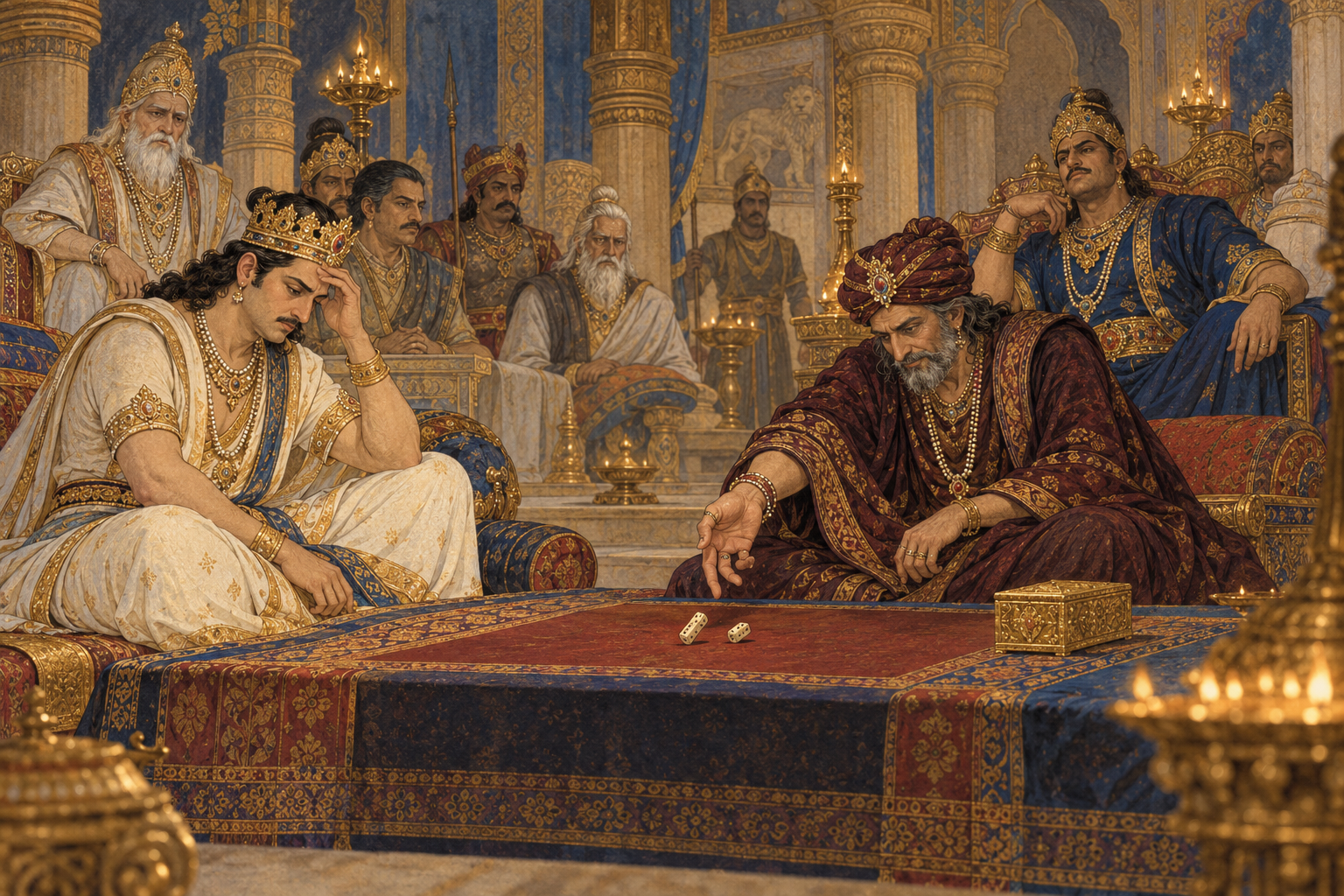
Who was lost first?
The messenger reports the sequence of stakes. Draupadī asks whether Yudhiṣṭhira lost himself before he purported to stake her; the question is repeated before the assembly.
Reference: Sabha Parva, Section LXVI — Draupadī and the messenger. Kisari Mohan Ganguli, English translation (1883–1896).
English translation — selected passage
'When he had nothing else to stake, it was then that Ajatasatru, the son of Pandu, staked you. The king had first staked his brothers, then himself, and then you, O princess.'
"Draupadi said,—
'O son of the Suta race, go, and ask that gambler present in the assembly, whom he has lost first, himself, or me. Ascertaining this, come hither, and then take me with you, O son of the Suta race.'
Vaisampayana continued,—"The messenger coming back to the assembly told all present the words of Draupadi. And he spoke unto Yudhishthira sitting in the midst of the kings, these words,—
Draupadi has asked you, Whose lord were you at the time you lost me in play? Didst you lose thyself first or me?
Yudhishthira, however sat there like one demented and deprived of reason and gave no answer good or ill to the Suta.
Read the complete cited section →
Public-domain translation; selected passage, not the complete section. Wording follows the linked online witness.
The answer is disputed, not supplied by the messenger
Later in the same section, Bhīṣma says he cannot decide the issue, setting competing claims beside one another. Draupadī disputes the idea that Yudhiṣṭhira played voluntarily and calls on the elders to decide. The narrative also describes coercion against her and the assembly’s silence.
Draupadī challenges the description of consent
Draupadī replies after Bhīṣma’s statement of uncertainty. These are her words within the dialogue.
Reference: Sabha Parva, Section LXVI — Draupadī’s reply to Bhīṣma. Kisari Mohan Ganguli, English translation (1883–1896).
English translation — selected passage
"The king was summoned to this assembly and though possessing no skill at dice, he was made to play with skilful, wicked, deceitful and desperate gamblers.
How can he be said then to have staked voluntarily?
The chief of the Pandavas was deprived of his senses by wretches of deceitful conduct and unholy instincts, acting together, and then vanquished. He could not understand their tricks, but he has now done so.
Here, in this assembly, there are Kurus who are the lords of both their sons and their daughters-in-law! Let all of them, reflecting well upon my words, duly decide the point that I have put.
Read the complete cited section →
Public-domain translation; selected passage, not the complete section. Wording follows the linked online witness.
Handbook reading guidance: distinguish the sequence of the stakes, the claim of voluntary participation and the failure of those present to answer. None is answered merely by repeating that a game occurred.
Why does the order of the stakes matter to Draupadī’s question?
Answer: The messenger says Yudhiṣṭhira staked himself before her. She challenges what authority he possessed at the later moment; the selection records his failure to answer.
This section discusses humiliation and coercion. The historical claims about control over a wife are disputed within this scene and are not offered as household instructions.
The Yakṣa dialogue: answering and choosing
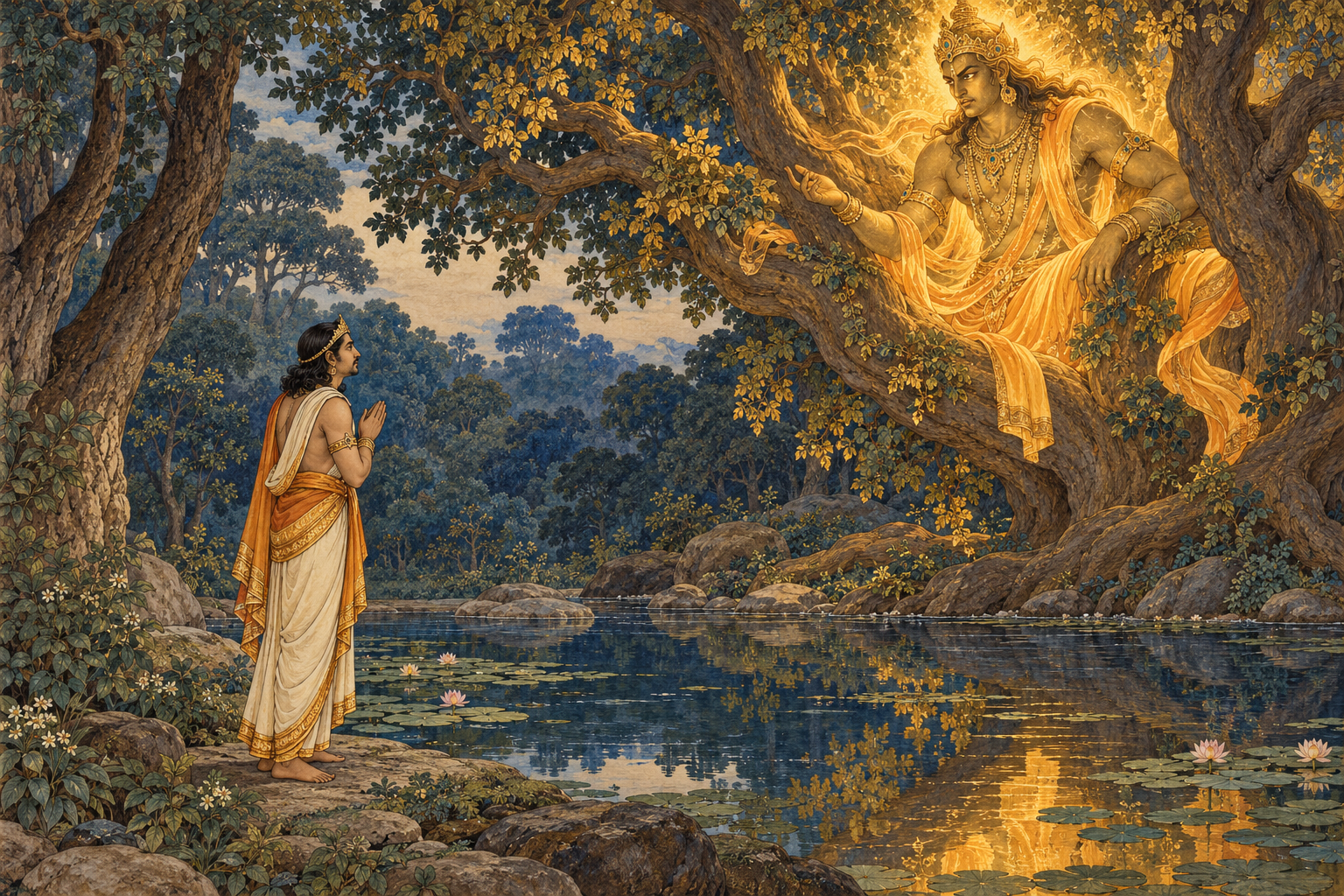
Near the end of the forest book, Yudhiṣṭhira finds his brothers lying unresponsive and answers questions from a Yakṣa before taking water. The exchange contains many questions; the two selections below focus on mortality, uncertainty and his choice of a brother.
Questions about happiness, wonder, the path and time
The Yakṣa questions Yudhiṣṭhira. The response moves from everyday circumstances to mortality, differing authorities and an image of time cooking creatures.
Reference: Vana Parva, Section CCCXI — four questions and answers. Kisari Mohan Ganguli, English translation (1883–1896).
English translation — selected passage
'Who is truly happy? What is most wonderful? What is the path? And what is the news? Answer these four questions of mine and let your dead brothers revive.'
Yudhishthira answered,—
'O amphibious creature, a man who cooks in his own house, on the fifth or the sixth part of the day, with scanty vegetables, but who is not in debt and who stirs not from home, is truly happy. Day after day countless creatures are going to the abode of Yama, yet those that remain behind believe themselves to be immortal.
What can be more wonderful than this? Argument leads to no certain conclusion, the Srutis are different from one another; there is not even one Rishi whose opinion can be accepted by all; the truth about religion and duty is hid in caves: therefore, that alone is the path along which the great have trod.
This world full of ignorance is like a pan. The sun is fire, the days and nights are fuel. The months and the seasons constitute the wooden ladle. Time is the cook that is cooking all creatures in that pan (with such aids); this is the news.'
Read the complete cited section →
Public-domain translation; selected passage, not the complete section. Wording follows the linked online witness.
Handbook reading guidance: notice that the question about “the path” appears beside questions about happiness, wonder and news. Preserve that sequence rather than treating one line as an isolated explanation of all dharma.
Why Yudhiṣṭhira asks for Nakula
Offered the restoration of one brother, Yudhiṣṭhira chooses Nakula. The Yakṣa asks why he does not choose Bhīma or Arjuna; Yudhiṣṭhira explains his concern for both mothers.
Reference: Vana Parva, Section CCCXI — Yudhiṣṭhira’s choice. Kisari Mohan Ganguli, English translation (1883–1896).
English translation — selected passage
'Let this one that is of darkish hue, whose eyes are red, who is tall like a large Sala tree, whose chest is broad and arms long, let this Nakula, O Yaksha, get up with life!'
The Yaksha rejoined,-
'This Bhimasena is dear unto you, and this Arjuna also is one upon whom all of you depend! Why, then, O king dost you, wish a step-brother to get up with his life! How canst you, forsaking Bhima whose strength is equal to that of ten thousand elephants, wish Nakula to live? People said that this Bhima was dear to you. From what motive then dost you wish a step-brother to revive? Forsaking Arjuna the might of whose arm is worshipped by all the sons of Pandu, why dost you wish Nakula to revive?'
Yudhishthira said,—
'If virtue is sacrificed, he that sacrifices it, is himself lost. So virtue also cherishes the cherisher. Therefore taking care that virtue by being sacrificed may not sacrifice us, I never forsake virtue. Abstention from injury is the highest virtue, and is, I ween, even higher than the highest object of attainment. I endeavour to practise that virtue. Therefore, let Nakula, O Yaksha, revive! Let men know that the king is always virtuous!
I will never depart from my duty. Let Nakula, therefore, revive! My father had two wives, Kunti and Madri. Let both of them have children. This is what I wish. As Kunti is to me, so also is Madri. There is no difference between them in my eye. I desire to act equally towards my mothers. Therefore, let Nakula live?'
The Yaksha said,—
’since abstention from injury is regarded by you as higher than both profit and pleasure, therefore, let all your brothers live, O bull of Bharata race!"
Read the complete cited section →
Public-domain translation; selected passage, not the complete section. Wording follows the linked online witness.
Handbook reading guidance: the choice is explained through Kuntī and Mādrī, rather than only through the military strength of the brothers. The dialogue then reports that all the brothers may live.
What reason does Yudhiṣṭhira give for choosing Nakula?
Answer: He wants both Kuntī and Mādrī to have surviving children and says that he wishes to act equally toward both mothers. Read his stated reason before supplying a motive of your own.
Counsel, negotiation and Karṇa’s allegiance
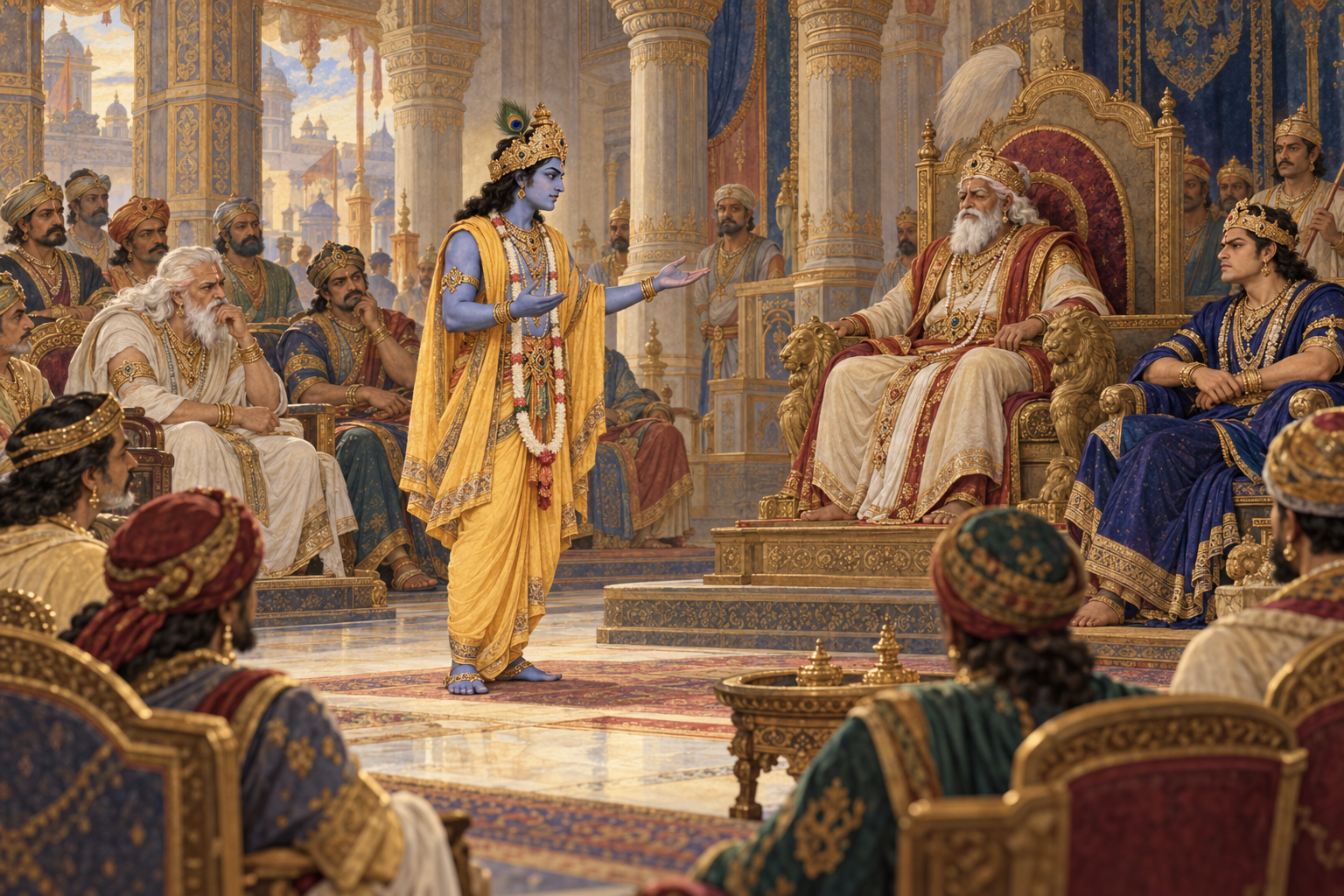
Udyoga Parva, Section CXXVIII — Kṛṣṇa addresses the assembly
Kṛṣṇa responds to Duryodhana in the Kuru assembly. This paraphrase retains the disagreement and the failure of the appeal.
English reading — attributed handbook paraphrase. Kisari Mohan Ganguli, English translation (1883–1896).
Kṛṣṇa recalls the dice match and the wrongs against the Pāṇḍavas, challenges Duryodhana’s claim that he has done no wrong, and says peace benefits both him and Yudhiṣṭhira. Duryodhana then leaves the court angrily, followed by his supporters. Kṛṣṇa addresses those remaining and urges that Duryodhana be restrained so peace can still be made. This episode portrays an unsuccessful appeal and a further proposal, not an agreement ending the dispute.
Read the complete cited section →
Handbook paraphrase of the identified public-domain translation; not an exact quotation.
Vidura addresses a worried king
Dhṛtarāṣṭra calls Vidura after Sañjaya’s return and asks for beneficial counsel. The setting matters: this is advice delivered to a king facing the consequences of the conflict, not a list without an audience.
Listening, judgment and perseverance
Vidura speaks to Dhṛtarāṣṭra. These consecutive statements describe qualities of a wise person.
Reference: Udyoga Parva, Section XXXIII — Vidura’s account of wisdom. Kisari Mohan Ganguli, English translation (1883–1896).
English translation — selected passage
He that understands quickly, listens patiently, pursues his objects with judgment and not from desire and spends not his breath on the affairs of others without being asked, is said to possess the foremost mark of wisdom.
They that do not strive for objects that are unattainable, that do not grieve for what is lost and gone, that do not suffer their minds to be clouded amid calamities, are regarded to possess intellects endued with wisdom.
He who strives, having commenced anything, till it is completed, who never wastes his time, and who has his soul under control, is regarded wise.
Read the complete cited section →
Public-domain translation; selected passage, not the complete section. Wording follows the linked online witness.
Yudhiṣṭhira explains his peace request
The request for five places to live
After Sañjaya’s departure, Yudhiṣṭhira asks Kṛṣṇa for help. This selected paragraph describes a proposed settlement and his report of its rejection.
Reference: Udyoga Parva, Section LXXII — Yudhiṣṭhira addresses Kṛṣṇa. Kisari Mohan Ganguli, English translation (1883–1896).
English translation — selected passage
Abiding by counsels of Suyodhana, the king, O Janardana, actuated by avarice and seeking his own good, behaves untruthfully towards us. What can be more sorrowful, O Janardana, than this, that I am unable to maintain my mother and my friends? Having the Kasis, the Pancalas, the Chedis, and the Matsyas, for my allies and with you, O slayer of Madhu, for my protector, I prayed for only five villages, etc., Avishthala, Vrikasthala, Makandi, Varanavata, with any other, O Govinda, as the fifth;—Grant us, we said, five villages or towns, O sire, where we five may dwell in union, for we do not desire the destruction of the Bharatas.—The wicked-minded son of Dhritarashtra, however, regarding the lordship of the world to be; in him, does not agree to even that. What can be more sorrowful than this?
Read the complete cited section →
Public-domain translation; selected passage, not the complete section. Wording follows the linked online witness.
Handbook reading guidance: distinguish an envoy’s mission, a proposed settlement and its reception. The epic’s outline records Kṛṣṇa’s journey for peace and Duryodhana’s rejection of his embassy. The decision to fight follows this attempted negotiation.
Kuntī’s revelation and Karṇa’s reply
Kuntī identifies herself as Karṇa’s mother
Karṇa first names Rādhā and Adhiratha as his parents. Kuntī then reveals his birth and urges a different allegiance in the remainder of the section.
Reference: Udyoga Parva, Section CXLV — Kuntī and Karṇa. Kisari Mohan Ganguli, English translation (1883–1896).
English translation — selected passage
"Karna said,
'I am Karna, son of Radha and Adhiratha. For what, O lady, hast you come here? Tell me what I am to do for you?'
"Kunti said,
'You are Kunti’s son, and not Radha’s. Nor is Adhiratha your father. You, O Karna, art not born in the Suta order. Believe what I say. You were brought forth by me while a maiden. I held you first in my womb. O son, you were born in the palace of Kuntiraja. O Karna, that divine Surya who blazes forth in light and makes everything visible, O foremost of all wielders of weapons, begat you upon me.
Read the complete cited section →
Public-domain translation; selected passage, not the complete section. Wording follows the linked online witness.
Why Karṇa does not change sides
Karṇa responds to Kuntī’s appeal. These selected paragraphs give his grievance, concern about abandoning friendship and limited pledge regarding her sons; intervening argument is omitted.
Reference: Udyoga Parva, Section CXLVI — Karṇa replies to Kuntī. Kisari Mohan Ganguli, English translation (1883–1896).
English translation — selected passage
'O Kshatriya lady, I cannot admit what you have said, viz., that obedience to your commands constitutes (in my case) the highest of my duties. O mother, I was abandoned by you as soon as I was born. This great injury, involving risk to life itself, that you didst me, has been destructive of my achievements and fame. If, indeed, I am a Kshatriya, I have, for you, been deprived of all the rites of a Kshatriya. What enemy would have done me a greater injury? Without showing me mercy, when you should have shown it, and having kept me divested of all the rites (that are obligatory in consequence of the order of my birth), you wouldst however, lay your command on me today! You had never before sought my good as a mother should. You addressest me today, however, desiring to do good to thyself.
Who is there that would not be afraid of Dhananjaya having Krishna with him (for the driver of his car)? If, therefore, I go today unto the Parthas, who is there that would not regard me as doing so from fright? Hitherto, nobody knew me to be their brother. If, giving out on the eve of battle that I am their brother, I go to the Pandavas, what would all the Kshatriyas say? Furnished with every object of desire, and worshipped by them with a view to make me happy, how can I render that friendship of Dhritarashtra’s sons utterly futile?
For the sake of Dhritarashtra’s son, I shall fight against your sons to the best of my strength and might. I must not, however, abandon kindness and the conduct that becomes the good. Your words, therefore, however beneficial cannot be obeyed by me now. This your solicitation to me will not yet be fruitless. Except Arjuna, your other sons, Yudhishthira, Bhima, and the twins, though capable of being withstood by me in tight and capable also of being slain, shall not yet be slain by me. It is with Arjuna alone, among all the combatants of Yudhishthira, that I will fight. Slaying Arjuna in battle, I shall achieve great merit, or slain by Savyasachin, I shall be covered with glory. O famous lady, the number of your sons will never be less than five. Five it will always be,—either with me, or with Arjuna, and myself slain.'
Read the complete cited section →
Public-domain translation; selected passage, not the complete section. Wording follows the linked online witness.
Handbook reading guidance: Karṇa acknowledges neither a simple change of identity nor an unrestricted refusal. He speaks about abandonment, reputation and prior obligations, then makes a pledge concerning four sons while retaining the conflict with Arjuna. Read the scope of that pledge carefully.
Does Karṇa promise to avoid fighting every Pāṇḍava?
Answer: No. He pledges not to kill the other four while preserving his intended encounter with Arjuna. Kuntī asks him to remember the pledge.
The account records what each character claims. It does not establish that gratitude cancels responsibility for other acts, including Karṇa’s conduct in the dice hall.
The Bhagavad Gītā within the epic
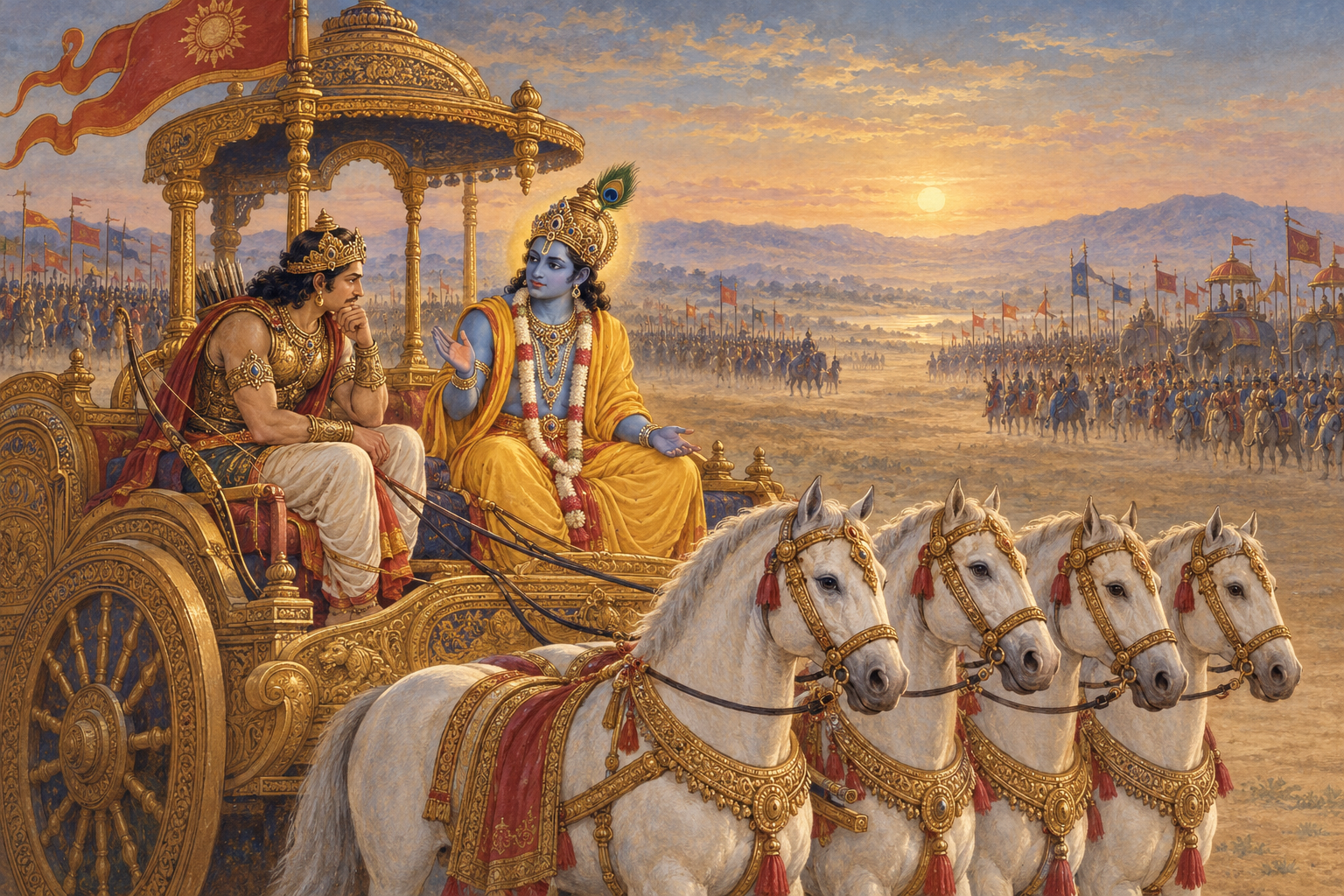
The Bhagavad Gītā is a dialogue within the Bhīṣma Parva. Ganguli places its second chapter in Section XXVI. Sañjaya reports Arjuna’s exchange with Kṛṣṇa between the two armies. It can be studied as a focused teaching text while its battlefield circumstances remain visible.
Arjuna turns from argument to a request for instruction
Arjuna speaks about Bhīṣma, Droṇa and the relatives before him, then asks Kṛṣṇa to identify what is good for him.
Reference: Bhīṣma Parva, Section XXVI — Bhagavad Gītā chapter 2, Arjuna’s opening speech. Kisari Mohan Ganguli, English translation (1883–1896).
English translation — selected passage
"How, O slayer of Madhu, can I with arrows contend in battle against Bhishma and Drona, deserving as they are. O slayer of foes, of worship? Without slaying (one’s) preceptors of great glory, it is well (for one), to live on even alms in this world. By slaying preceptors, even if they are avaricious of wealth, I should only enjoy pleasures that are bloodstained! We know not which of the two is of greater moment to us, viz., whether we should conquer them or they should conquer us. By slaying whom we would not like to live,—even they, the sons of Dhritarashtra, stand before (us). My nature affected by the taint of compassion, my mind unsettled about (my) duty, I ask you. Tell me what is assuredly good (for me). I am your disciple. O, instruct me, I seek your aid. I do not see (that) which would dispel that grief of mine blasting my very senses, even if I obtain a prosperous kingdom on earth without a foe or the very sovereignty of the gods.'"
Read the complete cited section →
Public-domain translation; selected passage, not the complete section. Wording follows the linked online witness.
Handbook reading guidance: identify the change within Arjuna’s speech: reasons against the action before him lead to an admission that his understanding of duty is unsettled and a request to be taught. This opening request is not the whole of Kṛṣṇa’s response.
The dedicated Bhagavad Gītā guide provides further on-page readings in its own named translation. Keep that translator distinct from Ganguli when moving between the two guides. Do not join sentences from different translations and present the result as one quotation.
Who reports this conversation, and who asks for teaching?
Answer: Sañjaya reports it; Arjuna asks Kṛṣṇa for instruction. Keep the reporting voice and the participants in the dialogue separate.
The war: a reading map beyond the famous duels
The Parva-saṅgraha describes an eighteen-day encounter. It assigns the first ten days and Bhīṣma’s fall to the Bhīṣma book, then follows the commanders Droṇa, Karṇa and Śalya. This sequence is a useful map; it is not a substitute for the individual battlefield accounts.
- Bhīṣma: the Gītā precedes the continuing battle narrative; Arjuna places Śikhaṇḍin before him when he brings Bhīṣma down. Bhīṣma’s later teaching requires remembering that his fall is not his immediate death.
- Droṇa: the outline brings together Abhimanyu’s death while unsupported against many warriors, Arjuna’s response concerning Jayadratha, Ghaṭotkaca’s death and the fall of Droṇa. Track the sequence of losses rather than treating every encounter as independent.
- Karṇa: the book follows his command through his death in the encounter with Arjuna. Return to his earlier conversation with Kuntī when considering what the reader already knows about the brothers.
- Śalya: Yudhiṣṭhira kills Śalya, Sahadeva kills Śakuni, and Bhīma’s mace encounter with Duryodhana follows. The conclusion of the principal battle does not protect those asleep in the camp afterward.
Source: the English outline above and Ādi Parva, Section II, books 6–10.
Keep a battle-reading record
Optional handbook method: record who gives an order, who carries it out, what the narrator reports and what a character says about it afterward. If you want to discuss whether a tactic violates an agreement, bring the stated agreement and the relevant scene together first. A famous duel’s name alone does not supply that evidence.
The book map links the full battle indexes for sustained reading. The close readings in this guide do not attempt to decide every disputed weapon, promise or tactic.
After victory: grief, protection and instruction
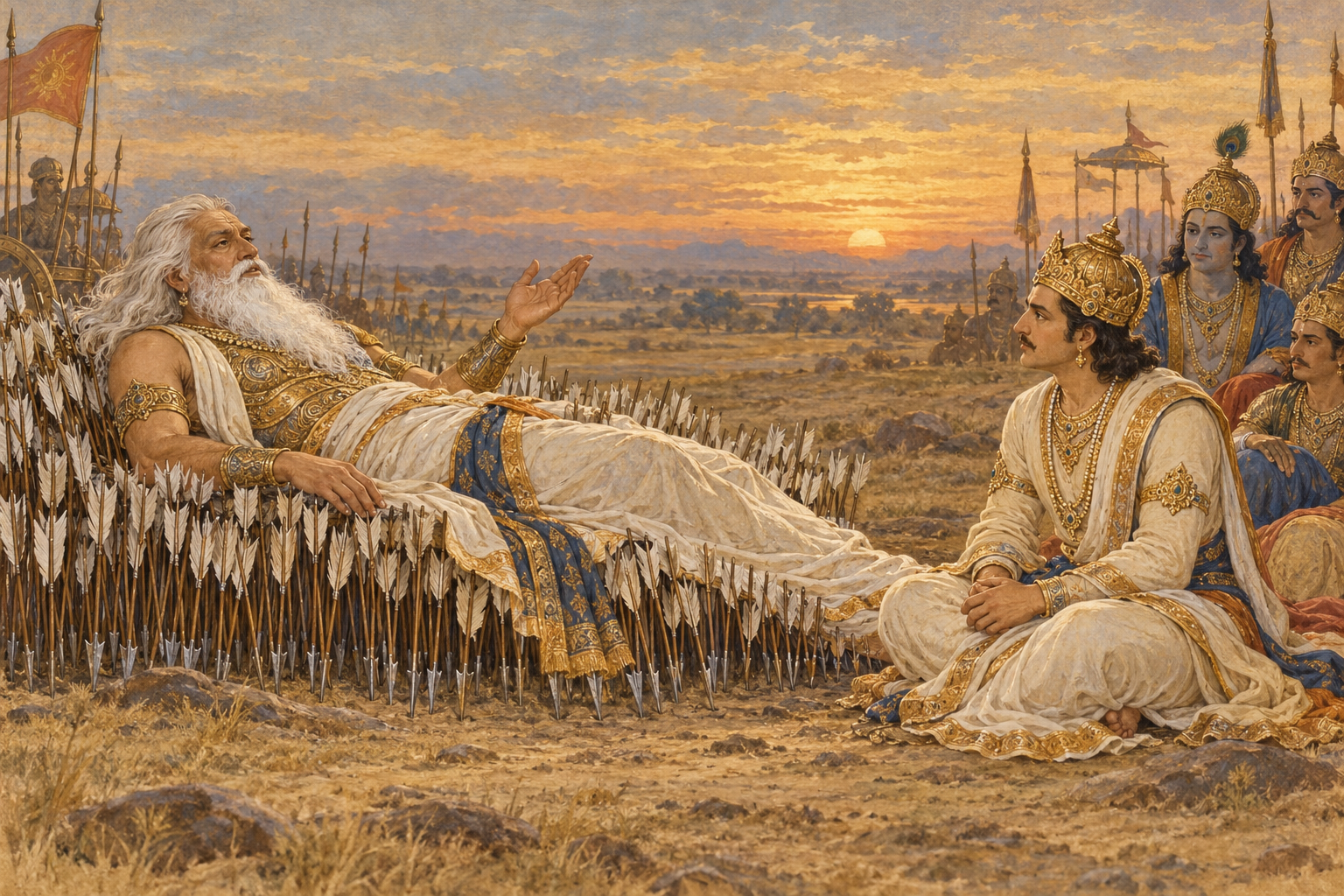
Why the books after the battle matter
This paraphrase follows the epic’s own opening account of its later books.
Reference: Ādi Parva, Section II — outline of Strī, Śānti and Anuśāsana. Kisari Mohan Ganguli, English translation (1883–1896).
English reading — attributed handbook paraphrase
Sauti’s outline of the Strī Parva describes the royal women going to the battlefield, their lamentations over sons, brothers and fathers, funeral rites, and Kuntī’s acknowledgment that Karṇa was her son. The Śānti outline begins with Yudhiṣṭhira’s despondency after killing relatives. Bhīṣma, still on his bed of arrows, then expounds duties of kings, duties in emergencies and final emancipation. Further instruction on conduct, gifts and duties follows in Anuśāsana, together with Bhīṣma’s ascent to heaven.
Read the complete cited section →
Handbook paraphrase of the identified public-domain translation; not an exact quotation.
The instructor on the bed of arrows
The same Bhīṣma who could not decide Draupadī’s question in the hall now teaches the surviving king. Keep both appearances in view. The fact that a character gives instruction later does not remove the earlier scene from the narrative.
Bhīṣma on the ruler’s duty to protect
The paraphrase keeps the speech’s protective aims and its coercive political means visible together.
Reference: Śānti Parva, Section LVIII — Bhīṣma addresses Yudhiṣṭhira. Kisari Mohan Ganguli, English translation (1883–1896).
English reading — attributed handbook paraphrase
In Ganguli’s translation of this section, Bhīṣma makes protection central to kingly duty. He includes paying servants their due, collecting taxes considerately, avoiding arbitrary seizures, appointing honest officials, seeking the people’s good and repairing unsafe buildings. The same speech also discusses spies, punishment, deception and political force, and says the ruler must use both candour and crookedness. These are elements of Bhīṣma’s counsel in this setting, rather than a modern administrative code.
Read the complete cited section →
Handbook paraphrase of the identified public-domain translation; not an exact quotation.
Handbook reading guidance: note the audience, the circumstances after war and the range of duties described. The Śānti book’s subjects extend beyond rulership: the opening outline explicitly includes emergency duties and liberation. Anuśāsana continues the teaching rather than simply repeating the battle.
Is the Mahābhārata finished when Duryodhana falls?
Answer: No. The night attack, mourning, Bhīṣma’s instruction, the horse sacrifice, elders’ retirement, Vṛṣṇi destruction and the final journey all follow in the book map.
Stories within the story: Nala and Sāvitrī
The forest book contains narratives told to the exiles. Read these with two settings in mind: the events inside the tale and the circumstances of the listeners outside it. The epic’s outline identifies Nala’s story in connection with Yudhiṣṭhira’s distress and his encounter with Bṛhadaśva.
Nala and Damayantī: another royal story
A gathering for Damayantī’s choice
Within Bṛhadaśva’s narrative, Nārada tells Indra why the kings are gathering in Vidarbha. The Bhīma named as Damayantī’s father here is not the Pāṇḍava Bhīma.
Reference: Vana Parva, Section LIV — Bṛhadaśva’s account of Damayantī’s svayaṃvara. Kisari Mohan Ganguli, English translation (1883–1896).
English translation — selected passage
'Listen, O Mahavat, why seest not you the kings (now)? The ruler of the Vidarbhas has a daughter—the celebrated Damayanti. In beauty she transcends all the women of the earth. Her Swayamvara, O Sakra, will take place shortly. Thither are going all the kings and Princes from all directions. And all the lords of the earth desire to have that pearl of the earth,—desire to have her eagerly, O slaver of Vala and Vritra.'
Read the complete cited section →
Public-domain translation; selected passage, not the complete section. Wording follows the linked online witness.
Handbook reading guidance: this brief selection establishes the new family, the royal gathering and another layer of narration. Continue through the linked section and its following chapters to follow the tale. Do not assume that every person sharing a familiar name is the same character in the outer narrative.
Sāvitrī and Satyavān: a sustained dialogue
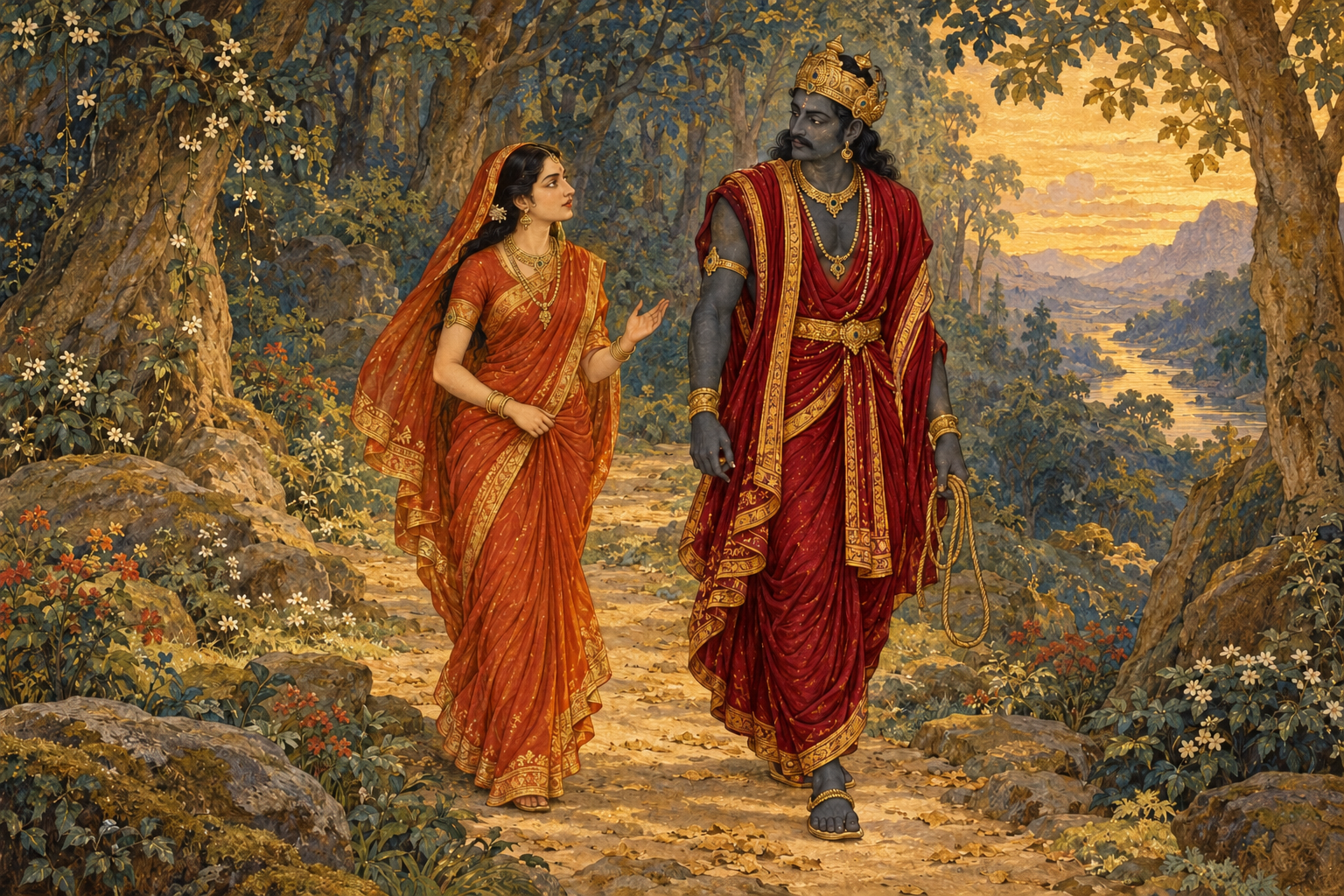
Mārkaṇḍeya’s account follows Sāvitrī as she continues after Yama with Satyavān. Yama offers boons while initially excluding her husband’s life. The selected exchange below comes late in their dialogue.
Sāvitrī asks that Yama’s promise be made true
Sāvitrī first asks for descendants through herself and Satyavān. Later she points to the dependence of that promised boon on her husband’s restoration. Intervening praise and further dialogue are omitted.
Reference: Vana Parva, Section CCLXLV — Sāvitrī’s appeal to Yama. Kisari Mohan Ganguli, English translation (1883–1896).
English translation — selected passage
'Both of me and Satyavan’s loins, begotten by both of us, let there be a century of sons possessed of strength and prowess and capable of perpetuating our race! Even this is the fourth boon that I would beg of you!'
'O bestower of honours, the boon you have already given me is incapable of accomplishment without union with my husband. Therefore, among other boons, I ask for this, may this Satyavan be restored to life! Deprived of my husband, I am as one dead! Without my husband, I do not wish for happiness.
Without my husband, I do not wish for heaven itself. Without my husband, I do not wish for prosperity. Without my husband, I cannot make up my mind to live! You thyself hast bestowed on me the boon, namely, of a century of sons; yet you takest away my husband!
I ask for this boon,
'May Satyavan be restored to life, for by that your words will be made true.'"
Read the complete cited section →
Public-domain translation; selected passage, not the complete section. Wording follows the linked online witness.
The narrative then reports Yama freeing Satyavān and Sāvitrī returning to him. In the linked online witness this section is titled CCLXLV; its unusually written Roman numeral is retained here so readers can locate that exact witness.
Handbook reading guidance: follow the sequence of request, promise and renewed appeal. Her actual words supply more to study than a summary that says only that love won.
What earlier promise does Sāvitrī invoke in her final appeal?
Answer: She recalls the boon of descendants through herself and Satyavān and argues that it cannot be fulfilled without her husband. Check the paired selections above.
These embedded narratives are selected starting points, not complete reproductions of both tales. Their chapter links provide the surrounding account.
The final journey and the dog
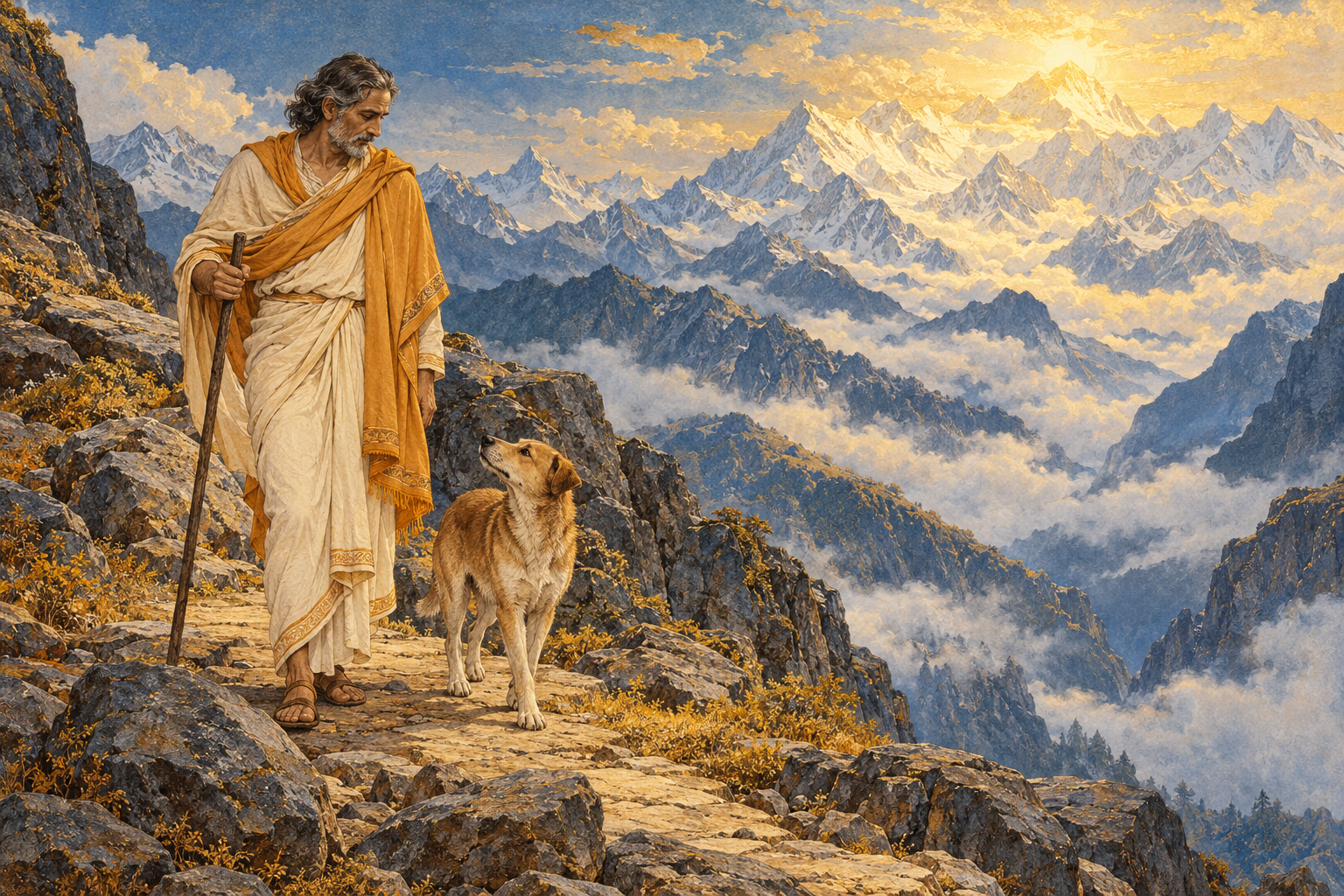
Yudhiṣṭhira’s refusal to abandon a dependent
This paraphrase follows Ganguli’s dialogue and reported revelation. The scene explicitly recalls the Yakṣa episode.
Reference: Mahāprasthānika Parva, Section 3 — Yudhiṣṭhira, Indra and Dharma. Kisari Mohan Ganguli, English translation (1883–1896).
English reading — attributed handbook paraphrase
Indra invites Yudhiṣṭhira to ascend but tells him to leave the dog behind. Yudhiṣṭhira refuses to gain happiness by abandoning one devoted to him. When Indra compares this with leaving his fallen family, Yudhiṣṭhira distinguishes those who have died, whom he could not revive, from a living dependent. The narrator then reports the dog’s transformation into Dharma. Dharma praises his compassion and recalls his earlier choice of Nakula in the forest.
Read the complete cited section →
Handbook paraphrase of the identified public-domain translation; not an exact quotation.
Handbook reading guidance: return to the choice of Nakula and identify the connection made by Dharma himself. The comparison is present in this passage, rather than added only by a modern reader.
The Svargārohaṇika Parva continues after this encounter with further testing and reunion. The dog episode is a major point in the final journey, but it is not the last page of the epic.
What earlier choice is recalled in the dog episode?
Answer: Dharma recalls Yudhiṣṭhira’s wish to revive Nakula out of concern for his stepmother. Both episodes are available in English on this page.
Three ways to continue reading
These are optional handbook study paths. Each begins with the story’s frame and returns to an available source instead of requiring a purchased book to follow this guide.
A first encounter with the epic
- Read the story arc and character guide.
- Read the opening exchange; identify composer, reciter and listener.
- Choose Draupadī’s question and Yudhiṣṭhira’s choice of Nakula.
- Read Arjuna’s request, then the postwar account.
- Read the final test and check how it recalls the forest episode.
A study of voices and difficult choices
- Read Ekalavya’s scene and mark the narrator’s descriptions.
- Read both of Draupadī’s selections, keeping her question separate from the assembly’s response.
- Read Vidura, Yudhiṣṭhira’s peace request and both sides of the Kuntī–Karṇa exchange.
- Compare the Yakṣa episode, Sāvitrī’s argument and the dog episode using their exact passages.
A sustained reading of the whole epic
Use the eighteen-book map in order. For each sitting, record book, section, speaker, setting and one question that the next passage might answer. Allow room for the embedded narratives and the long teaching books. Keep the translator’s preface and notes distinct from the narrative. Return to a brief outline after finishing a book, then revise that outline from what you actually read.
On a later day, recall the participants in one scene before reopening the selection. This is a suggested review method; no learning result is claimed.
Translations, retellings and section numbers
This guide uses Kisari Mohan Ganguli’s English translation, published in 1883–1896. Wisdom Library supplies the online text witness linked beside each passage; it is the access host, not the translator. The historical English and the website’s spellings sometimes differ from contemporary editions.
Full translation: retains the long narrative and teaching material. Abridgment or retelling: selects and reshapes material. Commentary: explains or interprets it. Name which kind of work you are using before comparing claims.
Use book and section together: “Section XXXIII” by itself is not an adequate reference because multiple books contain that label. If another edition uses chapter and verse numbers, match the scene, speakers and wording before assuming that equal numbers identify the same passage. This page does not claim that Ganguli’s section numbers match a Sanskrit critical edition.
Selected English passages follow the cited online witness, with its paragraph order retained. Where nonconsecutive paragraphs are selected, the adjacent context says so. Paraphrases are labeled and remain separate from quotations. No Sanskrit reading is required to follow these lessons.
A traditional narrative of events is not, on its own, an independently verified date for those events. This guide does not assign a precise historical date to the war.
Questions to test your understanding
How many major books does this reading map contain?
Answer: Eighteen. The titles run from Ādi to Svargārohaṇika. The eighteen-day battle is a separate measure of the narrative’s time.
Is the Gītā outside the Mahābhārata?
Answer: In this edition it is within the Bhīṣma Parva. The selected chapter-2 speech appears in Ganguli’s Section XXVI.
Why is a single verdict on a character often inadequate?
Answer: The guide shows characters in more than one scene: Bhīṣma in the hall and as later instructor, Karṇa in the hall and speaking to Kuntī, and Yudhiṣṭhira at dice and in the Yakṣa encounter. Support a claim with the particular episode rather than replacing those different actions with one label.
Does a character’s speech automatically state the narrator’s conclusion?
Answer: No. First identify the speaker and any reply, objection or subsequent consequence. Draupadī’s challenge and Karṇa’s response are examples of arguments within a conversation.
Why are Nala and Sāvitrī included in a guide to the main epic?
Answer: Their narratives occur within the forest book. They are stories heard within the wider story, not unrelated works added to this page.
How can I check a claim from a screen adaptation or family retelling?
Answer: Record the claimed episode, identify the version, and locate the corresponding scene in your named translation. Describe differences without assuming that the adaptation’s invented dialogue is a quotation from the epic.
Is this the complete translated Mahābhārata?
Answer: It is a substantial study guide with a whole-epic map and selected on-page readings. The eighteen book indexes lead to the full translated text. It does not reproduce every section or claim that every interpretive dispute is settled.
Related readings in the handbook
Continue with the Bhagavad Gītā for a focused teaching dialogue, Dharma for further attributed readings on duty, or the Rāmāyaṇa guide to compare the opening of another epic. Each guide identifies its own translation. Return to scriptures and texts to choose another source.
Sources, scope and review
Primary translated authority: Kisari Mohan Ganguli, The Mahābhārata of Kṛṣṇa-Dvaipāyana Vyāsa, English translation (1883–1896). This guide uses identified translated passages and separately labeled handbook paraphrases and study guidance. Traditional composition is attributed to Vyāsa in the preserved opening exchange.
Open the full translation’s book index → · Project Gutenberg, volume 1, books 1–3 →
Exact citations and links appear beside each reading. The eighteen-book map follows Ādi Parva, Section II; the close readings use Ādi CXXXIV, Sabha LXVI, Vana CCCXI, LIV and CCLXLV, Udyoga XXXIII, LXXII, CXLV and CXLVI, Bhīṣma XXVI, Śānti LVIII and Mahāprasthānika Section 3.
Scope: a whole-epic orientation and selected study readings, with full-text links for further depth. It does not replace the complete translation, supply a verse-by-verse commentary, reconcile every recension or establish historical dates. Source links and attributions do not imply that a scholar or teacher has approved this guide.
Sources consulted October 10, 2026. Specialist factual, translation and interpretive review remains pending.