Epic study • Story, dialogue and retelling
Rāmāyaṇa traditions
Explore the Rāmāyaṇa’s story, characters and seven-book map, with on-page readings on Sītā, Bharata, Hanumān, refuge and the differences between translation and retelling.
Reading in smaller steps? Choose a study path for Sītā’s voice, messengers, family disagreement, the aftermath or homecoming. Each uses passages available on this page.
Begin with the story or a passage
The Rāmāyaṇa follows Rāma, Sītā and their companions through royal expectations, forest exile, abduction, an alliance, war and return. Its conversations matter as much as its sequence of events. A decision that sounds simple in an outline may involve an argument, a competing obligation or a painful consequence in the actual scene.
Learning goal: place a scene within the story, identify its speakers and explain their reasoning from an available reading.
- First visit: use the story arc, character guide and book map.
- Close reading: choose Sītā’s decision, Bharata’s appeal, Hanumān’s message or Rāma’s pledge of refuge.
- Comparing tellings: read the postwar exchange before the comparison with Vivekananda’s retelling.
Major outcomes appear below. English readings stay visible, while the existing Sanskrit selection and answer feedback open when you choose them.
The story arc: departure, search and return
A named retelling of the central story
This is a modern lecture’s narrative overview, not a translation of Vālmīki’s verses. Its distinctive details are considered separately below.
Reference: Swami Vivekananda, “The Ramayana”, lecture delivered January 31, 1900 — central narrative. Swami Vivekananda; Complete Works, volume 4, Lectures and Discourses; Ramakrishna/Vedānta perspective.
English reading — attributed handbook paraphrase
Vivekananda recounts Rāma’s marriage to Sītā, his intended succession and Kaikeyī’s demand that Bharata receive the kingdom while Rāma goes into exile. Sītā and Lakṣmaṇa accompany Rāma. Rāvaṇa abducts Sītā; the search brings an alliance with Sugrīva and the service of Hanumān, who reaches her in Laṅkā. The allies cross to Laṅkā, Rāvaṇa dies in battle and Vibhīṣaṇa becomes king. Rāma returns to Ayodhyā, where Bharata has held the kingdom for him. The lecture continues beyond this return to later separation and the story of the twins.
Handbook paraphrase of the identified reading, not the translator’s exact wording. Complete chapter linked; specialist review pending.
Before the exile
The opening movement connects a royal family, education, encounters with sages and Rāma’s marriage. Do not begin with the abduction alone: the relationships established before it explain why departure, separation and return matter to the characters.
The forest is more than a waiting period
The story changes setting and brings its protagonists into new relationships. The opening source reading below names Lakṣmaṇa and Sītā as companions. Sītā’s own argument makes that companionship a decision she voices, rather than a background fact supplied only by the narrator.
The search depends on other people
The central action broadens from a royal household to an alliance. Hanumān’s meeting with Sītā supplies information the searchers lack; the ring helps establish who sent him. Vibhīṣaṇa’s arrival raises another problem: whether to receive someone connected to the opposing side.
Victory does not end every question
The reunion in the translated Yuddha Kāṇḍa includes Rāma’s harsh words and Sītā’s reply. The later ending retold by Vivekananda introduces further separation. Keep those stages distinct when saying where your chosen edition or adaptation ends.
Handbook orientation: these reading prompts connect the attributed overview with the translated scenes reproduced below. They are not additional verses of the epic.
Continue with Śabarī’s welcome and the onward search for the full learning sequence.
Characters and relationships
This guide uses diacritics, while the linked translation often prints Rama, Seetha, Lakshmana, Hanuma and Vibhishana. Match the person and scene rather than treating a spelling difference as a different character.
Rāma
Son of Daśaratha; Sītā’s husband; brother of Bharata, Lakṣmaṇa and Śatrughna. The opening presents him through the qualities Nārada attributes to him.
Sītā
Associated with Janaka’s household. She argues to accompany Rāma, questions Hanumān in captivity and answers Rāma after the war. Read those speeches alongside descriptions of her.
Lakṣmaṇa
Rāma’s brother and companion in exile. His presence is named in the opening selection; he also appears in the difficult postwar scene.
Bharata and Śatrughna
Rāma’s other brothers. Bharata appeals for Rāma’s return and accepts the sandals as a sign of the kingship he holds for him. Śatrughna is present at their farewell.
Daśaratha and Kaikeyī
The king and one of his queens. The succession and exile turn on the demands made through the king’s promise. Rāma invokes his father’s vow when replying to Bharata.
Janaka
Sītā’s father in the royal household of Mithilā. Vivekananda’s retelling explains her association with the earth and her adoption by Janaka.
Hanumān
Sugrīva’s ally and Rāma’s messenger to Sītā. The Sundara reading concerns identification, trust, questions and information, not strength alone.
Sugrīva and Vāli
Brothers in the vānaras’ royal conflict. Sugrīva becomes Rāma’s ally; Vivekananda’s narrative describes Rāma’s intervention in their struggle. A full assessment requires that episode’s complete dialogue.
Rāvaṇa and Vibhīṣaṇa
Brothers on opposing paths in the war. Rāvaṇa holds Sītā in Laṅkā; Vibhīṣaṇa seeks Rāma’s refuge and later becomes king in the retelling.
Vālmīki and Nārada
The questioning and answering voices in the opening. Traditional composition is associated with Vālmīki; he is also a character within the narrative frame.
Lava and Kuśa
The twins in the later story retold by Vivekananda. His account places their upbringing and recitation in Vālmīki’s hermitage. This guide does not supply a translated Uttara Kāṇḍa.
Source basis: the opening passage, the named lecture overview and the close readings on this page. These short descriptions are orientation, not complete biographies or a ranking of devotion.
A map of the seven kāṇḍas
A kāṇḍa is a major book; a sarga is a chapter within it. The map is a conventional seven-book orientation. The English labels explain the reading focus rather than translating every title literally.
| Book | Reading focus |
|---|---|
| 1. Bāla Kāṇḍa Beginnings | The opening dialogue, the princes’ early life and Rāma’s marriage. |
| 2. Ayodhyā Kāṇḍa Departure from the kingdom | The succession crisis, exile and Bharata’s appeal. |
| 3. Araṇya Kāṇḍa The forest | Forest encounters and Sītā’s abduction. |
| 4. Kiṣkindhā Kāṇḍa The alliance | Sugrīva, Vāli and preparations for the search. |
| 5. Sundara Kāṇḍa The mission to Laṅkā | Hanumān’s journey, meeting with Sītā and return with news. |
| 6. Yuddha Kāṇḍa War and return | The campaign, Rāvaṇa’s fall, the postwar reunion and return. |
| 7. Uttara Kāṇḍa The later narrative | Later events including separation and the twins; not included in the six-book translation site used here. |
Open the translation site’s six book indexes → The site credits Desiraju Hanumanta Rao for Bāla, Araṇya and Kiṣkindhā, and K. M. K. Murthy for Ayodhyā, Sundara and Yuddha. An author credit for one book does not automatically apply to another.
Coverage gap: this guide offers the later ending through Vivekananda’s identified retelling, not an on-page Uttara Kāṇḍa translation. Its account must not be cited as Vālmīki’s exact wording or used to establish the textual history of that book.
The opening source passage
Begin with Vālmīki’s question and Nārada’s answer. The existing attributed paraphrase, provisional editorial English and optional original selection remain together below.
Vālmīki Rāmāyaṇa, Bāla Kāṇḍa 1.1.1–4, 8–9, 24–29
The original lines, the English paraphrase, and the website’s explanatory notes are separate layers. Original verse numbers are retained. Verse 28 is grouped with 29 in the original display: the group also names the journey to the Gaṅgā and Guha. The original line for 1.1.3 is not transcribed on the accessed opening page.
Reference: Desiraju Hanumanta Rao; ValmikiRamayan.net verse translation and notes. Check the cited passage or chapter →
English translation of the original passage shown · provisional handbook rendering
English source: Handbook editorial translation — provisional; Direct English rendering of the identified original text; specialist review pending. Check the English source →
Provisional handbook translation from the identified original. It has not been independently reviewed by a Sanskrit specialist and is not attributed to a guru or scholar. Square brackets mark supplied context.
1.1.1. Vālmīki, the ascetic, questioned Nārada, foremost among sages and masters of speech, devoted to austerity and sacred study.
1.1.2. “Who in the present world is endowed with virtues and valor, knows dharma, is grateful, speaks truth and is firm in his vows?”
1.1.4. “Who is self-possessed, has conquered anger, is radiant and free from envy? Of whom are even the gods afraid when his anger rises in battle?”
1.1.8. Born in the Ikṣvāku line, he is known among people as Rāma: self-controlled, of great valor, radiant, steadfast and master of himself.
1.1.9. Intelligent, wise in conduct, eloquent, fortunate and a destroyer of enemies; broad-shouldered, mighty-armed, with a conch-shaped neck and a great jaw.
1.1.24. That hero went to the forest, keeping his promise, in obedience to his father’s command and for Kaikeyī’s satisfaction.
1.1.25. His dear brother Lakṣmaṇa followed him out of love, endowed with humility and increasing Sumitrā’s joy.
1.1.26. The brother showed brotherly affection toward the brother he loved. Rāma’s beloved wife was always as dear and beneficial to him as his own life.
1.1.27. Born in Janaka’s family, seemingly fashioned by divine power, endowed with every auspicious mark, she was the foremost bride among women.
1.1.28. Sītā too followed Rāma, as Rohiṇī follows the Moon. He was followed a long way by the townspeople and his father Daśaratha.
1.1.29. At Śṛṅgaverapura, on the bank of the Gaṅgā, he dismissed the charioteer after meeting his dear friend Guha, lord of the Niṣādas. Rāma, devoted to dharma, was with Guha, Lakṣmaṇa and Sītā.
English meaning · handbook paraphrase of the cited Indian translation
1–4: Vālmīki asks Nārada who possesses exemplary qualities: courage, knowledge of duty, gratitude, truthfulness, firm resolve, good conduct, care for beings, learning, capability, self-control, and freedom from envy.
8–9: Nārada names Rāma of Ikṣvāku’s lineage and begins describing him.
24–28: The introductory summary turns to the promised boons, Rāma’s departure for the forest, and Lakṣmaṇa and Sītā accompanying him. These selected lines support the character-list exercise; the rest of the sarga is optional further reading.
Selected ancient Sanskrit lines in the source’s transliteration system, preserved as printed. The accessed opening chapter omits its original line for 1.1.3; that verse is covered by the attributed paraphrase. English is an attributed handbook paraphrase of the named translation, not that translator’s full wording.
Read the original Sanskrit
Original Sanskrit · source transliteration
tapaH svaadhyaaya nirataam tapasvii vaagvidaam varam | naaradam paripapracCha vaalmiikiH muni puMgavam || 1-1-1
kaH nu asmin saaMpratam loke guNavaan kaH ca viiryavaan | dharmaj~naH ca kR^itaj~naH ca satya vaakyo dhR^iDha vrataH || 1-1-2
aatmavaan ko jitakrodho dyutimaan kaH anasuuyakaH | kasya bibhyati devaaH ca jaata roShasya saMyuge || 1-1-4
ikShvaaku vaMsha prabhavo raamo naama janaiH shrutaH | niyata aatmaa mahaaviiryo dyutimaan dhR^itimaan vashii || 1-1-8
buddhimaan niitimaan vaa~Ngmii shriimaan shatru nibarhaNaH | vipulaaMso mahaabaahuH kaMbu griivo mahaahanuH || 1-1-9
sa jagaama vanam viiraH pratij~naam anupaalayan | pitur vacana nirdeshaat kaikeyyaaH priya kaaraNaat || 1-1-24
taM vrajantaM priyo bhraataa lakShmaNaH anujagaama ha | snehaat vinaya saMpannaH sumitra aanaMda vardhanaH || 1-1-25 bhraataram dayito bhraatuH saubhraatram anu darshayan |
raamasya dayitaa bhaaryaa nityam praaNa samaa hitaa || 1-1-26 janakasya kule jaataa deva maayeva nir.hmitaa | sarva lakShaNa saMpannaa naariiNaam uttamaa vadhuuH || 1-1-27 siitaapya anugataa raamam shashinam rohiNii yathaa |
pauraiH anugato duuram pitraa dasharathena ca || 1-1-28 shR^ingibera pure suutam gaMgaa kuule vyasarjayat | guham aasaadya dharmaatmaa niShaada adhipatim priyam || 1-1-29 guheana sahito raamo lakshmaNena cha siitayaa |
Read the opening as a question and answer
Vālmīki asks about a person combining qualities; Nārada identifies Rāma and begins an account of his life. Notice the movement from a question about character to a narrative. The opening does not begin with a list of events without a speaker.
- Identify the questioner and respondent.
- Choose two qualities from the visible opening English.
- Find where Nārada names Rāma.
- Read the departure selection and identify Rāma’s companions.
Who names Rāma in the opening dialogue?
Answer: Nārada, answering Vālmīki’s question. The passage distinguishes the person asking from the person describing Rāma.
Does the departure selection place Rāma alone in the forest?
Answer: No. It names Lakṣmaṇa and Sītā accompanying him. Sītā’s own argument is available in the next reading.
Handbook guidance: describe what the opening asserts before deciding how a later scene confirms, complicates or develops it. Keep your inference separate from the translated or paraphrased words.
How the poem begins: compassion, composition and listening
Learning goal: distinguish the story’s events from the frame that presents its composition and performance. Identify the poet, divine commissioner, teachers, performers and listeners without combining their roles.
Reading path: begin with Vālmīki’s question and Nārada’s answer, then read these selections from Bāla Kāṇḍa 2 and 4. Chapter 3 lies between them; this path is a selection, not the complete opening sequence.
A lament prompts a metrical utterance
Selected river scene and reflection; the verse itself is summarized, not quoted.
Reference: Bāla Kāṇḍa, Sarga 2 — selected narrative. Desiraju Hanumanta Rao; ValmikiRamayan.net English prose translation, Sanskrit Documents mirror; narrative separated from explanatory commentary and alternative translations.
English reading — attributed handbook paraphrase
After Nārada departs, Vālmīki goes to the Tamasā with his disciple Bharadvāja. A hunter kills the male of a krauñca bird pair, and the surviving bird laments. Moved by compassion, Vālmīki condemns the killing. He then reflects that his utterance has an ordered, musical form. The chapter connects the moment of sorrow with the verse’s emergence.
Handbook paraphrase of the identified translation, not its exact wording. Complete chapter linked; specialist review pending.
Does the poem’s origin scene begin at Rāma’s court?
Answer: No. This selection takes place at the river with Vālmīki and his disciple.
Brahmā commissions the account
Selected encounter at the hermitage; assurances are presented as Brahmā’s speech.
Reference: Bāla Kāṇḍa, Sarga 2 — selected narrative. Desiraju Hanumanta Rao; ValmikiRamayan.net English prose translation, Sanskrit Documents mirror; narrative separated from explanatory commentary and alternative translations.
English reading — attributed handbook paraphrase
Back at the hermitage, Vālmīki remains absorbed in the utterance. Brahmā appears and tells him to compose Rāma’s story as heard from Nārada, including events involving Lakṣmaṇa, Sītā and the rākṣasas. He promises that matters not yet known will become known and that the account will endure. The disciples repeat the verse, and Vālmīki undertakes the composition.
Handbook paraphrase of the identified translation, not its exact wording. Complete chapter linked; specialist review pending.
How should Brahmā’s assurances be labeled?
Answer: As statements within the epic’s divine commissioning scene. They are not an independent modern historical verification of every episode.
Lava and Kuśa learn and perform the poem
Selected teaching and performance before sages; the intervening composition chapter is not reproduced.
Reference: Bāla Kāṇḍa, Sarga 4 — selected narrative. Desiraju Hanumanta Rao; ValmikiRamayan.net English prose translation, Sanskrit Documents mirror; narrative separated from explanatory commentary and alternative translations.
English reading — attributed handbook paraphrase
Vālmīki considers who will perform the poem and teaches it to Lava and Kuśa, who live in the hermitage. They memorize it and sing with careful attention to its meaning and musical delivery. Before an assembly of sages, their performance wins praise, gifts and blessings. The chapter presents transmission through teaching, learning and an audience’s response.
Handbook paraphrase of the identified translation, not its exact wording. Complete chapter linked; specialist review pending.
Is transmission portrayed as merely handing over a manuscript?
Answer: No. The account includes teaching, memorization, musical performance and listeners responding.
Rāma becomes a listener to the story
Selected movement from public performance to the royal gathering.
Reference: Bāla Kāṇḍa, Sarga 4 — selected narrative. Desiraju Hanumanta Rao; ValmikiRamayan.net English prose translation, Sanskrit Documents mirror; narrative separated from explanatory commentary and alternative translations.
English reading — attributed handbook paraphrase
Rāma encounters the singers and brings them to the palace, honoring them. With his brothers and ministers gathered, he asks that their meaningful song be heard attentively. Lava and Kuśa perform, and Rāma listens. The chapter’s presentation includes the story of Sītā alongside Rāma’s life and the defeat of Rāvaṇa.
Handbook paraphrase of the identified translation, not its exact wording. Complete chapter linked; specialist review pending.
Is Rāma only a character spoken about in this frame?
Answer: No. In this opening frame he also becomes a listener to the performance.
Two timelines to keep apart
| Timeline | Reading task |
|---|---|
| Events being recounted | Use the story arc to locate exile, search, war and return. |
| Telling and hearing the account | Follow the commissioning, teaching and performance scenes supplied here. |
Handbook reading guidance: a frame can appear near the beginning of a text while referring to a later stage of the story it introduces. Do not assume that the order of presentation is identical to the order of every event. Use the speaker and setting to orient each reading.
Does “first poem” establish an archaeological date?
This section follows the epic’s own origin account. It does not establish a date for the composition, prove the absence of earlier poetry or settle questions about the text’s formation.
Are the linked pages’ explanations all part of the translated narrative?
No. The linked edition interleaves narrative, additional explanations and, in places, alternative renderings. These selections summarize the identified narrative and keep those other layers separate. Do not attribute an explanatory note to a character in the story.
Connect this frame to a later report: compare Hanumān telling Bharata about earlier events. Both readings require attention to who tells a story and who hears it; their settings and purposes differ.
Continue: the journey with Viśvāmitra. Keep the composition frame available as context while following the episodes.
Optional review: identify one speaker, one performer and one listener from these readings, then state which scene each belongs to. Check the passages before adding your own interpretation.
With Viśvāmitra: service, trust and instruction
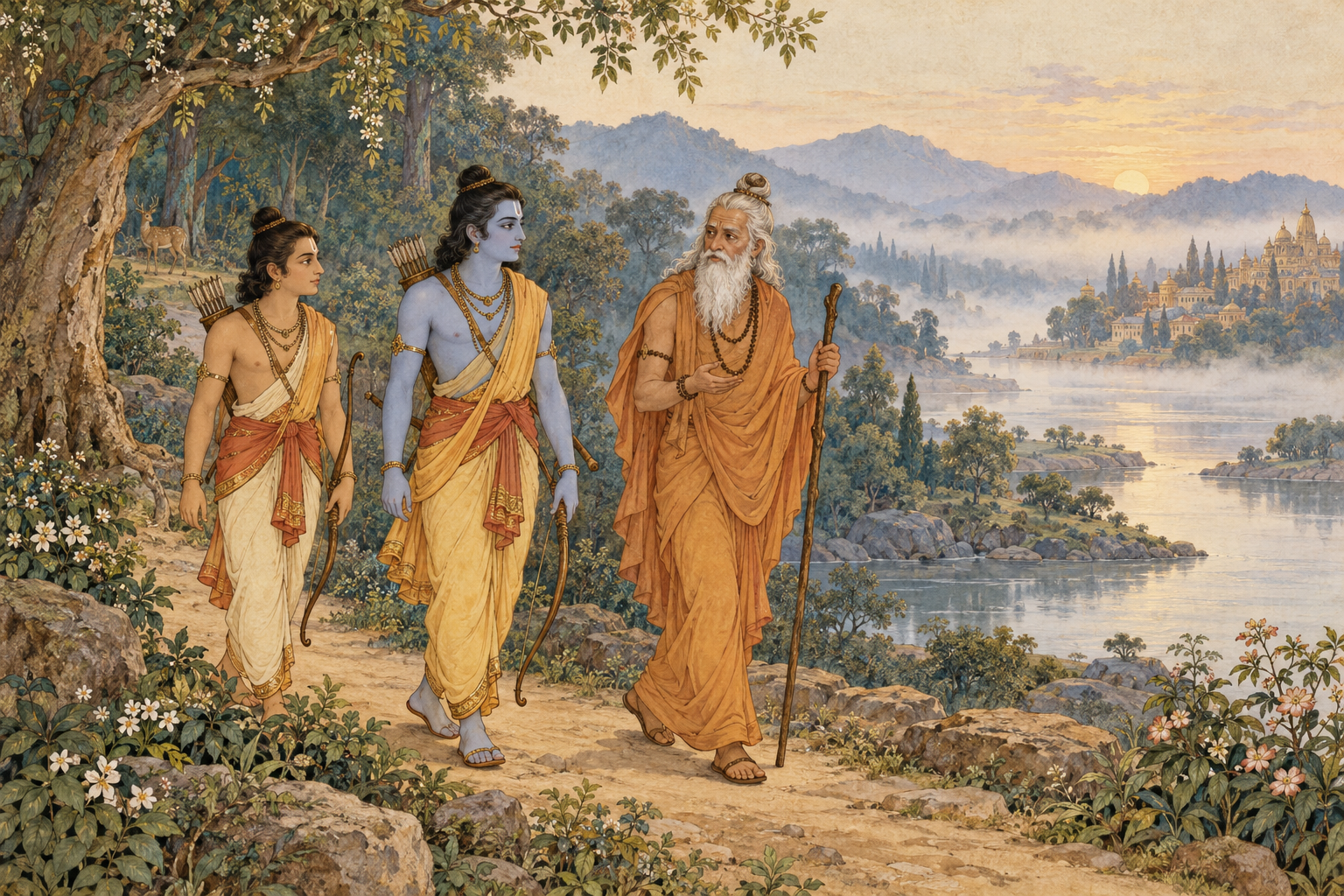
Reading goal: follow the sage’s request and the beginning of the journey. Distinguish the king’s initial distress from his later decision to entrust the brothers to the sage.
Viśvāmitra asks for Rāma’s help
The sage addresses Daśaratha at his court.
Reference: Bāla Kāṇḍa, Sarga 19 — selected narrative. Desiraju Hanumanta Rao; ValmikiRamayan.net English prose translation, Sanskrit Documents mirror; narrative distinguished from accompanying commentary.
English reading — attributed handbook paraphrase
Viśvāmitra says Mārīca and Subāhu repeatedly disrupt his sacrificial undertaking. His vow prevents him from answering them with an angry curse. He asks Daśaratha to send Rāma for ten days, assures him of Rāma’s capacity and promises protection and benefits. He also invokes the judgment of Vasiṣṭha and the other sages and asks for their assent. Daśaratha is shaken by the request.
Handbook paraphrase of the identified translation, not its exact wording. Complete chapter linked; specialist review pending.
Handbook reading guidance: The request combines a particular need, assurance and consultation. This chapter ends with the king distressed; it has not yet settled his response.
What work does Viśvāmitra ask Rāma to do?
Answer: Protect the ritual from the two disruptors, Mārīca and Subāhu.
The journey begins with instruction
This follows the king’s response and Vasiṣṭha’s counsel in the intervening chapters.
Reference: Bāla Kāṇḍa, Sarga 22 — selected narrative. Desiraju Hanumanta Rao; ValmikiRamayan.net English prose translation, Sanskrit Documents mirror; narrative distinguished from accompanying commentary.
English reading — attributed handbook paraphrase
Daśaratha sends Rāma and Lakṣmaṇa with Viśvāmitra after blessings from the parents and Vasiṣṭha. The brothers follow the sage with their bows. At the Sarayū, Viśvāmitra addresses Rāma and teaches Bala and Atibala, describing protection from exhaustion, hunger, thirst and hostile attack. Rāma receives the teachings and performs his duties toward the teacher. The three spend the night beside the river.
Handbook paraphrase of the identified translation, not its exact wording. Complete chapter linked; specialist review pending.
Handbook reading guidance: Notice the named addressee, Rāma. The linked page separately comments that Lakṣmaṇa is included. Keep that explanatory inference distinct from the dialogue. This reading introduces the episode rather than providing a practice instruction.
Where do the three spend this night?
Answer: Beside the Sarayū, after the instruction.
A selected path: these chapters do not reproduce the entire journey or its intervening encounters. The next reading moves ahead to Mithilā, retaining its own chapter reference.
Bhagīratha and Gaṅgā: a task carried across generations
Learning goal: follow an embedded ancestral story, distinguish successive generations’ roles, and explain why a granted request still requires further help and effort.
Reading path: five selections from Bāla Kāṇḍa 40–44. Viśvāmitra is telling Rāma about earlier generations during the journey. Bhagīratha’s story belongs to that narrated past; it is not an event Rāma performs during his exile.
The five panels provide a route from an accusation to a discovery, from an unresolved responsibility to a request, and from the descent to the king’s return. Read them in order before comparing individual moments. Earlier chapters contain the wider setup of Sagara’s sacrifice; these are selected readings, not the complete Gaṅgā account.
Sagara’s sons turn a search into an accusation
Selected conclusion of the search; the preceding horse-sacrifice narrative is outside this selection.
Reference: Bāla Kāṇḍa, Sarga 40 — selected narrative and dialogue. Desiraju Hanumanta Rao; ValmikiRamayan.net English prose translation; translated narrative distinguished from introductory summaries and explanatory commentary.
English reading — attributed handbook paraphrase
Viśvāmitra tells Rāma that Sagara sends his sons to continue searching beneath the earth. In the northeastern direction they encounter Kapila and accuse him of stealing the ritual horse. They rush at him with implements, trees and stones. Kapila responds with a powerful sound, and they become heaps of ashes. The princes’ accusation is their judgment; their angry approach does not itself establish that Kapila stole the horse.
Handbook paraphrase of the identified translation, not its exact wording. Complete chapter linked; specialist review pending.
Does the princes’ accusation establish who took the horse?
Answer: No. The reading reports their accusation and attack. An accusation must remain distinct from an established explanation.
Aṃśumān finds the horse and an unfinished responsibility
Selected search, Garuḍa’s advice and return; read the complete chapter for the intervening encounters.
Reference: Bāla Kāṇḍa, Sarga 41 — selected narrative and dialogue. Desiraju Hanumanta Rao; ValmikiRamayan.net English prose translation; translated narrative distinguished from introductory summaries and explanatory commentary.
English reading — attributed handbook paraphrase
Sagara sends his grandson Aṃśumān along the route taken by the missing princes. He asks respectfully about them, finds their ashes and sees the horse nearby. Grieving, he looks for water for an offering. Garuḍa tells him that Gaṅgā’s waters are needed to bring the departed to heaven. Aṃśumān returns with the horse and reports what happened. Sagara completes the sacrifice, but bringing Gaṅgā to earth remains unresolved.
Handbook paraphrase of the identified translation, not its exact wording. Complete chapter linked; specialist review pending.
Is recovering the horse the same as completing the ancestral task?
Answer: No. The horse returns and the sacrifice is completed, while the task concerning Gaṅgā remains.
Bhagīratha asks for Gaṅgā and the continuation of his family

Selected succession, effort and exchange with Brahmā; introductory summaries and marked commentary are not included.
Reference: Bāla Kāṇḍa, Sarga 42 — selected narrative and dialogue. Desiraju Hanumanta Rao; ValmikiRamayan.net English prose translation; translated narrative distinguished from introductory summaries and explanatory commentary.
English reading — attributed handbook paraphrase
Aṃśumān later entrusts the kingdom to his son Dilīpa and undertakes austerities, but Gaṅgā does not descend. Dilīpa also remains troubled by the unresolved task. His son Bhagīratha becomes king and delegates administration to his ministers while pursuing it. When Brahmā invites a request, Bhagīratha asks that Gaṅgā reach his ancestors’ ashes and that his own dynasty continue through offspring. Brahmā grants the request but explains that Śiva must receive the river’s force because the earth cannot bear her fall.
Handbook paraphrase of the identified translation, not its exact wording. Complete chapter linked; specialist review pending.
Does Brahmā’s response remove every remaining difficulty?
Answer: No. The request is granted, but receiving the river’s force requires Śiva’s help.
Śiva receives the descent; the journey meets another interruption
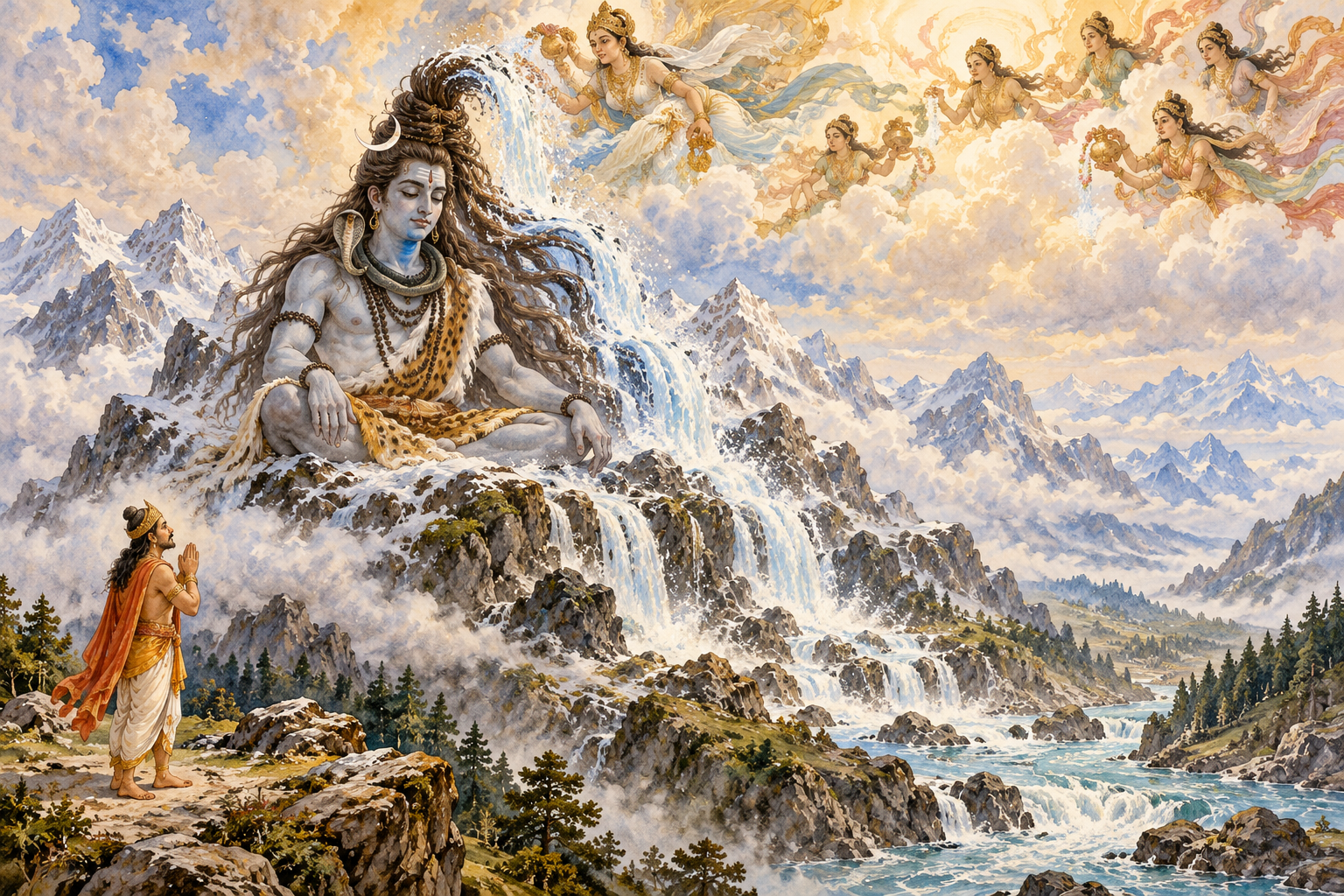
Selected descent narrative; the edition’s modern geographical identifications are separate commentary.
Reference: Bāla Kāṇḍa, Sarga 43 — selected narrative and dialogue. Desiraju Hanumanta Rao; ValmikiRamayan.net English prose translation; translated narrative distinguished from introductory summaries and explanatory commentary.
English reading — attributed handbook paraphrase
Bhagīratha next seeks Śiva’s help. Śiva agrees to receive Gaṅgā, but when she intends to sweep him along, he contains her in his matted hair. Bhagīratha renews his effort, and Śiva releases her toward Bindu Lake. Seven streams emerge; one follows Bhagīratha’s chariot. When it floods Jahnu’s ritual ground, the sage drinks the water. The gods and sages appeal to him, and he releases Gaṅgā, who is thereafter called Jāhnavī. She resumes following Bhagīratha, reaches the ocean and the netherworld, and washes over the ancestors’ ashes; the narrative says they attain heaven.
Handbook paraphrase of the identified translation, not its exact wording. Complete chapter linked; specialist review pending.
Does the river reach the ancestors immediately after Śiva first agrees?
Answer: No. Containment, renewed effort, release and Jahnu’s interruption precede the completion of the journey.
Brahmā acknowledges the achievement, and Bhagīratha returns
Selected acknowledgement, offerings and return; the chapter’s subsequent multi-text commentary is outside the selection.
Reference: Bāla Kāṇḍa, Sarga 44 — selected narrative and dialogue. Desiraju Hanumanta Rao; ValmikiRamayan.net English prose translation; translated narrative distinguished from introductory summaries and explanatory commentary.
English reading — attributed handbook paraphrase
Brahmā tells Bhagīratha that Sagara’s sons have reached heaven and praises the task that earlier generations had not completed. He associates the river with Bhagīratha and names her Bhāgīrathī and Tripathagā, describing her connection with three worlds. He directs the king to make water offerings for his ancestors. Bhagīratha performs them, returns to his city and resumes ruling. Viśvāmitra then brings his account of Gaṅgā’s descent to a close for Rāma.
Handbook paraphrase of the identified translation, not its exact wording. Complete chapter linked; specialist review pending.
Where does the account leave Bhagīratha after the offerings?
Answer: He returns to his city and resumes kingship. The episode includes that return as well as the river’s descent.
Keep the generations and the tasks apart
| Person | Role in these selections | Reading |
|---|---|---|
| Sagara | Sends the searchers and receives the returning report | 40 and 41 |
| Aṃśumān | Finds the horse, receives advice and later pursues the task | 41 and 42 |
| Dilīpa | Carries the unresolved concern into the next generation | 42 |
| Bhagīratha | Makes the requests, follows through and returns to rule | 42–44 |
Handbook reading guidance: write a verb beside each name before giving the whole episode a theme. This keeps discovery, advice, effort and completion from becoming one undifferentiated achievement.
Three names encountered along the way
The readings connect Jāhnavī with Jahnu’s release of the river, Bhāgīrathī with Bhagīratha’s achievement, and Tripathagā with three worlds. Follow the accompanying source panels for those narrative explanations. These selections do not establish a modern map of every named river course.
Read the frame as well as the story
Who is speaking to whom in this account?
Answer: Viśvāmitra narrates the ancestral episode to Rāma. Within it, Garuḍa, Brahmā and other figures speak. Keep the narrator of this embedded story distinct from its participants.
Why is Aṃśumān’s role still important if Bhagīratha completes the task?
Answer: His reading supplies a discovery, advice and a report. Use those particular actions when comparing him with Bhagīratha’s later request; completion is not the only action described.
Is the episode a complete instruction for a family’s funeral offerings?
Answer: No. It narrates particular ancestors, divine encounters and a king’s offerings. For contemporary preparation, see the funeral guide and discuss the family’s tradition with a qualified officiant. The narrative’s claim about heavenly attainment is presented as its religious account, not a measured outcome or a medical claim.
Can the linked edition’s endnotes be treated as part of Viśvāmitra’s speech?
Answer: No. The prose pages interleave translated narrative with introductory summaries, marked comments and wider interpretations. Identify the layer being read; the selections above do not adopt the later physiological or geographical comparisons as the epic’s statements.
Compare another multistage undertaking: organizing the search for Sītā and Hanumān’s ocean crossing. Ask what information, help and next action are needed at each stage. Their different settings and religious claims remain distinct.
Optional review: without looking, name the finder of the horse, the giver of advice about Gaṅgā, the king who approaches Brahmā, and the deity who receives the descent. Then check the five panels and explain one interruption that follows the first granted request.
Continue the main journey: Mithilā, the bow and the four marriages. Return to the main story’s order after this account of earlier generations.
Mithilā: the bow and the four marriages
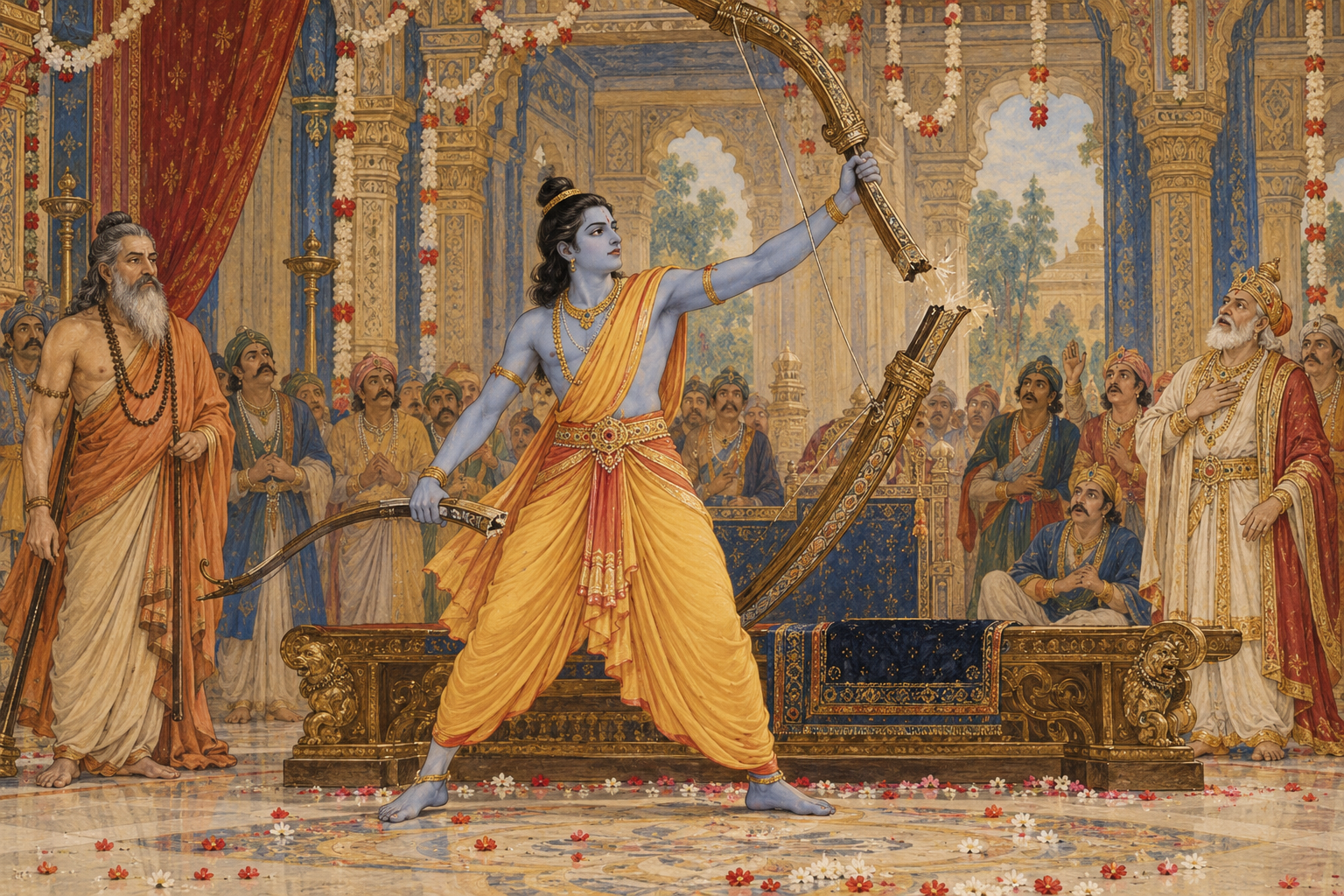
Reading goal: distinguish the bow episode, the family invitation and the marriage ceremony. Identify each couple before following their later roles.
Śiva’s bow and Janaka’s proposal
Many episodes of the journey precede this scene at Mithilā; this selection resumes when the bow is displayed.
Reference: Bāla Kāṇḍa, Sarga 67 — selected narrative. Desiraju Hanumanta Rao; ValmikiRamayan.net English prose translation, Sanskrit Documents mirror; narrative distinguished from accompanying commentary.
English reading — attributed handbook paraphrase
At Viśvāmitra’s request, Janaka has Śiva’s bow brought before the princes. Rāma asks to handle it and receives permission from the sage and king. He strings it and, drawing it, breaks it in the middle with a tremendous sound. Janaka marvels at his strength and says the condition attached to Sītā’s marriage has been fulfilled. With Viśvāmitra’s agreement, he sends messengers to tell Daśaratha and bring him to Mithilā.
Handbook paraphrase of the identified translation, not its exact wording. Complete chapter linked; specialist review pending.
Handbook reading guidance: The feat leads to a proposal and a message to the family. Keep the handling of the bow, Janaka’s response and the later wedding as distinct stages.
Does this chapter already conduct the wedding?
Answer: No. Janaka sends for Daśaratha after the bow episode.
Four marriages at Mithilā
Daśaratha and the wedding party have arrived; this selection concerns the ceremony’s narrative.
Reference: Bāla Kāṇḍa, Sarga 73 — selected narrative. Desiraju Hanumanta Rao; ValmikiRamayan.net English prose translation, Sanskrit Documents mirror; narrative distinguished from accompanying commentary.
English reading — attributed handbook paraphrase
Vasiṣṭha prepares the altar and kindles the fire. Janaka brings Sītā before Rāma, describes her as sharing his duty, and asks him to take her hand. The other pairings are Lakṣmaṇa with Urmilā, Bharata with Māṇḍavī and Śatrughna with Śrutakīrti. The four couples take hands and perform the prescribed rites and circumambulations under Vasiṣṭha’s direction. The narrative describes celestial music and celebration, followed by the families’ departure from the ceremony.
Handbook paraphrase of the identified translation, not its exact wording. Complete chapter linked; specialist review pending.
Handbook reading guidance: Separate this narrative from the extensive interpretive dialogue on the linked page. The four pairings and the shared ceremony matter to the family story. For present-day practices, consult the Vivāha guide and the family’s officiant.
Who marries Urmilā?
Answer: Lakṣmaṇa. Bharata marries Māṇḍavī, and Śatrughna marries Śrutakīrti.
Continue by theme: read the Vivāha guide for an introduction to marriage practices, or Sītā’s argument to share the forest life for a later conversation about companionship. The passages provide different contexts; compare their wording before proposing a connection.
Before the exile: a proposed succession and its reasons
Learning goal: distinguish a proposal, consent and a completed appointment. Identify who gives the reasons for supporting Rāma.
Reading path: two selections from Ayodhyā Kāṇḍa 2. They provide context before the later demands concerning the two boons; the intervening preparations and palace conversations are not reproduced here.
Daśaratha asks the assembly to consider succession
Selected proposal and invitation to deliberation.
Reference: Ayodhyā Kāṇḍa, Sarga 2 — selected narrative and dialogue. K. M. K. Murthy; ValmikiRamayan.net English prose translation, Sanskrit Documents mirror; selected chapter text and speakers distinguished.
English reading — attributed handbook paraphrase
Daśaratha tells the gathering that the burden of rule has wearied him and proposes appointing Rāma as ruling prince. He asks for consent if the proposal is appropriate, while inviting consideration of another beneficial course. The assembled leaders and citizens discuss it and support the appointment. The king then asks why they want Rāma to succeed him while he is still ruling.
Handbook paraphrase of the identified translation, not its exact wording. Complete chapter linked; specialist review pending.
Does this chapter narrate the completed coronation?
Answer: No. It presents a proposal, deliberation and assent. The later reversal and eventual coronation belong to different scenes.
The assembly gives reasons for its support
Selected explanation of support; the full chapter contains a longer catalogue.
Reference: Ayodhyā Kāṇḍa, Sarga 2 — selected narrative and dialogue. K. M. K. Murthy; ValmikiRamayan.net English prose translation, Sanskrit Documents mirror; selected chapter text and speakers distinguished.
English reading — attributed handbook paraphrase
The assembly answers by describing Rāma’s truthfulness, restraint, gratitude, patience, learning and concern for people’s welfare. Its speakers recall his inquiries about households after returning from campaigns and his participation in others’ sorrow and joy. They ask Daśaratha to fulfill their wish for Rāma’s appointment. These are the assembly’s stated reasons in the dialogue.
Handbook paraphrase of the identified translation, not its exact wording. Complete chapter linked; specialist review pending.
Whose assessment is being heard here?
Answer: The assembly’s. Identify its speakers and examples before using its praise as a summary of every later action in the epic.
Handbook reading guidance: compare the assembly’s specific examples with Nārada’s opening description. Both speak about character, but their speakers and circumstances differ. The proposal gives the reversal a context; it is not the eventual coronation.
Should this assembly be called a modern election?
This selection describes deliberation within the epic’s royal setting. It does not establish a modern electoral process or prescribe present-day constitutional arrangements.
Continue: the exile decision and competing duties. Track which earlier expectation is changed.
Optional review: name the proposer, the respondents and two examples they give. Check that your account stops at what this chapter actually settles.
The exile decision: a promise and competing duties
Reading goal: distinguish Kaikeyī’s demand, Rāma’s acceptance and the resistance of Lakṣmaṇa and Kausalyā. Compare the reasons given rather than treating the family as speaking with one voice.
Kaikeyī names the two boons
Rāma arrives for what he expects to be the time of his coronation and finds Daśaratha unable to speak freely.
Reference: Ayodhyā Kāṇḍa, Sarga 18 — selected disclosure. K. M. K. Murthy; ValmikiRamayan.net English prose translation; identified chapter or Sanskrit Documents mirror.
English reading — attributed handbook paraphrase
Rāma asks why his father is distressed. Kaikeyī says the king made a promise he now hesitates to disclose. Before hearing its terms, Rāma promises to fulfil his father’s word. Kaikeyī then recalls two boons granted after she aided Daśaratha in battle: Bharata is to be crowned, and Rāma is to spend fourteen years in the Daṇḍaka forest. She presents his departure as necessary to preserve the king’s truthfulness. Daśaratha is deeply distressed.
Handbook paraphrase of the identified translation, not its exact wording. Complete chapter linked; specialist review pending.
Handbook reading guidance: Follow the order: Rāma commits to his father’s word before Kaikeyī states these demands. Kaikeyī’s appeal to truth is her argument for carrying them out.
What are the two demands?
Answer: Bharata’s coronation and Rāma’s fourteen-year forest exile.
Rāma accepts and asks why his father is silent
This reply follows Kaikeyī’s disclosure.
Reference: Ayodhyā Kāṇḍa, Sarga 19 — selected reply. K. M. K. Murthy; ValmikiRamayan.net English prose translation; identified chapter or Sanskrit Documents mirror.
English reading — attributed handbook paraphrase
Rāma agrees to go to the forest and fulfil the king’s promise. He is pained that Daśaratha has not told him directly about Bharata’s coronation. He asks that Bharata be summoned from his maternal uncle’s home. Kaikeyī presses for an immediate departure, while Daśaratha faints in grief. Rāma says he will first take leave of his mother and speak with Sītā, and asks that Bharata care for their father. He leaves the chamber with Lakṣmaṇa.
Handbook paraphrase of the identified translation, not its exact wording. Complete chapter linked; specialist review pending.
Handbook reading guidance: His acceptance coexists with distress about his father’s silence. Keep the stated commitment, the question and the intended farewells together.
Is Bharata present when these demands are announced?
Answer: No. Rāma asks that messengers bring him from his maternal uncle’s home.
Lakṣmaṇa, Kausalyā and Rāma argue about duty
Kausalyā has learned of the exile and is grieving.
Reference: Ayodhyā Kāṇḍa, Sarga 21 — selected competing arguments. K. M. K. Murthy; ValmikiRamayan.net English prose translation; identified chapter or Sanskrit Documents mirror.
English reading — attributed handbook paraphrase
Lakṣmaṇa questions the justice of sending a blameless Rāma away and urges him to claim the kingdom with armed support. Kausalyā asks Rāma to remain, invoking his obligation to serve his mother as well as his father. Rāma refuses to violate his father’s word, invokes earlier examples of filial obedience and asks Lakṣmaṇa to abandon force. He seeks his mother’s blessing and promises to return after fulfilling the exile. Kausalyā continues to resist the separation.
Handbook paraphrase of the identified translation, not its exact wording. Complete chapter linked; specialist review pending.
Handbook reading guidance: Identify what each speaker treats as binding. The paraphrase selects the debate’s structure; the linked chapter contains stronger threats and Rāma’s troubling examples. A summary should not imply that the disagreement disappears immediately.
What duty does Kausalyā invoke?
Answer: Service to his mother. She argues that she too deserves his reverence and care.
Next: read Sītā’s own argument to accompany Rāma. Her choice belongs to another conversation, not merely to the command announced here.
Sītā argues to accompany Rāma
Companionship as a voiced decision
This chapter preserves Sītā’s argument and Rāma’s continuing objection. The statements about a wife’s duties are part of this character’s speech.
Reference: Ayodhyā Kāṇḍa, Sarga 27. K. M. K. Murthy; ValmikiRamayan.net prose translation, Sanskrit Documents mirror.
English reading — attributed handbook paraphrase
Sītā responds to Rāma’s words by insisting that she will accompany him. She invokes a wife’s share in her husband’s fortune and the conduct she learned from her parents. She offers to walk ahead through the thorns, accepts the forest’s hardships and imagines its rivers, mountains and groves as places they can enjoy together. Separation from him is unacceptable to her. At the chapter’s end, Rāma is still unwilling to take her and continues describing the difficulties of forest life.
Handbook paraphrase of the identified reading, not the translator’s exact wording. Complete chapter linked; specialist review pending.
Handbook reading guidance: distinguish her claim about obligation from her descriptions of shared life. Both belong to her argument. Do not turn the scene into an instruction that every contemporary marriage must follow the same circumstances.
Has Rāma accepted her request by the end of this chapter?
Answer: No. The cited chapter ends with him continuing to describe forest hardships. A summary that concludes “he immediately agrees” loses the ongoing disagreement.
A useful note has three parts: what she requests, the reasons she gives, and what remains unresolved when the chapter ends.
Leaving Ayodhyā: family and public grief
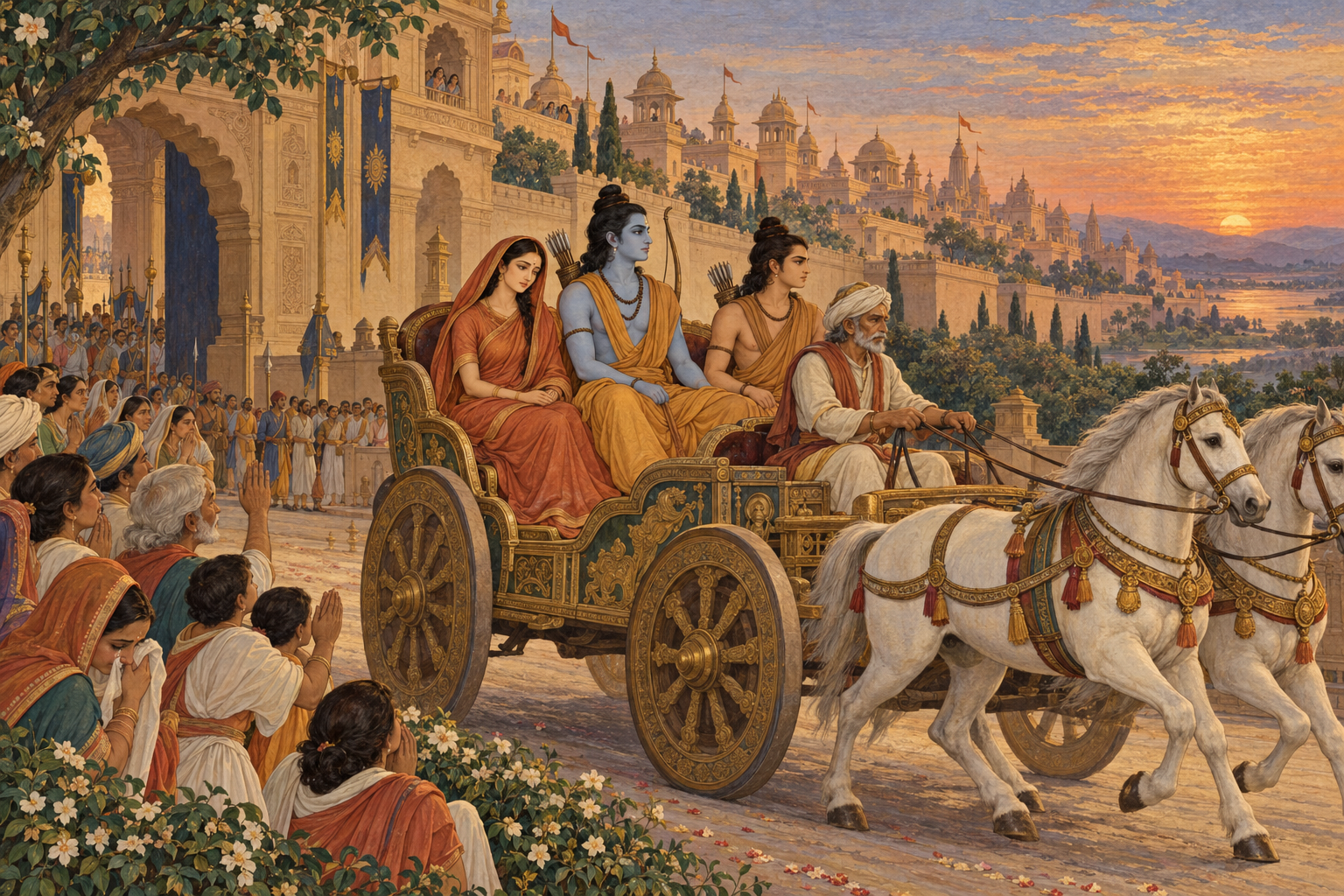
After the decisions about companionship, the departure brings the consequences into view. This selection does not reproduce all the intervening preparations.
The farewell and Sumantra’s conflicting directions
This later chapter follows the decisions and preparations for the three companions to leave.
Reference: Ayodhyā Kāṇḍa, Sarga 40 — selected farewell and departure. K. M. K. Murthy; ValmikiRamayan.net English prose translation; identified chapter or Sanskrit Documents mirror.
English reading — attributed handbook paraphrase
Rāma, Sītā and Lakṣmaṇa take leave of Daśaratha and their mothers. Sumitrā urges Lakṣmaṇa to care for Rāma and regard Sītā as his mother and the forest as Ayodhyā. They mount Sumantra’s chariot. Citizens follow, asking him to slow down so they can see Rāma. Daśaratha and Kausalyā also follow in grief. Rāma urges Sumantra to drive on, saying the prolonged sight of their suffering is unbearable; the king calls for him to stop.
Handbook paraphrase of the identified translation, not its exact wording. Complete chapter linked; specialist review pending.
Handbook reading guidance: The departure is both a family separation and a public event. Sumantra receives incompatible directions from Rāma and Daśaratha. Keep the charioteer’s predicament visible alongside the decision to leave.
Why is Sumantra torn between directions?
Answer: Rāma urges him onward, while Daśaratha and the followers want the chariot to stop or slow.
Connect the absence and return: compare this departure with the later welcome at Nandigrāma. Name the participants, the movement of the vehicle and the expressions of grief or joy in each account. Their differences are visible in the readings.
Bharata comes home: grief, disclosure and a refusal
Learning goal: keep Kaikeyī’s intention, Bharata’s knowledge and Bharata’s later choice distinct. Follow a proposed course of action without assuming it succeeds.
Reading path: selected scenes from Ayodhyā Kāṇḍa 72 and 79, then the later meeting and sandals in Sarga 112. The selections omit intervening chapters; they are not one continuous conversation.
Bharata learns what happened during his absence
Selected news of Daśaratha’s death and the exile; the next chapters develop Bharata’s response.
Reference: Ayodhyā Kāṇḍa, Sarga 72 — selected narrative and dialogue. K. M. K. Murthy; ValmikiRamayan.net English prose translation, Sanskrit Documents mirror; selected chapter text and speakers distinguished.
English reading — attributed handbook paraphrase
Bharata returns and, not finding his father, questions Kaikeyī. She tells him Daśaratha has died, and he grieves. Asking after Rāma, he learns that Rāma, Sītā and Lakṣmaṇa have left for the forest. He asks what caused the exile. Kaikeyī denies the wrongdoing he asks about and explains that she requested the two boons for his benefit, then urges him to accept rule.
Handbook paraphrase of the identified translation, not its exact wording. Complete chapter linked; specialist review pending.
Does Kaikeyī’s stated purpose prove Bharata requested the exile?
Answer: No. In this scene she tells him what she did while he was absent. Her claim that it was for his benefit is not his agreement.
Bharata rejects the offered succession
Selected refusal and preparations to seek Rāma; intervening grief and funeral chapters are not reproduced.
Reference: Ayodhyā Kāṇḍa, Sarga 79 — selected narrative and dialogue. K. M. K. Murthy; ValmikiRamayan.net English prose translation, Sanskrit Documents mirror; selected chapter text and speakers distinguished.
English reading — attributed handbook paraphrase
The king-makers urge Bharata to accept the kingdom, with consecration materials ready. He refuses, arguing that kingship belongs to the eldest in their lineage and that Rāma should rule. He proposes bringing Rāma back and going to the forest himself. He orders preparations for a route and expedition. The assembly welcomes his purpose; the reunion has not yet taken place.
Handbook paraphrase of the identified translation, not its exact wording. Complete chapter linked; specialist review pending.
Is Bharata’s proposed outcome already achieved?
Answer: No. This is his decision and preparation to seek Rāma. The later meeting supplies Rāma’s response.
Whose intention is whose?
| Reading | What to distinguish |
|---|---|
| The disclosure | Kaikeyī’s stated purpose and Bharata’s questions. |
| The refusal | The offered kingdom and Bharata’s proposed alternative. |
| The later meeting | Bharata’s request and Rāma’s answer. |
Handbook reading guidance: being named as the intended beneficiary does not supply a character’s consent. Record what each speaker knows, wants and decides in the actual scene. Bharata’s appeal to their lineage’s succession practice is his argument here, not a universal rule for every Hindu family.
Does rejecting the throne bring Rāma back immediately?
No. The expedition and later discussion remain. Read the meeting before describing the arrangement that follows.
Connect the return: compare Hanumān’s later arrival at Nandigrāma and Bharata’s return of entrusted sovereignty. Keep each stage attached to its reference.
Optional review: complete three separate sentences: “Kaikeyī says she intended ___”; “Bharata learns ___”; “Bharata decides ___.” Check each against the on-page readings.
On the way to Rāma: questions of purpose and care for the hermitage
Learning goal: identify what prompts a question, how Bharata explains his purpose and how the expedition’s presence affects its hosts.
Reading path: continue from Bharata’s refusal in Sarga 79 to selections from Sargas 85, 90 and 91. Intervening travel and grief chapters are omitted; the two hosts’ conversations are separate scenes.
Guha asks about the approaching army
Selected hospitality, route inquiry and explanation of purpose.
Reference: Ayodhyā Kāṇḍa, Sarga 85 — selected narrative and dialogue. K. M. K. Murthy; ValmikiRamayan.net English prose translation, Sanskrit Documents mirror; selected chapter text and speakers distinguished.
English reading — attributed handbook paraphrase
Bharata thanks Guha for offering hospitality to the large army and asks the route to Bharadvāja’s hermitage. Guha offers guides and his own help, but says the army makes him fear an attack on Rāma. Bharata rejects that intention and says he has come to bring his elder brother back. Guha responds joyfully. That evening Bharata rests with Śatrughna, while grief for Rāma remains; Guha offers reassurance.
Handbook paraphrase of the identified translation, not its exact wording. Complete chapter linked; specialist review pending.
What prompts Guha’s question?
Answer: He points to the large army. Bharata answers by stating why he has come.
Bharata approaches with Vasiṣṭha
Selected approach and exchange of welfare inquiries.
Reference: Ayodhyā Kāṇḍa, Sarga 90 — selected narrative and dialogue. K. M. K. Murthy; ValmikiRamayan.net English prose translation, Sanskrit Documents mirror; selected chapter text and speakers distinguished.
English reading — attributed handbook paraphrase
Bharata leaves the army behind, sets aside weapons and ornaments, and approaches on foot with Vasiṣṭha. His ministers remain at a distance. Bharadvāja welcomes them and asks about Ayodhyā, its resources and companions. They ask in turn about the sage, disciples and the hermitage’s trees, animals and birds. Hospitality precedes the question about the expedition’s purpose.
Handbook paraphrase of the identified translation, not its exact wording. Complete chapter linked; specialist review pending.
Does the army enter with Bharata in this opening scene?
Answer: No. He approaches with Vasiṣṭha after leaving it behind.
The sage asks, and then explains his question
Selected purpose inquiry, answer and directions.
Reference: Ayodhyā Kāṇḍa, Sarga 90 — selected narrative and dialogue. K. M. K. Murthy; ValmikiRamayan.net English prose translation, Sanskrit Documents mirror; selected chapter text and speakers distinguished.
English reading — attributed handbook paraphrase
Bharadvāja asks whether Bharata intends harm to Rāma and Lakṣmaṇa. Distressed, Bharata rejects the suggestion, disavows his mother’s action during his absence and says he seeks Rāma’s return. The sage then says he already knew Bharata’s purpose but wanted it confirmed. He directs him toward Citrakūṭa and invites him to stay overnight; Bharata agrees.
Handbook paraphrase of the identified translation, not its exact wording. Complete chapter linked; specialist review pending.
Does Bharadvāja give the same explanation as Guha?
Answer: No. Guha links his concern to the army; Bharadvāja later says he knew the purpose and asked to confirm it. Preserve their separate explanations.
Why the army was kept at a distance
Selected opening dialogue; the chapter’s longer miraculous banquet account is not reproduced here.
Reference: Ayodhyā Kāṇḍa, Sarga 91 — selected narrative and dialogue. K. M. K. Murthy; ValmikiRamayan.net English prose translation, Sanskrit Documents mirror; selected chapter text and speakers distinguished.
English reading — attributed handbook paraphrase
Bharadvāja wishes to feed the army and asks why it was left behind. Bharata explains his concern that the people, horses and elephants might damage trees, huts and ground or pollute the hermitage’s water. After the sage explicitly invites the army, Bharata permits it to come. The rest of the chapter turns to extraordinary hospitality beyond this selected exchange.
Handbook paraphrase of the identified translation, not its exact wording. Complete chapter linked; specialist review pending.
When does Bharata permit the army to enter?
Answer: After Bharadvāja invites it. His earlier concern is about the expedition’s impact on the hermitage.
Compare the questions without merging them
| Scene | Question to retain |
|---|---|
| Guha’s exchange | What does he say causes concern? |
| Bharadvāja’s inquiry | What explanation does he later give for asking? |
| The army’s admission | What concern is stated, and what invitation changes the arrangement? |
Handbook reading guidance: a question is not the same as a finding of guilt. Keep the questioner’s reason, Bharata’s answer and the subsequent response in order. Likewise, distinguish a concern about possible damage from a claim that the damage has already occurred.
Has the meeting with Rāma happened by the end of this path?
No. These selections concern preparation, hosts and directions. Continue to the later meeting and sandals before describing its outcome.
Is the hermitage-care dialogue a complete description of the feast?
No. It is the opening conversation about the army’s arrival. The complete chapter links to a much longer account of miraculous hospitality; this selected path does not supply that whole scene or a present-day ceremony menu.
Compare the later return: read Rāma’s welfare inquiry at Bharadvāja’s hermitage and Hanumān’s mission concerning Guha and Bharata. The same names recur in different situations; keep each scene’s purpose and timing distinct.
Optional review: name the two hosts, the concern stated about the army and the next destination. Check your answers against the readings, then note which questions remain for the meeting itself.
At Citrakūṭa: reunion, bereavement and competing duties
Learning goal: distinguish an emotional reunion from the negotiations that follow. Track who brings the news and how different obligations are argued.
Reading path: continue from the journey and hosts through selections from Sargas 99, 102, 103 and 106. These omit intervening conversations; they are not a transcript of one uninterrupted exchange.
The brothers meet in grief
Selected arrival and embrace; verses 1–6, 25–40 in the linked verse-by-verse edition.
Reference: Ayodhyā Kāṇḍa, Sarga 99 — selected narrative and dialogue. K. M. K. Murthy; ValmikiRamayan.net English translation, Sanskrit Documents mirror; verse-by-verse chapter.
English reading — attributed handbook paraphrase
Bharata stations his forces and approaches with Śatrughna, asking Vasiṣṭha to bring the mothers. Signs along the path lead toward the hermitage. He finds Rāma seated with Sītā and Lakṣmaṇa. Seeing the contrast with royal life, Bharata laments and is overcome. Śatrughna also approaches weeping, and Rāma embraces both brothers with tears.
Handbook paraphrase of the identified translation, not its exact wording. Complete chapter linked; specialist review pending.
Does the embrace settle the succession question?
Answer: No. It is the meeting itself; the news and arguments that follow are separate scenes.
Bharata brings the news of Daśaratha’s death
Selected request to return and disclosure of the death.
Reference: Ayodhyā Kāṇḍa, Sarga 102 — selected narrative and dialogue. K. M. K. Murthy; ValmikiRamayan.net English prose translation, Sanskrit Documents mirror; selected chapter text.
English reading — attributed handbook paraphrase
Bharata invokes their lineage’s practice favoring the elder son and asks Rāma to return and be consecrated. He then reports that Daśaratha died after the departure. He asks Rāma to offer water for their father, explaining that he and Śatrughna have already performed their part. His speech joins a request concerning rule with the family’s bereavement.
Handbook paraphrase of the identified translation, not its exact wording. Complete chapter linked; specialist review pending.
Who supplies the news in this scene?
Answer: Bharata tells Rāma. Keep this disclosure distinct from Bharata himself learning the news from Kaikeyī earlier.
Rāma grieves and makes an offering
Selected response and river scene; the full chapter includes the approaching crowd.
Reference: Ayodhyā Kāṇḍa, Sarga 103 — selected narrative and dialogue. K. M. K. Murthy; ValmikiRamayan.net English prose translation, Sanskrit Documents mirror; selected chapter text.
English reading — attributed handbook paraphrase
Rāma collapses on hearing the news, and his brothers and Sītā attend to him. After recovering, he laments the loss and speaks to Sītā and Lakṣmaṇa. The brothers console him. With Sumantra’s help they go to the Mandākinī, where Rāma offers water and food for Daśaratha. They return to the hut, and Rāma embraces his brothers. Their grief draws the waiting people toward them.
Handbook paraphrase of the identified translation, not its exact wording. Complete chapter linked; specialist review pending.
Is Rāma presented as untouched by grief?
Answer: No. This chapter narrates distress, consolation and action together. Do not replace its account with an assumption that firmness excludes sorrow.
Bharata argues that returning would fulfill duty
Selected appeal and response; additional intermediate arguments are not reproduced.
Reference: Ayodhyā Kāṇḍa, Sarga 106 — selected narrative and dialogue. K. M. K. Murthy; ValmikiRamayan.net English prose translation, Sanskrit Documents mirror; selected chapter text.
English reading — attributed handbook paraphrase
Bharata disavows the action taken for his benefit during his absence. He argues that the father’s decision should be corrected and that Rāma’s royal duty is to protect the people. He asks for consecration there and says he will remain with Rāma if the appeal is refused. Rāma remains committed to his father’s words. Others join the plea, grieving at his refusal while admiring his resolve.
Handbook paraphrase of the identified translation, not its exact wording. Complete chapter linked; specialist review pending.
Do the brothers disagree about whether duty matters?
Answer: Both appeal to duty, but they argue for different actions. Identify Bharata’s reasons and Rāma’s stated commitment before reducing the exchange to one being dutiful and the other having no reason.
Keep the stages separate
| Stage | On-page reading |
|---|---|
| Meeting | The embrace |
| News | Bharata’s disclosure |
| Response to loss | Grief, consolation and offering |
| Argument about return | The appeal and continuing refusal |
Handbook reading guidance: affection and disagreement coexist here. A reunion does not automatically settle the requested return, and an argument about duty should retain the speaker’s actual reason. Preserve the chapter’s grief rather than treating it as an interruption to be omitted from the political conversation.
Is the river offering a present-day funeral checklist?
No. This is a literary account of the characters’ actions. For family arrangements use the Antyeṣṭi guide and guidance from the family’s officiant.
Do these four readings cover every argument before the sandals?
No. The cited chapters are a selected path. Later exchanges precede the arrangement involving the sandals; do not silently join the excerpts as though nothing occurs between them.
Connect the later scenes: compare Daśaratha’s celestial encounter after the war and the return of entrusted sovereignty. Their position later in the epic does not remove the grief or uncertainty narrated here.
Optional review: name the speaker bringing news, one action taken in response and the two different obligations invoked in the return debate. Check each against its passage.
The debate continues: promises, skeptical counsel and truth
Learning goal: compare arguments that seek the same result from different premises. Identify an argument, its rejection and the speaker’s later clarification.
Reading path: begin with Bharata’s appeal in Sarga 106, then follow selections from Sargas 107–109. Further exchanges precede the sandals arrangement; this selected path does not reproduce the entire council.
Rāma explains the promises he intends to uphold
Selected reply to Bharata; the full speech also invokes obligations concerning ancestors.
Reference: Ayodhyā Kāṇḍa, Sarga 107 — selected dialogue. K. M. K. Murthy; ValmikiRamayan.net English prose translation, Sanskrit Documents mirror; selected speeches, separated from translator footnotes.
English reading — attributed handbook paraphrase
Rāma recalls a promise concerning the kingdom made when Daśaratha married Kaikeyī, followed by the two boons granted after her help in battle. He says those boons led to Bharata’s proposed rule and his own fourteen-year exile. He asks Bharata to uphold their father’s truth by taking responsibility in Ayodhyā, while he continues in the forest with Sītā and Lakṣmaṇa.
Handbook paraphrase of the identified translation, not its exact wording. Complete chapter linked; specialist review pending.
Does Rāma treat his refusal as having no consequence for Bharata?
Answer: No. He assigns Bharata a responsibility in Ayodhyā as part of upholding their father’s promises.
Jābāli offers a different argument for returning
Selected skeptical argument within the dialogue; this is Jābāli’s speech.
Reference: Ayodhyā Kāṇḍa, Sarga 108 — selected dialogue. K. M. K. Murthy; ValmikiRamayan.net English prose translation, Sanskrit Documents mirror; selected speeches, separated from translator footnotes.
English reading — attributed handbook paraphrase
Jābāli urges Rāma not to remain bound by attachment to his deceased father. He likens family and possessions to temporary lodging and challenges the idea that food offered by the living nourishes the dead. He urges attention to what is perceptible and asks Rāma to accept the kingdom. His argument seeks the same return as Bharata’s appeal, but proceeds from different premises.
Handbook paraphrase of the identified translation, not its exact wording. Complete chapter linked; specialist review pending.
Are Bharata’s and Jābāli’s arguments interchangeable?
Answer: No. Compare Bharata’s appeal to royal duty with Jābāli’s challenge to the premises binding Rāma to exile.
Rāma grounds his answer in truth and example
Selected truthfulness argument; the longer chapter also contains harsh reproach of Jābāli, not reproduced here.
Reference: Ayodhyā Kāṇḍa, Sarga 109 — selected dialogue. K. M. K. Murthy; ValmikiRamayan.net English prose translation, Sanskrit Documents mirror; selected speeches, separated from translator footnotes.
English reading — attributed handbook paraphrase
Rāma rejects the advice. He argues that a ruler’s conduct shapes the conduct of others and places truth at the foundation of rule and virtuous action. He says greed, forgetfulness or pride will not make him abandon his promise. Having committed to the exile before his father, he refuses to reverse that commitment for the kingdom.
Handbook paraphrase of the identified translation, not its exact wording. Complete chapter linked; specialist review pending.
What connects the personal promise with rule in his argument?
Answer: Rāma invokes the ruler’s example for others alongside his commitment to his father. His answer is not presented only as a private preference.
Jābāli explains his strategy
Selected closing clarification after Rāma’s reply.
Reference: Ayodhyā Kāṇḍa, Sarga 109 — selected dialogue. K. M. K. Murthy; ValmikiRamayan.net English prose translation, Sanskrit Documents mirror; selected speeches, separated from translator footnotes.
English reading — attributed handbook paraphrase
Jābāli then denies that he is simply an atheist. He says that he used the nonbelieving argument to soothe Rāma and persuade him to return, describing his speech in relation to the occasion. The chapter therefore supplies a clarification after the skeptical speech; the two should be read together rather than treating the first as his complete self-description.
Handbook paraphrase of the identified translation, not its exact wording. Complete chapter linked; specialist review pending.
Should Jābāli’s closing explanation be omitted when discussing his speech?
Answer: No. Preserve both the argument and his subsequent explanation of why he offered it.
State the argument before evaluating it
| Speaker and reading | Question for your notes |
|---|---|
| Bharata | Which responsibility does he say requires Rāma’s return? |
| Rāma’s first reply | Which commitments does he say the brothers should fulfill? |
| Jābāli | Which premises does he challenge? |
| Rāma’s rejection | How does he connect truthfulness with a ruler’s conduct? |
| Jābāli’s clarification | How does he explain his earlier speech? |
Handbook reading guidance: distinguish the chapter’s narrator, a character’s speech and translator explanation. The presence of an argument in an epic is not an endorsement of it; a rejection should likewise be attributed to its speaker and read in context. These selections do not convert one side into an unsigned handbook teaching.
Does this excerpt settle Jābāli’s lifelong beliefs?
The supplied dialogue includes a skeptical argument and a subsequent statement about the purpose of that argument. Describe those statements before assigning a permanent personal identity or reconstructing a biography from this scene alone.
Is agreeing on a desired outcome the same as agreeing on its reasons?
No. Bharata and Jābāli both seek Rāma’s return, but their arguments differ. Compare the available readings rather than combining their positions into one speech.
Keep the selection boundary visible: the linked chapter 109 is longer and more polemical than the selected truthfulness passage. Consult the full text before describing its complete tone or range of claims.
Continue: the later discussion and sandals. Keep the refusal here distinct from the practical arrangement eventually reached.
Optional review: write one sentence for each speaker’s premise and one for the action being urged. Then check where the reply accepts or rejects that premise.
The final council: the teacher’s appeal and Bharata’s proposals
Learning goal: follow further appeals after Jābāli’s argument. Distinguish advice, pressure and an offer to substitute for another person.
Reading path: selected portions of Sargas 110–111, followed by the existing Sarga 112 reading. The full chapters contain more detail than these selections.
Vasiṣṭha appeals to the lineage
Selected intervention and succession appeal; the long genealogy is not reproduced.
Reference: Ayodhyā Kāṇḍa, Sarga 110 — selected narrative and dialogue. K. M. K. Murthy; ValmikiRamayan.net English prose translation, Sanskrit Documents mirror; speakers and narrative distinguished.
English reading — attributed handbook paraphrase
Vasiṣṭha explains Jābāli’s speech as an effort to bring Rāma back. He then recounts a creation narrative and the line of kings leading to Daśaratha. He invokes the succession practice of the Ikṣvāku lineage, argues that Rāma is its rightful elder heir and asks him to govern the people. This is the teacher’s argument within the ongoing council.
Handbook paraphrase of the identified translation, not its exact wording. Complete chapter linked; specialist review pending.
Is the genealogy supplied here as a verified historical chronology?
Answer: No. It is part of Vasiṣṭha’s speech in the epic. This selection identifies its argumentative role without establishing dates or a modern historical timeline.
The teacher’s appeal meets the father’s command
Selected opening exchange before Bharata’s further proposal.
Reference: Ayodhyā Kāṇḍa, Sarga 111 — selected narrative and dialogue. K. M. K. Murthy; ValmikiRamayan.net English prose translation, Sanskrit Documents mirror; speakers and narrative distinguished.
English reading — attributed handbook paraphrase
Vasiṣṭha invokes the roles of teacher, father and mother. As the family’s teacher, he argues that honoring his request, the mother’s wishes, the subjects’ needs and Bharata’s appeal would not violate duty. Rāma replies by recalling the care parents give their child and says that Daśaratha’s command cannot be disregarded. The exchange does not produce agreement.
Handbook paraphrase of the identified translation, not its exact wording. Complete chapter linked; specialist review pending.
Does the teacher’s appeal immediately change Rāma’s decision?
Answer: No. Rāma responds by reaffirming the obligation he sees in his father’s command.
Bharata proposes pressure, then substitution
Selected later exchange and rejection of a proxy exile.
Reference: Ayodhyā Kāṇḍa, Sarga 111 — selected narrative and dialogue. K. M. K. Murthy; ValmikiRamayan.net English prose translation, Sanskrit Documents mirror; speakers and narrative distinguished.
English reading — attributed handbook paraphrase
Distressed, Bharata proposes a severe fast before Rāma’s hut to press for his return. Rāma asks him to abandon that resolve. The assembled people say they cannot persuade Rāma to break his father’s word. Bharata then denies having requested the kingdom or approved the exile and offers to serve the forest term himself. Rāma rejects substitution and says he will rule with Bharata’s help after fulfilling the exile.
Handbook paraphrase of the identified translation, not its exact wording. Complete chapter linked; specialist review pending.
What two proposals are distinguished here?
Answer: The pressure of a fast and the offer to take Rāma’s place in the forest. The speech rejecting substitution follows the earlier attempt at pressure.
Different appeals, one unresolved return
| Appeal | Where to examine it |
|---|---|
| Lineage and succession | Vasiṣṭha’s genealogical argument |
| Teacher, parents and subjects | The next exchange |
| Pressure and substitution | Bharata’s proposals and the replies |
Handbook reading guidance: do not compress every appeal into the statement that everyone asks Rāma to return. The reasons and forms of persuasion differ. Record the particular appeal and response before moving to the practical arrangement.
Does the offered proxy term become the accepted arrangement?
No. Rāma rejects substitution. Read the sandals passage to identify what the later arrangement actually contains.
Reading boundary: Bharata’s proposed fast is part of a disputed scene, not an action prescribed by this guide. The passage also records Rāma urging him to give it up.
Optional review: list one reason offered by Vasiṣṭha and each of Bharata’s proposals. Match each to the reply supplied beside it.
Bharata: authority, counsel and the sandals
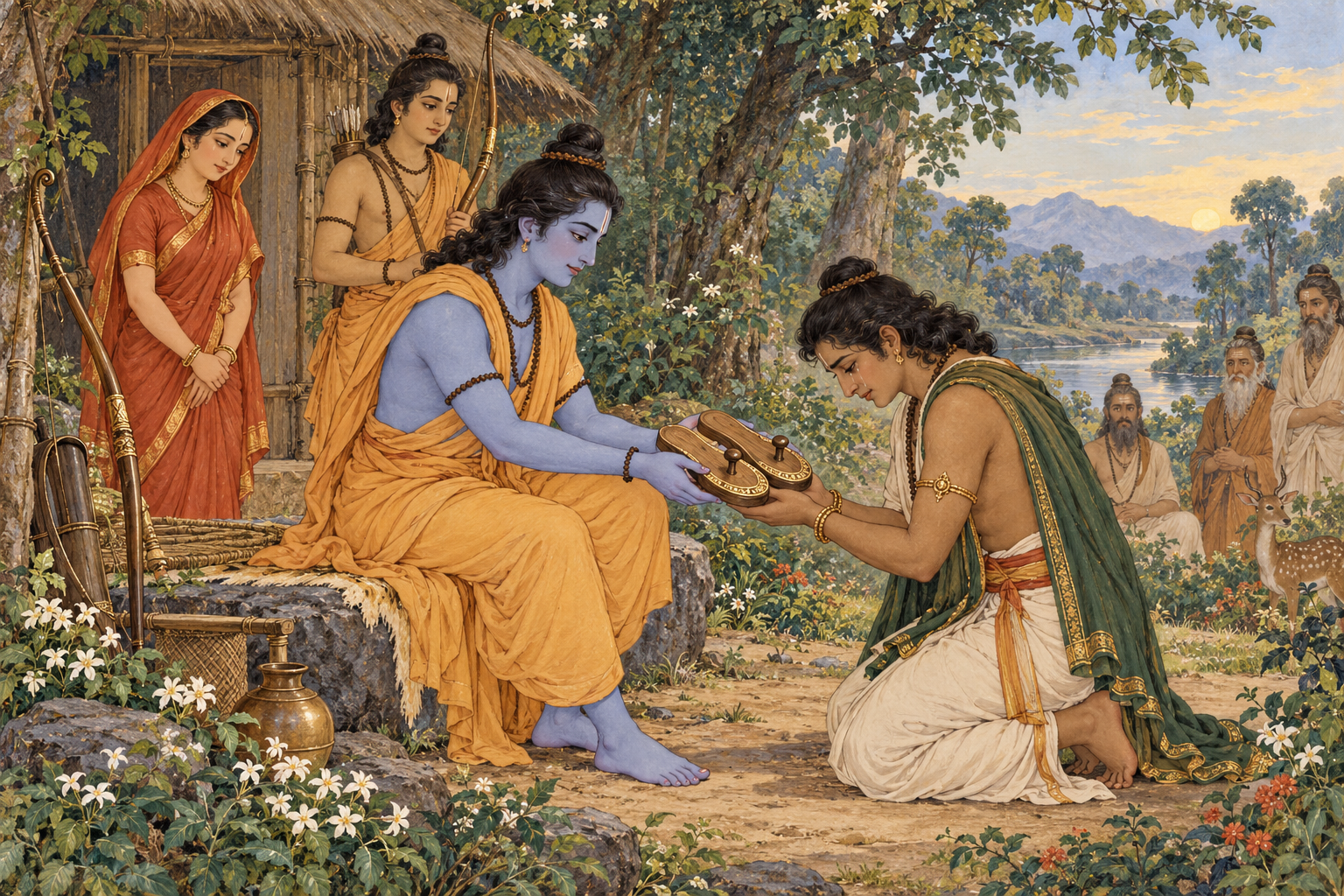
The kingdom held for an absent brother
The exchange contains a disagreement about return, practical counsel about government and an intense pledge. It is not merely an explanation of a royal symbol.
Reference: Ayodhyā Kāṇḍa, Sarga 112. K. M. K. Murthy; ValmikiRamayan.net prose translation, Sanskrit Documents mirror.
English reading — attributed handbook paraphrase
Bharata appeals for Rāma to return, saying he cannot govern the vast kingdom alone to its people’s satisfaction. Rāma affirms Bharata’s capacity, advises consultation with ministers and counsellors, and refuses to break his father’s vow. Bharata asks for Rāma’s sandals and promises an austere life outside the city, offering the kingdom’s rule to them until Rāma returns. His pledge includes entering fire if Rāma fails to return when the fourteen years end. Rāma embraces his brothers and asks Bharata not to remain angry with Kaikeyī.
Handbook paraphrase of the identified reading, not the translator’s exact wording. Complete chapter linked; specialist review pending.
Handbook reading guidance: the sandals appear after an appeal and refusal. Ask what Bharata accepts, what he still hopes for and how the arrangement marks Rāma’s authority. Rāma’s recommendation to seek counsel is a separate part of his reply.
Does Rāma tell Bharata to govern without advice?
Answer: No. He explicitly recommends ministers, companions and intelligent counsellors. His confidence in Bharata does not mean solitary decision-making.
Nandigrāma: authority held in trust during the absence
Learning goal: distinguish holding entrusted authority from claiming it permanently. Notice the continuing work alongside Bharata’s waiting.
Reading path: continue from the sandals in Sarga 112 to this selection from Sarga 115. Chapters 113–114 cover intervening travel and return scenes not reproduced here.
Bharata holds the kingdom in trust at Nandigrāma
Selected decision, installation of the sandals and administration; travel chapters after the council are omitted.
Reference: Ayodhyā Kāṇḍa, Sarga 115 — selected narrative and dialogue. K. M. K. Murthy; ValmikiRamayan.net English prose translation, Sanskrit Documents mirror; speakers and narrative distinguished.
English reading — attributed handbook paraphrase
After bringing the mothers back to Ayodhyā, Bharata asks leave to wait at Nandigrāma. The elders approve, and he goes with Śatrughna, the sandals and an accompanying retinue. He describes the kingdom as a trust received from Rāma, places the sandals under the royal canopy and promises to restore authority when Rāma returns. Wearing ascetic dress, he administers the state with his ministers while honoring the sandals as Rāma’s symbols.
Handbook paraphrase of the identified translation, not its exact wording. Complete chapter linked; specialist review pending.
Does waiting at Nandigrāma mean abandoning administration?
Answer: No. The chapter describes Bharata carrying on the state’s work with his ministers while awaiting Rāma.
Follow the object across its three settings
- The sandals are requested after the refusal to return.
- Bharata explains their place in the trust while carrying on administration.
- The sandals and entrusted sovereignty are returned when Rāma comes home.
Handbook reading guidance: the sandals’ meaning is supplied by the surrounding words and actions. They do not replace the ministers or the work of administration. Keep the symbolic acknowledgment and the practical responsibilities together.
Is “trust” here a drafted modern legal arrangement?
This is the language and relationship in the cited literary account. The reading does not establish a contemporary legal trust, ownership structure or succession instrument.
Connect the later news: Hanumān finds Bharata at Nandigrāma before the reunion. This earlier passage supplies context for that setting.
Optional review: recall what is being held, what Bharata promises and what work continues. Check each against the selection before comparing the later return.
With Atri and Anasūyā: welcome, counsel and Sītā’s recollection
Learning goal: distinguish an elder’s counsel, Sītā’s reply and her account of an earlier event. Follow the departure without confusing the present conversation with the marriage she recalls.
Reading path: selected portions of Ayodhyā Kāṇḍa 117–119, after the Citrakūṭa council. Sarga 116 supplies an intervening episode not reproduced here. The path reaches the onward forest journey, not the whole of Araṇya Kāṇḍa.
Leaving Citrakūṭa and meeting Anasūyā
Selected departure, welcome and opening counsel; Atri’s longer account of Anasūyā’s austerities is omitted.
Reference: Ayodhyā Kāṇḍa, Sarga 117 — selected narrative and dialogue. K. M. K. Murthy; ValmikiRamayan.net English prose translation, Sanskrit Documents mirror; selected narrative separated from explanatory footnotes.
English reading — attributed handbook paraphrase
Rāma decides to leave Citrakūṭa, troubled by memories of the family’s visit and the effects of the encamped army. At Atri’s hermitage the three travelers are warmly received. Atri introduces Anasūyā, and Sītā approaches her respectfully. Anasūyā praises Sītā for accompanying Rāma and speaks of a wife’s devotion to her husband, extending that devotion even to a husband of flawed conduct. These are her words within this historical epic scene.
Handbook paraphrase of the identified translation, not its exact wording. Complete chapter linked; specialist review pending.
Whose teaching is being reported?
Answer: Anasūyā’s counsel to Sītā in the cited chapter. It is not an unsigned handbook rule for every present-day relationship.
Sītā responds, and Anasūyā gives gifts
Selected response and gift exchange before the marriage recollection.
Reference: Ayodhyā Kāṇḍa, Sarga 118 — selected narrative and dialogue. K. M. K. Murthy; ValmikiRamayan.net English prose translation, Sanskrit Documents mirror; selected narrative separated from explanatory footnotes.
English reading — attributed handbook paraphrase
Sītā responds respectfully, affirming devotion to her husband and praising Rāma’s compassion and affection. She remembers advice from her mother and Kausalyā. Anasūyā offers a boon; Sītā says she is already fulfilled. The elder nevertheless gives garments, ornaments, a garland and cosmetics as affectionate gifts. Sītā accepts and sits beside her.
Handbook paraphrase of the identified translation, not its exact wording. Complete chapter linked; specialist review pending.
Does Sītā’s reply contain only an abstract statement about marriage?
Answer: No. It also names Rāma’s qualities and remembers advice from the women of her family.
Sītā narrates her own marriage story
Selected retrospective after Anasūyā asks to hear the story as Sītā experienced it.
Reference: Ayodhyā Kāṇḍa, Sarga 118 — selected narrative and dialogue. K. M. K. Murthy; ValmikiRamayan.net English prose translation, Sanskrit Documents mirror; selected narrative separated from explanatory footnotes.
English reading — attributed handbook paraphrase
At Anasūyā’s request, Sītā recounts Janaka finding her while ploughing and raising her with affection. She recalls his search for a suitable husband and the bow challenge. Rāma comes with Lakṣmaṇa and Viśvāmitra, strings the bow and breaks it while drawing it. Sītā says Rāma waited for Daśaratha’s approval; the king was invited, the marriage followed, and Urmilā married Lakṣmaṇa.
Handbook paraphrase of the identified translation, not its exact wording. Complete chapter linked; specialist review pending.
Is this the marriage happening again during the exile?
Answer: No. It is Sītā’s retrospective account to Anasūyā. Compare it with the earlier Mithilā reading while keeping the narrative settings distinct.
The conversation ends, and the journey resumes
Selected evening farewell and next-morning departure.
Reference: Ayodhyā Kāṇḍa, Sarga 119 — selected narrative and dialogue. K. M. K. Murthy; ValmikiRamayan.net English prose translation, Sanskrit Documents mirror; selected narrative separated from explanatory footnotes.
English reading — attributed handbook paraphrase
Anasūyā praises Sītā’s telling, embraces her and describes the approaching night. Sītā puts on the gifts and returns to Rāma, showing what she has received. The travelers stay overnight. In the morning they take leave; the ascetics describe the dangers of the onward forest, identify a path used by sages and bless their journey. Rāma proceeds with Sītā and Lakṣmaṇa.
Handbook paraphrase of the identified translation, not its exact wording. Complete chapter linked; specialist review pending.
Does Anasūyā’s farewell send the party away immediately at night?
Answer: No. Sītā returns to Rāma, they spend the night there, and the party leaves the following morning.
A conversation has more than one role
| Role in the scene | Reading to examine |
|---|---|
| Welcoming and advising | Atri’s introduction and Anasūyā’s counsel |
| Responding and remembering family advice | Sītā’s reply |
| Asking for and telling a story | The marriage recollection |
| Closing the visit | Evening farewell and morning departure |
Handbook reading guidance: describe the counsel accurately and keep its speaker and setting visible. Sītā’s agreement in this scene does not remove her earlier argument about accompanying Rāma or her later objection to his public accusation. Read the different situations without making one speech substitute for all of them.
Is the marriage recollection an independent new wedding ceremony?
No. It refers back to events explored in the Mithilā section. Record that one reading presents the episode and another presents Sītā telling it to a listener later.
Does the description of the onward path establish a safe modern route?
This is the epic’s forest setting and the ascetics’ advice within it. It is not a modern travel itinerary or safety assessment.
Return journey connection: the later landscape recollection also looks back on the exile. Compare what each speaker chooses to recall, keeping the selected passage and the complete chapter link together.
Continue: Sītā and Rāma discuss carrying weapons in a later forest episode. This guide’s selections omit other intervening scenes rather than pretending the conversations are consecutive.
Optional review: recall the elder’s role, one personal detail in Sītā’s reply and the difference between the time of her telling and the event told. Check each against the readings.
Entering Daṇḍaka: welcome, danger and the protection request
Learning goal: follow how the forest journey introduces obligations beyond exile. Distinguish hospitality, an encounter’s later explanation, an appeal and a promise.
Reading path: selected portions of Araṇya Kāṇḍa 1, 4 and 6 after the visit to Atri and Anasūyā. Chapters 2–3 and 5 contain intervening events; the selections are not a continuous account of every forest episode.
The travelers are welcomed at the hermitages
Selected arrival and hospitality; the linked edition’s modern introductory essays are not part of this selection.
Reference: Araṇya Kāṇḍa, Sarga 1 — selected narrative and dialogue. Desiraju Hanumanta Rao; ValmikiRamayan.net English prose translation, Sanskrit Documents mirror; narrative and dialogue separated from commentary, introductory essays and alternative renderings.
English reading — attributed handbook paraphrase
Entering Daṇḍaka, Rāma sees a cluster of hermitages with trees, animals, ritual fires and forest provisions. He approaches with his bow unstrung. The sages welcome Rāma, Sītā and Lakṣmaṇa, offering blessings, water, flowers and forest foods. The scene begins with reception before their appeal about protection.
Handbook paraphrase of the identified translation, not its exact wording. Complete chapter linked; specialist review pending.
Does the scene open with a battle?
Answer: No. It describes the travelers’ approach and the sages’ welcome.
The sages invoke the ruler’s responsibility
Selected speech following the welcome.
Reference: Araṇya Kāṇḍa, Sarga 1 — selected narrative and dialogue. Desiraju Hanumanta Rao; ValmikiRamayan.net English prose translation, Sanskrit Documents mirror; narrative and dialogue separated from commentary, introductory essays and alternative renderings.
English reading — attributed handbook paraphrase
The sages describe the king as a guardian of righteousness and a protector of the people. They tell Rāma that his responsibility extends to them whether he is in the capital or the forest. Having set aside punishment by force or curses and restrained their anger, they ask him to protect them. These are their stated reasons for seeking his help.
Handbook paraphrase of the identified translation, not its exact wording. Complete chapter linked; specialist review pending.
Who claims that responsibility continues in the forest?
Answer: The sages make that argument to Rāma. Keep their appeal distinct from a modern legal description of jurisdiction.
Virādha explains his identity and gives directions
Selected later portion of the encounter; the beginning and earlier combat in Sargas 2–3 are not reproduced.
Reference: Araṇya Kāṇḍa, Sarga 4 — selected narrative and dialogue. Desiraju Hanumanta Rao; ValmikiRamayan.net English prose translation, Sanskrit Documents mirror; narrative and dialogue separated from commentary, introductory essays and alternative renderings.
English reading — attributed handbook paraphrase
After the struggle, Virādha recognizes the travelers and says that he is the gandharva Tumburu, placed in his present form by Kubera’s curse. He describes release through an encounter with Rāma and directs him to the sage Śarabhaṅga. The brothers bury Virādha, whom weapons cannot kill in this account, and continue with Sītā. His explanation and the onward advice belong to this later part of the episode.
Handbook paraphrase of the identified translation, not its exact wording. Complete chapter linked; specialist review pending.
Is Virādha’s explanation supplied before the encounter begins?
Answer: No. It comes in this later phase, after the preceding struggle. The selected reading does not reproduce the entire encounter.
The request becomes a commitment
Selected appeal and reply after Śarabhaṅga’s departure; the intervening hermitage episode is not reproduced.
Reference: Araṇya Kāṇḍa, Sarga 6 — selected narrative and dialogue. Desiraju Hanumanta Rao; ValmikiRamayan.net English prose translation, Sanskrit Documents mirror; narrative and dialogue separated from commentary, introductory essays and alternative renderings.
English reading — attributed handbook paraphrase
The assembled sages describe attacks on their communities and ask Rāma to protect them, connecting protection with the obligations of a ruler. Rāma asks them to address him as one ready to serve. He speaks of entering the forest under his father’s command and promises to oppose the rākṣasas harming them. The party then goes toward Sūtīkṣṇa with Sītā and Lakṣmaṇa.
Handbook paraphrase of the identified translation, not its exact wording. Complete chapter linked; specialist review pending.
Is the appeal left without an answer?
Answer: No. Rāma responds and gives a commitment. Read the later conversation with Sītā to examine how he explains it there.
From an appeal to a later discussion
- Identify the sages’ stated reason for seeking Rāma’s protection.
- Read the later request and commitment.
- Read Sītā’s warning about weapons in the later forest conversation.
- Read Rāma’s reply beside it, retaining his reasons and the promise he discusses.
Handbook reading guidance: do not reduce the sequence to a forest setting alone. The speakers introduce a request, a responsibility and a commitment. At the same time, the selected narrative does not turn each later act into something fully explained by one earlier sentence.
Are the linked page’s archaeological and social theories part of the epic narrative?
No. The accessed edition interleaves translated passages with introductory and explanatory material. These readings use the identified narrative and dialogue, not those additional historical theories. Cite the layer actually being discussed.
Does the Virādha selection cover his whole story?
No. It selects the later explanation and transition to the next destination. Use the complete linked chapter and the preceding encounter chapters for a fuller sequence.
Compare a different appeal to duty: Bharata asks Rāma to protect the kingdom by returning. Here the sages ask for protection in the forest. Compare the actual requests and replies rather than assuming their circumstances are the same.
Continue: Sītā and Rāma discuss the bow. Their exchange remains a dialogue with more than one reason to consider.
Optional review: recall who offers welcome, who explains a former identity and who asks for protection. Locate each statement before forming an interpretation of the whole path.
In the forest: Sītā and Rāma discuss the bow
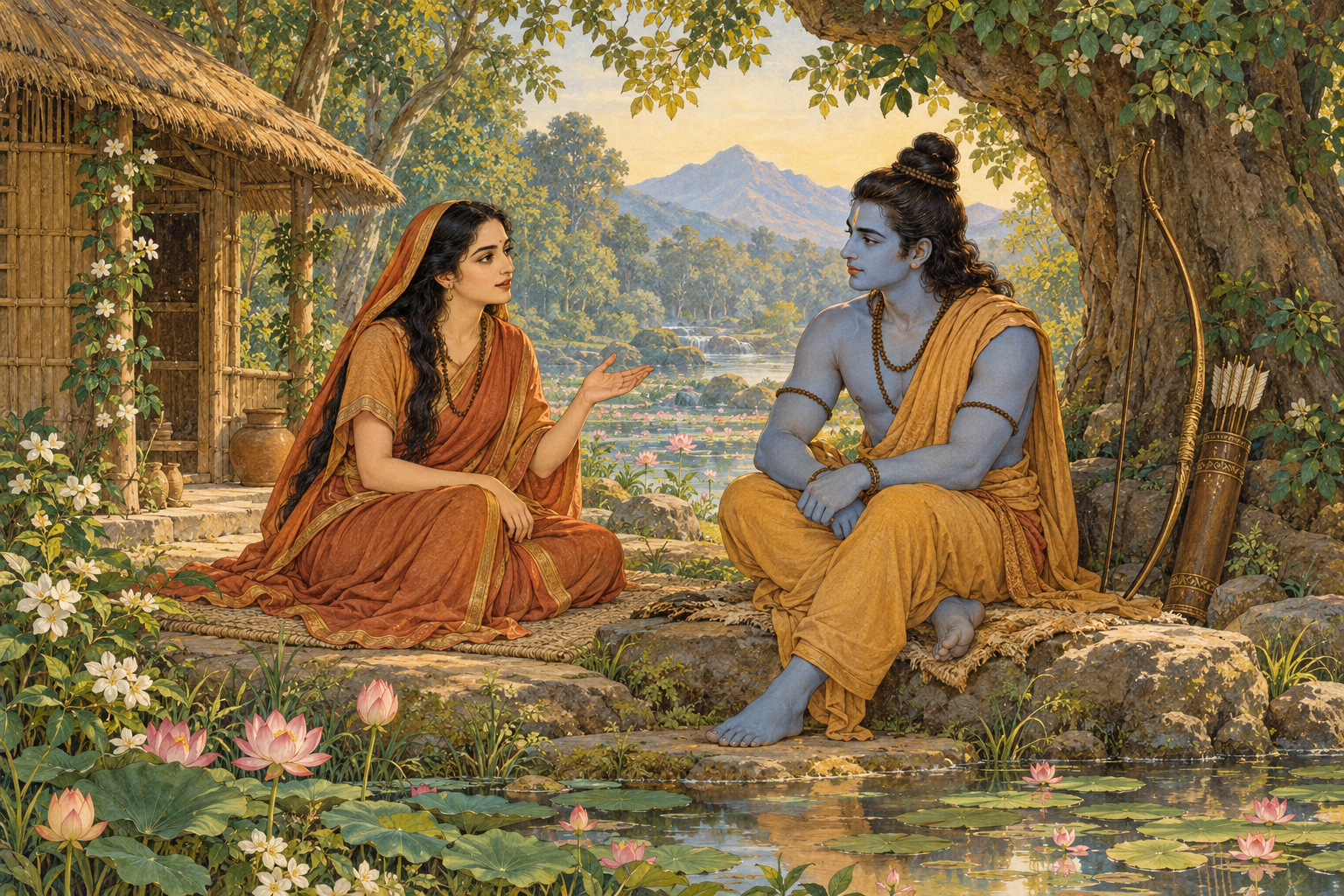
Reading goal: reconstruct the reasons each speaker gives. Follow a concern, an example and a reply before forming your own judgment.
Sītā’s warning about weapons
Sītā speaks as the forest journey continues, after the visit to Sūtīkṣṇa.
Reference: Araṇya Kāṇḍa, Sarga 9 — selected dialogue. Desiraju Hanumanta Rao; ValmikiRamayan.net English prose translation, Sanskrit Documents mirror; dialogue distinguished from accompanying commentary.
English reading — attributed handbook paraphrase
Sītā distinguishes false speech, desire for another’s wife and cruelty without enmity. She affirms Rāma’s truthfulness and fidelity, then questions the third danger: his promise to fight the forest’s rākṣasas. She tells of a hermit entrusted with a sword. Constantly carrying it changes his disposition and destroys his discipline. She warns against killing those who have done no wrong and says a warrior’s bow should protect the suffering. She asks Rāma to consider the matter with Lakṣmaṇa and act appropriately.
Handbook paraphrase of the identified translation, not its exact wording. Complete chapter linked; specialist review pending.
Handbook reading guidance: Identify the purpose of the sword story: Sītā examines how repeated association with a weapon can change conduct. Her concern is specific to the contemplated action; do not turn it into an accusation that Rāma has already committed every fault she lists.
Which of the three dangers does Sītā focus on?
Answer: Cruelty without enmity. She explicitly affirms Rāma’s truthfulness and fidelity before raising this concern.
Rāma’s answer: protection and a promise
Read this reply directly after Sītā’s argument in the preceding chapter.
Reference: Araṇya Kāṇḍa, Sarga 10 — selected dialogue. Desiraju Hanumanta Rao; ValmikiRamayan.net English prose translation, Sanskrit Documents mirror; dialogue distinguished from accompanying commentary.
English reading — attributed handbook paraphrase
Rāma calls Sītā’s words caring and beneficial. He repeats the purpose of a warrior’s bow: relieving distress. He recounts the forest sages’ request for protection from attacks, including assaults during their rites. They have the power to curse but do not wish to diminish the merit of their austerities. He says he has promised their protection and will not abandon that promise, even at the cost of his life or separation from Lakṣmaṇa or Sītā. He praises her concern and calls her his companion in dharma, then continues the journey with his bow.
Handbook paraphrase of the identified translation, not its exact wording. Complete chapter linked; specialist review pending.
Handbook reading guidance: Rāma answers with the sages’ reported suffering and his commitment. His acknowledgment of Sītā’s care does not mean he adopts her proposal. Notice both the force of the promise and its stated personal cost.
Does Rāma put down his bow after hearing Sītā?
Answer: No. He appreciates her warning but continues with the bow, explaining his obligation to protect the sages.
Read the exchange in two passes
First, identify the concern, example and request in Sītā’s speech. Then identify the evidence, commitment and decision in Rāma’s reply. Keep a character’s argument separate from your evaluation of it.
Discussion prompt: where do the speakers share a starting point, and where do their proposed responses diverge? Use the two readings above to support your answer.
Suggested answer
Both invoke the protection of those who suffer. Sītā asks Rāma to reconsider how he uses weapons; Rāma grounds his decision to carry on in the attacks reported by the sages and his promise to protect them. This identifies their reasoning without requiring readers to resolve the entire ethical question in one sentence.
Connect the episodes: revisit Viśvāmitra’s request and the exile decision. Identify the promise or request in each scene, its circumstances and who bears its consequences. The supplied readings are starting points for comparison, not interchangeable statements of one rule.
Agastya and Pañcavaṭī: directions, gifts and a dwelling
Learning goal: follow four different kinds of help along the forest journey: directions, reception and gifts, advice about a residence, and the work of building it.
Reading path: selected portions of Araṇya Kāṇḍa 11–13 and 15, after Sītā and Rāma’s discussion of weapons and the protection promise. Sarga 14 contains the intervening meeting with Jaṭāyu, selected below; these selections do not reproduce every event or every part of the linked chapters.
Sūtīkṣṇa directs the travelers toward Agastya
Selected onward journey; the chapter also contains other hermitage visits and embedded stories.
Reference: Araṇya Kāṇḍa, Sarga 11 — selected narrative and dialogue. Desiraju Hanumanta Rao; ValmikiRamayan.net English prose translation, Sanskrit Documents mirror; narrative and dialogue separated from commentary, introductory essays and alternative renderings.
English reading — attributed handbook paraphrase
After visiting forest hermitages, Rāma returns to Sūtīkṣṇa and asks where he can find Agastya. Sūtīkṣṇa welcomes the request and describes a route through the hermitage of Agastya’s brother. Rāma, Sītā and Lakṣmaṇa travel there, receive hospitality and stay overnight. They take leave the following day and continue toward Agastya’s dwelling.
Handbook paraphrase of the identified translation, not its exact wording. Complete chapter linked; specialist review pending.
Do they go directly from Sūtīkṣṇa to Agastya without a stop?
Answer: No. They first visit Agastya’s brother and stay overnight before continuing.
Agastya welcomes the travelers and gives weapons
Selected reception and gifts; distinguish the translated narrative from the edition’s explanatory commentary.
Reference: Araṇya Kāṇḍa, Sarga 12 — selected narrative and dialogue. Desiraju Hanumanta Rao; ValmikiRamayan.net English prose translation, Sanskrit Documents mirror; narrative and dialogue separated from commentary, introductory essays and alternative renderings.
English reading — attributed handbook paraphrase
Lakṣmaṇa announces the travelers to a disciple, who informs Agastya. The sage welcomes Rāma, Sītā and Lakṣmaṇa with seats, water and forest provisions. He then gives Rāma a bow associated with Viṣṇu and made by Viśvakarmā, an arrow associated with Brahmā, two inexhaustible quivers and a sword with a golden sheath. Agastya describes the weapons’ earlier associations and asks Rāma to receive them.
Handbook paraphrase of the identified translation, not its exact wording. Complete chapter linked; specialist review pending.
Does the account begin with the weapons being handed over?
Answer: No. The announcement, welcome and hospitality precede the gifts.
Rāma asks where they should make a dwelling
Selected discussion of a place to live; Agastya’s wider counsel in the chapter is not reproduced here.
Reference: Araṇya Kāṇḍa, Sarga 13 — selected narrative and dialogue. Desiraju Hanumanta Rao; ValmikiRamayan.net English prose translation, Sanskrit Documents mirror; narrative and dialogue separated from commentary, introductory essays and alternative renderings.
English reading — attributed handbook paraphrase
Agastya acknowledges the travelers’ fatigue and asks Rāma to attend to Sītā’s comfort. Rāma asks for a suitable place with water and forest resources where they can build a dwelling. Agastya recommends Pañcavaṭī near the Godāvarī, describing its roots, fruits and animals. He connects residence there with Sītā’s comfort and the protection of the hermits, then gives directions for the journey.
Handbook paraphrase of the identified translation, not its exact wording. Complete chapter linked; specialist review pending.
Who asks about a suitable residence, and who recommends Pañcavaṭī?
Answer: Rāma asks; Agastya recommends the place and gives directions.
Lakṣmaṇa builds the dwelling at Pañcavaṭī
Selected arrival and construction; the preceding meeting with Jaṭāyu in Sarga 14 has a separate selection below.
Reference: Araṇya Kāṇḍa, Sarga 15 — selected narrative and dialogue. Desiraju Hanumanta Rao; ValmikiRamayan.net English prose translation, Sanskrit Documents mirror; narrative and dialogue separated from commentary, introductory essays and alternative renderings.
English reading — attributed handbook paraphrase
At Pañcavaṭī, Rāma asks Lakṣmaṇa to find a pleasant site with water and nearby materials. Lakṣmaṇa defers the choice to Rāma, who selects a place near the Godāvarī. Lakṣmaṇa builds a spacious dwelling with a raised clay floor, bamboo supports, branches and a roof of grass and leaves. After offerings, he shows it to Rāma. Rāma embraces him, praises his attentive care and skill, and recalls their father. The three settle there.
Handbook paraphrase of the identified translation, not its exact wording. Complete chapter linked; specialist review pending.
Does Lakṣmaṇa choose the final site by himself?
Answer: No. He asks Rāma to choose, then builds the dwelling at that site.
What each scene contributes
| Scene | Help described | Question to keep in view |
|---|---|---|
| Sūtīkṣṇa’s directions | A route and an intermediate stop | How do the travelers reach their next host? |
| Agastya’s reception | Hospitality and weapons | What happens before the gifts? |
| Advice about Pañcavaṭī | A place with water and forest resources | Whose comfort and responsibilities are mentioned? |
| The dwelling | Selection of a site and practical construction | How do Rāma and Lakṣmaṇa share the work? |
Handbook reading guidance: the narrative describes particular hosts, travelers and decisions. Its account of hospitality or construction is not a complete modern ritual or building instruction. Keep the speakers’ reasons attached to the scene in which they occur.
Do Agastya’s gifts erase Sītā’s earlier concern about weapons?
No. The gifts form a later scene. Read Sītā’s warning and Rāma’s reply alongside this reception without treating one passage as if it replaced the other.
Another Agastya scene: the solar hymn before the final battle occurs much later, in Yuddha Kāṇḍa. Keep its setting distinct from the forest visit here.
Continue: the golden-deer episode. The dwelling and its surroundings now have a narrative setting. Later, Rāma’s account of the return landscape revisits places associated with the forest journey.
Optional review: name the host who gives directions, the sage who gives weapons and residence advice, and the brother who builds the dwelling. Return to the source panels to check each answer.
Around Pañcavaṭī: Jaṭāyu’s friendship and thoughts of Bharata
Learning goal: recognize relationships carried into the forest: a friend of the travelers’ father and an absent brother remembered during an ordinary morning.
Reading path: selections from Araṇya Kāṇḍa 14 and 16. The first occurs on the way to Pañcavaṭī; the second follows the construction of the dwelling in Sarga 15.
Jaṭāyu identifies himself and offers help
Selected opening and closing of the meeting on the way to Pañcavaṭī; the extensive account of lineage and creation is not reproduced.
Reference: Araṇya Kāṇḍa, Sarga 14 — selected narrative and dialogue. Desiraju Hanumanta Rao; ValmikiRamayan.net English prose translation, Sanskrit Documents mirror; narrative and dialogue separated from commentary and alternative renderings.
English reading — attributed handbook paraphrase
Rāma and Lakṣmaṇa encounter a large bird and ask who he is, initially suspecting a rākṣasa. He identifies himself as a friend of Daśaratha. After recounting his lineage, he gives his name as Jaṭāyu and names Sampāti as his elder brother. He offers to watch over Sītā when the brothers are away. Rāma embraces him in recognition of his friendship with their father, and the party continues to Pañcavaṭī.
Handbook paraphrase of the identified translation, not its exact wording. Complete chapter linked; specialist review pending.
Does Jaṭāyu first appear during the abduction?
Answer: No. This earlier meeting establishes his connection with Daśaratha and his offer to help.
A river journey turns toward thoughts of Bharata
Selected seasonal setting and the later exchange about Bharata and Kaikeyī; symbolic explanations interleaved in the edition are not part of this paraphrase.
Reference: Araṇya Kāṇḍa, Sarga 16 — selected narrative and dialogue. Desiraju Hanumanta Rao; ValmikiRamayan.net English prose translation, Sanskrit Documents mirror; narrative and dialogue separated from commentary and alternative renderings.
English reading — attributed handbook paraphrase
During hemanta, Rāma, Sītā and Lakṣmaṇa go toward the Godāvarī for a morning bath. Lakṣmaṇa describes the cold season, then imagines Bharata’s austere life and bathing in the cold Sarayū. He praises Bharata and criticizes Kaikeyī. Rāma tells him not to speak against their mother and asks him to continue speaking of Bharata. Still resolved to stay in the forest, Rāma longs to be reunited with his family. They reach the river and perform their morning observances.
Handbook paraphrase of the identified translation, not its exact wording. Complete chapter linked; specialist review pending.
Does Rāma’s longing for Bharata mean he abandons his forest resolve?
Answer: No. He expresses both his settled resolve and his longing for reunion in this exchange.
Two connections across distance
Handbook reading guidance: Jaṭāyu’s offer is grounded in an existing friendship with Daśaratha. Lakṣmaṇa’s description of Bharata is a brother’s reflection while walking to a different river; it is not a new scene witnessed in Ayodhyā.
Continue the relationships: Jaṭāyu later resists the abduction; Bharata’s life at Nandigrāma gives the earlier setting for the brothers’ thoughts. These linked selections are available beside their explanations.
Does the river passage give a modern festival date?
No. It provides a seasonal and narrative setting. This selection is not a conversion of the poem’s season into a modern civil-calendar date.
Optional review: recall what Jaṭāyu offers and what Rāma asks Lakṣmaṇa to change in their conversation about Kaikeyī.
Śūrpaṇakhā and Khara: an encounter becomes a wider conflict
Learning goal: trace the sequence from proposal and threat to attack, injury, report and successive battles. Distinguish the narrated actions from interpretations of their justification.
Reading path: selected portions of Araṇya Kāṇḍa 17–20 and 30. Read the arrival and injury first, the report and first force next, and the later battle’s conclusion last. Sargas 21–29 contain the intervening campaign; this is a selected path through the episode.
Śūrpaṇakhā approaches the dwelling
Selected arrival, introductions and proposal; descriptive contrasts and later explanatory notes are not reproduced in full.
Reference: Araṇya Kāṇḍa, Sarga 17 — selected narrative and dialogue. Desiraju Hanumanta Rao; ValmikiRamayan.net English prose translation, Sanskrit Documents mirror; narrative and dialogue separated from commentary and alternative renderings.
English reading — attributed handbook paraphrase
Śūrpaṇakhā arrives while Rāma is at the hermitage with Sītā and Lakṣmaṇa. She asks why someone wearing an ascetic’s dress also has a wife and carries weapons. Rāma identifies himself, his wife and his brother, explaining his forest residence through his father’s command. She identifies herself and her brothers, including Rāvaṇa, and asks Rāma to become her husband. Her proposal includes a threat to consume Sītā and Lakṣmaṇa.
Handbook paraphrase of the identified translation, not its exact wording. Complete chapter linked; specialist review pending.
Is the arrival only an exchange of names?
Answer: No. It includes a question about the travelers’ situation, a marriage proposal and a threat.
The exchange becomes an attack and an injury
Selected dialogue and ensuing action; the edition’s extended interpretations of wordplay are not reproduced.
Reference: Araṇya Kāṇḍa, Sarga 18 — selected narrative and dialogue. Desiraju Hanumanta Rao; ValmikiRamayan.net English prose translation, Sanskrit Documents mirror; narrative and dialogue separated from commentary and alternative renderings.
English reading — attributed handbook paraphrase
Rāma says he is married and directs Śūrpaṇakhā toward Lakṣmaṇa. Lakṣmaṇa answers with a smiling response that sends her back toward Rāma. She takes his words as sincere, threatens to consume Sītā and rushes toward her. Rāma stops her and tells Lakṣmaṇa to disfigure her. Lakṣmaṇa cuts off her nose and ears. Injured, she flees to her brother Khara at Janasthāna and reports the encounter.
Handbook paraphrase of the identified translation, not its exact wording. Complete chapter linked; specialist review pending.
Is the injury described before or after she rushes toward Sītā?
Answer: After. The selected narrative also retains the preceding exchange and Rāma’s instruction.
Khara sends the first attacking force
Selected report, request and order; accompanying alternative theological readings are distinct from this narrative account.
Reference: Araṇya Kāṇḍa, Sarga 19 — selected narrative and dialogue. Desiraju Hanumanta Rao; ValmikiRamayan.net English prose translation, Sanskrit Documents mirror; narrative and dialogue separated from commentary and alternative renderings.
English reading — attributed handbook paraphrase
Khara asks who has injured his sister. Śūrpaṇakhā describes the brothers and Sītā, attributes her plight to them and asks for their deaths so that she can drink their blood. Khara summons fourteen rākṣasas and orders them to kill the travelers. They depart with Śūrpaṇakhā toward Pañcavaṭī. Her report and his order are separate steps in the escalation.
Handbook paraphrase of the identified translation, not its exact wording. Complete chapter linked; specialist review pending.
Who orders the fourteen rākṣasas to go?
Answer: Khara gives the order after hearing Śūrpaṇakhā’s report and request.
The first force attacks and is defeated
Selected encounter at the dwelling; the edition’s alternative allegorical reading is not included.
Reference: Araṇya Kāṇḍa, Sarga 20 — selected narrative and dialogue. Desiraju Hanumanta Rao; ValmikiRamayan.net English prose translation, Sanskrit Documents mirror; narrative and dialogue separated from commentary and alternative renderings.
English reading — attributed handbook paraphrase
Śūrpaṇakhā shows the travelers to the fourteen rākṣasas. Rāma asks Lakṣmaṇa to remain beside Sītā. He addresses the attackers and offers them the opportunity to leave if they wish to live. They threaten him and launch their weapons. Rāma breaks their spears with arrows and kills them. Śūrpaṇakhā returns to Khara and reports the defeat.
Handbook paraphrase of the identified translation, not its exact wording. Complete chapter linked; specialist review pending.
Does Lakṣmaṇa join Rāma against this first force?
Answer: In this scene, Rāma assigns him to remain with Sītā while Rāma confronts the attackers.
The later battle ends with Khara’s death
Selected conclusion after the larger campaign in Sargas 21–29; those intervening battle chapters are not reproduced here.
Reference: Araṇya Kāṇḍa, Sarga 30 — selected narrative and dialogue. Desiraju Hanumanta Rao; ValmikiRamayan.net English prose translation, Sanskrit Documents mirror; narrative and dialogue separated from commentary and alternative renderings.
English reading — attributed handbook paraphrase
In the concluding combat, Khara hurls an uprooted tree at Rāma, who breaks it with arrows. When Khara charges again, Rāma kills him with an arrow. The sages thank Rāma and say that their forest practices can proceed without the earlier obstruction. Lakṣmaṇa and Sītā return from a mountain cave to the hermitage. Sītā rejoices on seeing Rāma safe and embraces him.
Handbook paraphrase of the identified translation, not its exact wording. Complete chapter linked; specialist review pending.
Is this the same clash as the defeat of the fourteen attackers?
Answer: No. It concludes a later, larger campaign. The selected chapters leave the intervening battle narrative outside this reading path.
Keep the different stages visible
| Stage | What to identify |
|---|---|
| The arrival | The questions, proposal and threat in Śūrpaṇakhā’s own speech |
| The injury | The brothers’ replies, her rush toward Sītā, Rāma’s instruction and Lakṣmaṇa’s action |
| The report | What Śūrpaṇakhā tells Khara and what he orders |
| The first clash | Rāma’s warning, the attack and the defeat of fourteen rākṣasas |
| The later conclusion | Khara’s death and the reunion at the hermitage |
Handbook reading guidance: preserve the injury and the preceding threat when discussing this difficult episode. A description of sequence does not, by itself, settle questions about the brothers’ joking, the severity of the response or its consequences. The linked edition discusses wordplay and other interpretations in separate commentary; these paraphrases do not silently adopt those explanations.
Does this episode describe a general rule about women who make a proposal?
No. The selected account concerns named characters, a threat against Sītā, an attack, an injury and ensuing retaliation. Do not turn it into advice about responding to rejection or a rule about women in general.
Does Sītā’s happiness after the battle cancel her earlier warning about weapons?
The readings describe different moments. Keep her earlier warning, Rāma’s explanation of his promise and the later reunion available together before drawing a conclusion.
Continue: the reports reaching Rāvaṇa and Mārīca’s warnings and the plan involving the golden deer. Those selections follow the later chapters before the golden-deer encounter.
Optional review: put the five selected stages in order. Then identify which source describes the first attacking force and which describes the later conclusion.
Reports to Rāvaṇa: from defeat at Janasthāna to an abduction plan
Learning goal: distinguish news of a defeat, a proposal to harm Rāma through separation, and the later request for a specific deception.
Reading path: selected portions of Araṇya Kāṇḍa 31, 34 and 36, after the conflict with Śūrpaṇakhā and Khara. Sargas 32–33 and 35 supply intervening scenes not reproduced here. The selection follows the linked edition’s chapter numbering.
Akampana reports the defeat and proposes abduction
Selected report and first visit to Mārīca in this edition. Its editorial note reports that this chapter is omitted from the critical edition; do not assume the same sequence in every edition.
Reference: Araṇya Kāṇḍa, Sarga 31 — selected narrative and dialogue. Desiraju Hanumanta Rao; ValmikiRamayan.net English prose translation; Sanskrit Documents mirror; narrative and dialogue separated from commentary and alternative renderings.
English reading — attributed handbook paraphrase
Akampana reaches Laṅkā and reports the destruction of the forces at Janasthāna and Khara’s death. He tells Rāvaṇa that Rāma cannot be overcome in direct combat and proposes abducting Sītā, expecting separation to destroy Rāma through grief. Rāvaṇa visits Mārīca for help. Mārīca warns that the proposal is dangerous, advises him to leave Rāma and Sītā alone, and urges him to return home. Rāvaṇa returns to Laṅkā.
Handbook paraphrase of the identified translation, not its exact wording. Complete chapter linked; specialist review pending.
Does this first visit end with Mārīca becoming the deer?
Answer: No. In this chapter’s sequence, Rāvaṇa hears the warning and returns to Laṅkā.
Śūrpaṇakhā urges Rāvaṇa to take Sītā
Selected exchange in the presence of ministers; the chapter’s interleaved political and theological explanations are not part of this paraphrase.
Reference: Araṇya Kāṇḍa, Sarga 34 — selected narrative and dialogue. Desiraju Hanumanta Rao; ValmikiRamayan.net English prose translation; narrative and dialogue separated from commentary and alternative renderings.
English reading — attributed handbook paraphrase
Rāvaṇa asks Śūrpaṇakhā about Rāma, his strength, his weapons and her injury. She describes the brothers and the defeat at Janasthāna, then praises Sītā’s beauty and conduct. She urges Rāvaṇa to take Sītā as his wife and calls for action after Khara and Dūṣaṇa’s deaths. This is her report and proposal to Rāvaṇa, not Sītā’s agreement to a marriage.
Handbook paraphrase of the identified translation, not its exact wording. Complete chapter linked; specialist review pending.
Whose wish is expressed in the proposal to take Sītā?
Answer: Śūrpaṇakhā urges Rāvaṇa to act. This speech does not express Sītā’s wishes.
Rāvaṇa asks Mārīca to become a golden deer
Selected renewed request after the intervening journey in Sarga 35; retain Rāvaṇa’s description as his own speech.
Reference: Araṇya Kāṇḍa, Sarga 36 — selected narrative and dialogue. Desiraju Hanumanta Rao; ValmikiRamayan.net English prose translation; Sanskrit Documents mirror; narrative and dialogue separated from commentary and alternative renderings.
English reading — attributed handbook paraphrase
Rāvaṇa recounts the defeat at Janasthāna and seeks Mārīca’s help in abducting Sītā. He asks him to appear as a golden deer with silver markings near the hermitage. He expects Sītā to ask the brothers to catch it, leaving her alone so that he can abduct her. Mārīca is frightened when he hears the proposal involving Rāma. The plan is Rāvaṇa’s expectation, not yet the completed sequence of events.
Handbook paraphrase of the identified translation, not its exact wording. Complete chapter linked; specialist review pending.
Is Mārīca enthusiastic when the proposal is made?
Answer: No. The narrative describes his fear on hearing it.
Reports do not all do the same work
Handbook reading guidance: Akampana proposes separation as a way to harm Rāma. Śūrpaṇakhā urges Rāvaṇa to take Sītā. Rāvaṇa then asks for a disguise intended to empty the hermitage of its protectors. Read each speaker’s purpose beside the actual speech rather than merging the proposals into one unnamed decision.
Why is there an earlier visit to Mārīca and then another request?
That is the sequence in the linked edition: the Sarga 31 visit ends with Rāvaṇa returning home; the later request appears in Sarga 36. The edition flags a textual difference concerning Sarga 31. This reader preserves that note rather than claiming every edition contains the same sequence.
Continue: Mārīca’s warnings and Rāvaṇa’s response.
Optional review: identify which speaker proposes abduction as a means of causing grief and which speaker specifies the golden-deer disguise.
Mārīca’s counsel: remembered danger, rejected advice and coercion
Learning goal: follow how advice grounded in remembered encounters meets a decision already made, a reward and a death threat. Keep agreement under pressure distinct from endorsement.
Reading path: selections from Araṇya Kāṇḍa 37–42. For a shorter first reading, begin with the opening counsel, the threat and the transformation; then return to the two recollections and final warning.
Mārīca distinguishes pleasing speech from useful counsel
Selected opening counsel and recommendation to deliberate; separate the speech from the edition’s quotations of later commentary.
Reference: Araṇya Kāṇḍa, Sarga 37 — selected narrative and dialogue. Desiraju Hanumanta Rao; ValmikiRamayan.net English prose translation; Sanskrit Documents mirror; narrative and dialogue separated from commentary and alternative renderings.
English reading — attributed handbook paraphrase
Mārīca says that pleasing speakers are easy to find, while someone who offers unwelcome but beneficial advice—and someone willing to hear it—is rare. He rejects Rāvaṇa’s account of Rāma’s character and warns that a ruler’s wrongful resolve can destroy his people and city. He urges deliberation with sound advisers, including Vibhīṣaṇa, and an assessment of both sides’ strengths before acting. He advises against confrontation with Rāma.
Handbook paraphrase of the identified translation, not its exact wording. Complete chapter linked; specialist review pending.
What does Mārīca say is difficult to find besides a candid adviser?
Answer: A listener willing to hear advice that is unpleasant but beneficial.
Mārīca recalls the attack on Viśvāmitra’s rite
Selected recollection of an earlier encounter; details about ages and locations in the edition’s discussion are not reconciled by this paraphrase.
Reference: Araṇya Kāṇḍa, Sarga 38 — selected narrative and dialogue. Desiraju Hanumanta Rao; ValmikiRamayan.net English prose translation; Sanskrit Documents mirror; narrative and dialogue separated from commentary and alternative renderings.
English reading — attributed handbook paraphrase
Mārīca recounts how Viśvāmitra obtained Rāma’s help to protect his rite. He says that he dismissed the young Rāma as only a boy and advanced toward the ritual fire. Rāma’s arrow struck him and hurled him into the ocean, leaving him alive. Mārīca uses this earlier defeat to warn Rāvaṇa that renewed confrontation will bring disaster to him and Laṅkā.
Handbook paraphrase of the identified translation, not its exact wording. Complete chapter linked; specialist review pending.
Is the earlier encounter happening now in this chapter?
Answer: No. Mārīca recounts it to support his present warning.
A second recollection explains Mārīca’s continuing fear
Selected later encounter and its aftermath; the edition’s discussion of variant readings and arrow symbolism is not included.
Reference: Araṇya Kāṇḍa, Sarga 39 — selected narrative and dialogue. Desiraju Hanumanta Rao; ValmikiRamayan.net English prose translation; Sanskrit Documents mirror; narrative and dialogue separated from commentary and alternative renderings.
English reading — attributed handbook paraphrase
Mārīca describes another encounter in which he and two companions took animal forms and attacked Rāma in the forest. Rāma released three arrows; the companions died while Mārīca escaped. Mārīca says he subsequently lived in restraint, seeing Rāma everywhere in his fear and even being alarmed by words beginning with the sound ra. He warns against making others suffer through a ruler’s misconduct and disputes Rāvaṇa’s claim that Rāma wrongfully killed Khara.
Handbook paraphrase of the identified translation, not its exact wording. Complete chapter linked; specialist review pending.
Does Mārīca describe only one previous defeat?
Answer: No. This chapter adds a later encounter after the recollection in Sarga 38.
Rāvaṇa rejects the advice and threatens Mārīca
Selected rejection, detailed plan, reward and threat; Rāvaṇa’s assertions about kingship are his arguments in this exchange.
Reference: Araṇya Kāṇḍa, Sarga 40 — selected narrative and dialogue. Desiraju Hanumanta Rao; ValmikiRamayan.net English prose translation; Sanskrit Documents mirror; narrative and dialogue separated from commentary and alternative renderings.
English reading — attributed handbook paraphrase
Rāvaṇa says his decision is fixed and that he asked for help, not Mārīca’s judgment. He orders the deer disguise and adds a cry imitating Rāma’s voice, intended to draw Lakṣmaṇa away after Rāma. He promises half his kingdom for assistance. If Mārīca refuses, Rāvaṇa threatens to kill him immediately. He presents cooperation as a chance of survival, while disobedience means certain death at his own hands.
Handbook paraphrase of the identified translation, not its exact wording. Complete chapter linked; specialist review pending.
What pressure accompanies the promised reward?
Answer: Rāvaṇa threatens immediate death if Mārīca refuses.
Mārīca warns of consequences beyond his own death
Selected final response under threat; accompanying explanations and quotations from other works are not reproduced.
Reference: Araṇya Kāṇḍa, Sarga 41 — selected narrative and dialogue. Desiraju Hanumanta Rao; ValmikiRamayan.net English prose translation; narrative and dialogue separated from commentary and alternative renderings.
English reading — attributed handbook paraphrase
Mārīca again warns that Rāvaṇa’s course will ruin his family, ministers, kingdom and people. He argues that advisers should restrain a ruler taking a destructive path and that others can suffer through their ruler’s wrongdoing. Facing the threat, he says he will die at Rāma’s hands rather than those of his own kinsman Rāvaṇa. He continues to warn against taking Sītā. His expectation of death does not become support for the plan.
Handbook paraphrase of the identified translation, not its exact wording. Complete chapter linked; specialist review pending.
Has Mārīca withdrawn his warning after the threat?
Answer: No. He continues to warn of the consequences even while expecting his own death.
Under pressure, Mārīca travels and takes the deer form
Selected departure, transformation and Sītā’s first sight of the deer; modern technological comparisons in the edition are not treated as narrative evidence.
Reference: Araṇya Kāṇḍa, Sarga 42 — selected narrative and dialogue. Desiraju Hanumanta Rao; ValmikiRamayan.net English prose translation; Sanskrit Documents mirror; narrative and dialogue separated from commentary and alternative renderings.
English reading — attributed handbook paraphrase
Afraid of Rāvaṇa, Mārīca agrees to go while saying he expects to die when Rāma sees him. They travel by chariot to the hermitage. At Rāvaṇa’s urging, Mārīca takes the form of a remarkable deer with golden, silver and gemlike coloring, moving repeatedly within Sītā’s sight. While gathering flowers, she sees the extraordinary creature and looks at it in wonder. The narrator has already identified the deer as Mārīca.
Handbook paraphrase of the identified translation, not its exact wording. Complete chapter linked; specialist review pending.
Does the reader have to wait for the deer’s death to learn its identity?
Answer: No. This chapter identifies Mārīca’s transformation before Sītā sees the deer.
What the sequence lets a reader distinguish
| Part of the exchange | What to notice |
|---|---|
| Opening counsel | Mārīca asks for useful advice to be heard, even when unwelcome |
| Two remembered encounters | He supplies reasons for his fear of Rāma |
| Rāvaṇa’s response | He refuses reconsideration and demands assistance |
| Reward and threat | A promise of territory accompanies an immediate death threat |
| Final warning and departure | Mārīca continues to oppose the plan before taking part under pressure |
Handbook reading guidance: Rāvaṇa’s plan makes deception and forced separation visible before Sītā encounters the deer. The reader’s knowledge differs from hers at that moment. Keep that difference in view alongside Lakṣmaṇa’s warning and Sītā’s request in the next chapter.
Is Mārīca’s agreement evidence that he thinks the plan is sound?
No. The selected account places his agreement after repeated warnings and a direct threat. He still expects death. Preserve that context when describing his participation.
Does Rāvaṇa’s speech establish a handbook rule that rulers should not hear criticism?
No. It is his response to Mārīca. The preceding counsel asks that unwelcome but beneficial speech be heard. Read both positions as part of this exchange.
Does Sītā’s first sight of the deer make her responsible for the abduction plan?
No. The selections place the plan, warnings and coercion before she sees the creature. Her later request belongs to the sequence, but it does not transfer authorship of Rāvaṇa’s plan to her.
Continue: the golden deer, warning, pursuit and imitated cry, followed by the abduction and Jaṭāyu’s resistance.
Optional review: locate the initial disguise proposal, the instruction to imitate a voice and the narrator’s identification of the deer. They occur in different selected chapters.
The golden deer: warning, deception and separation
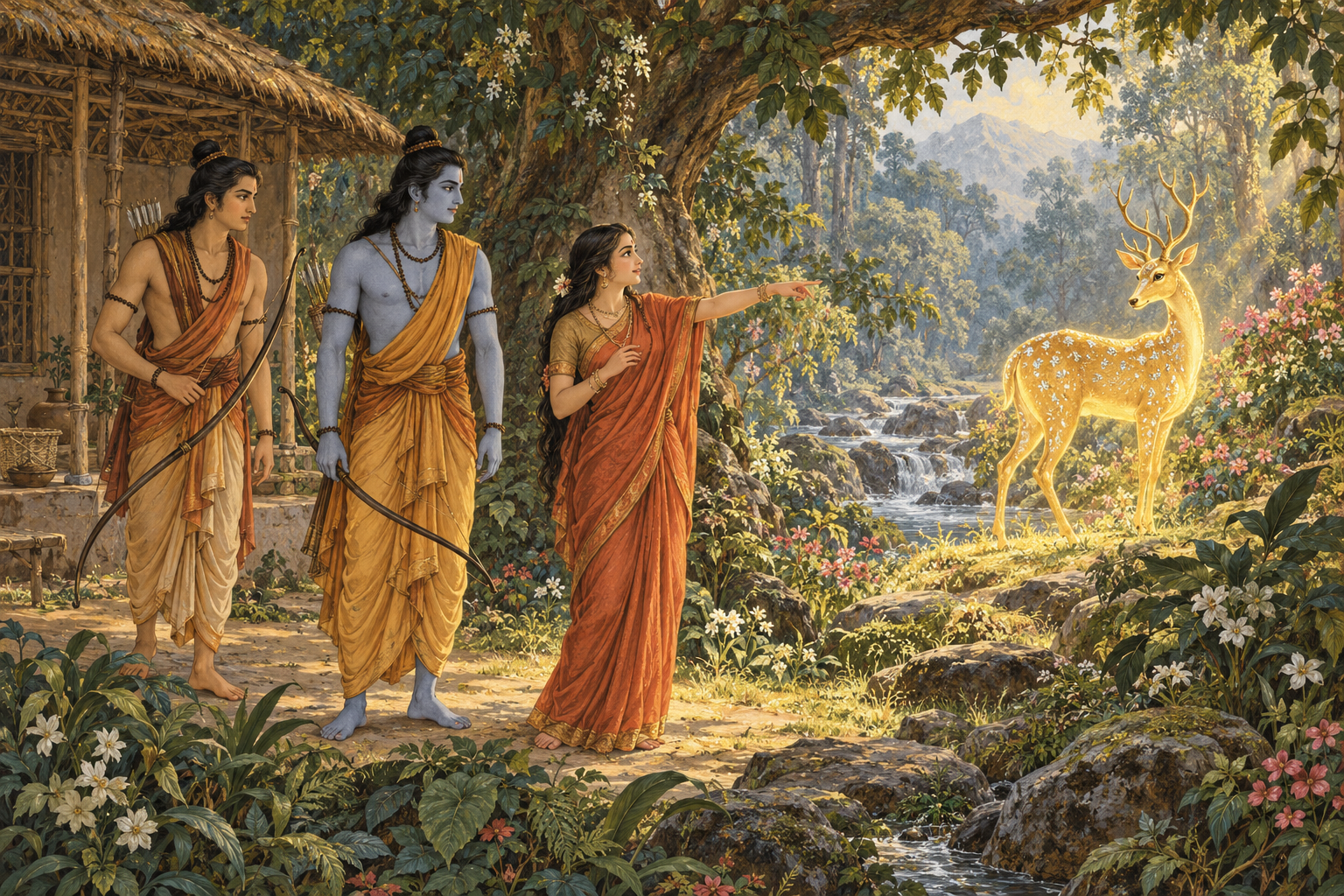
Reading goal: follow the request, decision, false cry and disagreement that separate the three companions. Name what each person knows at each stage before evaluating a choice.
The deer: a request, a warning and a decision
Sītā sees the extraordinary deer outside the hermitage.
Reference: Araṇya Kāṇḍa, Sarga 43 — selected narrative. Desiraju Hanumanta Rao; ValmikiRamayan.net English prose translation; narrative distinguished from accompanying commentary.
English reading — attributed handbook paraphrase
Sītā calls Rāma and Lakṣmaṇa to see the deer and asks Rāma to bring it alive, or its skin if it cannot be captured. Lakṣmaṇa suspects Mārīca’s disguise and warns that no ordinary animal has such an appearance. Rāma is also struck by its beauty. He says that, if it is Mārīca, the harmful demon should be killed. He tells Lakṣmaṇa to remain vigilant and protect Sītā while he pursues it.
Handbook paraphrase of the identified translation, not its exact wording. Complete chapter linked; specialist review pending.
Handbook reading guidance: Keep all three contributions visible. Sītā requests, Lakṣmaṇa warns, and Rāma decides after offering reasons. The narrative dialogue is distinct from the interpretive notes interspersed on the linked page.
Who first identifies the deer as a possible disguise?
Answer: Lakṣmaṇa names Mārīca and warns Rāma.
Mārīca’s false cry
Rāma has gone after the deer, leaving Lakṣmaṇa with Sītā.
Reference: Araṇya Kāṇḍa, Sarga 44 — selected narrative. Desiraju Hanumanta Rao; ValmikiRamayan.net English prose translation; narrative distinguished from accompanying commentary.
English reading — attributed handbook paraphrase
The deer repeatedly appears and vanishes, drawing Rāma far from the hermitage. Rāma finally shoots it. The dying Mārīca abandons the deer’s form and imitates Rāma’s voice, calling out to Sītā and Lakṣmaṇa. Rāma recognizes the deception Lakṣmaṇa had warned about and fears how the cry will affect those at the hermitage. He hurries back.
Handbook paraphrase of the identified translation, not its exact wording. Complete chapter linked; specialist review pending.
Handbook reading guidance: Distinguish what the reader now knows from what someone hearing the cry can know. The resemblance of the voice makes the deception consequential.
Whose voice does Mārīca imitate?
Answer: Rāma’s. The cry is not Rāma asking for rescue.
Fear, accusation and Lakṣmaṇa’s departure
Sītā hears the cry and asks Lakṣmaṇa to go to Rāma.
Reference: Araṇya Kāṇḍa, Sarga 45 — selected narrative. Desiraju Hanumanta Rao; ValmikiRamayan.net English prose translation; narrative distinguished from accompanying commentary.
English reading — attributed handbook paraphrase
Lakṣmaṇa initially stays because Rāma ordered him to guard Sītā. He says the cry is a deception and expresses confidence in Rāma’s strength. Sītā, frightened for Rāma, accuses Lakṣmaṇa of wishing his brother harm and having designs on her. Lakṣmaṇa protests the accusations and responds with harsh generalizations about women. He eventually asks the forest deities to protect her and leaves to find Rāma, repeatedly looking back.
Handbook paraphrase of the identified translation, not its exact wording. Complete chapter linked; specialist review pending.
Handbook reading guidance: The accusations and the generalizations belong to the speakers in a strained exchange; they are not handbook judgments. Track the conflict between the instruction to stay and the urgent demand to go.
Why does Lakṣmaṇa initially refuse to leave?
Answer: He is following Rāma’s instruction to guard Sītā and believes the cry is false.
Continue: the next selection jumps to the abduction in Sarga 49. The intervening approach and conversation are not reproduced in these selections.
The abduction and Jaṭāyu’s resistance
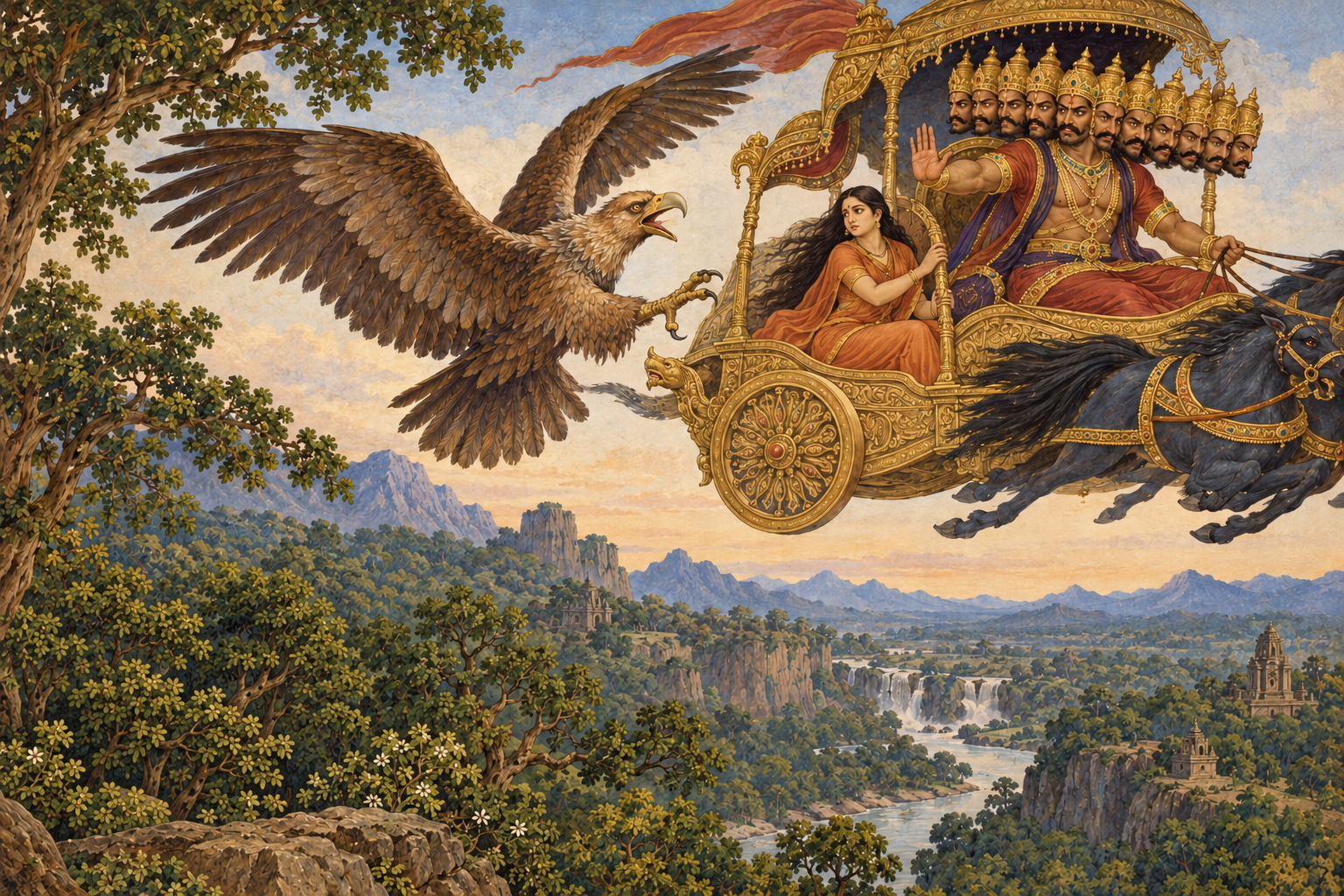
Reading goal: distinguish Sītā’s request for a report, Jaṭāyu’s attempt at rescue and the information he later gives Rāma. Read the injury, grief and continuing search alongside the heroic action.
Sītā calls for witnesses and a messenger
This selection follows Rāvaṇa’s approach and conversation in the intervening chapters.
Reference: Araṇya Kāṇḍa, Sarga 49 — selected narrative. Desiraju Hanumanta Rao; ValmikiRamayan.net English prose translation; narrative distinguished from accompanying commentary.
English reading — attributed handbook paraphrase
Rāvaṇa abandons his ascetic disguise, reveals his own form and forcibly takes Sītā into his aerial chariot. She calls to Rāma and Lakṣmaṇa, rebukes Rāvaṇa and appeals to the trees, Godāvarī, forest deities, birds and animals to carry news of her abduction. Seeing Jaṭāyu, she asks him to tell Rāma or Lakṣmaṇa exactly what happened, warning that the armed abductor is dangerous to confront.
Handbook paraphrase of the identified translation, not its exact wording. Complete chapter linked; specialist review pending.
Handbook reading guidance: Sītā speaks throughout the seizure. Preserve her appeals and her request for an accurate report alongside the account of force. Follow the translated narrative here separately from the page’s discussions of other tellings.
What does Sītā explicitly ask Jaṭāyu to do?
Answer: Tell Rāma or Lakṣmaṇa the complete account of her abduction.
Jaṭāyu attempts to stop Rāvaṇa
After Jaṭāyu’s remonstrance, the confrontation becomes a battle.
Reference: Araṇya Kāṇḍa, Sarga 51 — selected narrative. Desiraju Hanumanta Rao; ValmikiRamayan.net English prose translation; narrative distinguished from accompanying commentary.
English reading — attributed handbook paraphrase
Jaṭāyu withstands Rāvaṇa’s arrows and attacks with his feet, wings and beak. He breaks Rāvaṇa’s bows and destroys the chariot and its team. Rāvaṇa continues carrying Sītā, and Jaṭāyu attacks again. Rāvaṇa uses his sword to cut the bird’s wings and other parts of his body. Jaṭāyu falls gravely wounded; Sītā approaches, embraces him and weeps as for a relative.
Handbook paraphrase of the identified translation, not its exact wording. Complete chapter linked; specialist review pending.
Handbook reading guidance: The attempt to protect Sītā does not succeed in freeing her. Retain both Jaṭāyu’s resistance and its cost when describing this encounter.
Does Jaṭāyu’s destruction of the chariot complete the rescue?
Answer: No. Rāvaṇa continues the abduction and gravely wounds Jaṭāyu.
The final report and Rāma’s care for Jaṭāyu
Later, Rāma and Lakṣmaṇa find the wounded Jaṭāyu during their search.
Reference: Araṇya Kāṇḍa, Sarga 68 — selected narrative. Desiraju Hanumanta Rao; ValmikiRamayan.net English prose translation; narrative distinguished from accompanying commentary.
English reading — attributed handbook paraphrase
Jaṭāyu names Rāvaṇa as the abductor, says he took Sītā southward and describes his own injuries. He struggles to continue but dies before answering all Rāma’s questions. Rāma grieves and says Jaṭāyu deserves the honour he gives his father Daśaratha. He and Lakṣmaṇa perform funeral rites and offer water in the Godāvarī. They then turn toward the southern forest to continue searching.
Handbook paraphrase of the identified translation, not its exact wording. Complete chapter linked; specialist review pending.
Handbook reading guidance: The report gives a name and direction while leaving questions unanswered. Rāma’s response also honours the person who tried to help. Read the funeral as part of this narrative, rather than as a practical ritual checklist.
What two pieces of search information does Jaṭāyu provide?
Answer: The abductor is Rāvaṇa, and he travelled south with Sītā.
Connect the search: Jaṭāyu’s report precedes the welcome at Śabarī’s hermitage and the alliance with Sugrīva. Those readings show how the search brings further relationships and assistance.
Compare two acts of care: place Rāma’s care for Jaṭāyu beside the later authorization of rites for Rāvaṇa. Identify the relationship and action in each scene before proposing a shared meaning.
Toward Pampā: directions, welcome and the hermitage
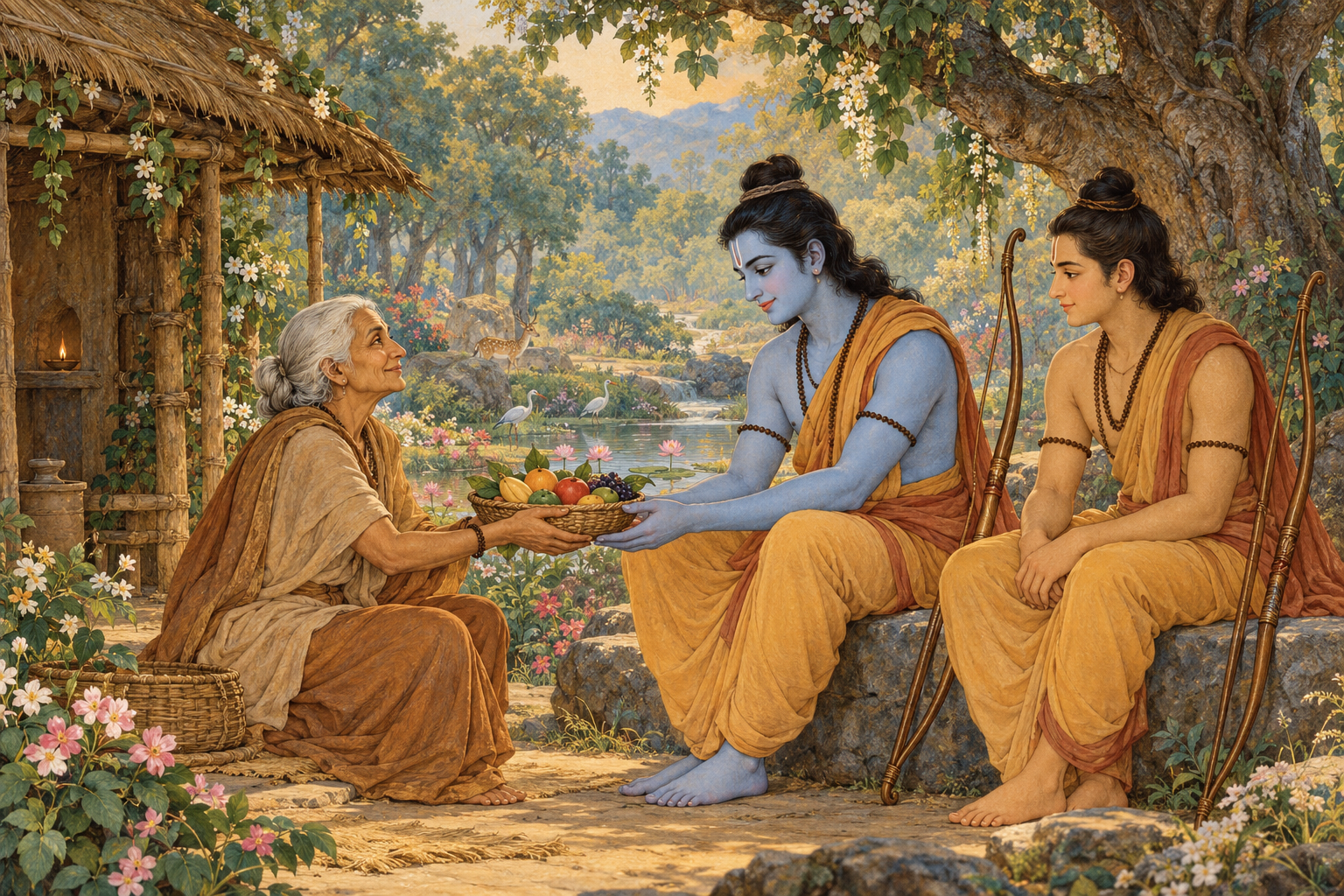
Reading goal: follow how a report leads to a journey, a welcome and an introduction to a place. Read the three selections in order before moving into the alliance chapters.
Kabandha points toward Pampā and Sugrīva
This selection follows Kabandha’s recovery of his divine form; it concerns his directions to the brothers.
Reference: Araṇya Kāṇḍa, Sarga 73 — selected narrative. Desiraju Hanumanta Rao; ValmikiRamayan.net English prose translation, Sanskrit Documents mirror; narrative distinguished from accompanying commentary.
English reading — attributed handbook paraphrase
Kabandha directs Rāma westward through forests toward Pampā. He tells him of Mātaṅga’s woodland and Śabarī, who remains there after her teachers’ departure. He describes Ṛśyamūka, where Sugrīva lives with four companions. As he departs, he again urges Rāma to befriend Sugrīva. His directions give the brothers both a route and a person to seek.
Handbook paraphrase of the identified translation, not its exact wording. Complete chapter linked; specialist review pending.
Handbook reading guidance: Notice the difference between directions and an accomplished alliance. Kabandha recommends a friendship; the brothers still have to travel and meet Sugrīva.
Has the alliance already been made here?
Answer: No. Kabandha gives directions and recommends it.
Śabarī: hospitality, practice and her teachers
Rāma and Lakṣmaṇa reach Śabarī’s hermitage near Pampā during the search. This selection follows their welcome and conversation, before the chapter’s later account of her departure.
Reference: Araṇya Kāṇḍa 3.74.5–17. Desiraju Hanumanta Rao; ValmikiRamayan.net English translation; verse-by-verse online chapter.
English reading — attributed handbook paraphrase
Śabarī rises to greet Rāma and Lakṣmaṇa, bows at their feet and provides water for their reception. Rāma asks about her ascetic practice, discipline, peace of mind and service to her teachers. She says that seeing him has brought her practice and service to fulfilment. Her teachers had told her that he would arrive with Lakṣmaṇa and that she should welcome them. She has gathered forest food from the surroundings of Pampā for him.
Handbook paraphrase of the identified translation, not its exact wording. Complete chapter linked; specialist review pending.
Handbook reading guidance: Śabarī speaks about her teachers and her preparation; Rāma asks about her practice. The welcome is a conversation with an accomplished ascetic. Follow both contributions before reducing the encounter to the food alone.
Does this selection say she tastes each fruit before offering it?
Answer: No. Verse 17 says she gathered forest food. The tasting detail is not stated in these selected verses; identify a separate source when studying that telling.
Śabarī shows her teachers’ hermitage
This selected continuation follows the welcome and conversation reproduced above.
Reference: Araṇya Kāṇḍa, Sarga 74 — selected narrative. Desiraju Hanumanta Rao; ValmikiRamayan.net English prose translation, Sanskrit Documents mirror; narrative distinguished from accompanying commentary.
English reading — attributed handbook paraphrase
Rāma says he has heard from Kabandha about Śabarī and her teachers, and asks to see their hermitage. Śabarī shows the brothers the woodland and the places where her teachers performed fire offerings. She describes the enduring radiance of their altars and the flowers used in worship, preserving their memory through the place.
Handbook paraphrase of the identified translation, not its exact wording. Complete chapter linked; specialist review pending.
Handbook reading guidance: Read these wonders as part of Śabarī’s account.
Who asks to see the hermitage?
Answer: Rāma, after recalling Kabandha’s report.
Follow the handover of information
Use the source readings above to trace who speaks, what information is given and what happens next. Separate a recommendation from a meeting, and a meeting from an agreement.
Which reading supplies directions, and which supplies a welcome?
Answer: Kabandha supplies the route and recommendation. Śabarī receives the brothers and speaks about her teachers. Rāma then asks to see the hermitage.
Continue the search: return to Jaṭāyu’s report for the earlier discovery, then proceed to the alliance with Sugrīva. Keep each scene’s source reference beside your comparison.
The first meeting: speech, trust and mutual need
Reading goal: follow the sequence by which strangers become prospective allies. Identify who speaks for whom, what help is requested and what remains to be agreed.
Begin with Kabandha’s recommendation, then read these two conversations before the pact before fire. The chapter references keep the recommendation, introduction and commitment distinct.
Hanumān introduces himself as Sugrīva’s envoy
Before the pact, Sugrīva sends Hanumān to approach the unknown brothers.
Reference: Kiṣkindhā Kāṇḍa, Sarga 3 — selected narrative and dialogue. Desiraju Hanumanta Rao; ValmikiRamayan.net English prose translation, Sanskrit Documents mirror; narrative distinguished from accompanying commentary.
English reading — attributed handbook paraphrase
Hanumān approaches Rāma and Lakṣmaṇa in an ascetic’s form, greets them respectfully and asks about their appearance and arrival. He then names himself as Sugrīva’s minister and says his king desires friendship. Rāma asks Lakṣmaṇa to speak with him. In this edition, Rāma praises Hanumān’s learning, grammar, expression and measured speech, and connects such an envoy’s abilities with a king’s success. Lakṣmaṇa replies that they too are seeking Sugrīva. Hanumān is pleased at the prospect of bringing them together.
Handbook paraphrase of the identified translation, not its exact wording. Complete chapter linked; specialist review pending.
Handbook reading guidance: Follow the introduction before the praise. The linked edition flags manuscript variation in the extended assessment of Hanumān’s speech; this reading follows its presented text, without treating every edition as identical.
Who does Rāma ask to answer the envoy?
Answer: Lakṣmaṇa. Rāma first discusses Hanumān’s speech with his brother.
Lakṣmaṇa explains why they need help
The conversation continues before the brothers meet Sugrīva.
Reference: Kiṣkindhā Kāṇḍa, Sarga 4 — selected narrative and dialogue. Desiraju Hanumanta Rao; ValmikiRamayan.net English prose translation, Sanskrit Documents mirror; narrative distinguished from accompanying commentary.
English reading — attributed handbook paraphrase
Lakṣmaṇa recounts Rāma’s family, exile and Sītā’s abduction. He explains that Kabandha, released from his curse, recommended Sugrīva as someone able to help. He appeals for assistance for the grief-stricken Rāma. Hanumān describes Sugrīva’s own displacement and fear of Vāli, and promises help from the vānaras in searching for Sītā. Lakṣmaṇa recognizes the possibility of mutual assistance. Hanumān resumes his own form, carries the brothers on his back and brings them toward Sugrīva at Ṛśyamūka.
Handbook paraphrase of the identified translation, not its exact wording. Complete chapter linked; specialist review pending.
Handbook reading guidance: Separate the appeal, Hanumān’s assurance and the actual introduction. The chapter ends in movement toward a meeting; the pact is in the next chapter.
What makes the proposed friendship useful to both sides?
Answer: The brothers seek help finding Sītā; Sugrīva seeks help after displacement by Vāli. The conversation brings those needs together.
Pause before the pact
Write one sentence for each stage: an envoy approaches; the brothers explain their need; a meeting becomes possible. Use the supplied readings to check each sentence. Then read the pact and identify what is promised there that was not yet formally agreed in the introduction.
Which step actually establishes the friendship before fire?
Answer: The supplied Sarga 5 reading in the next section. Sargas 3 and 4 prepare the meeting rather than already completing that rite.
A question to carry forward: how does hearing another person’s circumstances change what becomes possible? Compare the information exchanged here with the later message to Sītā, using each scene’s own reading.
The alliance and Vāli’s challenge
Follow the friendship, the disputed intervention and the concern for those left behind. This reading path keeps the participants’ reasons visible before considering a later interpretation.
A friendship made before fire
Hanumān introduces the brothers to Sugrīva. The pact comes before the confrontation with Vāli.
Reference: Kiṣkindhā Kāṇḍa, Sarga 5. Desiraju Hanumanta Rao; ValmikiRamayan.net English translation; identified online chapter or Sanskrit Documents mirror.
English reading — attributed handbook paraphrase
Hanumān explains Rāma’s circumstances and recommends friendship. Sugrīva extends his hand; Rāma takes it and embraces him. Hanumān kindles and honours a fire, and the new friends walk around it. Sugrīva says their joys and sorrows are now shared, describes his fear of Vāli and asks for protection. Rāma promises to kill Vāli. Sugrīva hopes to recover his wife and kingdom.
Handbook paraphrase of the identified translation, not its exact wording. Complete chapter linked; specialist review pending.
Handbook reading guidance: the handclasp, embrace and fire accompany a spoken commitment. Sugrīva names his need for protection; Rāma makes a promise that matters in the later reply. Read the pact before evaluating what its obligations require.
Who prepares the fire for the pact?
Answer: Hanumān. Rāma and Sugrīva then walk around it as they establish their friendship.
Vāli asks what justifies the attack
Struck by Rāma’s arrow while fighting Sugrīva, Vāli is still alive and addresses Rāma when he approaches.
Reference: Kiṣkindhā Kāṇḍa, Sarga 17 — selected objections. Desiraju Hanumanta Rao; ValmikiRamayan.net English translation; identified online chapter or Sanskrit Documents mirror.
English reading — attributed handbook paraphrase
Vāli questions why Rāma struck him while he was occupied with another opponent and did not confront him openly. He contrasts Rāma’s reputation for righteousness with the action he has suffered. He says he has not wronged Rāma in his territory and asks what interest justified the intervention. He also claims that, if asked, he could have recovered Sītā himself. These objections are Vāli’s speech, not the narrator’s settled verdict.
Handbook paraphrase of the identified translation, not its exact wording. Complete chapter linked; specialist review pending.
Handbook reading guidance: separate the objection about the method of attack from the question of Rāma’s authority to intervene. Vāli raises both. The source also contains commentary interpreting his accusations differently; that commentary is an additional layer, not a replacement for the translated speech.
Rāma’s defence and Vāli’s concern for Angada
Read this reply alongside Vāli’s objections. The paraphrase follows the dialogue rather than the separate commentary woven into the linked page.
Reference: Kiṣkindhā Kāṇḍa, Sarga 18 — selected reply and concluding exchange. Desiraju Hanumanta Rao; ValmikiRamayan.net English translation; identified online chapter or Sanskrit Documents mirror.
English reading — attributed handbook paraphrase
Rāma invokes the authority of the Ikṣvāku rulers and Bharata, describes punishment as royal duty, and accuses Vāli of taking his living younger brother’s wife, Rumā. He also cites his promise to Sugrīva and argues that hunting need not be a face-to-face encounter. Vāli accepts the reply and asks for protection of his son Angada and care for Tārā. Rāma assures him that those he leaves behind will be cared for.
Handbook paraphrase of the identified translation, not its exact wording. Complete chapter linked; specialist review pending.
Handbook reading guidance: Rāma offers several grounds, including royal authority, Rumā’s treatment, his promise and hunting. List them separately before deciding whether a particular ground answers a particular objection. The narrative’s account of Vāli accepting the reply should also remain visible.
Does the reply rely only on Rāma’s promise to Sugrīva?
Answer: No. It also invokes royal duty, Vāli’s conduct toward Rumā and a hunting argument. A one-reason summary loses the structure of the reply.
The survivors matter: Vāli’s request about Angada and Tārā turns the exchange toward responsibility after violence. Name the people whose protection he seeks, alongside the earlier dispute.
Organizing the search: purpose, people and recognition
Reading goal: distinguish the goal of an expedition, command of a party and an individual messenger’s assignment. Follow how a question becomes a search and how a token prepares for a later conversation.
Where this fits: the first meeting and pact precede the dispute with Vāli. These selections resume later, when search parties are being commissioned. They are a selected path through Kiṣkindhā, not a replacement for all its intervening chapters.
Rāma defines what the search must establish
This occurs after the pact, Vāli’s death, Sugrīva’s accession and the intervening delay; those events are not collapsed into one meeting.
Reference: Kiṣkindhā Kāṇḍa, Sarga 40 — selected narrative and dialogue. Desiraju Hanumanta Rao; ValmikiRamayan.net English prose translation, Sanskrit Documents mirror; narrative distinguished from accompanying commentary.
English reading — attributed handbook paraphrase
Sugrīva presents the assembled vānaras and invites Rāma to assign their task. Rāma says they must first learn whether Sītā is alive and determine Rāvaṇa’s dwelling. Further action will follow that knowledge and consultation with Sugrīva. He entrusts the direction of the search to Sugrīva, recognizing his ability and understanding of their purpose. Sugrīva then appoints Vinata to lead the eastern search and instructs that party to seek Sītā and Rāvaṇa’s residence.
Handbook paraphrase of the identified translation, not its exact wording. Complete chapter linked; specialist review pending.
Handbook reading guidance: Identify the questions before the mobilization. Gathering a force does not itself answer where Sītā is or establish her condition. Read the geographical catalogue in its epic context; it is not a modern route plan.
What two things does Rāma want established first?
Answer: Whether Sītā is alive and where Rāvaṇa dwells.
Angada leads the southern search party
The eastern instructions are followed by a separate commission for the south.
Reference: Kiṣkindhā Kāṇḍa, Sarga 41 — selected narrative and dialogue. Desiraju Hanumanta Rao; ValmikiRamayan.net English prose translation, Sanskrit Documents mirror; narrative distinguished from accompanying commentary.
English reading — attributed handbook paraphrase
Sugrīva makes Angada chief of the southern party, which includes Hanumān, Jāmbavān and Nīla among its named members. He describes places to search and singles out the island associated with Rāvaṇa as especially important. He tells them to investigate possible locations thoroughly before moving on, including places not individually named. He calls for a quick return with news and promises particular favour to the one who reports seeing Sītā before a month has passed.
Handbook paraphrase of the identified translation, not its exact wording. Complete chapter linked; specialist review pending.
Handbook reading guidance: Distinguish the commander from other members’ assignments. A place marked for investigation is not yet a witnessed report that Sītā has been found there. The chapter contains wonders and realms as well as named places; do not silently turn its catalogue into precise modern geography.
Who commands this party, and is Hanumān part of it?
Answer: Angada commands it. Hanumān is one of its named members, along with Jāmbavān and Nīla.
Rāma entrusts his ring to Hanumān
This follows the directional commissions and gives Hanumān a particular responsibility within the larger expedition.
Reference: Kiṣkindhā Kāṇḍa, Sarga 44 — selected narrative and dialogue. Desiraju Hanumanta Rao; ValmikiRamayan.net English prose translation, Sanskrit Documents mirror; narrative distinguished from accompanying commentary.
English reading — attributed handbook paraphrase
Sugrīva expresses confidence in Hanumān’s movement, strength, judgment and ability to act with regard to time and place. Rāma observes that confidence and gives Hanumān a ring bearing his name. He explains that Sītā can recognize through it that Hanumān has come from him and meet him without fear. Hanumān receives the ring reverently, bows before Rāma and departs with the expedition. Rāma asks him to make the effort needed to reach Sītā.
Handbook paraphrase of the identified translation, not its exact wording. Complete chapter linked; specialist review pending.
Handbook reading guidance: Keep the named narrative function of the ring distinct from the page’s later symbolic and wedding interpretations. The token prepares for recognition; it is not yet the encounter with Sītā.
What is the ring meant to establish for Sītā?
Answer: That Hanumān has come from Rāma, so she can recognize his connection and hear him without apprehension.
Keep the responsibilities distinct
Use the readings above to compare the roles. Each row points back to the passage supplying it.
| Role | Reading to revisit |
|---|---|
| Define the information needed before further action | Rāma’s search goal |
| Assign the search parties | Sugrīva commissions Vinata |
| Command the southern party | Angada’s appointment |
| Carry a token connecting the messenger with Rāma | Hanumān receives the ring |
Three questions for a closer reading
Does receiving the ring make Hanumān the commander of the southern party?
Answer: These readings assign the command to Angada and the ring to Hanumān. Keep the two responsibilities distinct.
Does naming an island establish that the searchers have seen Sītā?
Answer: No. An instruction directs an investigation; a witnessed report is a later step. Compare the commission with Hanumān’s message and recognition scene.
What is the difference between the ring’s purpose here and a later interpretation of it?
Answer: The supplied narrative explains recognition of the messenger’s connection to Rāma. A symbolic explanation belongs to a separately attributed interpretive layer.
A manageable review path
On another visit, begin with the three questions above before reopening the answers. Revisit the linked readings for any detail you cannot support. Then follow Jāmbavān’s encouragement and the encounter with Sītā to see how the commission develops into action and a report.
At the ocean: information, limits and encouragement
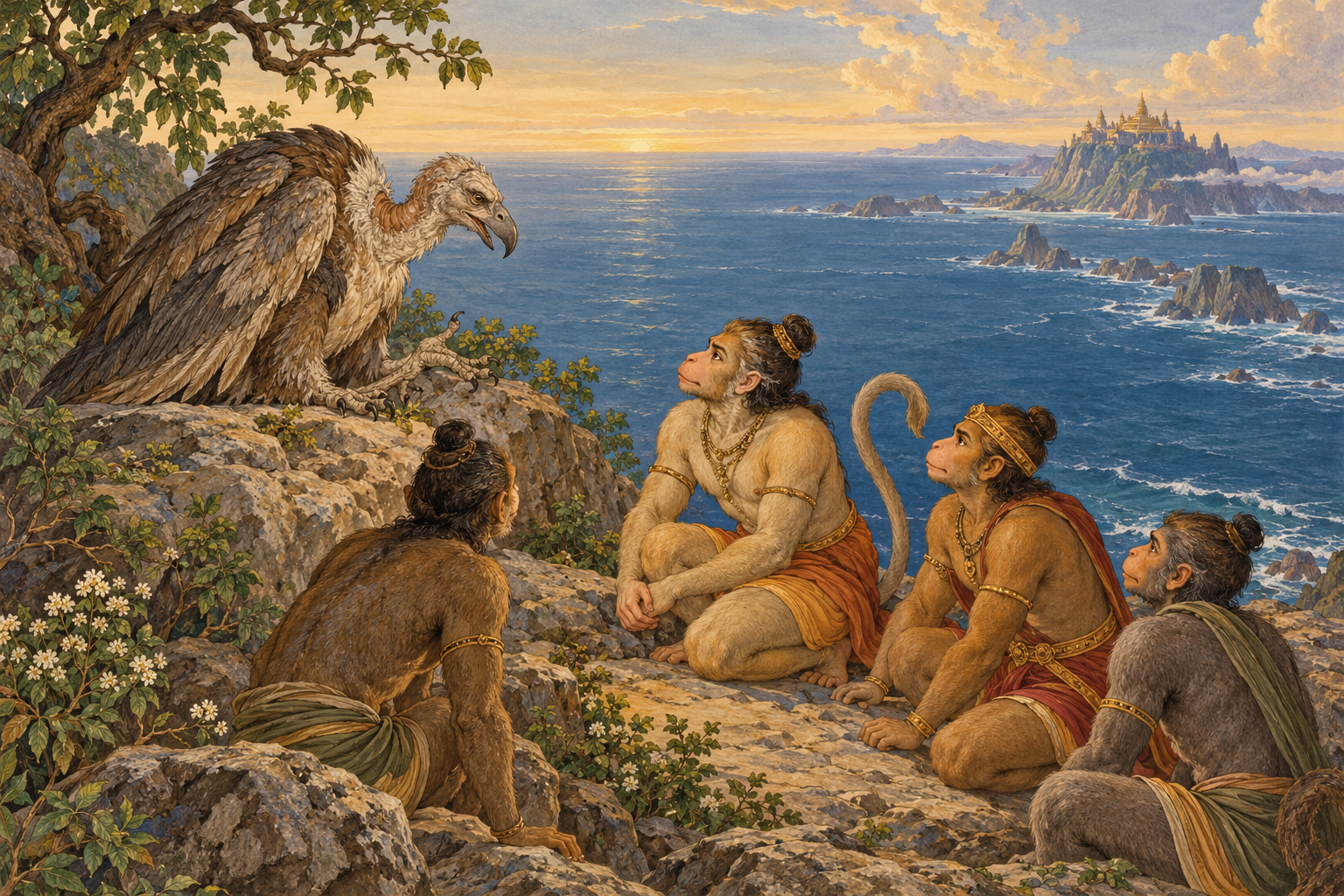
Reading goal: follow the movement from a lead to a practical problem and a decision. Identify what information is available, what the party cannot yet do and how counsel changes its next step.
Begin with the southern party’s commission. These selections resume after further difficulties in the search; they do not reproduce every intervening encounter.
Sampāti supplies a lead to Laṅkā
After hearing of Jaṭāyu’s death, Sampāti speaks to Angada and the searchers.
Reference: Kiṣkindhā Kāṇḍa, Sarga 58 — selected narrative. Desiraju Hanumanta Rao; ValmikiRamayan.net English prose translation, Sanskrit Documents mirror; narrative distinguished from accompanying commentary.
English reading — attributed handbook paraphrase
Sampāti identifies Jaṭāyu as his younger brother and recalls losing his wings while shielding him from the sun. Angada asks whether he knows Rāvaṇa’s whereabouts. Sampāti says he saw a woman carried away by Rāvaṇa, calling for Rāma and Lakṣmaṇa and dropping ornaments. He infers that she was Sītā. He names Laṅkā as Rāvaṇa’s city and says Sītā is confined there under guard. Although unable to fly, he offers help through his words and urges the party to find a way across the ocean. The vānaras assist him in offering water for Jaṭāyu, then resume the search with renewed hope.
Handbook paraphrase of the identified translation, not its exact wording. Complete chapter linked; specialist review pending.
Handbook reading guidance: Separate the reported sight, the identification and the proposed next step. This is Sampāti’s information to the party, before Hanumān’s own encounter with Sītā.
How can Sampāti help despite losing his wings?
Answer: He supplies information: what he saw, whom he believes he saw and where he directs the search.
The party weighs the crossing and the return
The searchers consider who can reach the far shore.
Reference: Kiṣkindhā Kāṇḍa, Sarga 65 — selected narrative. Desiraju Hanumanta Rao; ValmikiRamayan.net English prose translation, Sanskrit Documents mirror; narrative distinguished from accompanying commentary.
English reading — attributed handbook paraphrase
The vānaras take turns stating how far they can leap. Jāmbavān contrasts his former strength with the limits of his age. Angada says he can cross the ocean but is uncertain of returning. Jāmbavān says Angada must be protected as the mission’s leader, rather than sent as its lone assignee. Angada fears returning to Sugrīva without accomplishing the task. Jāmbavān reassures him that he will find the one who can succeed, and turns to encourage Hanumān.
Handbook paraphrase of the identified translation, not its exact wording. Complete chapter linked; specialist review pending.
Handbook reading guidance: Reaching the destination and returning with information are separate demands. Jāmbavān also raises a question about preserving leadership. Keep his argument distinct from the linked commentary’s explanation of the other searchers’ motives.
What uncertainty does Angada state?
Answer: He believes he can cross, but does not know whether he can come back.
Jāmbavān calls Hanumān to act
The search party faces the ocean. These closing verses focus on Jāmbavān’s encouragement and Hanumān’s response.
Reference: Kiṣkindhā Kāṇḍa 4.66.34–38. Desiraju Hanumanta Rao; ValmikiRamayan.net English translation; identified online chapter or Sanskrit Documents mirror.
English reading — attributed handbook paraphrase
Jāmbavān says that age has diminished his own strength, while Hanumān possesses the qualities needed now. He urges Hanumān to rise and cross the ocean, saying the dispirited company is waiting to see his power. Encouraged by him, Hanumān increases his bodily form and gladdens the assembled vānaras. The selection ends with this preparation for action.
Handbook paraphrase of the identified translation, not its exact wording. Complete chapter linked; specialist review pending.
Handbook reading guidance: distinguish the elder’s assessment, his exhortation and Hanumān’s response. The chapter’s later “parables” note discusses a curse about remembering strength; that is a separate explanatory note, not wording supplied by verses 34–38.
Have these verses already narrated the landing in Laṅkā?
Answer: No. They end with Hanumān enlarging his form after encouragement. The crossing belongs to the narrative that follows.
A lead is not the end of the mission
Use the three readings to distinguish knowing where to investigate, reaching that place and returning with a report. For each stage, identify the person who contributes and the problem still to be solved.
Why is a report about a destination insufficient by itself?
Answer: The party still needs a way to reach the destination and bring back information. Sampāti’s lead, the assessment of abilities and Jāmbavān’s encouragement address different parts of that task.
Read next: follow Hanumān’s crossing, then the recognition and message. Keep a report, preparation, arrival and an encounter as distinct stages.
Across the ocean: choosing a response
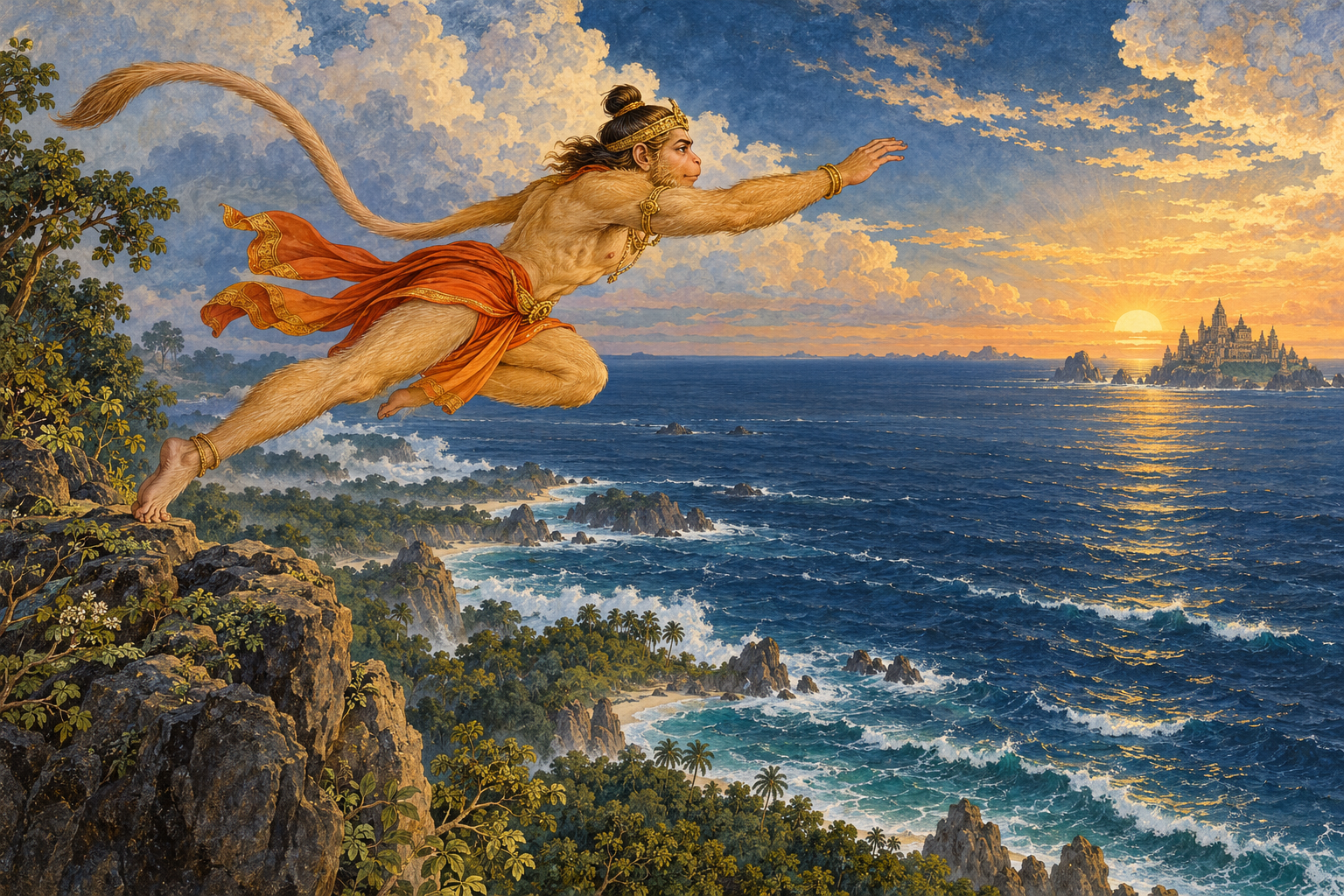
Reading goal: distinguish an offer, a test and a hostile encounter. Use the compact reading below before opening the complete chapter.
Hanumān crosses: hospitality, a test and an attack
The opening chapter of Sundara Kāṇḍa follows the preparations in Kiṣkindhā.
Reference: Sundara Kāṇḍa, Sarga 1 — selected narrative. Kishore Kopalle; ValmikiRamayan.net English prose translation, Sanskrit Documents mirror; narrative distinguished from accompanying commentary.
English reading — attributed handbook paraphrase
Hanumān sets out from Mahendra. Maināka rises to offer rest; Hanumān acknowledges the welcome but continues because his task is urgent. The gods send Surasā to test him. After enlarging with her expanding mouth, he becomes tiny, enters and exits it, and receives her blessing. Siṃhikā seizes his shadow and checks his flight; he enters her mouth and kills her. Near the far shore he reduces his size to avoid attracting attention, lands and sees Laṅkā.
Handbook paraphrase of the identified translation, not its exact wording. Complete chapter linked; specialist review pending.
Handbook reading guidance: These encounters require different responses. Arrival at Laṅkā still precedes finding Sītā.
Does Hanumān kill Surasā?
Answer: No. He passes through her mouth and receives her blessing.
Compare the encounters
For each encounter in the supplied reading, name what is presented to Hanumān and what he does. Support your comparison from the reading before offering a broader interpretation.
Should every interruption be described as the same kind of enemy?
Answer: No. Revisit who offers help, who tests and who attacks in the reading above. Similarity in interrupting the journey does not make their purposes identical.
Continue in order: the next recognition and message readings move ahead to the conversation with Sītā. The linked full chapter supplies the crossing’s wider narrative; this guide uses selected episodes and leaves intervening chapters visible through their separate references.
Hanumān’s message: recognition and useful information
Reading goal: follow how a messenger approaches a frightened listener, explains his connection and answers questions. Distinguish the opening story, Sītā’s inquiry, the ring and the later proposal for rescue.
A selected conversation path: begin with the deliberation below, then read the account from the tree, Sītā’s questions, the ring and the proposed rescue. The chapter references mark the gaps between these selections.
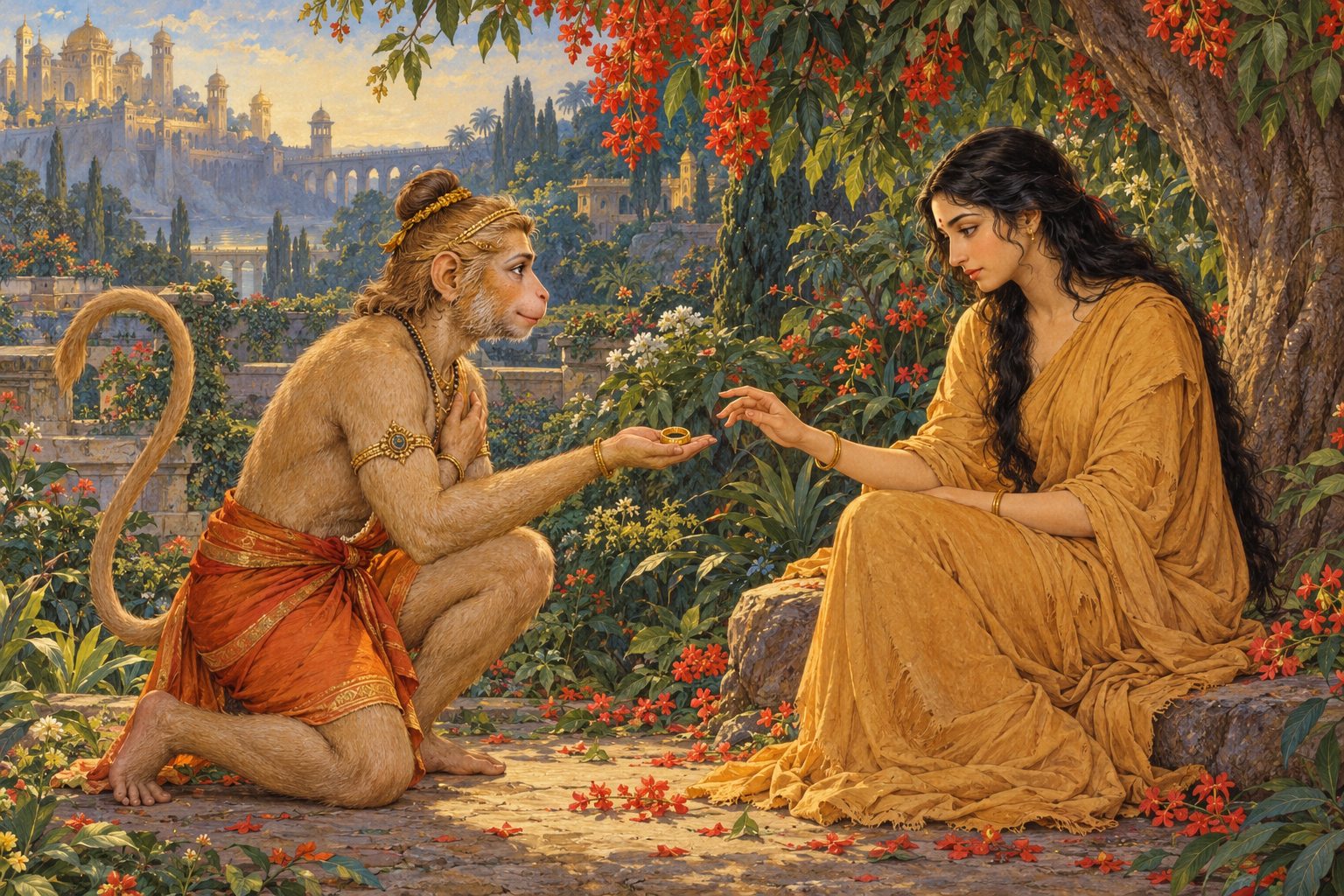
Before speaking: how can Sītā hear without fear?
This reflection comes before Hanumān’s conversation with Sītā and the ring presented below.
Reference: Sundara Kāṇḍa, Sarga 30. K. M. K. Murthy; ValmikiRamayan.net English translation; identified chapter or Sanskrit Documents mirror.
English reading — attributed handbook paraphrase
Hanumān weighs the danger of leaving Sītā without consolation against the danger of alarming her. Learned Sanskrit spoken by a monkey might make her suspect Rāvaṇa in disguise. A frightened cry could summon guards and endanger both Sītā and the mission. He considers the messenger’s responsibility to judge circumstances and timing. He decides to speak gently about Rāma, whose story can help her understand and trust his message.
Handbook paraphrase of the identified translation, not its exact wording. Complete chapter linked; specialist review pending.
Handbook reading guidance: attend to the listener’s fear as well as the messenger’s knowledge. Hanumān’s deliberation asks how a true message can be delivered in a form that can safely be heard.
Why does Hanumān hesitate to speak?
Answer: He fears that Sītā may mistake him for Rāvaṇa and alert the guards. Silence also carries danger, so he must choose how to approach her.
Hanumān speaks Rāma’s story within Sītā’s hearing
This follows the deliberation in Sarga 30; several intervening chapters precede the later ring scene.
Reference: Sundara Kāṇḍa, Sarga 31 — selected dialogue. K. M. K. Murthy; ValmikiRamayan.net English prose translation, Sanskrit Documents mirror; dialogue distinguished from accompanying commentary.
English reading — attributed handbook paraphrase
Hanumān speaks gently within Sītā’s hearing. He begins with Daśaratha and Rāma, recounts the exile with Sītā and Lakṣmaṇa, and describes the abduction through the deception of the deer. He tells of Rāma’s friendship with Sugrīva, Vāli’s death and the search parties. He says Sampāti’s words led him to cross the ocean, and that the woman he has found matches Rāma’s description. He then falls silent. Sītā looks toward the tree and around her, remembers Rāma with joy and sees Hanumān.
Handbook paraphrase of the identified translation, not its exact wording. Complete chapter linked; specialist review pending.
Handbook reading guidance: Follow the sequence: deliberation, a spoken account, silence and the listener’s response. These events prepare a conversation; do not assume that hearing familiar names removes the need for further questions.
Where does Hanumān begin his account?
Answer: With Daśaratha and Rāma’s family, before moving through the exile and search.
Sītā asks how Hanumān knows the brothers
This selected exchange precedes the ring in Sarga 36. The full chapter contains a much longer description and account.
Reference: Sundara Kāṇḍa, Sarga 35 — selected dialogue. K. M. K. Murthy; ValmikiRamayan.net English prose translation, Sanskrit Documents mirror; dialogue distinguished from accompanying commentary.
English reading — attributed handbook paraphrase
Sītā asks where Hanumān met Rāma, how he knows Lakṣmaṇa and how men and vānaras became allies. She asks him to describe the brothers’ appearance. Hanumān supplies descriptions and recounts his introduction of them to Sugrīva. He tells of Sītā’s ornaments being shown to Rāma, Rāma’s grief, the friendship, and the search under Angada. He explains how Sampāti supplied the lead and how he crossed to Laṅkā. He identifies himself as the messenger and gives his own background. These reasons inspire Sītā’s confidence, and she weeps with joy.
Handbook paraphrase of the identified translation, not its exact wording. Complete chapter linked; specialist review pending.
Handbook reading guidance: Her questions ask for the messenger’s connection, descriptions and an account of events. Read the answers as parts of an unfolding exchange. Do not replace Sītā’s active questioning with an image of automatic trust.
What does Sītā ask beyond hearing Rāma’s name?
Answer: How Hanumān knows the brothers, how the alliance arose and what the brothers look like.
A ring, questions and news
The selection joins the initial identification to Sītā’s questions and Hanumān’s answer; intervening verses are not reproduced.
Reference: Sundara Kāṇḍa 5.36.1–3, 15–20, 33–34. K. M. K. Murthy; ValmikiRamayan.net English translation; identified online chapter.
English reading — attributed handbook paraphrase
Hanumān identifies himself as Rāma’s messenger and presents the ring bearing Rāma’s name as a means of establishing trust and consolation. Sītā’s questions then concern Rāma’s grief, his effort, allies, divine help and human action, and whether he remembers her. Hanumān explains that Rāma does not yet know where she is. He assures her that, once Rāma hears the news, he will come with the army of monkeys and bears.
Handbook paraphrase of the identified reading, not the translator’s exact wording. Complete chapter linked; specialist review pending.
Handbook reading guidance: recognition opens the conversation but does not replace it. Sītā asks for information, and Hanumān explains what Rāma still lacks. Keep present knowledge and promised future action separate.
According to Hanumān’s answer, does Rāma already know Sītā’s location?
Answer: No. He says Rāma does not yet know it. The message must therefore carry news back as well as provide reassurance.
For a second reading, group her questions into concern for Rāma, available help and the prospect of release. This is an editorial way to follow the conversation, not a division supplied by the Sanskrit text.
Sītā considers and declines the immediate rescue
After the recognition and exchange of news, Hanumān offers to carry Sītā across the ocean.
Reference: Sundara Kāṇḍa, Sarga 37 — selected exchange. K. M. K. Murthy; ValmikiRamayan.net English translation; identified chapter or Sanskrit Documents mirror.
English reading — attributed handbook paraphrase
Sītā initially questions how Hanumān’s small body could carry her. After he enlarges his form, she acknowledges his ability but gives further reasons for declining. She fears falling during swift flight, pursuit, battle and recapture. She says a victory won entirely by Hanumān would diminish Rāma’s renown. She also invokes fidelity to her husband, distinguishing voluntary contact from Rāvaṇa’s forced seizure. She asks Hanumān to bring Rāma, Lakṣmaṇa and the army to Laṅkā.
Handbook paraphrase of the identified translation, not its exact wording. Complete chapter linked; specialist review pending.
Handbook reading guidance: distinguish the initial doubt about strength from the later objections. Sītā acknowledges Hanumān’s capacity and still declines. Practical risks, reputation and her stated marital commitment each belong to her reasoning; avoid reducing the exchange to only one.
Does showing his larger form resolve all of Sītā’s objections?
Answer: No. It answers her concern about his capacity, but her other reasons remain. She asks him to bring Rāma and the army.
Read the exchange as a sequence
The supplied readings let you follow preparation, an opening account, questions, a token and a practical proposal. For each step, ask what has been learned and what remains unresolved. A true connection, a hopeful message and a safe plan are different questions.
Does the ring replace Sītā’s questions?
Answer: No. The Sarga 35 selection already shows her inquiry before the ring. The Sarga 36 reading then contains further questions about Rāma’s condition, help and action. Read both stages.
Does confidence in the messenger require accepting his rescue proposal?
Answer: No. In the supplied Sarga 37 reading Sītā acknowledges Hanumān’s ability but gives reasons for declining immediate transport. Trust and agreement with a particular plan remain distinct.
Review on another visit: recall three things Sītā asks the messenger before opening the answer above. Then revisit the source panel to check your recall. Compare Hanumān’s account of the introduction with the first meeting readings; one narrates the meeting as it happens and the other recounts it to Sītā.
Before Rāvaṇa: the message and the messenger
Reading goal: distinguish a messenger’s identity, the demand he carries and a debate about how he may be treated. Follow the three speakers’ reasons before offering your own evaluation.
This sequence follows the conversation with Sītā. It resumes at the court after intervening violence and capture, retaining those circumstances in each reading.
Before Rāvaṇa: Hanumān names his mission
These readings resume after the encounter with Sītā, the garden’s destruction, fighting and capture. Those intervening events are not reproduced here.
Reference: Sundara Kāṇḍa, Sarga 50 — selected dialogue. K. M. K. Murthy; ValmikiRamayan.net English prose translation, Sanskrit Documents mirror; dialogue distinguished from accompanying commentary.
English reading — attributed handbook paraphrase
Rāvaṇa orders Prahasta to question Hanumān about his arrival and actions. Prahasta asks who sent him and promises release if he speaks truthfully. Hanumān rejects the suggested identities and names himself as Rāma’s messenger. He says he fought to protect himself and submitted to the missile because he wished to see Rāvaṇa. He asks the king to hear words intended for his benefit.
Handbook paraphrase of the identified translation, not its exact wording. Complete chapter linked; specialist review pending.
Handbook reading guidance: Treat the explanation of his conduct as Hanumān’s answer to interrogation. The chapter contains competing descriptions of him; identify the speaker before taking a description as a settled verdict.
Who conducts the questioning at Rāvaṇa’s command?
Answer: Prahasta. Hanumān then speaks to Rāvaṇa and identifies his mission.
The message asks for Sītā’s return
Hanumān continues after identifying himself.
Reference: Sundara Kāṇḍa, Sarga 51 — selected dialogue. K. M. K. Murthy; ValmikiRamayan.net English prose translation, Sanskrit Documents mirror; dialogue distinguished from accompanying commentary.
English reading — attributed handbook paraphrase
Hanumān brings Sugrīva’s greeting and recounts Rāma’s exile, the loss of Sītā, the friendship with Sugrīva and the search. He says he crossed the ocean and found Sītā in Laṅkā. He appeals to Rāvaṇa’s knowledge and austerities, says holding another’s wife is wrong and urges him to restore Sītā to Rāma. He warns that refusing threatens Rāvaṇa, his family and his city. Hearing the unwelcome message, Rāvaṇa orders Hanumān’s death.
Handbook paraphrase of the identified translation, not its exact wording. Complete chapter linked; specialist review pending.
Handbook reading guidance: Identify both the requested action and the warning. Praise of the king’s knowledge forms part of an appeal to change his conduct; it does not erase the criticism or guarantee that he will listen.
What specific action does Hanumān request?
Answer: Return Sītā to Rāma.
Vibhīṣaṇa opposes killing the messenger
Rāvaṇa’s order prompts an objection from his brother.
Reference: Sundara Kāṇḍa, Sarga 52 — selected dialogue. K. M. K. Murthy; ValmikiRamayan.net English prose translation, Sanskrit Documents mirror; dialogue distinguished from accompanying commentary.
English reading — attributed handbook paraphrase
Vibhīṣaṇa asks Rāvaṇa to set aside anger and says killing an envoy violates royal duty and accepted custom. Rāvaṇa replies that killing a wrongdoer is no sin. Vibhīṣaṇa persists: even a hostile and offensive messenger speaks on another’s behalf and should not be killed. He allows other punishments, including bodily harm, rather than arguing that the envoy must receive no punishment. He also gives a strategic reason for keeping Hanumān alive: the messenger can return to those who sent him. Rāvaṇa understands his counsel.
Handbook paraphrase of the identified translation, not its exact wording. Complete chapter linked; specialist review pending.
Handbook reading guidance: Do not turn this objection to execution into a claim that the chapter forbids every form of harm. Separate Vibhīṣaṇa’s appeal to duty, his concession about punishment and his strategic argument. This is an epic debate, not a statement of modern diplomatic law.
Does Vibhīṣaṇa argue that Hanumān did nothing offensive?
Answer: No. He acknowledges offence while rejecting execution of the envoy.
Compare the reasons, not only the outcome
Use the supplied passages to identify what Hanumān asks Rāvaṇa to do, how Rāvaṇa answers and why Vibhīṣaṇa objects. Then separate a reason based on duty from a reason based on advantage.
Does rejecting the message settle how the messenger should be treated?
Answer: The chapter makes that a further dispute. Rāvaṇa condemns Hanumān, while Vibhīṣaṇa argues that the envoy’s role limits the punishment even when his conduct or message causes offence.
Why should the strategic argument be read beside the appeal to duty?
Answer: Vibhīṣaṇa supplies both. Killing the messenger would violate the rule he invokes and remove someone able to carry news back. Preserve both arguments instead of replacing the speech with a single modern slogan.
Carry the question forward: compare this intervention with Vibhīṣaṇa’s later reception by Rāma. The envoy debate and the refuge debate concern different people, circumstances and decisions. Name those differences before proposing a common theme.
Review later: without opening the answers, recall the requested action, the king’s response and two kinds of reasons given against execution. Check each point against its reading above.
Laṅkā burns: concern for Sītā and the returning report
Reading goal: follow how action, consequences and new information change Hanumān’s assessment. Distinguish a character’s fear, a report he hears and an encounter he resolves to verify.
Continue from the debate over the envoy. The readings retain the violence, religious context and concern for the person the mission seeks.
Punishment, Sītā’s prayer and escape
The decision follows Vibhīṣaṇa’s objection to executing an envoy.
Reference: Sundara Kāṇḍa, Sarga 53 — selected narrative and speech. K. M. K. Murthy; ValmikiRamayan.net English prose translation, Sanskrit Documents mirror; narrative and speech distinguished from accompanying commentary.
English reading — attributed handbook paraphrase
Rāvaṇa accepts that an envoy should not be killed but orders Hanumān’s tail burned and a procession through the city to humiliate him. Hanumān endures the procession while observing Laṅkā by daylight. Hearing what is happening, Sītā prays to the fire-god for his welfare. The burning tail causes him no pain; he attributes this to Sītā, Rāma and his father, the wind-god. Changing his size, he escapes his bonds and kills the guards at the gate.
Handbook paraphrase of the identified translation, not its exact wording. Complete chapter linked; specialist review pending.
Handbook reading guidance: This continuation shows the limit of the earlier intervention: execution is rejected, but a violent punishment follows. Keep Sītā’s prayer and Hanumān’s own explanation distinct from a general promise that fire cannot harm a devotee.
What does Hanumān learn while enduring the procession?
Answer: He observes the city and its defences in daylight, supplementing his earlier night-time reconnaissance.
The burning of Laṅkā
After escaping, Hanumān considers what further damage he can do.
Reference: Sundara Kāṇḍa, Sarga 54 — selected narrative and speech. K. M. K. Murthy; ValmikiRamayan.net English prose translation, Sanskrit Documents mirror; narrative and speech distinguished from accompanying commentary.
English reading — attributed handbook paraphrase
Hanumān decides that damaging the fortified city will ease Rāma’s coming battle. Carrying the fire on his tail from house to house, he burns buildings, including Rāvaṇa’s residence, while leaving Vibhīṣaṇa’s house untouched. Wind spreads the fire. The narration depicts frightened inhabitants, women carrying infants, lost wealth and destruction affecting animals and trees. It also depicts celestial beings praising Hanumān and rejoicing.
Handbook paraphrase of the identified translation, not its exact wording. Complete chapter linked; specialist review pending.
Handbook reading guidance: Read the description of suffering beside the praise. Both appear in this chapter. The next reading then gives Hanumān’s own anxious reassessment; do not stop the sequence at the triumph.
Which residence does the passage explicitly leave untouched?
Answer: Vibhīṣaṇa’s house.
Concern for Sītā changes the assessment
Hanumān sees the burning city and fears that he has defeated the purpose of the mission.
Reference: Sundara Kāṇḍa, Sarga 55 — selected narrative and speech. K. M. K. Murthy; ValmikiRamayan.net English prose translation, Sanskrit Documents mirror; narrative and speech distinguished from accompanying commentary.
English reading — attributed handbook paraphrase
Hanumān worries that Sītā may have died in the fire. He condemns anger that overwhelms judgement and reproaches himself for acting without first protecting her. His fear is that the mission he served has been ruined. Then he notices favourable omens, reflects on Sītā’s virtue and on the fire’s failure to burn his own tail, and hears celestial bards say that she is unharmed. Relieved, he resolves to see her personally again before returning.
Handbook paraphrase of the identified translation, not its exact wording. Complete chapter linked; specialist review pending.
Handbook reading guidance: His initial conclusion is a fear, not the narrator’s announcement of Sītā’s death. Follow the change from alarm through reassurance to a decision to check personally. The chapter’s claims about sacred protection belong to its religious narrative.
Does reassurance immediately replace a personal visit?
Answer: No. Hanumān decides to see Sītā again before returning.
The report and Sītā’s token reach Rāma
This selected report occurs after the renewed visit, return crossing and intervening episodes; those events are not reproduced here.
Reference: Sundara Kāṇḍa, Sarga 65 — selected narrative and speech. K. M. K. Murthy; ValmikiRamayan.net English prose translation, Sanskrit Documents mirror; narrative and speech distinguished from accompanying commentary.
English reading — attributed handbook paraphrase
The returning search party brings news of Sītā to Rāma, Lakṣmaṇa and Sugrīva. Rāma asks where she is and about her feelings toward him. The others ask Hanumān to explain because he knows the events best. He reports seeing her in Laṅkā, guarded and threatened, and describes how he gained her confidence. He conveys her remembered incidents and urgent message, and gives Rāma the head-jewel she entrusted to him.
Handbook paraphrase of the identified translation, not its exact wording. Complete chapter linked; specialist review pending.
Handbook reading guidance: Notice how the report combines location, condition, conversation and an entrusted object. Compare the outward journey’s ring with this returning token using the earlier reading below. Finding Sītā and delivering her news are stages of the mission; her rescue still lies ahead.
Why does the party ask Hanumān to give the detailed report?
Answer: He has the closest knowledge of the encounter. The chapter presents his account alongside the token and Sītā’s message.
Follow the mission through its changing evidence
Handbook comparison: the first three readings form a consecutive sequence. The fourth selects the later report to Rāma. A chapter gap is not an instantaneous journey.
Why does a successful destructive action become a cause for alarm?
Answer: Hanumān fears that the action has endangered Sītā, whose welfare is central to the mission. Compare his purpose before the fire with his concern afterward in the supplied readings.
What distinguishes fear from received news in this sequence?
Answer: Hanumān first fears Sītā has been harmed. He then hears that she is safe and decides to see her again. Identify who supplies each statement before treating it as the same kind of evidence.
Connect the tokens: revisit the ring entrusted for the search and Sītā’s conversation with Hanumān. Compare the direction of each token’s journey, who entrusts it and who receives it. Keep the remembered words beside the object when explaining recognition.
Review later: recall the punishment, the spared house, the cause of Hanumān’s alarm and what he delivers to Rāma. Check each against its source panel before continuing to the refuge debate.
Counsel in Laṅkā: warning, accusation and departure
Reading goal: distinguish an adviser’s proposal from a ruler’s judgment of the adviser. Read the two speeches before following Vibhīṣaṇa into the refuge debate.
This selected path bridges Hanumān’s return and the decision about refuge. It does not reproduce every meeting in Rāvaṇa’s court; the linked chapters supply the surrounding narrative.
Vibhīṣaṇa asks for Sītā’s return
Selected speech before Vibhīṣaṇa leaves Laṅkā.
Reference: Yuddha Kāṇḍa, Sarga 9 — selected speech and narrative. K. M. K. Murthy; ValmikiRamayan.net English prose translation, Sanskrit Documents mirror; narrative distinguished from accompanying commentary.
English reading — attributed handbook paraphrase
When the warriors propose an immediate attack, Vibhīṣaṇa asks them to sit and listen. He advises trying other measures before force and warns against dismissing an opponent whose capabilities remain uncertain. He questions the justification for taking Sītā and repeatedly urges her return. His appeal joins the wrong done to her with the danger to Laṅkā and its families. Rāvaṇa hears him, then withdraws to his palace.
Handbook paraphrase of the identified translation, not its exact wording. Complete chapter linked; specialist review pending.
What does Vibhīṣaṇa want Rāvaṇa to do?
Answer: Return Sītā. The proposed remedy is explicit; merely preparing better for battle would not fulfil it.
Rāvaṇa’s accusation and Vibhīṣaṇa’s departure
Selected exchange at the break between the brothers.
Reference: Yuddha Kāṇḍa, Sarga 16 — selected speech and narrative. K. M. K. Murthy; ValmikiRamayan.net English prose translation, Sanskrit Documents mirror; narrative distinguished from accompanying commentary.
English reading — attributed handbook paraphrase
Rāvaṇa treats his brother’s advice as evidence of concealed hostility and envy. He says another speaker would die for addressing him this way. Vibhīṣaṇa rises into the air with four companions and replies that respect for an elder brother does not make the insults bearable. He distinguishes agreeable speech from useful advice that is difficult to hear. Still wishing Rāvaṇa and the city well, he departs.
Handbook paraphrase of the identified translation, not its exact wording. Complete chapter linked; specialist review pending.
Does Rāvaṇa answer the proposed remedy on its merits?
Answer: In this selection he attacks the adviser’s motives. Compare that accusation with Vibhīṣaṇa’s stated concern for the city.
Read the disagreement without merging its voices
Handbook reading guidance: Rāvaṇa’s accusation is a character’s speech, not a finding that the handbook adopts. Likewise, identify Vibhīṣaṇa’s declared reasons before deciding what additional motives a reader might infer. Keep your inference separate from the supplied wording.
- Write the action the adviser requests.
- Write the accusation made in reply.
- Identify whether the reply addresses the action, the speaker, or both.
- Continue to the receiving council and compare how it assesses the same newcomer.
Optional discussion: can advice be unwelcome and still deserve examination? Use details from these readings to support an answer rather than treating the question as a rule for every family disagreement.
Vibhīṣaṇa and the pledge of refuge
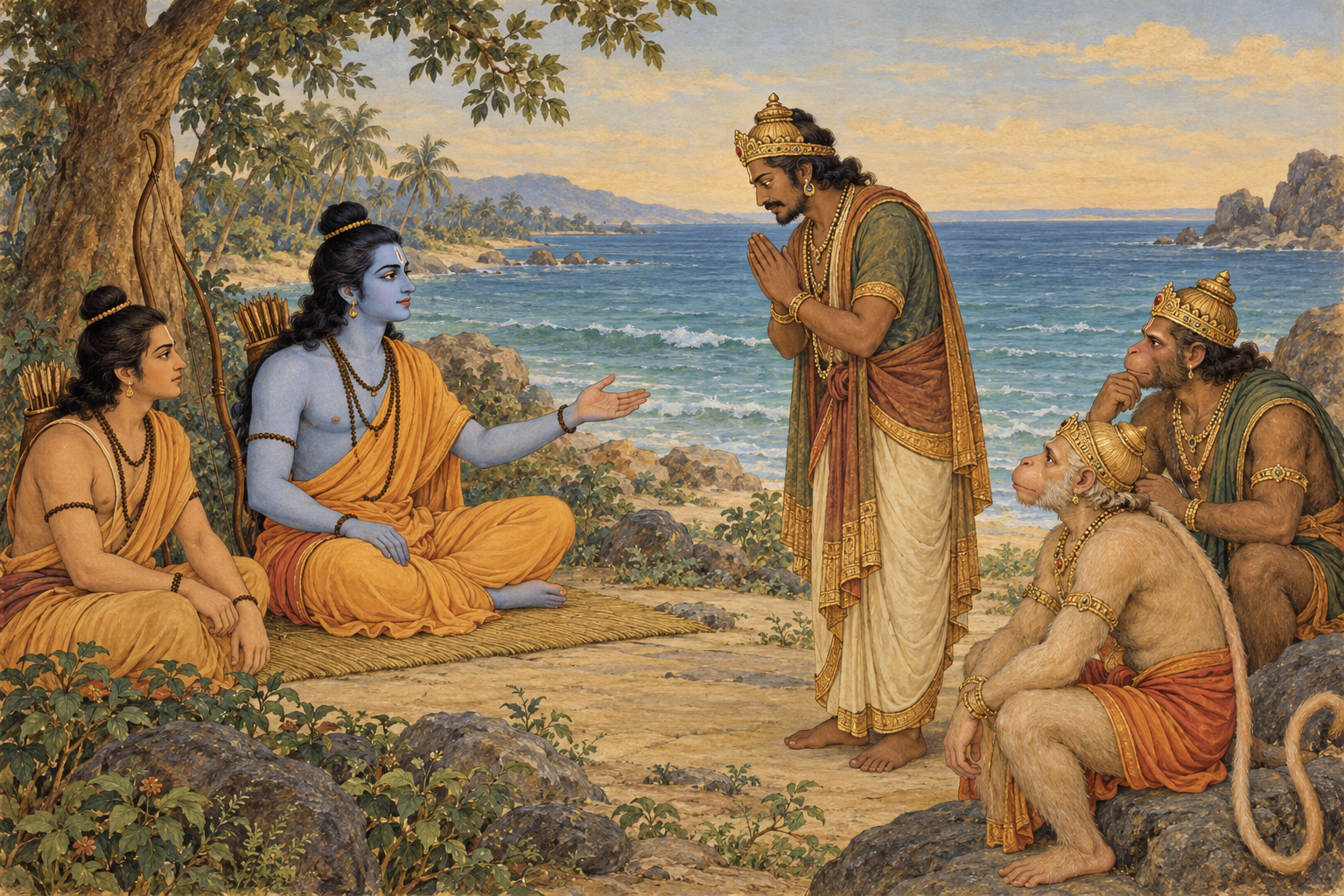
Reading goal: compare proposals for judging a newcomer with reasons for protecting someone who asks for refuge. Track disagreement before reading the final pledge.
The three readings move from a council’s competing proposals through Rāma’s reasons to the decision. They follow Hanumān’s returning report, with intervening events omitted.
The council weighs Vibhīṣaṇa’s arrival
Vibhīṣaṇa arrives with four companions and requests refuge after leaving Rāvaṇa. The speakers disagree about how to judge him.
Reference: Yuddha Kāṇḍa, Sarga 17 — selected council dialogue. K. M. K. Murthy; ValmikiRamayan.net English prose translation, Sanskrit Documents mirror; dialogue distinguished from accompanying commentary.
English reading — attributed handbook paraphrase
Vibhīṣaṇa says he urged Rāvaṇa to restore Sītā, was humiliated and has come to Rāma for refuge. Sugrīva suspects a hostile infiltrator. Rāma asks the leaders for their opinions. Aṅgada proposes examining merits and faults; Śarabha suggests an investigator; Jāmbavān questions the timing; Mainda proposes gentle questioning. Hanumān challenges the practicality of some tests and argues that hostile questioning could alienate a potential friend. He judges Vibhīṣaṇa sincere, while also identifying a desire for kingship as a reason for his arrival. He leaves the final decision to Rāma.
Handbook paraphrase of the identified translation, not its exact wording. Complete chapter linked; specialist review pending.
Handbook reading guidance: Keep each proposal with its speaker. Hanumān’s favourable judgment includes political motivation; it does not require the absence of self-interest.
Does everyone offer the same test?
Answer: No. The proposed approaches differ, and Hanumān questions some of their practicality.
Rāma gives reasons beyond assessing sincerity
These selected reasons precede the pledge reproduced below.
Reference: Yuddha Kāṇḍa, Sarga 18 — selected council dialogue. K. M. K. Murthy; ValmikiRamayan.net English prose translation, Sanskrit Documents mirror; dialogue distinguished from accompanying commentary.
English reading — attributed handbook paraphrase
Sugrīva renews his concern about betrayal. Rāma explains the circumstances of family rivalry and declares his ability to withstand harm. He then invokes hospitality and teachings attributed to Kaṇḍu: even an enemy seeking protection should be protected. He treats failure to protect as a serious fault.
Handbook paraphrase of the identified translation, not its exact wording. Complete chapter linked; specialist review pending.
Handbook reading guidance: Distinguish confidence in his own strength from the obligation he invokes. Both precede the pledge.
Is the decision based only on trusting Vibhīṣaṇa?
Answer: No. Rāma also invokes an obligation toward someone seeking protection.
Receiving someone from the opposing side
This selected ending follows a debate over receiving Vibhīṣaṇa. Rāma’s pledge and Sugrīva’s assessment are different contributions to the decision.
Reference: Yuddha Kāṇḍa 6.18.33–39. K. M. K. Murthy; ValmikiRamayan.net English translation; identified online chapter.
English reading — attributed handbook paraphrase
Rāma declares his pledge to grant safety to one who seeks refuge once and declares allegiance to him. He tells Sugrīva to bring the newcomer, whether that person is Vibhīṣaṇa or even Rāvaṇa. Sugrīva replies in agreement and explains his judgment that Vibhīṣaṇa is genuine. Rāma then meets Vibhīṣaṇa.
Handbook paraphrase of the identified reading, not the translator’s exact wording. Complete chapter linked; specialist review pending.
Handbook reading guidance: notice the breadth of Rāma’s statement and the role of the person charged with bringing the newcomer. Naming Rāvaṇa makes the pledge more striking than a promise to receive only an already trusted ally.
Does Rāma limit this statement to Vibhīṣaṇa by name?
Answer: No. His instruction explicitly includes the possibility that the person is Rāvaṇa himself. That wording matters when explaining the scope of the pledge.
Religious interpretations of refuge may develop this scene further. Attribute those interpretations to their teachers rather than presenting every later explanation as part of these verses.
Compare two kinds of questions
Handbook exercise: for each supplied speech, ask whether it concerns the newcomer’s intentions or the receiving party’s duty. Some reasons concern both. Identify the words or actions in the reading that support your classification.
Connect the earlier intervention: compare Vibhīṣaṇa’s defence of the envoy with this reception. State who seeks protection, who decides and what protection is at issue before drawing a common theme. An envoy’s treatment and a request for refuge are distinct situations.
Review later: name two different council proposals, then recall one reason Rāma gives before his pledge. Check the source panels and separate a speaker’s assessment from a rule the speaker invokes.
The bridge to Laṅkā: skill and shared work
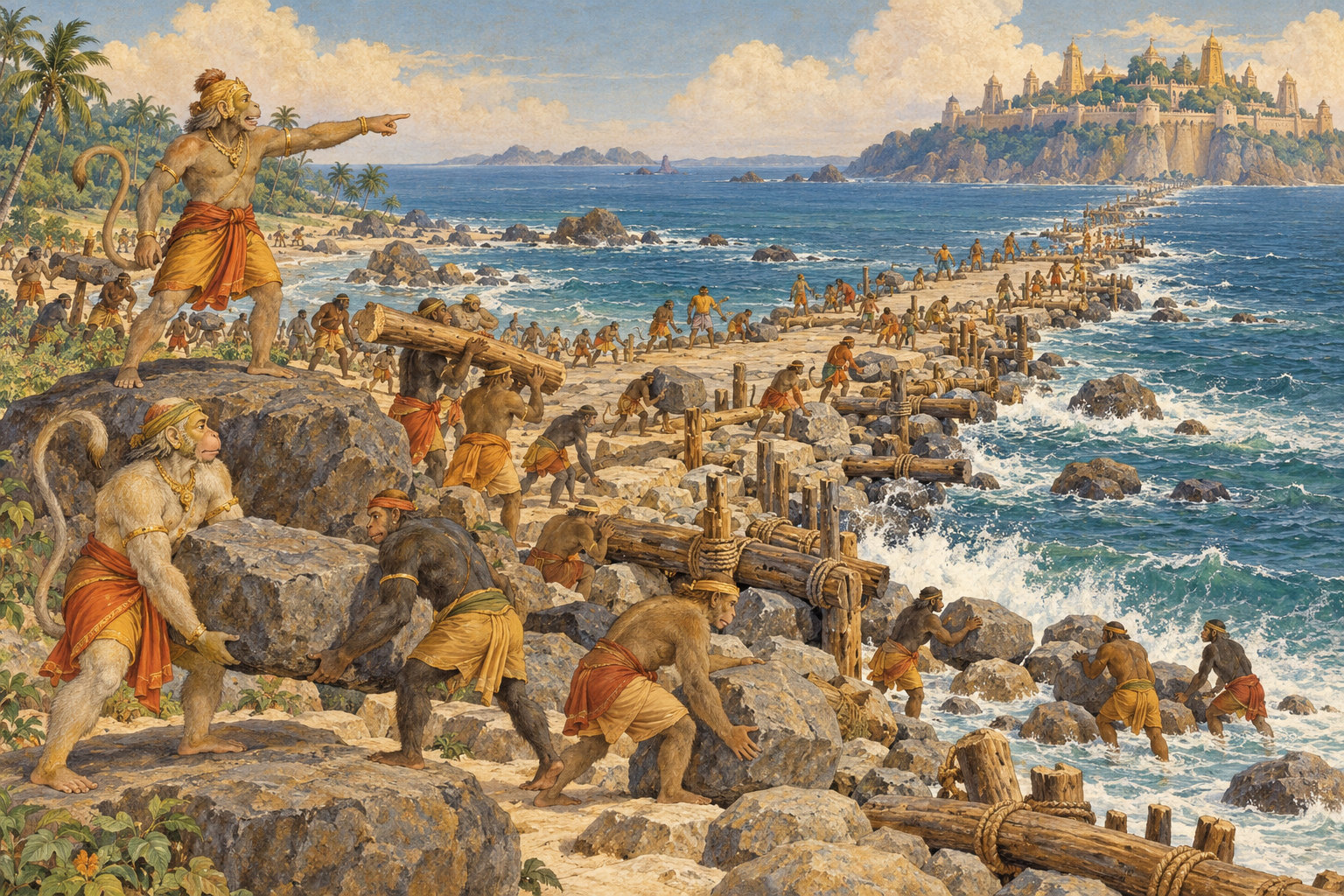
Reading goal: trace the move from an unanswered appeal through anger and intervention to advice, coordinated construction and a crossing. Keep each speaker’s contribution distinct.
Waiting, anger and Lakṣmaṇa’s intervention
This selection precedes the ocean deity’s appearance and the construction reading below.
Reference: Yuddha Kāṇḍa, Sarga 21 — selected narrative and speech. K. M. K. Murthy; ValmikiRamayan.net English prose translation, Sanskrit Documents mirror; dialogue distinguished from accompanying commentary.
English reading — attributed handbook paraphrase
Rāma lies on sacred grass beside the sea and waits for three nights. When the ocean does not appear, he becomes angry, tells Lakṣmaṇa to bring his bow and arrows, and threatens to dry the sea so the army can cross. His arrows disturb the waters and terrify its inhabitants. Lakṣmaṇa takes hold of the bow and urges him to seek another way to accomplish the purpose without destroying the ocean.
Handbook paraphrase of the identified translation, not its exact wording. Complete chapter linked; specialist review pending.
Handbook reading guidance: Read Lakṣmaṇa’s intervention beside Rāma’s speech. The scene gives both the threat and a call for restraint, rather than a single uncontested instruction.
What alternative does Lakṣmaṇa urge?
Answer: An enduring way to fulfil the purpose without destroying the ocean.
The search has become a larger expedition. Read this construction episode after Vibhīṣaṇa’s request for refuge and before the postwar reunion.
The ocean’s advice, Nala’s skill and the builders
This follows Rāma’s threat against the ocean. The selection focuses on the advice and construction rather than reproducing the entire chapter.
Reference: Yuddha Kāṇḍa, Sarga 22 — selected verses 25–28 and 44–71. K. M. K. Murthy; ValmikiRamayan.net English translation; identified chapter or Sanskrit Documents mirror.
English reading — attributed handbook paraphrase
The ocean deity says that the elements retain their nature: he cannot simply make the sea shallow or solid. He offers to support a crossing and identifies Nala, son of Viśvakarmā, as the builder. Nala confirms his inherited ability and calls for work to begin. The vānaras gather trees and rocks, transport materials, stretch alignment strings and use measuring poles. Under Nala’s direction they build the bridge over five days.
Handbook paraphrase of the identified translation, not its exact wording. Complete chapter linked; specialist review pending.
Handbook reading guidance: the episode combines divine encounter, inherited skill and organized labour. Notice who identifies the builder, who accepts the task and what the workforce does. The bridge’s extraordinary scale belongs to the epic narrative; this reading does not establish a modern engineering or archaeological conclusion.
Who is named as the bridge’s builder?
Answer: Nala, son of Viśvakarmā. The passage also describes the vānaras supplying and arranging the materials.
The crossing reaches a new camp
Selected closing narrative after the construction.
Reference: Yuddha Kāṇḍa, Sarga 22 — selected closing narrative. K. M. K. Murthy; ValmikiRamayan.net English prose translation, Sanskrit Documents mirror; dialogue distinguished from accompanying commentary.
English reading — attributed handbook paraphrase
The army crosses Nala’s bridge. Sugrīva establishes its camp on a shore with fruit, roots and water.
Handbook paraphrase of the identified translation, not its exact wording. Complete chapter linked; specialist review pending.
Handbook reading guidance: The crossing concludes this selection; the campaign continues.
Does building the bridge conclude the war?
Answer: No. It enables the army to cross.
Continue with care: the bridge enables the campaign; it does not narrate its battles or settle the questions raised in the aftermath. Keep these stages distinct when summarizing the story.
Review the sequence
Handbook comparison: revisit Hanumān’s concern after the fire. Compare how concern about consequences enters that scene and this one. Identify the person who voices it and the action under discussion, using the supplied readings.
Review later: recall who urges another course, who identifies the builder and what the workforce contributes. Check your answers against the three source panels before continuing to the campaign readings.
Before battle: consultation and Aṅgada’s embassy
Reading goal: distinguish independent action, coordinated leadership and an envoy’s assignment. This chapter follows the crossing and reaches another demand for Sītā’s return.
Rāma questions Sugrīva’s independent action
Selected opening exchange, after Sugrīva’s encounter with Rāvaṇa.
Reference: Yuddha Kāṇḍa, Sarga 41 — selected speech and narrative. K. M. K. Murthy; ValmikiRamayan.net English prose translation, Sanskrit Documents mirror; narrative distinguished from accompanying commentary.
English reading — attributed handbook paraphrase
Rāma embraces Sugrīva but rebukes him for acting without consultation. He explains the anxiety his absence caused the allies. Sugrīva answers that seeing Sītā’s captor moved him to act. Their exchange precedes the coordinated deployment of the army.
Handbook paraphrase of the identified translation, not its exact wording. Complete chapter linked; specialist review pending.
Does affection prevent disagreement here?
Answer: No. The embrace and rebuke occur in the same exchange.
Aṅgada carries the demand into Rāvaṇa’s court
Selected embassy near the close of the chapter.
Reference: Yuddha Kāṇḍa, Sarga 41 — selected speech and narrative. K. M. K. Murthy; ValmikiRamayan.net English prose translation, Sanskrit Documents mirror; narrative distinguished from accompanying commentary.
English reading — attributed handbook paraphrase
With Vibhīṣaṇa’s agreement, Rāma sends Aṅgada as his envoy. Aṅgada identifies himself as Vāli’s son and delivers the demand to restore Sītā, with a warning of battle and loss of kingship. Rāvaṇa orders his seizure and death. Aṅgada allows four attendants to seize him, then leaps upward, throws them off, damages the palace roof and returns to Rāma.
Handbook paraphrase of the identified translation, not its exact wording. Complete chapter linked; specialist review pending.
Has this embassy achieved Sītā’s return?
Answer: No. The messenger returns; the demand remains unmet.
Compare the two envoy scenes
Handbook comparison: return to Hanumān’s account of his mission and Vibhīṣaṇa’s objection to killing an envoy. Compare the messages and the recipient’s response using both visible readings.
| Question | Hanumān’s encounter | Aṅgada’s encounter |
|---|---|---|
| Who is represented? | Check the messenger’s own account of his mission. | Check Rāma’s instruction and Aṅgada’s introduction. |
| What is requested? | Name the proposed action. | Name the proposed action. |
| How is the envoy treated? | Separate the order from the objection raised against it. | Separate the order from the messenger’s escape. |
Reading boundary: the cited Sarga 41 does not contain the famous challenge to move Aṅgada’s planted foot. Do not insert that motif into a summary of this chapter. A comparison with another retelling would need its own named source and visible English passage.
Review later: recall each messenger’s purpose, then check the relevant on-page reading. Continue to the selected war episodes after noting what these exchanges leave unresolved.
Sītā and Trijaṭā: a battlefield view and reasons for hope
Reading goal: distinguish a ruler’s intended message, a witness’s conclusion and the narrator’s description. Then follow reassurance without erasing the grief that remains.
Place in the story: these selections from Sargas 47–48 follow the early fighting after Aṅgada’s embassy. They precede the encounter in Sarga 59 and the later events collected below.
A battlefield view and a claim of death
Selected early-war narrative, before the later illusory-Sītā episode.
Reference: Yuddha Kāṇḍa, Sarga 47 — selected narrative and speech. K. M. K. Murthy; ValmikiRamayan.net English prose translation, Sanskrit Documents mirror; narrative and speakers distinguished from accompanying commentary.
English reading — attributed handbook paraphrase
Rāvaṇa orders the women guarding Sītā to take her in Puṣpaka and show her the fallen brothers. He wants her to believe that Rāma and Lakṣmaṇa are dead and that reunion is impossible. Sītā sees them wounded and motionless among the troops and grieves. The narrator describes the brothers as unconscious; her conclusion that they have died is not the same as that description.
Handbook paraphrase of the identified translation, not its exact wording. Complete chapter linked; specialist review pending.
What distinction must a summary preserve?
Answer: The brothers are described as unconscious, while Sītā believes them dead.
Trijaṭā offers reasons for hope
Selected grief and reassurance; Sītā’s sorrow does not simply disappear.
Reference: Yuddha Kāṇḍa, Sarga 48 — selected narrative and speech. K. M. K. Murthy; ValmikiRamayan.net English prose translation, Sanskrit Documents mirror; narrative and speakers distinguished from accompanying commentary.
English reading — attributed handbook paraphrase
Sītā questions the earlier predictions about her life and fears for Kausalyā, who awaits the family’s return. Trijaṭā says the brothers live. She points to the army still guarding them rather than dispersing without leadership, their appearance and the nature of Puṣpaka. Sītā responds with a hope that this is true. They return to the Aśoka grove, where her grief continues.
Handbook paraphrase of the identified translation, not its exact wording. Complete chapter linked; specialist review pending.
Does reassurance end Sītā’s grief in the chapter?
Answer: No. She expresses hope, but the closing narrative still describes her sorrow.
Read three layers separately
Handbook reading guidance: record what Rāvaṇa wants Sītā to conclude, what she believes after seeing the brothers, and what the narrator says about their condition. Do not turn one voice into another.
Trijaṭā’s arguments about Puṣpaka and bodily appearance belong to the epic’s narrative world. The reading presents her reasons for reassurance, not a general method for determining whether an injured person is alive.
Can hope and grief remain together in this scene?
Answer: Yes. Sītā’s hopeful response to Trijaṭā does not remove the sorrow described at the chapter’s end.
Optional discussion: identify which part of the reassurance relies on the army’s conduct and which part relies on the story’s extraordinary setting. Explain the distinction with the visible English reading.
Kumbhakarṇa: criticism, kinship and commitment
Reading goal: follow a speaker’s change of position without erasing his earlier criticism. Distinguish an adviser’s proposal, a prediction and a narrated event.
Where this belongs: these chapters revisit the middle of the campaign. Read Rāvaṇa’s earlier withdrawal in Sarga 59 first, then these selections from Sargas 63–65. They stop at Kumbhakarṇa’s departure, before his battle; the later war readings continue with other encounters.
Criticism becomes a promise to fight
Selected exchange after Rāvaṇa’s earlier setback.
Reference: Yuddha Kāṇḍa, Sarga 63 — selected dialogue and narrative. K. M. K. Murthy; ValmikiRamayan.net English prose translation; narrative and speakers distinguished from accompanying explanatory notes.
English reading — attributed handbook paraphrase
Kumbhakarṇa says that the danger follows Rāvaṇa’s refusal to heed earlier counsel. He criticizes poorly timed decisions and says Vibhīṣaṇa’s advice was beneficial. Rāvaṇa dismisses further discussion of past wrongdoing and asks his brother to relieve the present crisis. Kumbhakarṇa then reassures him, explaining that his criticism came from brotherly affection. He promises to fight the enemies and says Rāma must kill him before reaching Rāvaṇa.
Handbook paraphrase of the identified translation, not its exact wording. Complete chapter linked; specialist review pending.
Does Kumbhakarṇa’s criticism lead him to leave Rāvaṇa?
Answer: No. In this exchange he changes from criticism to reassurance and a promise to fight. His response differs from Vibhīṣaṇa’s departure.
Mahodara proposes a false report
Selected opposing counsel; this is a proposal, not a report of an accomplished event.
Reference: Yuddha Kāṇḍa, Sarga 64 — selected dialogue and narrative. K. M. K. Murthy; ValmikiRamayan.net English prose translation; narrative and speakers distinguished from accompanying explanatory notes.
English reading — attributed handbook paraphrase
Mahodara disputes Kumbhakarṇa’s criticism and warns against confronting Rāma alone. He proposes a scheme: warriors should fight, then, if they fail to kill Rāma, return wounded and falsely announce that Rāma and Lakṣmaṇa are dead. Public celebration and gifts would reinforce the claim. He predicts that the report would make Sītā despair and submit to Rāvaṇa. That predicted response is Mahodara’s assertion; this selection does not establish that Sītā accepts such a report.
Handbook paraphrase of the identified translation, not its exact wording. Complete chapter linked; specialist review pending.
Is the announced death a verified event in this reading?
Answer: No. It is part of Mahodara’s proposed deception. His prediction about Sītā is also a claim within his speech.
The warrior sets out with the army
Selected reply, preparations and departure; the ensuing battle is outside this selection.
Reference: Yuddha Kāṇḍa, Sarga 65 — selected dialogue and narrative. K. M. K. Murthy; ValmikiRamayan.net English prose translation; narrative and speakers distinguished from accompanying explanatory notes.
English reading — attributed handbook paraphrase
Kumbhakarṇa rejects Mahodara’s counsel and accuses pleasing advisers of damaging the king’s affairs. Rāvaṇa praises his brother’s strength. When Kumbhakarṇa proposes going alone, Rāvaṇa tells him to take troops because a lone or careless fighter can be overwhelmed. Adorned for battle, Kumbhakarṇa salutes and circles his brother before leaving. The narrative describes ominous signs that he disregards. His appearance frightens the vānaras; this chapter has not yet narrated the outcome of his battle.
Handbook paraphrase of the identified translation, not its exact wording. Complete chapter linked; specialist review pending.
Does frightening the army establish victory?
Answer: No. The departure and the army’s fear precede the battle; they are not its outcome.
Compare different responses to a brother
Handbook reading guidance: compare Vibhīṣaṇa’s departure with Kumbhakarṇa’s decision to fight. Name what each criticizes, then name what each does next. A family relationship alone does not explain the difference; use their stated reasons.
| Reading task | Evidence to record |
|---|---|
| Track a change of position | Place the criticism and later commitment beside each other. |
| Identify a proposal | Separate the suggested plan from events the narrator says occurred. |
| Check a prediction | Identify whose expectation it is before treating it as knowledge about another person. |
| Follow the sequence | Distinguish preparation, departure, encounter and outcome. |
Questions for a closer reading
- Does a later choice cancel an earlier objection, or can both remain part of the character’s position?
- How does the recipient of advice decide which speaker to trust?
- What would you need to read next before summarizing the result of the proposed action?
These are discussion prompts, not questions with a single mandatory interpretation. Support your answer with the supplied readings and identify where you move from narrative evidence to your own judgment.
Optional review: return later and write one sentence about each speaker’s proposal. Check those sentences against the visible English before continuing to the war reading path.
Indrajit’s deception: witnessing, reporting and correction
Reading goal: follow how a mistaken conclusion passes from a witness to others, then identify the explanation and action proposed in response.
Place in the story: Sargas 81 and 84 belong later in the campaign than Trijaṭā’s reassurance and Kumbhakarṇa’s departure. The chapters between these selections remain available through the complete edition; this pair is a focused reading path.
Hanumān sees an illusory likeness
Selected later-war episode; this is distinct from the earlier view of the wounded brothers.
Reference: Yuddha Kāṇḍa, Sarga 81 — selected narrative and speech. K. M. K. Murthy; ValmikiRamayan.net English prose translation, Sanskrit Documents mirror; narrative and speakers distinguished from accompanying commentary.
English reading — attributed handbook paraphrase
Indrajit brings an illusory likeness of Sītā before the vānaras, intending to confuse them. Hanumān recognizes what he believes is her familiar appearance and becomes distressed. Indrajit stages her killing and declares that the rescue effort is pointless. The vānaras lose heart. The narrator identifies the figure as illusory even while describing the witnesses’ belief that they have seen Sītā.
Handbook paraphrase of the identified translation, not its exact wording. Complete chapter linked; specialist review pending.
What does the reader know that the witnesses do not yet understand?
Answer: The narrator has identified the figure as an illusion.
Vibhīṣaṇa explains the deception and proposes action
Selected explanation after Hanumān’s report has reached Rāma; intervening chapters are omitted.
Reference: Yuddha Kāṇḍa, Sarga 84 — selected narrative and speech. K. M. K. Murthy; ValmikiRamayan.net English prose translation, Sanskrit Documents mirror; narrative and speakers distinguished from accompanying commentary.
English reading — attributed handbook paraphrase
Vibhīṣaṇa finds Rāma overcome by grief after the report that Sītā was killed. He argues that Rāvaṇa would not permit her death and identifies Indrajit’s act as a deception. He explains that Indrajit has gone to Nikumbhilā for a sacrificial rite and urges action before its completion. He asks Rāma to send Lakṣmaṇa with the army. The speech supplies both an explanation of the false appearance and a proposed next step.
Handbook paraphrase of the identified translation, not its exact wording. Complete chapter linked; specialist review pending.
Does this selection narrate Indrajit’s defeat?
Answer: No. It explains the deception and proposes a mission; the mission’s outcome belongs to later chapters.
Compare appearance with narration
| Reading layer | Question to ask |
|---|---|
| Narrator | What does the narrative establish before the characters understand it? |
| Witness | What does the observer think the appearance means? |
| Report | What conclusion reaches someone who was not present? |
| Correction | What explanation is offered, and what action follows from it? |
Handbook reading guidance: Hanumān’s distress is not evidence of deliberate dishonesty. The supplied narrative distinguishes a deceived witness from the maker of the deception. Vibhīṣaṇa’s explanation changes the account without making the earlier grief unreal.
Connect the reading paths
- Compare the two battlefield episodes: who is meant to be deceived, and who offers another explanation?
- Revisit Mahodara’s proposed false report. Distinguish that proposal from the separate events narrated here.
- Return to Sītā’s questions to Hanumān and compare how recognition is examined in a different setting.
Support each comparison with its own visible passage. Similar themes do not make the episodes interchangeable or prove that one speaker’s proposal caused another event.
Review later: write two versions of the incident: what a witness believes at first, and what the narrator establishes. Check that you have clearly identified the source of each statement before continuing to the later war readings.
Nikumbhilā: a mission, a family dispute and the wounded return
Reading goal: follow the passage from explanation to authorization, confrontation, outcome and care. Identify the different contributions without turning a supported mission into a solitary achievement.
Begin with Vibhīṣaṇa’s explanation of the deception. These four selections continue through Sargas 85, 87, 90 and 91. They omit portions of the combat sequence; each chapter link supplies its fuller context.
Rāma asks to hear the explanation again
Selected instructions and departure following the explanation of the illusion.
Reference: Yuddha Kāṇḍa, Sarga 85 — selected narrative and dialogue. K. M. K. Murthy; ValmikiRamayan.net English prose translation, Sanskrit Documents mirror; narrative and speakers distinguished from accompanying commentary.
English reading — attributed handbook paraphrase
Still distressed, Rāma asks Vibhīṣaṇa to repeat what he means. Vibhīṣaṇa restates the urgency of acting before Indrajit completes his rite. Rāma acknowledges the opponent’s power and sends Lakṣmaṇa with the army, Hanumān and Jāmbavān, while Vibhīṣaṇa supplies knowledge of Indrajit’s methods. Lakṣmaṇa takes up his weapons, salutes his brother and departs. The mission is assigned and supported; it is not presented as one warrior acting without consultation.
Handbook paraphrase of the identified translation, not its exact wording. Complete chapter linked; specialist review pending.
What does Rāma do before issuing the order?
Answer: He asks to hear the explanation again. Receiving a message is not the same as immediately understanding it.
Indrajit challenges his uncle’s allegiance
Selected confrontation before the extended duel.
Reference: Yuddha Kāṇḍa, Sarga 87 — selected narrative and dialogue. K. M. K. Murthy; ValmikiRamayan.net English prose translation, Sanskrit Documents mirror; narrative and speakers distinguished from accompanying commentary.
English reading — attributed handbook paraphrase
Vibhīṣaṇa points out the place connected with Indrajit’s rite, and Lakṣmaṇa challenges Indrajit to fight. Indrajit turns on his uncle, arguing that loyalty to one’s relatives should prevail even when they lack virtue. Vibhīṣaṇa rejects that principle: he distinguishes his own disposition from his birth and names the wrongdoing that led him to leave Rāvaṇa. Their disagreement concerns the grounds of allegiance, not merely which army is stronger.
Handbook paraphrase of the identified translation, not its exact wording. Complete chapter linked; specialist review pending.
Do the two speakers agree about what kinship requires?
Answer: No. Indrajit puts loyalty to relatives first; Vibhīṣaṇa gives reasons for refusing allegiance to wrongdoing.
The duel reaches its outcome
Selected closing combat; the full chapter describes many exchanges omitted here.
Reference: Yuddha Kāṇḍa, Sarga 90 — selected narrative and dialogue. K. M. K. Murthy; ValmikiRamayan.net English prose translation, Sanskrit Documents mirror; narrative and speakers distinguished from accompanying commentary.
English reading — attributed handbook paraphrase
The duel continues as Indrajit returns with another chariot. Lakṣmaṇa resists his attacks, while Vibhīṣaṇa also participates. After further exchanges, Lakṣmaṇa fits a missile associated with Indra and invokes Rāma’s commitment to dharma, truthfulness to his promise and prowess. He releases it, and Indrajit is killed. The opposing troops disperse, while the vānaras and allies celebrate Lakṣmaṇa’s achievement.
Handbook paraphrase of the identified translation, not its exact wording. Complete chapter linked; specialist review pending.
Is Indrajit’s death still only a prediction at this point?
Answer: No. This chapter narrates the outcome, unlike the earlier speeches proposing the mission.
Victory is followed by care for the wounded
Selected return, recognition and treatment; the wider war is not yet over.
Reference: Yuddha Kāṇḍa, Sarga 91 — selected narrative and dialogue. K. M. K. Murthy; ValmikiRamayan.net English prose translation, Sanskrit Documents mirror; narrative and speakers distinguished from accompanying commentary.
English reading — attributed handbook paraphrase
Wounded and exhausted, Lakṣmaṇa returns supported by Vibhīṣaṇa and Hanumān. He reports the victory quietly, and Vibhīṣaṇa makes the news clear. Rāma embraces his brother, praises him and also recognizes the help of Vibhīṣaṇa and Hanumān. He calls Suṣeṇa to treat Lakṣmaṇa, Vibhīṣaṇa and the other wounded bear and vānara warriors. The narrative describes Lakṣmaṇa’s recovery and the allies’ joy. Rāma still anticipates a further encounter with Rāvaṇa.
Handbook paraphrase of the identified translation, not its exact wording. Complete chapter linked; specialist review pending.
Does the victory remove the need for help?
Answer: No. Lakṣmaṇa needs support on the return, and Rāma orders treatment for the wounded.
Follow the work, not only the final blow
| Contribution | Where to read it |
|---|---|
| Explanation and local knowledge | Vibhīṣaṇa’s account and the assigned mission |
| Authorization and coordination | Rāma’s instruction to Lakṣmaṇa and the allies |
| Combat and outcome | The selected close of the duel |
| Support, recognition and healing | The return and the order to Suṣeṇa |
Handbook reading guidance: distinguish the mission’s urgency from a claim that no deliberation occurs. Likewise, distinguish the final action from the preparation and help around it. Both are visible in the selected reading path.
Return to the question of allegiance
Compare the uncle and nephew’s dispute with Vibhīṣaṇa’s earlier departure and Kumbhakarṇa’s decision to fight. Each supplies a different response within the same family. Identify each speaker’s argument before offering your own judgment; the guide does not collapse them into one rule about all family relationships.
Has the whole campaign ended with Indrajit’s defeat?
Answer: No. The return reading still anticipates Rāvaṇa’s response. Continue to the final encounter for a later outcome.
Reading boundary: the healing account belongs to the epic narrative. It does not supply a practical treatment protocol. Here its place in the story is the movement from victory to attention for those who were hurt.
Optional review: without your notes, list the four stages of this reading path. Then check the visible passages and add one named contribution to each stage. This is a study suggestion, not a claim of measured learning.
Before the final encounter: exhaustion, prayer and skilled help
Learning goal: distinguish a charioteer’s explanation, a sage’s instruction and a warrior’s acknowledgment of expertise. Follow three successive chapters without reducing the final battle to one isolated act.
Reading path: Sargas 104–106. These selections follow later developments in the war, beyond the Nikumbhilā mission; they are not its immediate aftermath. Read each speaker’s reasons before comparing the scenes.
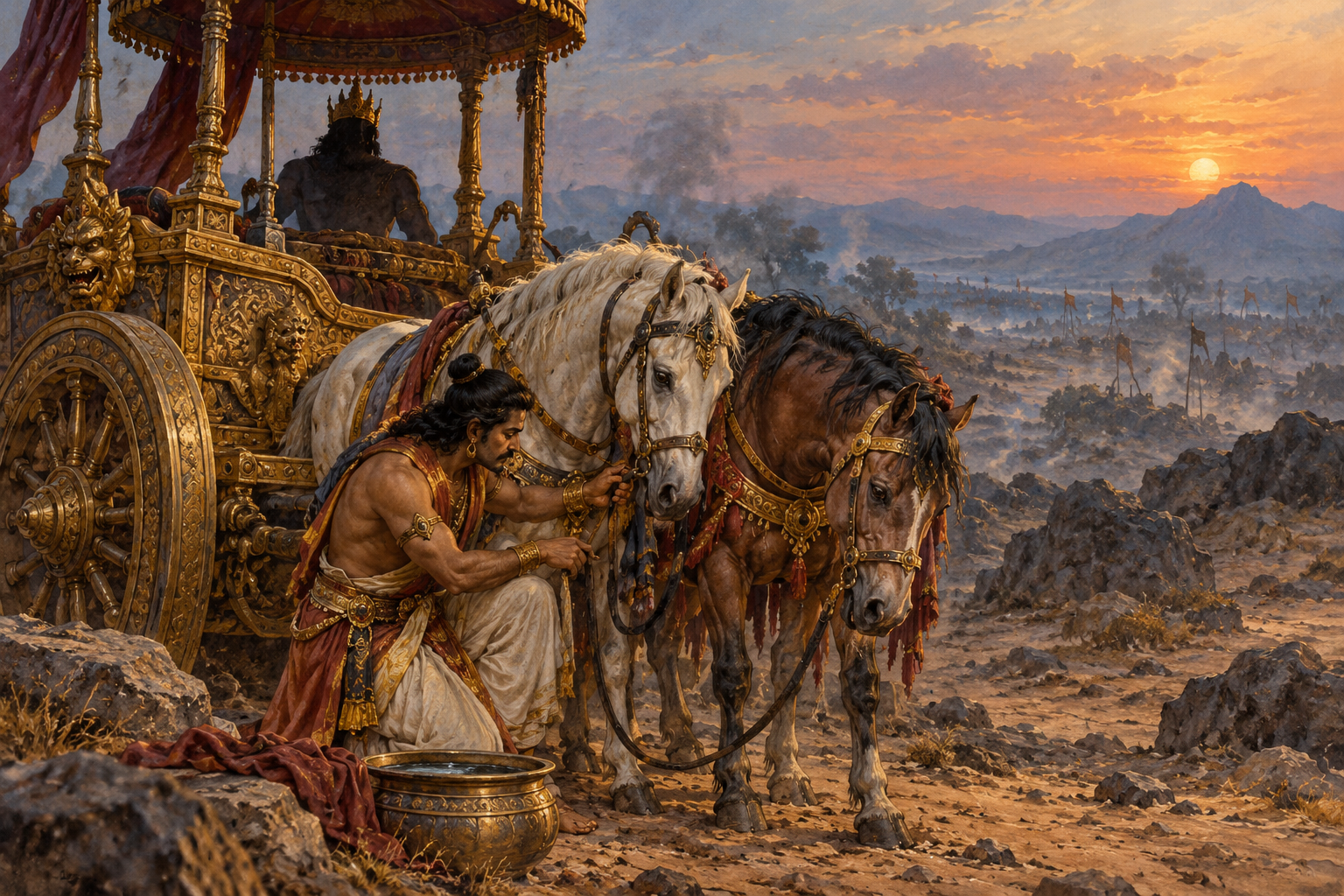
Rāvaṇa’s charioteer explains the withdrawal
Selected dialogue about withdrawal, exhaustion and the charioteer’s duties.
Reference: Yuddha Kāṇḍa, Sarga 104 — selected narrative and dialogue. K. M. K. Murthy; ValmikiRamayan.net English prose translation, Sanskrit Documents mirror; selected narrative and dialogue.
English reading — attributed handbook paraphrase
Rāvaṇa angrily interprets his charioteer’s withdrawal as humiliation and suspects disloyalty. The charioteer denies fear or betrayal. He explains that both Rāvaṇa and the horses were exhausted, and describes a driver’s responsibility to judge terrain, timing, the warrior’s condition and the movements of combat. He says the withdrawal provided rest and served his master’s interests. Rāvaṇa accepts the explanation, rewards him and orders a return to the battle.
Read the complete cited chapter →
Handbook paraphrase of the identified translation, not its exact wording. Complete chapter linked; specialist review pending.
What reason does the charioteer give for withdrawing?
Answer: He points to the exhaustion of Rāvaṇa and the horses, together with the practical judgments required of a charioteer. His explanation differs from Rāvaṇa’s initial accusation.
Agastya’s instruction and Rāma’s renewed attention
Selected narrative frame of the Āditya Hṛdayam episode; the complete hymn is not reproduced here.
Reference: Yuddha Kāṇḍa, Sarga 105 — selected narrative and dialogue. K. M. K. Murthy; ValmikiRamayan.net English prose translation, Sanskrit Documents mirror; selected narrative and dialogue.
English reading — attributed handbook paraphrase
Rāma stands exhausted and preoccupied as Rāvaṇa prepares to fight again. Agastya approaches and teaches praise of the sun deity, presenting it as a source of victory. The praise identifies the deity with divine powers and the sustaining activity of the world. Agastya directs Rāma to recite it three times. The narrator then describes Rāma’s distress subsiding: he retains the hymn, performs the stated observances, takes up his bow and advances with renewed resolve.
Read the complete cited chapter →
Handbook paraphrase of the identified translation, not its exact wording. Complete chapter linked; specialist review pending.
Which parts belong to Agastya’s speech, and which to the narrator?
Answer: Agastya supplies the praise and its promised efficacy. The narrator describes Rāma’s subsequent change of disposition and return to action. Keep the speaker’s claim and the narrated response distinct.
Rāma acknowledges Mātali’s experience
Selected opening exchange before the renewed combat; the chapter’s wider account of portents is omitted.
Reference: Yuddha Kāṇḍa, Sarga 106 — selected narrative and dialogue. K. M. K. Murthy; ValmikiRamayan.net English prose translation, Sanskrit Documents mirror; selected narrative and dialogue.
English reading — attributed handbook paraphrase
As Rāvaṇa’s chariot approaches, Rāma asks Mātali to drive steadily and with careful control. He then acknowledges that Mātali already knows his work as Indra’s charioteer: his words are a reminder prompted by attention to the battle, rather than an attempt to teach an experienced driver. Mātali is pleased and drives forward. The renewed encounter follows. This selection concerns the exchange between warrior and charioteer, rather than the chapter’s later descriptions of omens.
Read the complete cited chapter →
Handbook paraphrase of the identified translation, not its exact wording. Complete chapter linked; specialist review pending.
Does Rāma claim to be teaching Mātali how to drive?
Answer: No. He explicitly acknowledges Mātali’s experience and describes his words as a reminder.
Three different kinds of help
| Scene | What the selection shows | Question to carry forward |
|---|---|---|
| Rāvaṇa and his driver | A withdrawal is explained through fatigue and the driver’s responsibilities. | Does the initial accusation match the explanation? |
| Agastya and Rāma | A religious instruction is followed by the narrator’s account of renewed resolve. | Who promises efficacy, and who narrates the response? |
| Rāma and Mātali | The warrior acknowledges the driver’s existing expertise. | How is a reminder distinguished from instruction? |
Handbook reading guidance: compare the exchanges as distinct scenes. Both charioteers contribute judgment; Agastya contributes a religious instruction. The passages do not make those contributions interchangeable or establish one universal rule about advice.
Is this a complete Āditya Hṛdayam prayer guide?
No. The selection explains the hymn’s narrative setting and Rāma’s response; it does not reproduce the complete hymn, provide pronunciation instruction or establish a daily ritual procedure. Use the linked chapter for the fuller reading. A dedicated prayer reader will need checked text, paired English and clearly identified guidance.
Continue the sequence: Mātali’s later counsel and the final arrow, then grief after victory. Renewed resolve is not yet the battle’s outcome.
Optional review: return later and name one reason each speaker gives. Check your answer against the visible readings rather than replacing their words with a general moral.
The war: restraint, rescue and the final encounter
Reading goal: follow three distinct turning points, identify the help each requires and distinguish an earlier withdrawal from the final defeat. These selections are a reading path through the war, not a summary of every battle.
Begin after the bridge to Laṅkā. The linked chapters provide the fuller narratives between these selected moments.
An exhausted opponent is allowed to withdraw
This is an earlier encounter with Rāvaṇa, not the final battle in which he dies.
Reference: Yuddha Kāṇḍa, Sarga 59 — concluding encounter. K. M. K. Murthy; ValmikiRamayan.net English prose translation; identified chapter or Sanskrit Documents mirror.
English reading — attributed handbook paraphrase
Rāma fights from Hanumān’s back. After Rāvaṇa wounds Hanumān, Rāma destroys Rāvaṇa’s chariot and strikes him, causing him to drop his bow; another arrow breaks his crown. Rāma acknowledges the formidable fighting that has exhausted him and says he will not kill him in that condition. He tells Rāvaṇa to return to Laṅkā, recover and come back armed. After Rāvaṇa withdraws, Rāma arranges for arrows to be removed from the wounded vānaras and Lakṣmaṇa.
Handbook paraphrase of the identified translation, not its exact wording. Complete chapter linked; specialist review pending.
Handbook reading guidance: keep the action and Rāma’s stated reason together. He allows withdrawal because Rāvaṇa is exhausted, while explicitly expecting renewed combat. This episode leaves the conflict unresolved.
Does Rāvaṇa die in this encounter?
Answer: No. He returns to Laṅkā after Rāma tells him to recover and come back armed.
Hanumān brings the mountain of herbs
Rāma, Lakṣmaṇa and many vānaras have fallen after Indrajit’s attack. Hanumān and Vibhīṣaṇa search the battlefield at night.
Reference: Yuddha Kāṇḍa, Sarga 74 — selected search and recovery episode. K. M. K. Murthy; ValmikiRamayan.net English prose translation; identified chapter or Sanskrit Documents mirror.
English reading — attributed handbook paraphrase
The wounded Jāmbavān asks whether Hanumān survives, because his ability offers hope for the army. He sends Hanumān to a Himalayan mountain for four life-restoring and healing herbs. Hanumān reaches the mountain, but the herbs conceal themselves from his sight. Unable to find them, he takes its summit back to the army. In the narrative, the herbs’ fragrance heals Rāma and Lakṣmaṇa and restores the fallen vānaras. Hanumān then returns the mountain and rejoins Rāma.
Handbook paraphrase of the identified translation, not its exact wording. Complete chapter linked; specialist review pending.
Handbook reading guidance: follow the chain of help: Vibhīṣaṇa and Hanumān search, Jāmbavān gives directions, and Hanumān brings aid. The chapter says the herbs conceal themselves; reducing the episode to difficulty identifying plants changes its account. The extraordinary healing is presented as part of the epic narrative.
Who sends Hanumān for the herbs in this chapter?
Answer: Jāmbavān. This selection concerns the fallen army after Indrajit’s attack; keep its chapter reference attached when comparing other rescue episodes.
Mātali’s counsel and the final arrow
This later encounter brings the battle with Rāvaṇa to its conclusion. It follows many intervening episodes not reproduced in this reading path.
Reference: Yuddha Kāṇḍa, Sarga 108. K. M. K. Murthy; ValmikiRamayan.net English prose translation; identified chapter or Sanskrit Documents mirror.
English reading — attributed handbook paraphrase
Mātali urges Rāma to use the missile associated with Brahmā. Rāma takes the arrow earlier received from Agastya, consecrates it and releases it at Rāvaṇa. The arrow pierces his heart; Rāvaṇa’s bow falls from his hand and he falls dead from his chariot. The surviving rākṣasas retreat, while the vānaras celebrate. The chapter also describes celestial celebration and the allies paying respect to Rāma.
Handbook paraphrase of the identified translation, not its exact wording. Complete chapter linked; specialist review pending.
Handbook reading guidance: notice Mātali’s reminder and Agastya’s earlier gift alongside Rāma’s action. Compare this ending with the earlier withdrawal: the same opponent survives one encounter and dies in another, so the episodes should not be compressed into one.
Who gives the reminder at the decisive moment?
Answer: Mātali, the charioteer. Rāma then prepares and releases the arrow associated with Brahmā.
Next: read Vibhīṣaṇa’s grief before moving to the reunion. Victory and the treatment of those who have died are successive concerns.
After victory: grief and the duty toward the dead
The narrative turns from celebration to a surviving brother’s sorrow. Read Vibhīṣaṇa’s words as a bereaved participant’s speech, keeping his earlier disagreement with Rāvaṇa in view.
A brother’s grief and the duty toward the dead
After Rāvaṇa’s death, Vibhīṣaṇa approaches his fallen brother.
Reference: Yuddha Kāṇḍa, Sarga 109. K. M. K. Murthy; ValmikiRamayan.net English prose translation; identified chapter or Sanskrit Documents mirror.
English reading — attributed handbook paraphrase
Vibhīṣaṇa grieves for Rāvaṇa, recalling both his greatness and his refusal to accept counsel. Rāma responds that he fought courageously and directs attention to the duty now remaining. Vibhīṣaṇa recalls his brother’s gifts, learning and religious observances and asks permission to perform the rites for him. Rāma tells him to proceed: their hostility ends with death, their purpose is accomplished, and Rāvaṇa is to be treated as belonging to Rāma as well as to Vibhīṣaṇa.
Handbook paraphrase of the identified translation, not its exact wording. Complete chapter linked; specialist review pending.
Handbook reading guidance: admiration, criticism and grief coexist in Vibhīṣaṇa’s speech. Rāma’s reply moves toward the funeral duty rather than continuing hostility. Do not treat the praise in a lament as a reversal of every earlier judgment about Rāvaṇa’s conduct.
What action does Rāma authorize?
Answer: Vibhīṣaṇa is to perform Rāvaṇa’s funeral rites. The stated end of hostility accompanies this concrete duty toward the dead.
A literary reading, not a ritual checklist: this passage helps explain the story’s transition after battle. For practical funeral guidance, use the Antyeṣṭi guide and guidance from the family’s officiant.
Continue: the reunion with Sītā raises its own questions. Read her response alongside Rāma’s speech rather than treating the war’s end as the end of the dialogue.
Laṅkā after the war: lament, funeral and a new ruler
Learning goal: follow the aftermath through the bereaved women, Mandodarī, Vibhīṣaṇa and Rāma. Distinguish mourning, disagreement over the rites and the restoration of rule.
Reading path: begin with Vibhīṣaṇa’s earlier grief in Sarga 109, then read these selections from Sargas 110–112. This is a selected literary path, not the entire aftermath or a present-day funeral procedure.
The bereaved women recall rejected counsel
Selected collective lament; the chapter also contains their statements about destiny.
Reference: Yuddha Kāṇḍa, Sarga 110 — selected narrative and dialogue. K. M. K. Murthy; ValmikiRamayan.net English prose translation, Sanskrit Documents mirror; narrative and speakers distinguished.
English reading — attributed handbook paraphrase
Rāvaṇa’s wives reach the battlefield and mourn beside his body. They recall his power, express astonishment at his defeat and blame the abduction of Sītā and his rejection of friendly advice. They say that returning Sītā could have spared them this devastation, recalling Vibhīṣaṇa’s counsel. Their lament also turns toward destiny; the chapter preserves these different explanations within their grief.
Read the complete cited chapter →
Handbook paraphrase of the identified translation, not its exact wording. Complete chapter linked; specialist review pending.
Does this lament contain only praise of Rāvaṇa?
Answer: No. It recalls his power while also criticizing the abduction and the rejection of counsel.
Mandodarī joins affection with criticism
Selected portions of Mandodarī’s lament; her full speech contains further theological claims and personal recollections.
Reference: Yuddha Kāṇḍa, Sarga 111 — selected narrative and dialogue. K. M. K. Murthy; ValmikiRamayan.net English prose translation, Sanskrit Documents mirror; narrative and speakers distinguished.
English reading — attributed handbook paraphrase
Mandodarī recalls Rāvaṇa’s strength and their life together, while condemning the abduction of Sītā and his refusal to heed advice. She praises Sītā’s fidelity, identifies Rāma with Viṣṇu, and names the warnings of Vibhīṣaṇa and others. Her loss is personal: she remembers Indrajit’s death and now mourns her husband. When she collapses, the other grieving wives raise and console her.
Read the complete cited chapter →
Handbook paraphrase of the identified translation, not its exact wording. Complete chapter linked; specialist review pending.
Is Mandodarī’s grief presented as approval of the abduction?
Answer: No. Her affection and sorrow coexist with explicit criticism of Rāvaṇa’s actions.
Vibhīṣaṇa objects before performing the rites
Selected funeral dialogue and its outcome; the ritual sequence is not supplied as practical instruction.
Reference: Yuddha Kāṇḍa, Sarga 111 — selected narrative and dialogue. K. M. K. Murthy; ValmikiRamayan.net English prose translation, Sanskrit Documents mirror; narrative and speakers distinguished.
English reading — attributed handbook paraphrase
Rāma calls for Rāvaṇa’s funeral and comfort for the women. Vibhīṣaṇa initially refuses, citing his brother’s wrongdoing and calling him an enemy despite their kinship. Rāma acknowledges the wrongdoing but urges that hostility end with death and that the rites proceed. Vibhīṣaṇa then arranges and performs the funeral, consoles the women and returns to Rāma. The narrator subsequently describes Rāma laying aside both his weapons and his anger.
Read the complete cited chapter →
Handbook paraphrase of the identified translation, not its exact wording. Complete chapter linked; specialist review pending.
Does Vibhīṣaṇa agree immediately in this chapter?
Answer: No. Sarga 111 includes his objection and Rāma’s reply before the funeral is performed. Keep this later dialogue distinct from the earlier exchange in Sarga 109.
Laṅkā receives a ruler, and Sītā awaits the news
Selected installation and instruction to Hanumān; the following chapter narrates the message itself.
Reference: Yuddha Kāṇḍa, Sarga 112 — selected narrative and dialogue. K. M. K. Murthy; ValmikiRamayan.net English prose translation, Sanskrit Documents mirror; narrative and speakers distinguished.
English reading — attributed handbook paraphrase
Rāma respectfully takes leave of Mātali, then asks Lakṣmaṇa to install Vibhīṣaṇa as ruler of Laṅkā. Water is brought from the sea, and the installation takes place before the rākṣasas. Vibhīṣaṇa consoles his people. Rāma next sends Hanumān, with Vibhīṣaṇa’s permission, to tell Sītā that he and the allies are well and Rāvaṇa has been killed. Hanumān is to bring back her reply.
Read the complete cited chapter →
Handbook paraphrase of the identified translation, not its exact wording. Complete chapter linked; specialist review pending.
Has Hanumān already delivered the message in this selection?
Answer: No. This chapter records Rāma’s instruction; the delivery and Sītā’s response follow in Sarga 113.
Keep the voices and events distinct
| Reading | Voice or event | What to notice |
|---|---|---|
| Sarga 110 | The bereaved wives’ collective lament | Praise of power appears alongside criticism and statements about destiny. |
| Sarga 111, selected lament | Mandodarī’s speech | Personal grief does not erase her criticism. |
| Sarga 111, later dialogue | Vibhīṣaṇa’s objection, Rāma’s reply and the funeral | The objection precedes the narrated action. |
| Sarga 112 | Installation and instructions to Hanumān | A new ruler is installed; news still has to reach Sītā. |
Handbook reading guidance: identify who is speaking before treating an explanation as the narrator’s statement. These scenes permit admiration, criticism and grief to appear together. Funeral honor in the dialogue does not amount to withdrawing every criticism of the deceased.
Why include both Sargas 109 and 111?
They are separate scenes in the cited edition. The earlier exchange calls for the rites; the later chapter supplies an objection, a reply and the funeral itself. Preserving their order is more faithful than merging them into one uninterrupted conversation.
Ritual boundary: the full chapter describes historical epic rites not reproduced as a checklist here. For a family’s present-day arrangements, use the Antyeṣṭi guide and the family’s officiant.
Continue: Rāma’s public words and Sītā’s response. The installation of a ruler does not resolve every personal question raised after the war.
Optional review: name the speaker, one reason and the next action in each selection. Reopen the readings to check the sequence.
Sītā receives the news: gratitude, mercy and the public meeting
Learning goal: follow Sītā’s responses before the public speeches. Distinguish the news she receives, the decision she makes and the expectations surrounding her arrival.
Reading path: Rāma’s instruction to Hanumān in Sarga 112 leads to the delivery in Sarga 113, then the arrival in Sarga 114. Read the selected dialogue itself rather than relying on a chapter synopsis.
Sītā receives the victory news
Selected message and response, before Hanumān’s proposal concerning the guards.
Reference: Yuddha Kāṇḍa, Sarga 113 — selected narrative and dialogue. K. M. K. Murthy; ValmikiRamayan.net English prose translation, Sanskrit Documents mirror; selected chapter text, not the synopsis or editorial footnotes.
English reading — attributed handbook paraphrase
With Vibhīṣaṇa’s permission, Hanumān enters the Aśoka grove and tells Sītā that Rāma and the allies are well and Rāvaṇa has been killed. She is briefly unable to answer because of her joy. She says she can find no gift equal to the news. Hanumān values her affectionate words and the victory itself; she in turn praises his qualities.
Read the complete cited chapter →
Handbook paraphrase of the identified translation, not its exact wording. Complete chapter linked; specialist review pending.
Why does Sītā initially remain silent after the message?
Answer: She explains that overwhelming joy has made her speechless. Her silence should not be replaced with an invented motive.
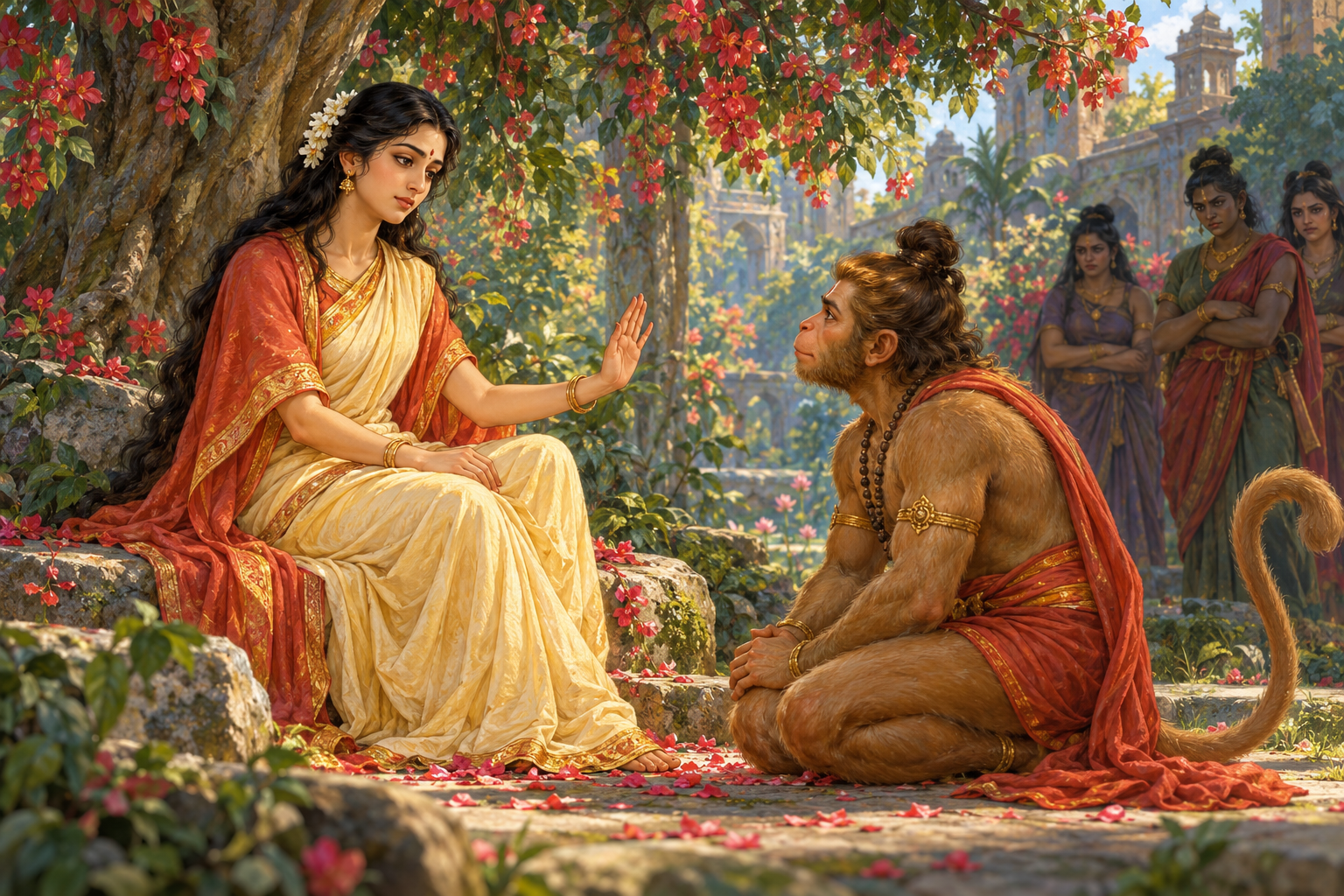
Sītā refuses the proposed retaliation
Selected exchange about the women who threatened Sītā; the complete chapter contains a longer speech.
Reference: Yuddha Kāṇḍa, Sarga 113 — selected narrative and dialogue. K. M. K. Murthy; ValmikiRamayan.net English prose translation, Sanskrit Documents mirror; selected chapter text, not the synopsis or editorial footnotes.
English reading — attributed handbook paraphrase
Hanumān asks permission to kill the guards who threatened Sītā. She refuses, describing them as servants acting under their king’s orders and saying that Rāvaṇa’s death ends those threats. She also speaks of her suffering in terms of fate and past action, and states that she forgives the women. Her reply appeals to good conduct and kindness. Hanumān accepts her response and asks for her message to Rāma. She says she wishes to see her husband; he returns with that reply.
Read the complete cited chapter →
Handbook paraphrase of the identified translation, not its exact wording. Complete chapter linked; specialist review pending.
Who proposes retaliation, and who refuses it?
Answer: Hanumān proposes it; Sītā refuses. Her response is a reasoned decision within the dialogue, not merely an action attributed to her by a later retelling.
The approach to the reunion is already unsettled
Selected preparations and arrival; the speeches in Sargas 115–116 follow this scene.
Reference: Yuddha Kāṇḍa, Sarga 114 — selected narrative and dialogue. K. M. K. Murthy; ValmikiRamayan.net English prose translation, Sanskrit Documents mirror; selected chapter text, not the synopsis or editorial footnotes.
English reading — attributed handbook paraphrase
Hanumān reports Sītā’s wish to see Rāma. Rāma directs Vibhīṣaṇa to bring her after bathing and adornment; Sītā first asks to come without bathing, then agrees to the instruction conveyed to her. When she arrives in a palanquin, the narrator describes Rāma’s mixed emotions. Rāma stops the dispersal of the assembled warriors and asks that she approach on foot. Lakṣmaṇa, Sugrīva and Hanumān are disturbed by his demeanor, while Sītā approaches with affection and joy at seeing him.
Read the complete cited chapter →
Handbook paraphrase of the identified translation, not its exact wording. Complete chapter linked; specialist review pending.
Do all participants understand the meeting in the same way?
Answer: No. The narrator describes Rāma’s mixed emotions, the allies’ concern and Sītā’s joy. Their different responses prepare the reader for the next speeches.
Follow the message in both directions
- Rāma instructs Hanumān to report the allies’ welfare and Rāvaṇa’s defeat.
- Sītā hears the news and expresses gratitude.
- She refuses the proposed retaliation and asks to see Rāma.
- Hanumān returns with her wish; the preparations and public arrival follow.
Handbook reading guidance: Sītā is not simply waiting for others to finish the story. In these readings she responds to a message, evaluates a proposal and states what she wants next. Keep each response attached to its particular situation.
Does Sītā’s forgiveness mean the threats are described as harmless?
No. Hanumān’s proposal explicitly recalls the threats. Sītā declines retaliation and gives reasons; that decision does not remove the preceding account of what she endured.
Should her words about fate be turned into a judgment about someone else’s suffering?
This is Sītā’s speech about her own situation in the selected narrative. The reading does not authorize readers to assign blame for another person’s suffering or turn this scene into a universal response expected from someone who has been harmed.
Keep the next scene open: her joy here and her later objection both belong in the story. Continue to Rāma’s public words and Sītā’s reply; do not substitute the earlier joyful expectation for those speeches.
Optional review: recall the news, the refused proposal and the return message. Check each against the readings above, then name one difference between Sītā’s expectation and the allies’ concern at her arrival.
After the war: hear Sītā’s reply
Rāma’s public words after victory
These are Rāma’s words in the cited translated chapter, alongside the narrator’s account of public scandal. The guide does not endorse the accusation.
Reference: Yuddha Kāṇḍa 6.115.11–21. K. M. K. Murthy; ValmikiRamayan.net English translation; identified online chapter.
English reading — attributed handbook paraphrase
The narrator describes Rāma as divided by fear of public scandal. Addressing Sītā before the assembled monkeys and rākṣasas, he says the campaign restored his honour and his family’s standing rather than being undertaken for her sake. He voices suspicion about her character after her captivity and tells her she may go where she wishes.
Handbook paraphrase of the identified reading, not the translator’s exact wording. Complete chapter linked; specialist review pending.
Sītā challenges the accusation
The paraphrase retains her argument before describing the ordeal. This selection ends at her entry into fire and does not reproduce the subsequent chapters.
Reference: Yuddha Kāṇḍa 6.116.5–16, 18–29. K. M. K. Murthy; ValmikiRamayan.net English translation; identified online chapter.
English reading — attributed handbook paraphrase
Sītā challenges Rāma’s harsh speech and asks him to trust her character. She distinguishes what she could control—her heart’s fidelity—from bodily captivity imposed on her. She asks why he did not abandon her when Hanumān first found her, and says their shared life and her devotion have been disregarded. She then asks Lakṣmaṇa to prepare a pyre. He acts after reading Rāma’s expression; she appeals to Agni as witness to her fidelity and enters the fire.
Handbook paraphrase of the identified reading, not the translator’s exact wording. Complete chapter linked; specialist review pending.
Handbook reading guidance: describe both speeches before offering an interpretation. Sītā responds with reasons about character, coercion, prior knowledge and their relationship. Calling the whole scene simply “a happy reunion” removes those reasons and the narrator’s description of her distress.
What distinction does Sītā make about captivity?
Answer: She separates the fidelity of the heart under her control from bodily captivity imposed by another. This is part of her answer to the accusation, not a conclusion supplied only by a later reteller.
Agni’s testimony and Rāma’s explanation
Continue beyond Sītā’s entry into the fire in chapter 116. This later chapter supplies Agni’s testimony and Rāma’s reply; these are distinct speakers’ statements.
Reference: Yuddha Kāṇḍa 6.118.1–22. K. M. K. Murthy; ValmikiRamayan.net English translation; verse-by-verse online chapter.
English reading — attributed handbook paraphrase
Agni emerges carrying Sītā and restores her to Rāma. He declares her innocent and faithful, describes her forced abduction and captivity, and commands Rāma to receive her without harsh words. Rāma replies that public opinion required a demonstration, while saying that he himself knew her unwavering affection. He explains his allowing her entry into the fire as intended to convince the worlds. He affirms her purity and accepts the assembled guardians’ counsel. The chapter ends with their reunion and Rāma’s joy.
Handbook paraphrase of the identified translation, not its exact wording. Complete chapter linked; specialist review pending.
Handbook reading guidance: retain the sequence of Rāma’s accusation, Sītā’s response, Agni’s testimony and Rāma’s explanation here. His later stated motive does not erase her earlier objection. Distinguish the character’s justification from your evaluation of it.
Who explicitly tells Rāma to receive Sītā without harsh words?
Answer: Agni, in verse 10. Rāma’s explanation about public opinion follows in his own reply.
After the reunion: Daśaratha’s words and a boon for the allies
Learning goal: distinguish the family encounter, a speaker’s explanation of the ordeal, the request to Indra and the narrated fulfillment. Notice whose needs remain after victory.
Reading path: continue from Agni’s testimony and Rāma’s explanation in Sarga 118 through these selections from Sargas 119–120. The later departure preparations are not reproduced here.
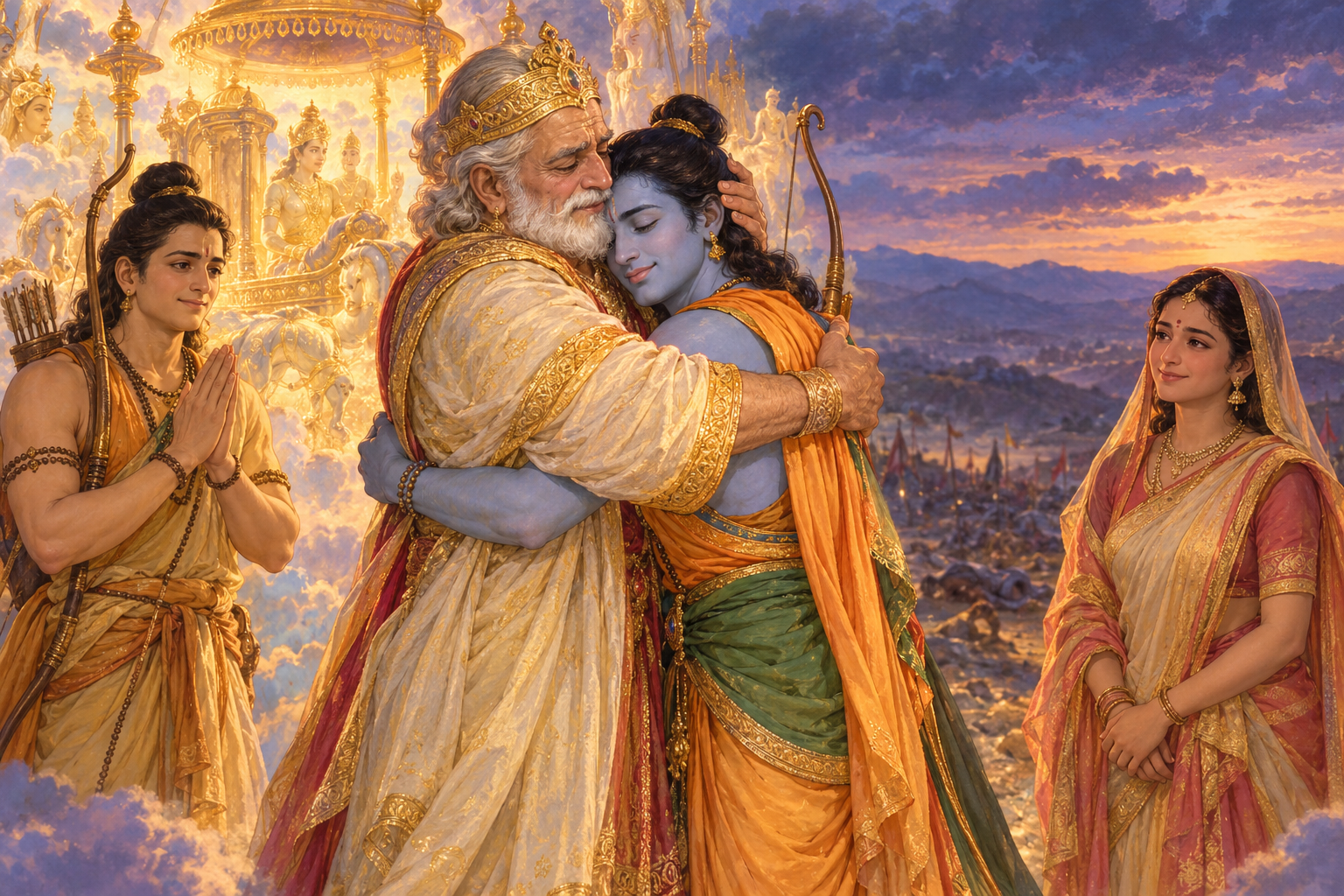
Daśaratha embraces his sons
Selected encounter and return instructions, following the reunion with Sītā.
Reference: Yuddha Kāṇḍa, Sarga 119 — selected narrative and dialogue. K. M. K. Murthy; ValmikiRamayan.net English prose translation, Sanskrit Documents mirror; selected narrative and speakers distinguished.
English reading — attributed handbook paraphrase
Śiva directs Rāma and Lakṣmaṇa to greet Daśaratha, who appears in a celestial vehicle. Daśaratha embraces Rāma and speaks of the sorrow of their separation and his present joy. He acknowledges the completed exile and urges reunion with Bharata and the resumption of rule. Rāma asks that his father’s earlier repudiation not harm Kaikeyī and Bharata; Daśaratha agrees.
Read the complete cited chapter →
Handbook paraphrase of the identified translation, not its exact wording. Complete chapter linked; specialist review pending.
What does Rāma ask for during this encounter?
Answer: He asks his father to be gracious to Kaikeyī and Bharata, so the earlier repudiation will not harm them.
Daśaratha addresses Lakṣmaṇa and Sītā
Selected closing counsel; Daśaratha’s explanation of the ordeal is his speech, not Sītā’s reply.
Reference: Yuddha Kāṇḍa, Sarga 119 — selected narrative and dialogue. K. M. K. Murthy; ValmikiRamayan.net English prose translation, Sanskrit Documents mirror; selected narrative and speakers distinguished.
English reading — attributed handbook paraphrase
Daśaratha praises Lakṣmaṇa’s service. Addressing Sītā affectionately, he tells her not to be angry with Rāma and explains the ordeal as a demonstration of her purity. He praises her difficult action and speaks of devotion to her husband. He then takes leave and returns to Indra’s abode.
Read the complete cited chapter →
Handbook paraphrase of the identified translation, not its exact wording. Complete chapter linked; specialist review pending.
Does Daśaratha’s explanation replace Sītā’s earlier objection?
Answer: No. It is another character’s explanation in a later scene. Read Sītā’s own argument alongside it rather than replacing her words.
Rāma requests restoration for the allies
Selected request after Daśaratha’s departure.
Reference: Yuddha Kāṇḍa, Sarga 120 — selected narrative and dialogue. K. M. K. Murthy; ValmikiRamayan.net English prose translation, Sanskrit Documents mirror; selected narrative and speakers distinguished.
English reading — attributed handbook paraphrase
Indra invites Rāma to name a desired boon. Rāma asks for the return to life of the vānaras who died helping him, recalling their separation from wives and children. He also asks that the vānaras and bears be free of wounds and pain, and that their home regions have water, roots, flowers and fruit.
Read the complete cited chapter →
Handbook paraphrase of the identified translation, not its exact wording. Complete chapter linked; specialist review pending.
Whose welfare is the request directed toward?
Answer: The allies who served in the campaign and their families. Rāma’s request concerns their lives, recovery and living conditions.
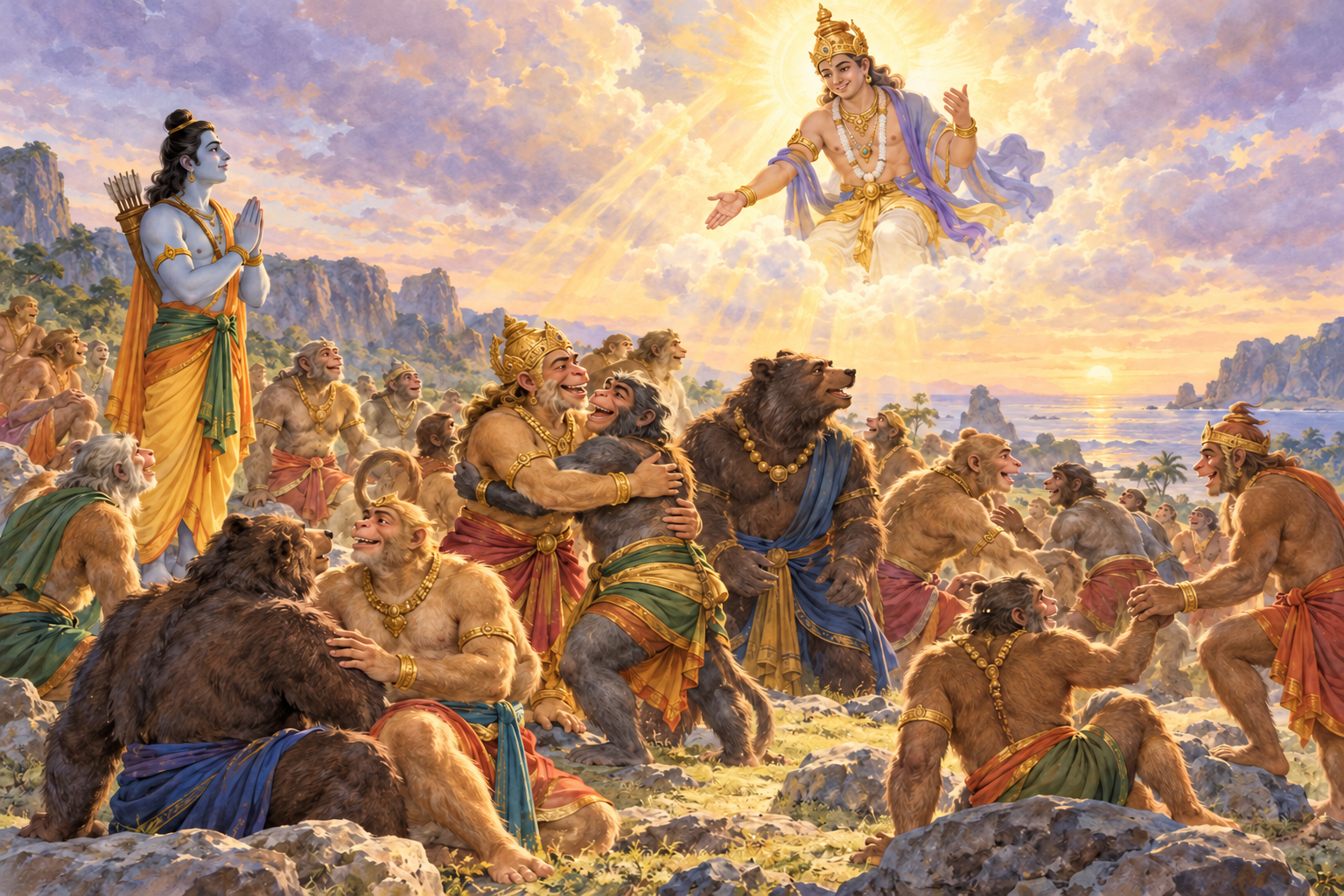
The narrator describes the boon fulfilled
Selected grant, restoration and closing rest.
Reference: Yuddha Kāṇḍa, Sarga 120 — selected narrative and dialogue. K. M. K. Murthy; ValmikiRamayan.net English prose translation, Sanskrit Documents mirror; selected narrative and speakers distinguished.
English reading — attributed handbook paraphrase
Indra agrees to restore the fallen allies and promises their recovery and reunion with family. The narrator describes the warriors rising healed, astonished at what has happened. The deities urge Rāma to return to Ayodhyā and then depart. After saluting them, Rāma and Lakṣmaṇa direct the vānara army to rest.
Read the complete cited chapter →
Handbook paraphrase of the identified translation, not its exact wording. Complete chapter linked; specialist review pending.
Does the chapter stop at Rāma’s request?
Answer: No. It includes Indra’s reply, the narrated restoration, the departure of the deities and the army’s rest.
Keep each voice attached to its statement
| Reading task | Where to look |
|---|---|
| Identify a request concerning the family | Rāma’s words to Daśaratha |
| Compare explanations of the ordeal | Daśaratha’s counsel, Rāma’s explanation and Sītā’s own reply |
| Distinguish a request from an outcome | The request to Indra and the grant and fulfillment |
Handbook reading guidance: a later character’s explanation does not erase an earlier character’s objection. Compare the supplied speeches before offering an interpretation. Likewise, distinguish what Rāma asks for from what Indra promises and what the narrator subsequently describes.
Is the family encounter the same scene as the reunion at Ayodhyā?
No. This encounter takes place before the homeward journey. The later reception involves Bharata and the people awaiting the returning party.
Does the restoration remove the earlier accounts of loss from the story?
The narrative supplies a restoration here after earlier accounts of combat and grief. Preserve that order rather than treating the earlier scenes as though they never occurred. The laments in Laṅkā and this boon also concern different participants; they should not be silently merged.
Narrative boundary: these selections present the epic’s celestial encounter and miraculous restoration. They are not a method for obtaining contact with the deceased, a recovery procedure or a promise about what will happen in a reader’s own bereavement.
Continue: the remembered places and companions on the journey home, followed by Hanumān’s mission to Bharata.
Optional review: recall the family request, the speaker who explains the ordeal here and the beneficiaries of the boon. Check each against its on-page passage.
Leaving Laṅkā: hospitality, recognition and a shared journey
Learning goal: follow the decisions that turn rest after victory into departure. Distinguish an offered stay, a reason for leaving, recognition of service and a request to travel together.
Reading path: continue from the allies’ restoration and rest in Sarga 120 through these selections from Sargas 121–122, before the journey chapter.
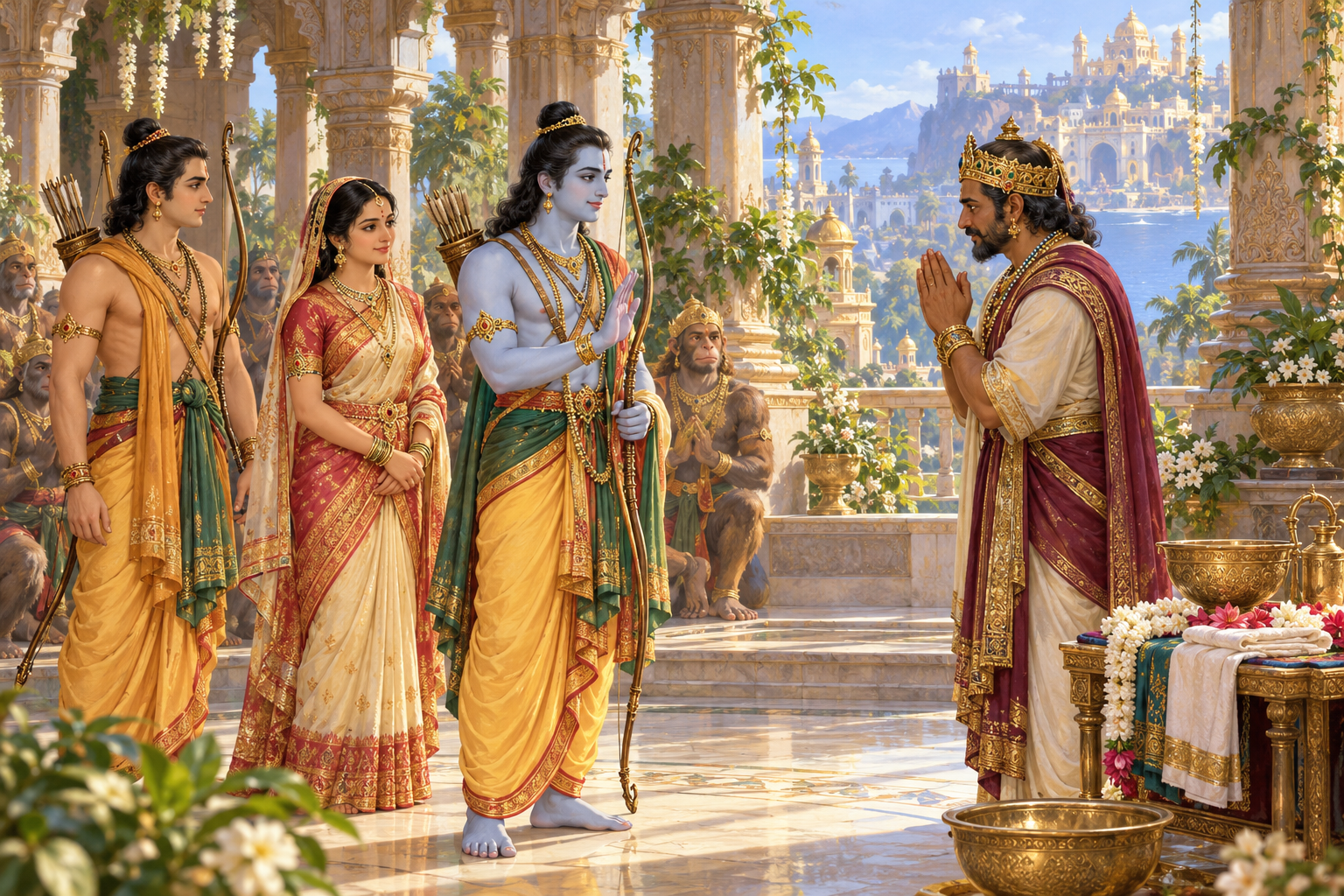
Rāma declines a longer stay
Selected hospitality dialogue after the army’s rest.
Reference: Yuddha Kāṇḍa, Sarga 121 — selected narrative and dialogue. K. M. K. Murthy; ValmikiRamayan.net English prose translation, Sanskrit Documents mirror; selected chapter text.
English reading — attributed handbook paraphrase
Vibhīṣaṇa offers bathing, adornment and a longer stay in Laṅkā. Rāma directs the hospitality toward the vānaras and says that Bharata’s hardship makes those comforts unwelcome to him. He acknowledges Vibhīṣaṇa’s counsel, effort and friendship, while asking permission to leave. He longs to see Bharata, his mothers, Guha and the people of Ayodhyā.
Read the complete cited chapter →
Handbook paraphrase of the identified translation, not its exact wording. Complete chapter linked; specialist review pending.
Does declining the stay mean Rāma denies Vibhīṣaṇa’s help?
Answer: No. He explicitly acknowledges that help and friendship while explaining his wish to return.
Vibhīṣaṇa arranges Puṣpaka
Selected transport proposal and arrival of the vehicle.
Reference: Yuddha Kāṇḍa, Sarga 121 — selected narrative and dialogue. K. M. K. Murthy; ValmikiRamayan.net English prose translation, Sanskrit Documents mirror; selected chapter text.
English reading — attributed handbook paraphrase
Vibhīṣaṇa offers Puṣpaka for the journey, explaining that it belongs to Kubera and was taken by Rāvaṇa. At Rāma’s request he brings the splendid vehicle. Rāma and Lakṣmaṇa look on in wonder. Its appearance prepares the departure; the flight itself follows in the next chapter.
Read the complete cited chapter →
Handbook paraphrase of the identified translation, not its exact wording. Complete chapter linked; specialist review pending.
Whose vehicle does this account identify Puṣpaka as?
Answer: Kubera’s. The later return of the vehicle to him appears in the reception reading from Sarga 127.
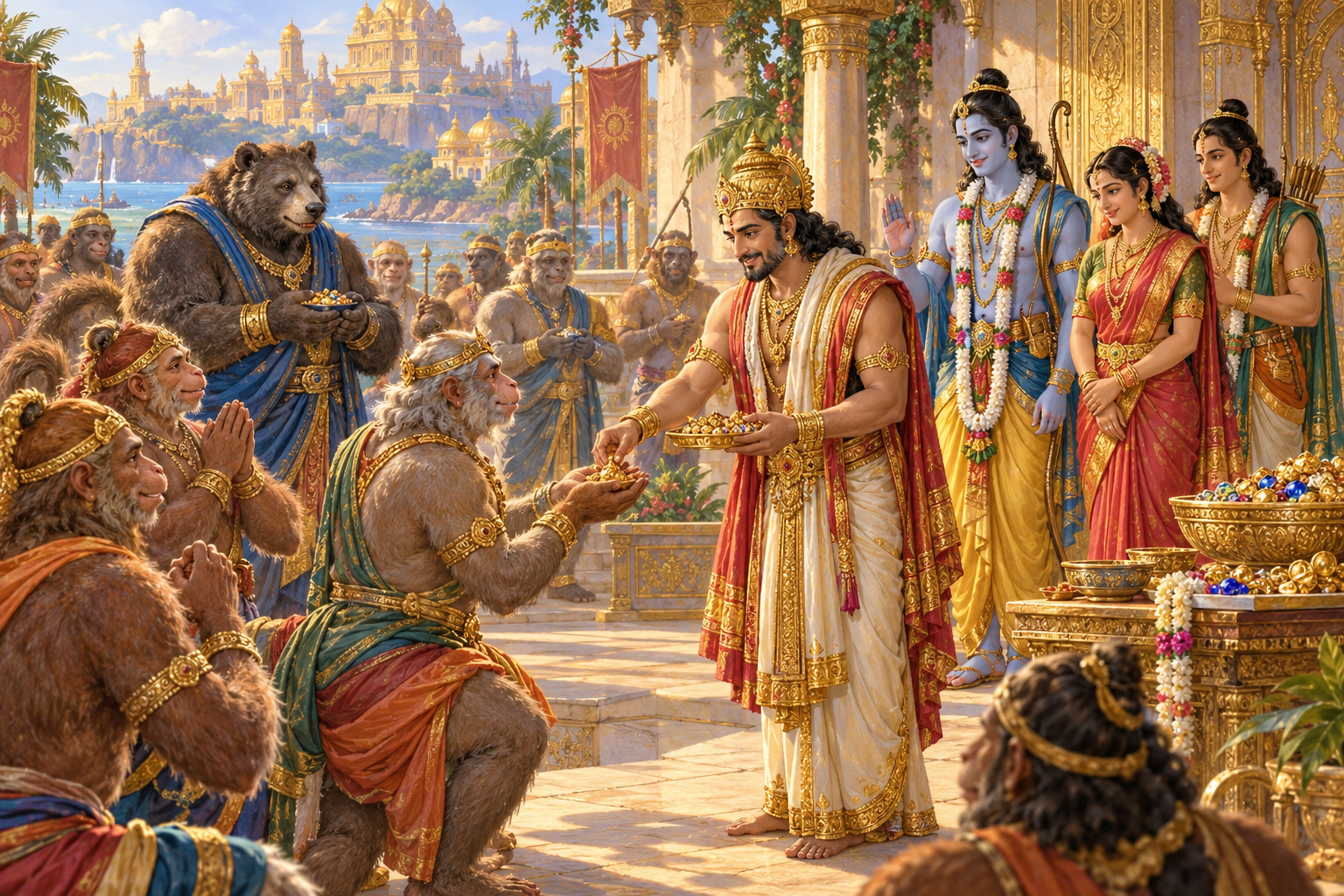
The allies are honored before departure
Selected instruction and distribution of gifts.
Reference: Yuddha Kāṇḍa, Sarga 122 — selected narrative and dialogue. K. M. K. Murthy; ValmikiRamayan.net English prose translation, Sanskrit Documents mirror; selected chapter text.
English reading — attributed handbook paraphrase
With Puṣpaka ready, Vibhīṣaṇa asks what else he can do. Rāma calls for honoring the vānaras and bears with wealth, recognizing the effort and risks of their service. He contrasts generosity and concern with a ruler who only orders an army into battle. Vibhīṣaṇa distributes gold and precious stones before Rāma boards.
Read the complete cited chapter →
Handbook paraphrase of the identified translation, not its exact wording. Complete chapter linked; specialist review pending.
Does honoring the allies wait until Ayodhyā?
Answer: No. This chapter describes gifts in Laṅkā. The later coronation chapter contains another setting for recognition.
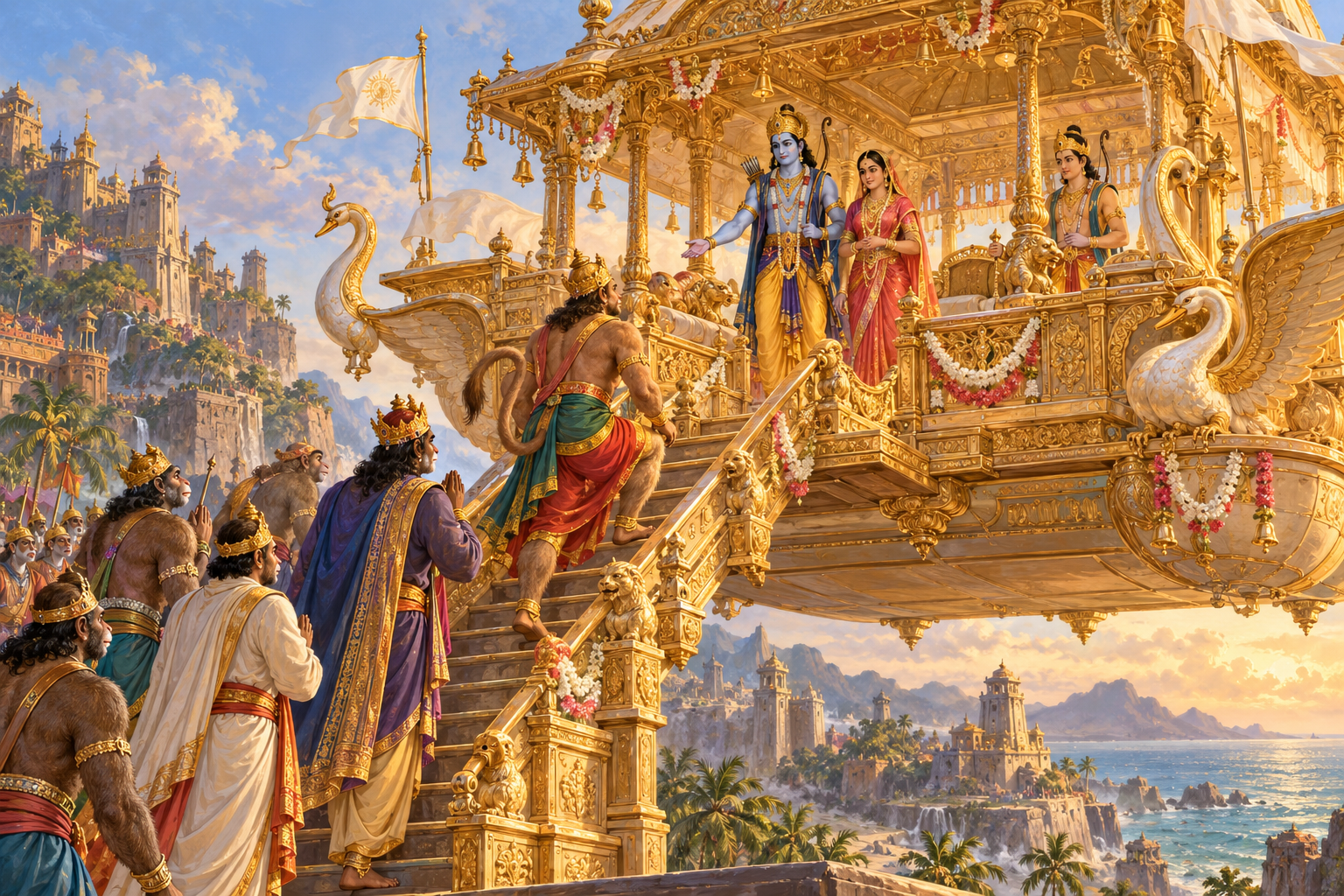
The allies ask to accompany him
Selected farewell, request and boarding.
Reference: Yuddha Kāṇḍa, Sarga 122 — selected narrative and dialogue. K. M. K. Murthy; ValmikiRamayan.net English prose translation, Sanskrit Documents mirror; selected chapter text.
English reading — attributed handbook paraphrase
Rāma releases the allies to return home, telling Sugrīva to go to Kiṣkindhā and Vibhīṣaṇa to remain in Laṅkā. They instead ask to accompany him, see the coronation and greet Kausalyā before returning. Rāma warmly agrees. The vānaras, Sugrīva, Vibhīṣaṇa and his counsellors board, and Puṣpaka rises with the party.
Read the complete cited chapter →
Handbook paraphrase of the identified translation, not its exact wording. Complete chapter linked; specialist review pending.
Who requests the shared journey?
Answer: The allies themselves. Rāma first permits them to return home, then welcomes their request to accompany him.
Follow the request through its response
| Starting point | Follow-up reading |
|---|---|
| Vibhīṣaṇa offers a longer stay | Rāma’s reply and acknowledged friendship |
| A vehicle is needed | Puṣpaka is arranged |
| Vibhīṣaṇa asks what else he can do | Recognition of the allies |
| The allies are free to return home | Their request to accompany Rāma |
Handbook reading guidance: pay attention to the reasons speakers give and the order of their responses. A farewell does not end the conversation: the allies answer with a request of their own. Recognition appears in more than one setting, so keep the gifts here distinct from the coronation gifts.
Does arranging Puṣpaka change its stated ownership?
The cited account identifies it with Kubera. Later, the reception reading records Rāma sending it back to him. Keep availability for the journey and stated ownership distinct.
Do all companions join at the same moment?
No. The allies board here. The next journey chapter includes Sītā’s request that their wives join at Kiṣkindhā. Preserve the separate boarding episodes.
Narrative boundary: Puṣpaka belongs to the epic’s story world. This reading does not establish a historical aircraft design or a modern transport claim.
Optional review: recall who offers hospitality, who requests gifts and who asks to travel together. Check those roles against the four passages before moving to the journey.
The journey home: remembered places, companions and welfare
Learning goal: connect the homeward journey with earlier episodes, notice who joins it and identify what Rāma asks about the people awaiting him.
Reading path: selected portions of Sargas 123–124, followed by the existing messenger reading from Sarga 125. The selections begin during the flight; they do not reproduce every intervening departure episode after the reunion.
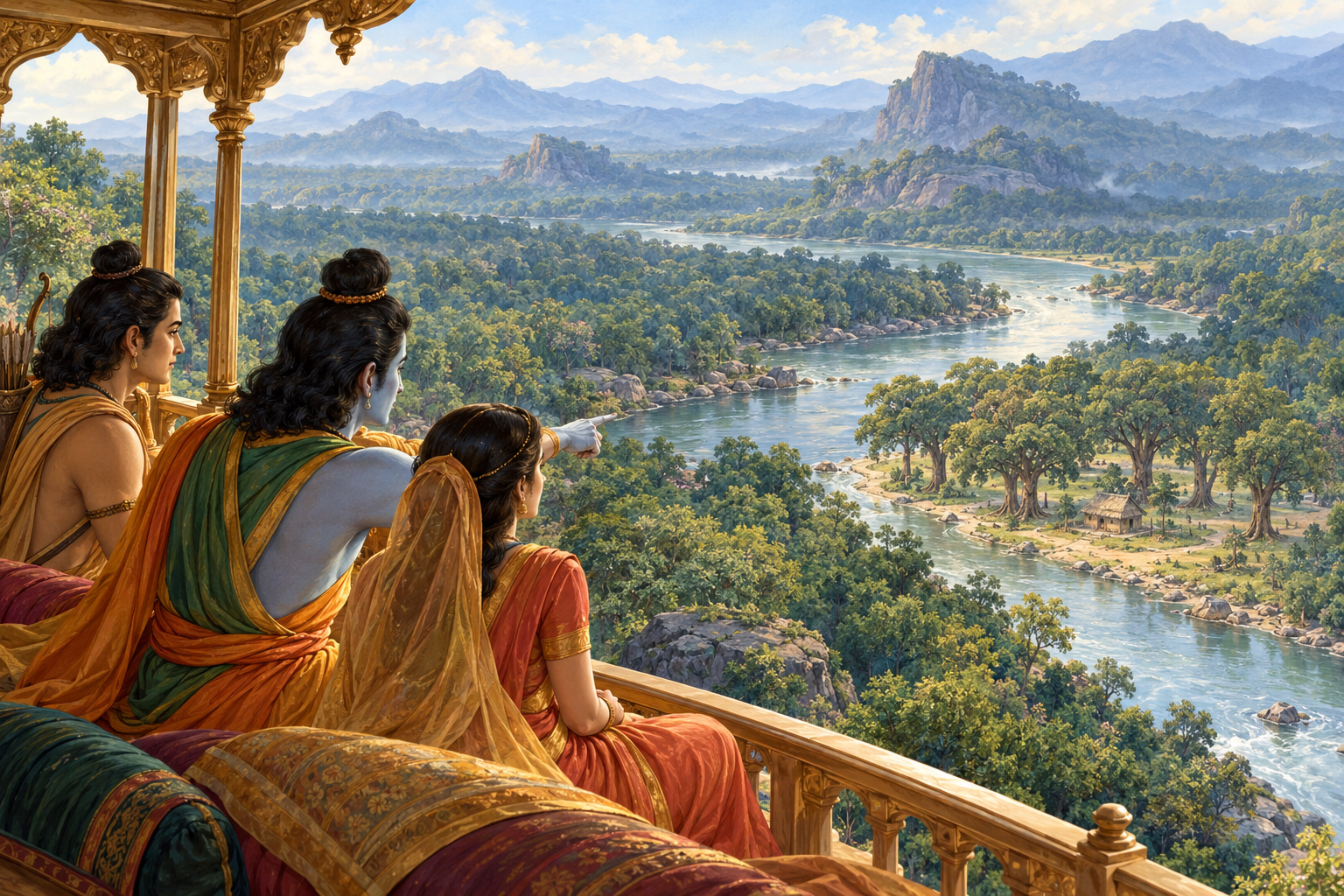
The landscape recalls the exile and campaign
Selected memories along the aerial journey; this is not a complete list of places in the chapter.
Reference: Yuddha Kāṇḍa, Sarga 123 — selected narrative and dialogue. K. M. K. Murthy; ValmikiRamayan.net English prose translation, Sanskrit Documents mirror; selected narrative and dialogue.
English reading — attributed handbook paraphrase
As Puṣpaka carries the party north, Rāma points out Laṅkā and the battlefield, the bridge, Kiṣkindhā and places from the exile. He recalls meeting Sugrīva, grieving beside Pampā, Jaṭāyu’s death and the hut from which Sītā was taken. Later he identifies Citrakūṭa, Bharadvāja’s hermitage, Guha’s town, the Sarayū and Ayodhyā. The sights call earlier events back into the return journey.
Read the complete cited chapter →
Handbook paraphrase of the identified translation, not its exact wording. Complete chapter linked; specialist review pending.
Are these places presented only as scenery?
Answer: No. Rāma identifies places through events and relationships remembered there. Revisit one linked earlier episode to see what its return reference recalls.
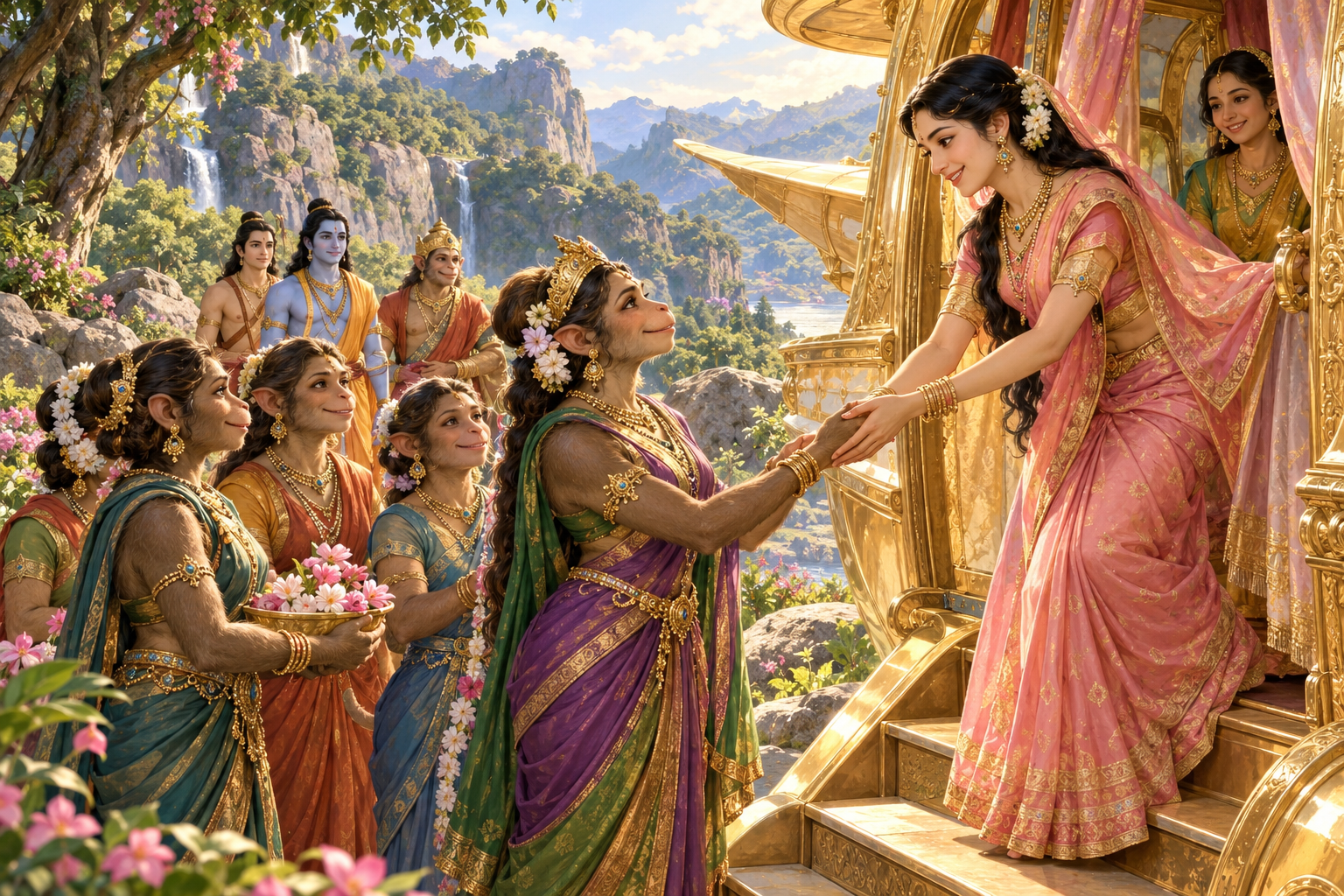
Sītā asks that the allies’ wives join the return
Selected stop at Kiṣkindhā within the journey chapter.
Reference: Yuddha Kāṇḍa, Sarga 123 — selected narrative and dialogue. K. M. K. Murthy; ValmikiRamayan.net English prose translation, Sanskrit Documents mirror; selected narrative and dialogue.
English reading — attributed handbook paraphrase
At Kiṣkindhā, Sītā asks to reach Ayodhyā with Tārā and the other wives of the vānara chiefs. Rāma agrees and halts the vehicle. Sugrīva conveys the invitation, Tārā gathers the women, and they board before the journey resumes.
Read the complete cited chapter →
Handbook paraphrase of the identified translation, not its exact wording. Complete chapter linked; specialist review pending.
Who asks to include the women in the journey?
Answer: Sītā. Rāma agrees, and Sugrīva and Tārā help make the request happen.
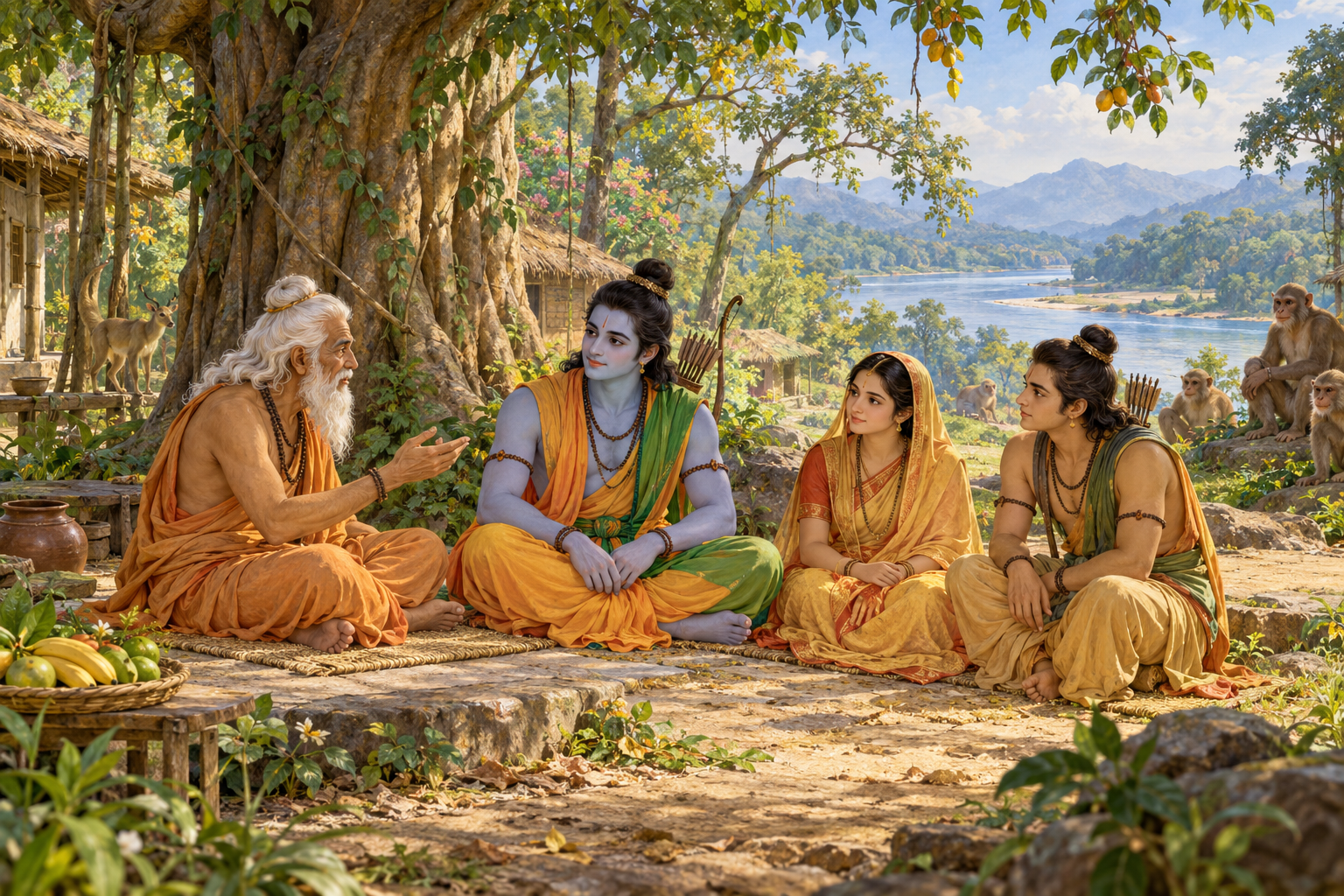
Rāma asks after the people at home
Selected welfare inquiry and boon; the chapter’s dating and wider retrospective account are not reproduced.
Reference: Yuddha Kāṇḍa, Sarga 124 — selected narrative and dialogue. K. M. K. Murthy; ValmikiRamayan.net English prose translation, Sanskrit Documents mirror; selected narrative and dialogue.
English reading — attributed handbook paraphrase
At Bharadvāja’s hermitage, Rāma asks about Ayodhyā’s food supply and freedom from illness, Bharata’s rule and his mothers. The sage says the household and city are safe, and Bharata awaits him with the sandals before him. Rāma requests fruit along the onward route, even out of season. Bharadvāja grants the boon; the narrator describes the trees bearing abundantly and the vānaras eating the fruit.
Read the complete cited chapter →
Handbook paraphrase of the identified translation, not its exact wording. Complete chapter linked; specialist review pending.
What does Rāma ask about before the onward journey?
Answer: The welfare of the city, Bharata and his mothers. The inquiry concerns those at home as well as the returning party.
Revisit an earlier scene through its place
| Remembered place or event | Earlier on-page reading |
|---|---|
| The ocean bridge | The bridge to Laṅkā |
| The alliance with Sugrīva | The first meeting and mutual need |
| Jaṭāyu and Sītā’s abduction | The abduction and Jaṭāyu’s resistance |
| Bharata’s earlier request | Bharata’s counsel and the sandals |
Handbook reading guidance: choose one row and read its earlier passage beside the return selection. Identify what is remembered and what the shorter retrospective leaves out. A recap is not a substitute for every participant’s earlier words.
Is this a verified modern travel itinerary?
No. This path follows places as named in the cited epic chapter. It does not establish archaeological identification, modern coordinates, distances or a practical travel route.
Does Bharadvāja’s report replace Hanumān’s mission?
No. The sage’s account and the subsequent mission are separate scenes. Continue to Rāma’s instruction to Hanumān to see the news carried to Guha and Bharata and the response observed.
Keep the narrative’s frame visible: the boon and abundant fruit are narrated within the epic. The page presents that account for reading, without turning it into a botanical or logistical claim about present-day travel.
Continue: news, reunion and coronation at Ayodhyā. Keep the journey, message, return of entrusted authority and consecration in their own sequence.
Optional review: name one remembered place, who requests additional companions and one welfare question. Reopen the three readings to check your answers.
Return to Ayodhyā: news, reunion and coronation
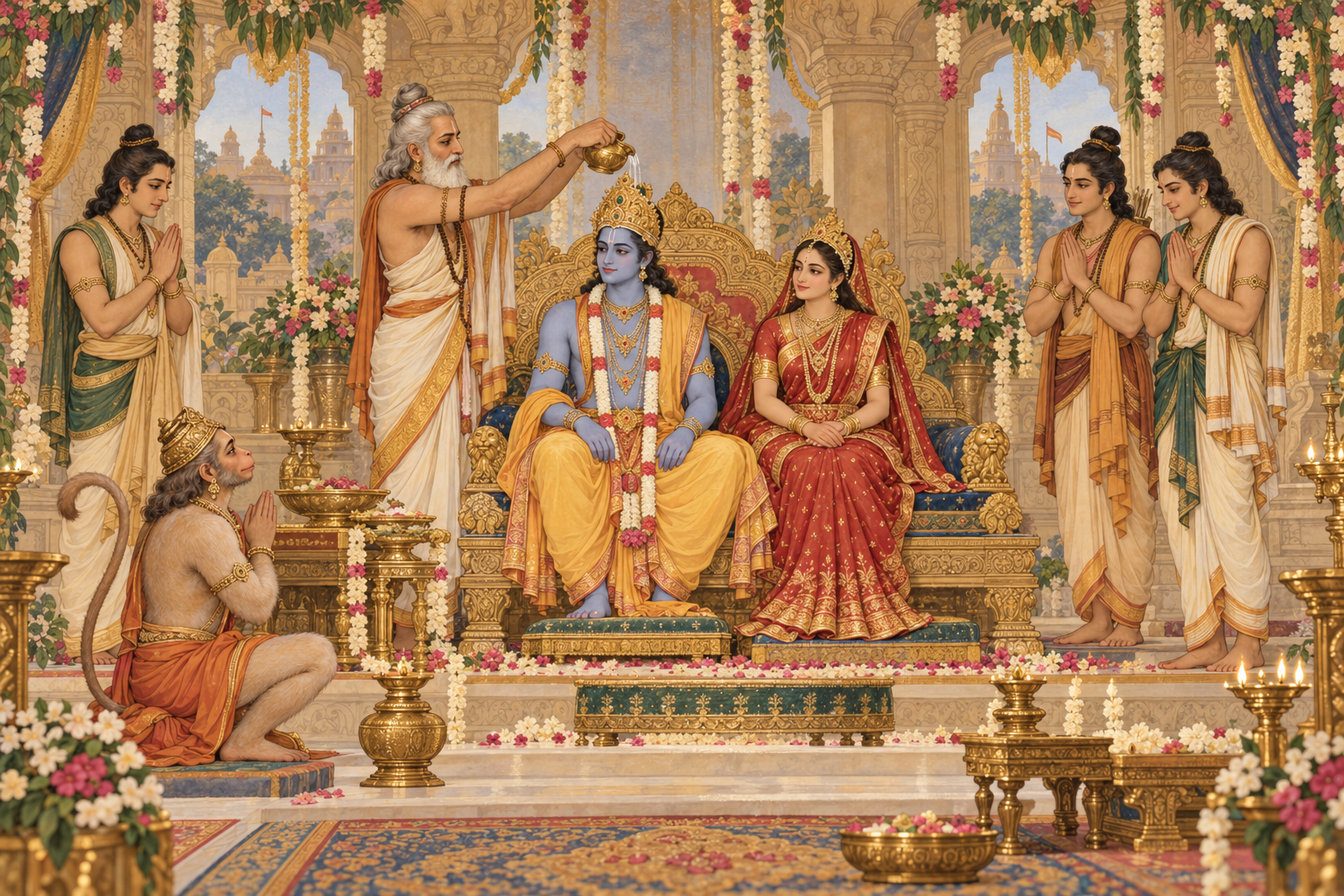
Reading goal: distinguish announcing the return, restoring entrusted authority and performing the coronation. These are successive scenes, each with its own participants and decisions.
Hanumān brings news and observes Bharata’s response
Rāma is nearing Ayodhyā after the campaign. He sends Hanumān ahead.
Reference: Yuddha Kāṇḍa, Sarga 125 — selected mission and response. K. M. K. Murthy; ValmikiRamayan.net English prose translation; identified chapter.
English reading — attributed handbook paraphrase
Rāma asks Hanumān to tell Guha of his welfare and then inform Bharata that he is returning with Sītā, Lakṣmaṇa and his allies. Hanumān must also observe Bharata’s expression, words and intentions. Rāma says that, if Bharata wants to retain the kingdom after ruling so long, he may do so. Hanumān finds Bharata living austerely at Nandigrāma, with Rāma’s sandals before him. Hearing the news, Bharata is overcome with joy and embraces the messenger.
Handbook paraphrase of the identified translation, not its exact wording. Complete chapter linked; specialist review pending.
Handbook reading guidance: Hanumān carries news and assesses a response. Rāma’s instruction leaves Bharata’s intention to be learned, rather than assuming it. Compare this mission with his earlier deliberation before speaking to Sītā: the listener and circumstances differ.
What must Hanumān do besides announce Rāma’s return?
Answer: Observe Bharata’s expression, words and intentions, then report back. Bharata’s response is joy at the news.
Bharata’s questions: the return news becomes a fuller account
Learning goal: distinguish a brief announcement from a retrospective account shaped by the listener’s question. Track when a speaker summarizes earlier events and when the narrative returns to the present.
Reading path: begin with the announcement in Sarga 125, read these selected portions of Sarga 126, then continue to the reception in Sarga 127. These are three stages of the return sequence, not three versions of one scene.
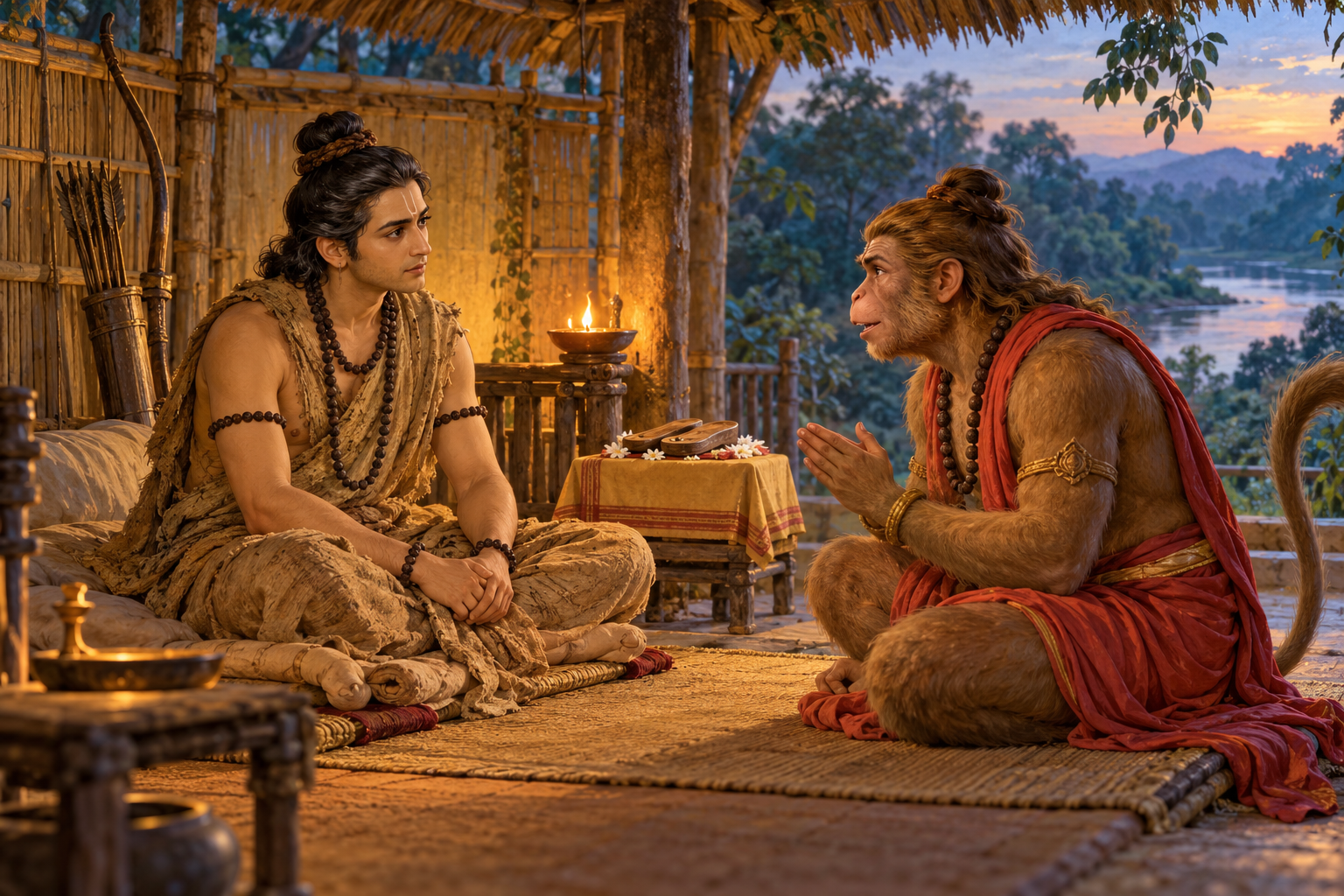
Bharata asks how the alliance began
Selected opening question and Hanumān’s orientation.
Reference: Yuddha Kāṇḍa, Sarga 126 — selected report and dialogue. K. M. K. Murthy; ValmikiRamayan.net English prose translation, Sanskrit Documents mirror; selected chapter text.
English reading — attributed handbook paraphrase
Bharata asks how, where and on what grounds Rāma formed an alliance with the vānaras, requesting a truthful account. Hanumān first distinguishes the events Bharata already knows, up to his departure with the sandals, from what followed. He then begins the forest narrative.
Read the complete cited chapter →
Handbook paraphrase of the identified translation, not its exact wording. Complete chapter linked; specialist review pending.
Why begin by identifying what Bharata already knows?
Answer: Hanumān marks the boundary between shared knowledge and the events he is about to recount. The new report begins after Bharata’s departure.
Hanumān recounts the search and exchanged tokens
Selected middle of the report; many intervening events are omitted here.
Reference: Yuddha Kāṇḍa, Sarga 126 — selected report and dialogue. K. M. K. Murthy; ValmikiRamayan.net English prose translation, Sanskrit Documents mirror; selected chapter text.
English reading — attributed handbook paraphrase
Hanumān’s account reaches the meeting with Sugrīva, the search and Sampāti’s information. He then speaks of his own crossing, finding Sītā, giving her Rāma’s ring and returning with her jewel. His report links that news to Rāma’s renewed hope and the campaign that follows.
Read the complete cited chapter →
Handbook paraphrase of the identified translation, not its exact wording. Complete chapter linked; specialist review pending.
Where does Hanumān describe his own participation?
Answer: In the crossing, meeting with Sītā and exchange of tokens. This is part of his report to Bharata, rather than a new occurrence during the return.
The account returns to the present
Selected ending of the retrospective report.
Reference: Yuddha Kāṇḍa, Sarga 126 — selected report and dialogue. K. M. K. Murthy; ValmikiRamayan.net English prose translation, Sanskrit Documents mirror; selected chapter text.
English reading — attributed handbook paraphrase
Hanumān moves from the bridge and major combat outcomes to the return flight and Rāma’s stay with Bharadvāja. He announces the forthcoming meeting. Bharata responds that his long-held wish is fulfilled. The chapter ends with that response; the reception itself follows in Sarga 127.
Read the complete cited chapter →
Handbook paraphrase of the identified translation, not its exact wording. Complete chapter linked; specialist review pending.
Does the retrospective end with the coronation?
Answer: No. It ends with the prospect of seeing Rāma and Bharata’s response. The reception and coronation are later scenes.
Use the report as a route back into the story
| Topic in the retrospective | Longer on-page reading |
|---|---|
| The alliance | Speech, trust and mutual need |
| Organizing the search | Purpose, people and recognition |
| Recognizing the messenger | Hanumān’s message to Sītā |
| The return of the search party | The returning report |
| The final encounter | Mātali’s counsel and the final arrow |
Handbook reading guidance: a speaker’s recap selects events for a listener. Read the earlier scene before deciding that details absent from the shorter report did not occur. Likewise, do not import every detail of the earlier scene into Hanumān’s speech as though he explicitly states it here.
Is Hanumān’s report a second journey through those events?
No. He is telling Bharata about earlier events. Distinguish the time of the conversation from the time of the events being recounted.
Does every part of the report claim personal eyewitness experience?
The chapter includes a wide retrospective, alongside passages where Hanumān describes his own actions. Do not label every event in the speech as something he personally witnessed. Identify the speaker and the form of the account without inventing how each item became known to him.
Compare two messenger situations: Sītā receives the victory news in Sarga 113; Bharata receives return news in Sarga 125 and asks further questions in Sarga 126. Compare what each listener is told and what each says next. Both readings are available on this page.
Optional review: write one sentence for each stage: announcement, fuller account, reception. Then check the three linked passages and add one question or action belonging to each stage.
Bharata returns the sandals and entrusted sovereignty
The reception takes place at Nandigrāma, before the procession and coronation described in the next chapter.
Reference: Yuddha Kāṇḍa, Sarga 127 — selected reception and transfer. K. M. K. Murthy; ValmikiRamayan.net English prose translation; identified chapter.
English reading — attributed handbook paraphrase
Bharata arranges a public welcome and carries Rāma’s sandals to meet him. When the Puṣpaka vehicle lands, Rāma embraces Bharata, who greets Sītā, Lakṣmaṇa and the allies. Bharata welcomes Sugrīva as a fifth brother and thanks Vibhīṣaṇa for his help. He places the sandals beneath Rāma’s feet and says he is returning the sovereignty entrusted to him. Rāma then sends Puṣpaka back to Kubera, to whom it belongs.
Handbook paraphrase of the identified translation, not its exact wording. Complete chapter linked; specialist review pending.
Handbook reading guidance: revisit the earlier request for the sandals. Here the object returns to Rāma as Bharata explicitly returns the entrusted sovereignty. The welcome also recognizes allies beyond the four brothers.
Is returning the sandals the coronation itself?
Answer: No. It accompanies Bharata’s return of entrusted authority. The coronation is described in Sarga 128.
The coronation and the recognition of allies
This selection follows Bharata’s request that Rāma resume rule. It ends before the chapter’s descriptions of his reign and praise of hearing the epic.
Reference: Yuddha Kāṇḍa, Sarga 128 — selected coronation and gifts. K. M. K. Murthy; ValmikiRamayan.net English prose translation; identified chapter.
English reading — attributed handbook paraphrase
Rāma accepts Bharata’s request. After preparations and the procession, Sugrīva sends vānaras to gather water from the oceans; river water is also brought. Vasiṣṭha seats Rāma with Sītā and, with other priests, performs the consecration and crowns him. Rāma honours the allies with gifts. Sītā gives Hanumān the pearl necklace she has received. The vānaras take leave, and Sugrīva and Vibhīṣaṇa return to their kingdoms.
Handbook paraphrase of the identified translation, not its exact wording. Complete chapter linked; specialist review pending.
Handbook reading guidance: keep the gathering of water, priestly consecration, crowning and gifts in sequence. Notice Sītā’s place beside Rāma and her gift to Hanumān. This is a literary account of the royal ceremony, not instructions for conducting a present-day ritual.
Who gives Hanumān the pearl necklace?
Answer: Sītā. The chapter places this gift among the acknowledgments of those who helped.
Where this path ends: these selections reach the coronation within Yuddha Kāṇḍa. They do not cover the later events of Uttara Kāṇḍa. Use the seven-book map to keep that boundary visible and the retelling comparison to examine how another author presents the story.
Compare a translated scene with a later retelling
Vivekananda’s account of the ordeal and later ending
This is the lecturer’s retelling and interpretation, delivered in Pasadena in 1900. Its assignment of responsibility for the first ordeal differs from the translated scenes above.
Reference: Swami Vivekananda, “The Ramayana” — reunion and concluding narrative. Swami Vivekananda; Complete Works, volume 4, Lectures and Discourses; Ramakrishna/Vedānta perspective.
English reading — attributed handbook paraphrase
In Vivekananda’s lecture, followers demand a trial by fire while Rāma protests that Sītā is pure. After the return to Ayodhyā, renewed public doubts lead to her exile. Vālmīki shelters her and brings up the twins, who learn his account of Rāma’s life. Their recitation brings the family’s story before Rāma. When Sītā is summoned for another public test, the earth receives her. The lecture subsequently recounts Rāma’s departure and presents Sītā as an ideal of endurance.
Handbook paraphrase of the identified reading, not the translator’s exact wording. Complete chapter linked; specialist review pending.
Handbook comparison: in the translated chapter 115, Rāma himself voices suspicion and dismisses Sītā. In the lecture, followers demand the ordeal and Rāma protests. The available readings support that specific difference. They do not establish that every retelling takes one of these two forms.
Can the lecture’s account be quoted as a translation of Yuddha 6.115?
Answer: No. It is an identified modern retelling, and the translated scene supplied above assigns the words and actions differently. Cite the work actually used.
Vivekananda’s idealization of Sītā belongs to his interpretation. Keep it distinct from her own argument in the translated scene. The lecture is also the source used here for the later ending, not a substitute for a verified Uttara Kāṇḍa translation.
Keep the edition’s layers distinct
The linked verse pages place transliterated Sanskrit, word explanations and connected English renderings near one another. Some also include explanatory comments. The prose mirrors supply connected English without the same verse-by-verse presentation.
- Original text: Sanskrit or its transliteration, with the edition’s own numbering.
- Translation: an identified author’s English rendering.
- Translator’s explanation: additional notes attributed to their author.
- Handbook paraphrase: a shortened account, labeled as such and linked to its source.
- Handbook guidance: questions and ways of organizing your reading.
The preserved opening includes provisional editorial English alongside its original selection. That label remains: expanding the guide does not make a provisional translation specialist-approved. New close readings use labeled paraphrases, without silently combining different translators’ wording.
When taking notes, record book, chapter, selected verses where supplied, translator and access URL. A different edition may use different spellings or numbering. Locate the corresponding scene before comparing sentences.
Choose a manageable reading path
Follow a request through to its answer
Handbook comparison: read the three on-page selections in order, then distinguish what each speaker requests from what the exchange actually settles. The table summarizes those readings; it is not a quotation or a claim that their situations are identical.
| Scene and reading | Request or assurance | What remains |
|---|---|---|
| Sītā’s request Ayodhyā 27 · K. M. K. Murthy | She argues that she should accompany Rāma and share the forest life. | This chapter ends with Rāma still objecting. Her determination is not yet his consent. |
| Bharata and the sandals Ayodhyā 112 · K. M. K. Murthy | Bharata asks Rāma to return; after Rāma refuses, he asks for the sandals. | The sandals mark an arrangement during the absence. They do not mean Rāma has returned. |
| Hanumān and the ring Sundara 5.36.1–3, 15–20, 33–34 · K. M. K. Murthy | The ring identifies the messenger; Hanumān promises action once Rāma receives the news. | Rāma still needs Sītā’s location. Recognition and reassurance precede her release. |
Do the sandals and ring accomplish the same thing?
Answer: No. In the Bharata reading, the sandals represent Rāma’s authority during his absence. In Hanumān’s visit, the ring establishes the messenger’s connection to Rāma. Both objects matter through their surrounding conversations; neither replaces the work that remains.
Try one sentence: “The speaker asks for ___; the reply agrees to ___ or refuses ___; ___ remains unresolved.” Check each part against the visible reading before treating your sentence as an interpretation.
First encounter
- Read the story overview and character guide.
- Read the opening questions and answer.
- Choose one close reading and open its answer feedback after making a note.
Duty and relationships
- Begin with Sītā’s request to accompany Rāma.
- Compare Bharata’s request and Rāma’s response with the later return of the sandals.
- Read the refuge pledge and name the obligation Rāma invokes.
In each scene, write what is requested, what reason is offered and what decision follows. The point is to retain the speaker’s reasoning, not force all scenes into one moral.
Counsel, disagreement and an envoy’s task
- Read the advice in Laṅkā and the brothers’ break.
- Continue through the refuge council.
- Compare Aṅgada’s embassy with Hanumān before Rāvaṇa.
Speech, trust and retelling
- Read Hanumān’s identification and Sītā’s questions.
- Read the two postwar speeches.
- Compare Vivekananda’s retelling with the translated scene.
Sītā’s voice across different situations
Learning goal: identify her questions, arguments and decisions without reducing them to one trait.
- Her request to accompany Rāma.
- Her concern about carrying weapons in the forest.
- Her response to the victory news.
- Her refusal of the proposed retaliation.
- Her reply to the public accusation.
How should the comparison be recorded?
Answer: Write one reason or question from each scene with its reference. Keep her objection in one situation distinct from her decision in another; the readings do not require one sentence to stand for all of them.
A messenger must listen as well as speak
Learning goal: follow instructions, recognition, delivery and the returning response.
- The ring and Sītā’s questions.
- The victory message reaches Sītā.
- Her return message.
- The instructions concerning Guha and Bharata.
- Bharata asks for a fuller account.
What distinguishes a message from its response?
Answer: Record who sends it, what the messenger is told to convey, what the listener says and what is carried back. Do not replace the listener’s actual words with the sender’s expectation.
Kinship, disagreement and grief
Learning goal: compare reasons given within family relationships before interpreting their differences.
- Vibhīṣaṇa’s break with Rāvaṇa.
- Kumbhakarṇa’s criticism and decision to fight.
- Indrajit challenges his uncle.
- Mandodarī’s affection and criticism.
- The disagreement over funeral rites.
Do the comparisons establish one rule for every family?
Answer: No. This is a comparison of identified epic speeches. State each speaker’s argument and context before proposing a broader interpretation.
Victory does not end every question
Learning goal: follow the distinct needs and disagreements narrated after the decisive battle.
- The final encounter.
- The lament in Laṅkā.
- Sītā’s response.
- Daśaratha’s later explanation.
- The request concerning the allies.
Should a later explanation erase an earlier objection?
Answer: No. Preserve both speakers and their place in the sequence. Compare what the later speech adds, without silently removing the earlier argument.
Homecoming as a series of decisions
Learning goal: distinguish departure, reporting, reception and consecration.
- The allies ask to accompany Rāma.
- Sītā asks that their wives join.
- Hanumān carries return news.
- The fuller report reaches the present.
- Bharata returns entrusted sovereignty.
- Consecration and recognition.
Where should the timeline end?
Answer: Use the endpoint stated by your chosen reading. This path reaches the coronation in Yuddha Kāṇḍa; it does not supply a verified translation of the later Uttara Kāṇḍa events.
Make a compact reading note
Use four fields: scene and reference, speaker or narrator, reason or action, and what remains unresolved. Mark your own interpretation separately. For a paraphrase, retain the translator and linked chapter; do not copy it as though it were an exact quotation.
For discussion: let each reader identify the passage supporting their answer. If two answers differ, check whether they concern different speakers, different moments or a later retelling before trying to resolve the disagreement.
Optional review: return later to one scene without your notes, recall its speakers and unresolved question, then check the visible reading. This is a study suggestion; no measured learning outcome is claimed.
Questions readers often bring
Is this the complete Rāmāyaṇa?
Answer: No. It is a whole-story orientation and selected on-page readings, with chapter links for deeper study. The seven-book map does not mean all seven books are translated on this page.
Why does the guide use more than one named author?
Answer: The translation site credits different translators for different books. Vivekananda’s lecture is separately identified as a retelling and interpretation. These sources are not blended into one anonymous text.
Are Sītā’s questions only a small part of Hanumān’s visit?
Answer: They are central to the selection here: she asks about grief, action, support and remembrance. The complete chapter contains additional dialogue beyond this shortened reading.
Why discuss the painful postwar scene?
Answer: It belongs to the translated narrative and contains Sītā’s own reasoning. Including both speeches lets a reader encounter the difficulty before considering later interpretations.
Does a source link mean a scholar has approved this page?
Answer: No. Links and named attributions support access and editorial checking. Specialist factual, translation and interpretive review remains pending.
Continue exploring
Read the Rāma guide and Hanumān guide for their attributed devotional readings. Continue with dharma for other source-linked discussions of duty, or the Mahābhārata for another epic’s distinct narrative frame and dialogues.
Use scriptures and texts to choose a different guide. Follow each page’s edition and review labels; a shared topic does not make different speakers or traditions interchangeable.
Sources, coverage and review
Translated epic: Vālmīki Rāmāyaṇa, the named English presentation at ValmikiRamayan.net. Its homepage credits Desiraju Hanumanta Rao for Bāla, Araṇya and Kiṣkindhā, and K. M. K. Murthy for Ayodhyā, Sundara and Yuddha. Sanskrit Documents mirrors are identified beside the two Ayodhyā readings.
Retelling and interpretation: Swami Vivekananda, “The Ramayana”, January 31, 1900, Complete Works, volume 4. The guide identifies his Ramakrishna/Vedānta perspective and distinguishes his account from the translated epic.
Exact chapter links accompany every on-page source reading. This guide supplies selected paraphrases and preserves the opening English and original selection. It does not provide the full epic, reconcile all recensions or regional tellings, establish historical dates, or provide a translated Uttara Kāṇḍa. A hosting repository supplies access; authorship remains with the named author.
Sources consulted October 10, 2026. Specialist factual, Sanskrit, translation and interpretive review remains pending.